A comprehensive teacher-facing resource for the final Value Project, including instructional milestones, a grading rubric, and SpEd presentation tips.
A summative project where students create a comprehensive one-week independence plan, including a detailed menu grid and a personal budget breakdown.
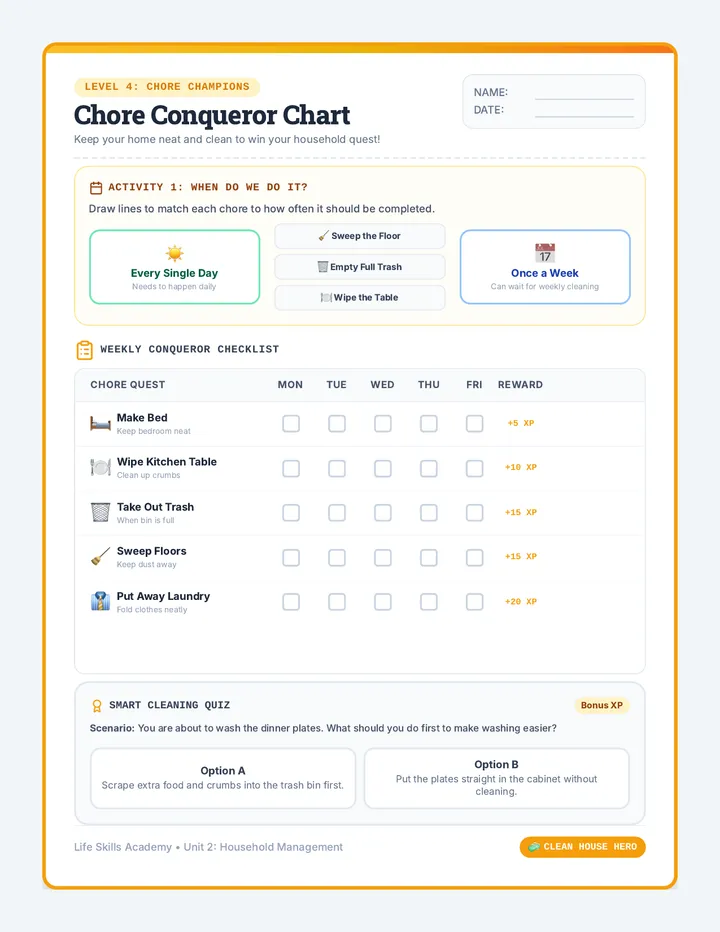
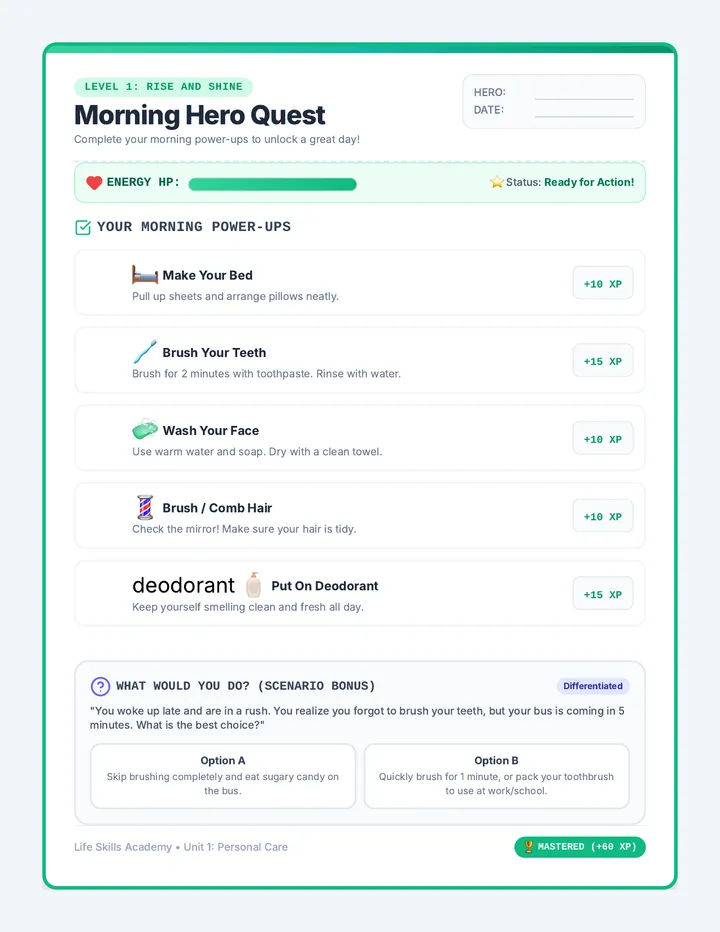
A structured daily routine checklist and time management tool designed to help students build consistent self-care and hygiene habits.
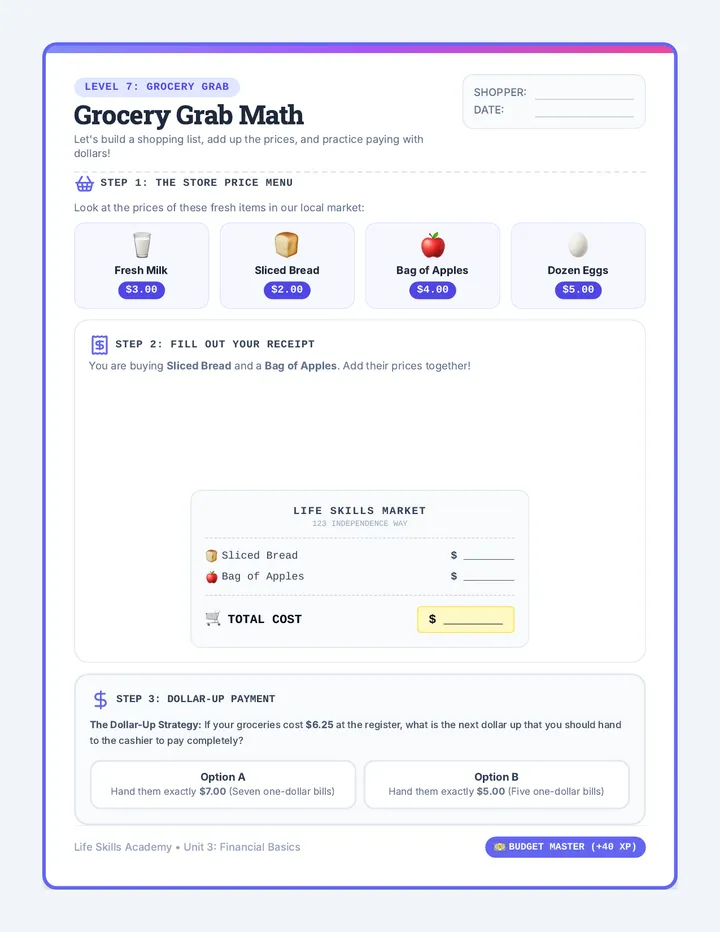
An interactive grocery shopping simulation worksheet where students practice budgeting with a fixed amount of money, revised with optimized student work areas for handwriting legibility.
A visually engaging slide deck that provides explicit instruction on personal finance, meal planning, and self-care for 10th-grade students, revised for better visibility and compliance with font size requirements.
A detailed instructional guide for teachers, outlining the sequence for teaching independent living skills with specific IEP accommodations and assessment strategies.
A professional instructional manual for teachers providing strategies for using the "Mental Mechanics" materials with 2e students, focusing on avoiding patronizing language and reframing emotions as data.
A set of high-contrast, technical anchor charts (posters) explaining distress tolerance techniques (STOP, Self-Soothing, Distraction) using engineering and systems metaphors.
A simplified, professional workbook focusing on logical decision-making, pros/cons, and radical acceptance without excessive technical jargon.
A simplified, professional graphic organizer for tracking physiological signs, internal narratives, and coping protocols without excessive jargon.
A two-page structured note-taking template for teachers to use during the Supportive Response PD. The front page includes sections for power dynamics and de-escalation strategies, while the back page provides a full-page lined area for additional notes and action items.
A one-page de-escalation cheat sheet for teachers. It provides a quick reference to the CPI response levels, tips for emotional constancy, and classification-specific strategies for immediate use in the classroom.
Updated facilitator guide for the Supportive Response PD. It includes specific coaching on power dynamics, the pitfalls of the "back and forth," and accessible language for the de-escalation framework. Pacing is set for a 30-minute high-impact session.
Updated professional development slides focusing on power dynamics, verbal de-escalation with accessible language, and the importance of avoiding power struggles. The 12-slide presentation emphasizes emotional constancy as the primary tool for maintaining teacher authority.
A comprehensive lesson plan for teachers, consolidating the purpose, SEBD rationale, materials list, and 6-step facilitation procedure into one organized document.
A detailed, 6-step instructional guide for teachers to facilitate the Mental Workbench lesson, including specific actions, student-facing explanations, and SEBD-specific strategies.
A set of challenge cards for the 'Reverse Recall Rumble' game, featuring tiered difficulty levels for auditory and visual working memory practice.
A student-facing reflection sheet focused on metacognition and emotional regulation. Includes a mood check-in and strategy self-assessment for the 'Mental Workbench' lesson.
A high-impact slide deck for teaching working memory using the 'Mental Workbench' analogy. Includes interactive auditory and visual-spatial activities, strategy instruction, and game rules.
A comprehensive teacher guide providing the purpose statement, pedagogical rationale for students with SEBD, and a detailed 41-minute pacing guide.
An answer key for the Sequence Scientist Worksheet, providing correctly marked sentences and accuracy calculations.
A professional Bulldog achievement report letter designed to fit on a single page by optimizing vertical spacing, table row heights, and font sizes while maintaining readability.
A practice worksheet for students to identify CWS, IWS, and calculate accuracy percentages across multiple sentence examples.
Instructional slides covering the definition of Correct Writing Sequences (CWS), the scoring caret, and the accuracy percentage formula with guided examples.
A comprehensive teacher guide for scoring Correct Writing Sequences (CWS) and calculating accuracy percentages in Curriculum-Based Measurement.
Answer key for the Week 7 student handout, providing model responses and pedagogical insights into the resolution of the story and the final evaluation of Gregor's worth.
Teacher guide for Week 7, focusing on the end of the novella, Gregor's death, and the family's transition.
Answer key for the Week 6 student handout, providing model responses and pedagogical insights into the boarders' presence and the dehumanization of Gregor.