Math-based lab worksheet where students calculate teaspoons of sugar from grams found on nutrition labels.
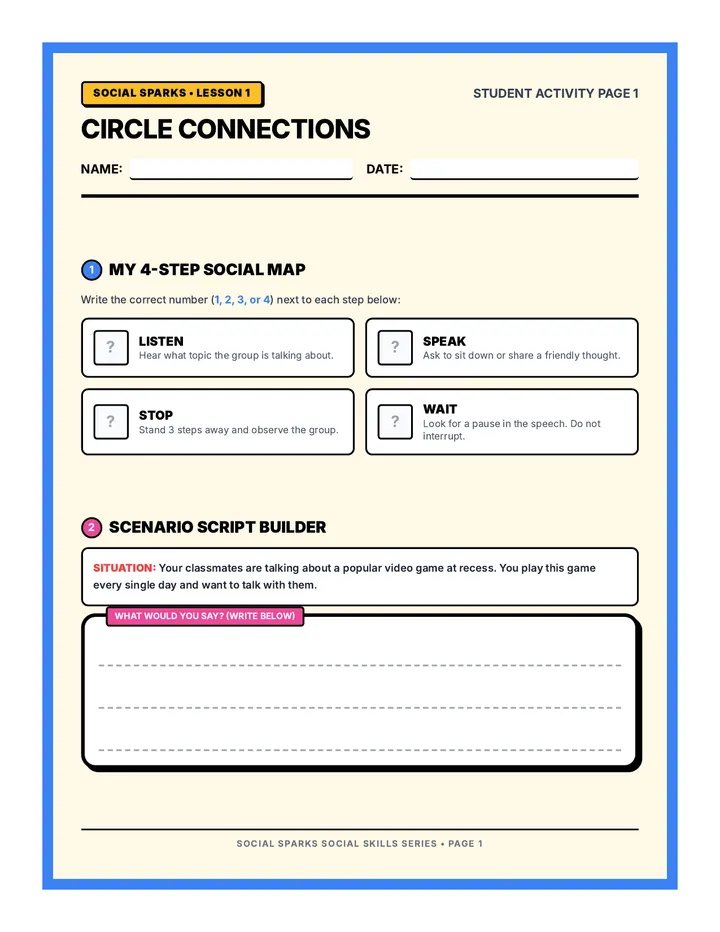
A highly visual, 2-page student worksheet designed to accompany the Circle Slides lesson. Features a step-ordering activity, speech bubble templates for student-written dialogues, a board-game style social path activity, and a self-reflection scorecard.
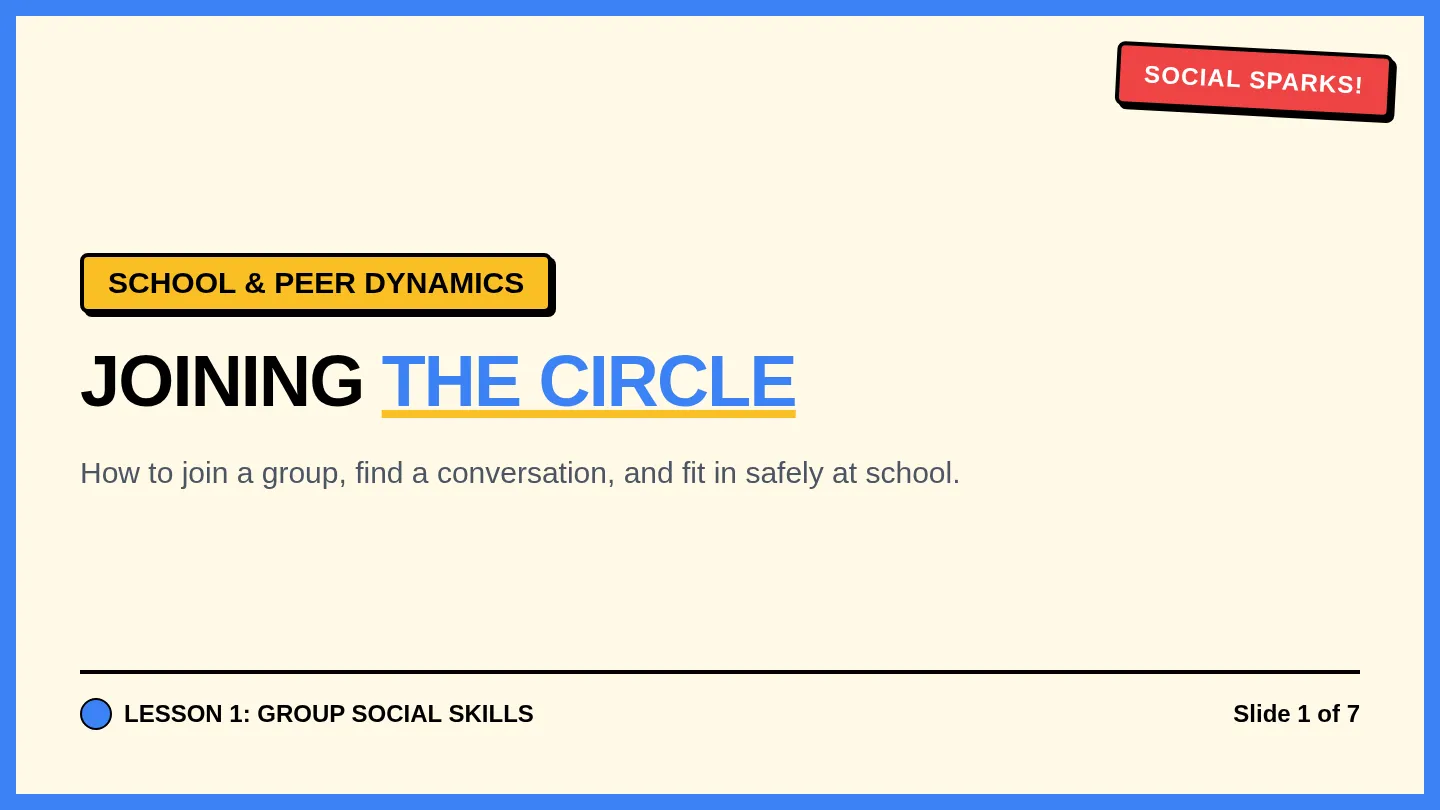
An expanded, highly visual slide deck for teaching students how to join a peer conversation. Features step-by-step guidance, three school-based practice scenarios, a Game Show challenge, and classroom discussion prompts with text size optimized for visibility.
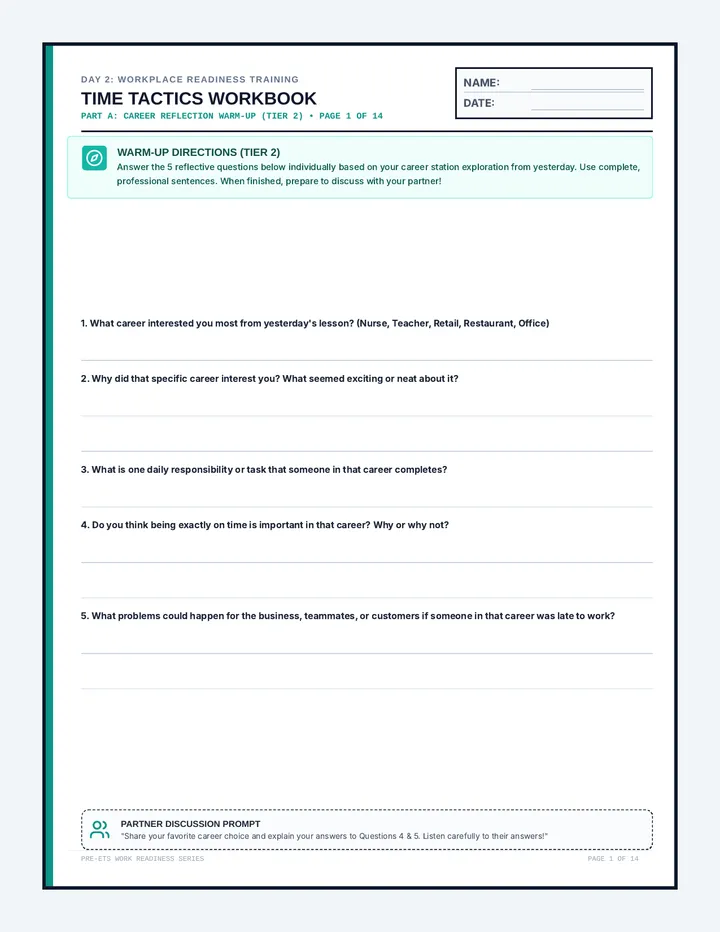
A comprehensive 14-page Tier 2 student-facing workbook for Day 2 Workplace Time Tactics. It integrates the advanced warm-up, 4-page guided notes, 2-page task duration estimator, 2-page punctuality scenario and consequence board, 4-page Time Thieves worksheet, and 1-page exit ticket into a single, cohesive print-ready packet styled with the teal and indigo theme.
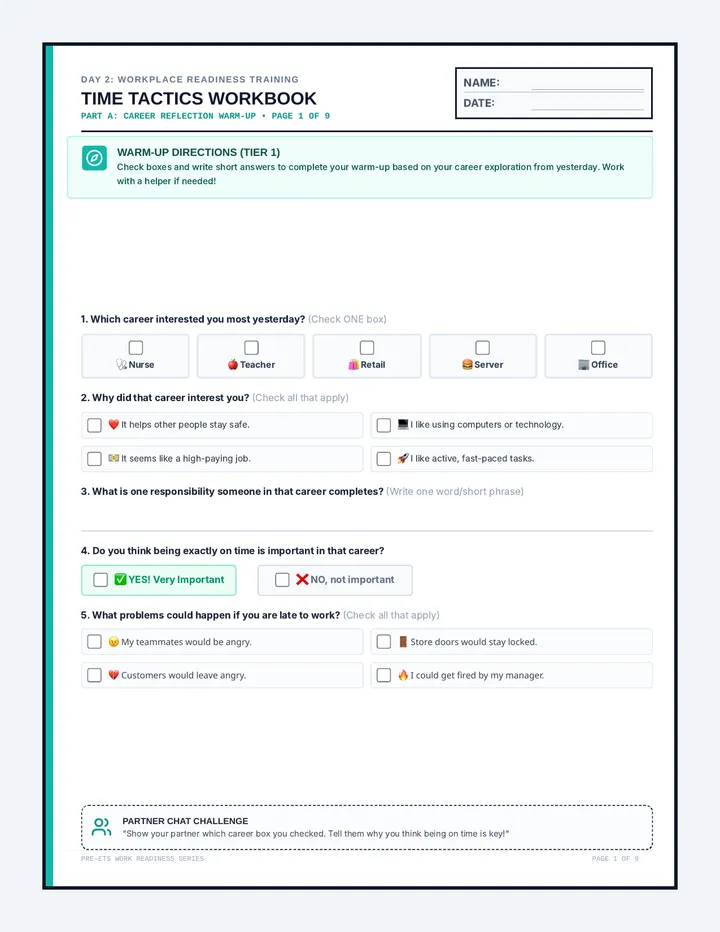
A comprehensive 9-page Tier 1 student-facing workbook for Day 2 Workplace Time Tactics. It combines the visual warm-up, 4-page guided notes, 2-page task estimator, and 2-page punctuality scenario and consequence board into a single, cohesive print-ready packet styled with the teal and indigo theme.
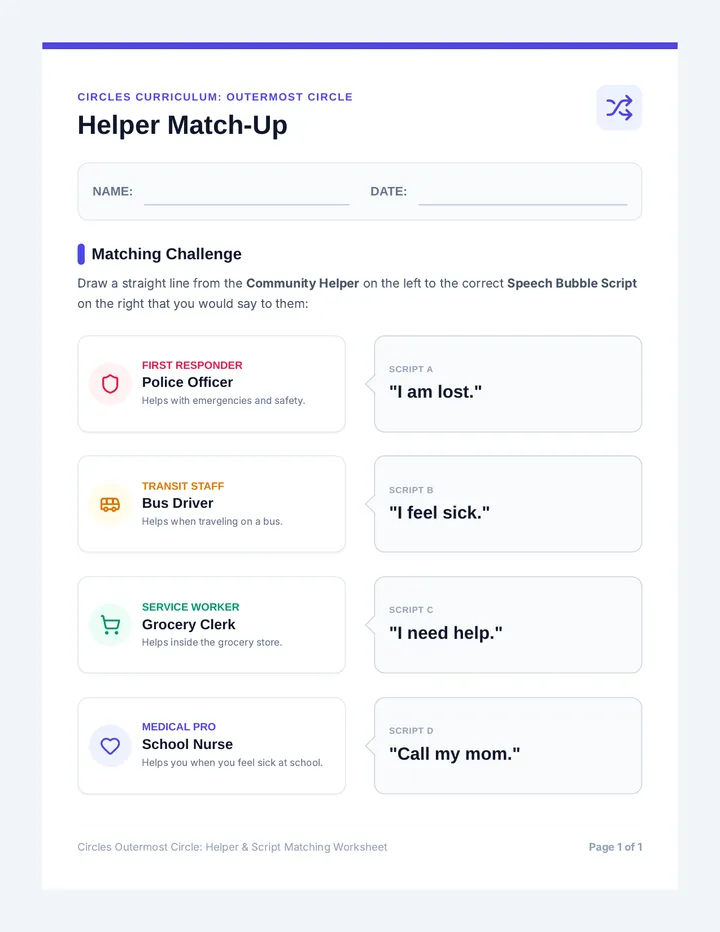
An interactive, highly visual student matching worksheet where students draw lines to connect official community helpers with the specific verbal request or emergency script they would say to them.
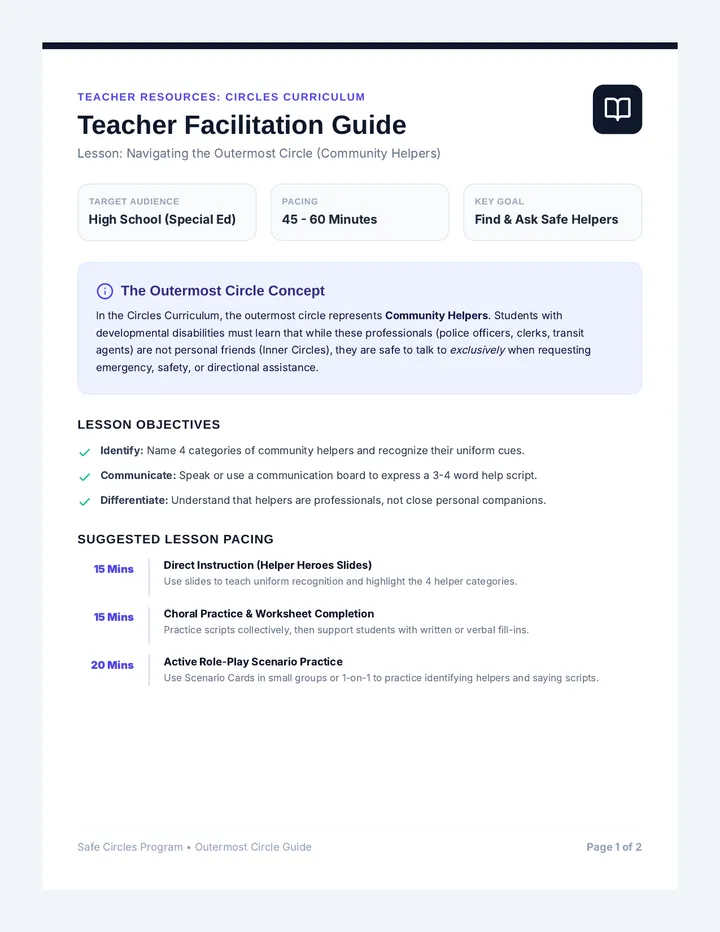
A comprehensive, step-by-step teacher facilitation guide featuring lesson plans, instructional pacing, script-practice structures, differentiation tips, and safety insights for teaching the Outermost Circle.
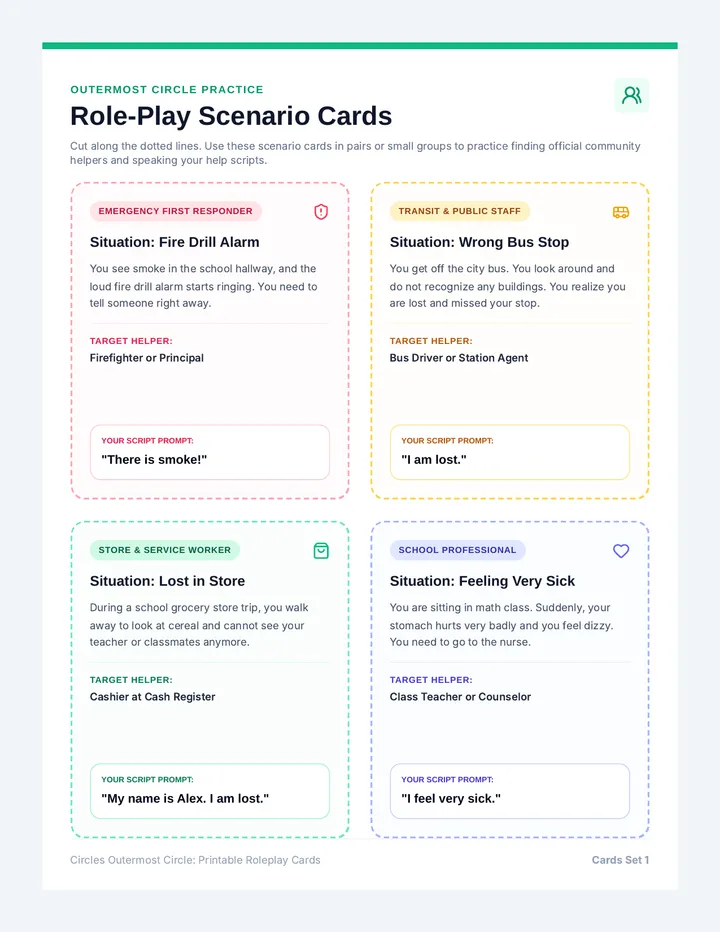
A set of 4 printable, easy-to-cut role-play scenario cards color-coded by helper category with simple social situations, targeted helpers, and bold practice scripts.
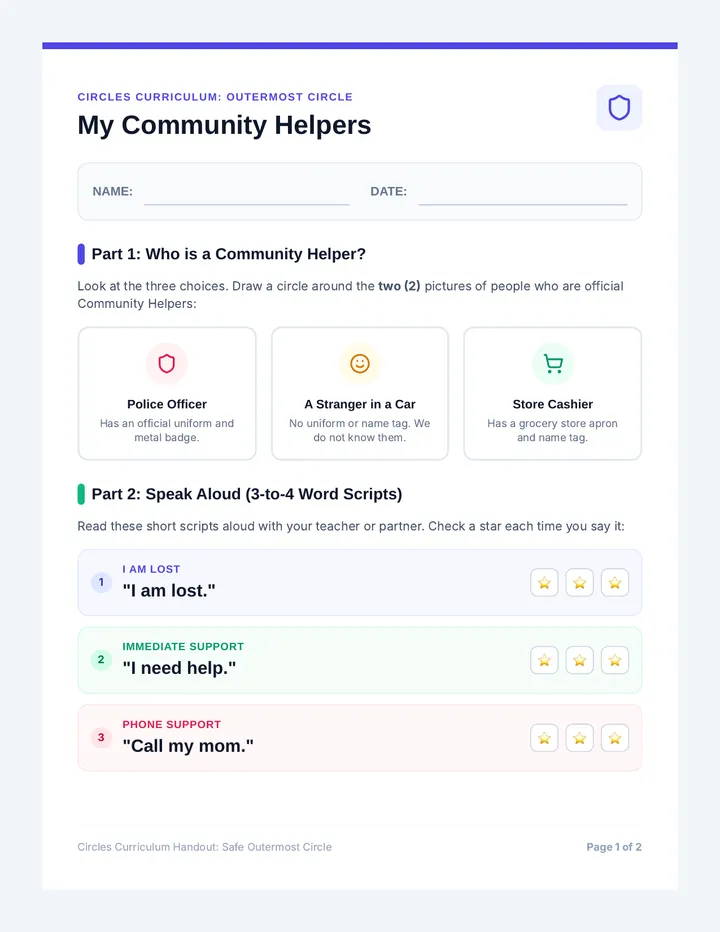
A structured, highly visual student worksheet featuring simple 3-4 word speech-practice check-offs and interactive fill-in-the-blank script templates with large handwriting lines.
A visual slide presentation designed for students with developmental disabilities to learn about the four main categories of community helpers, understand the concept of the outermost circle, and learn simple scripts to request help.
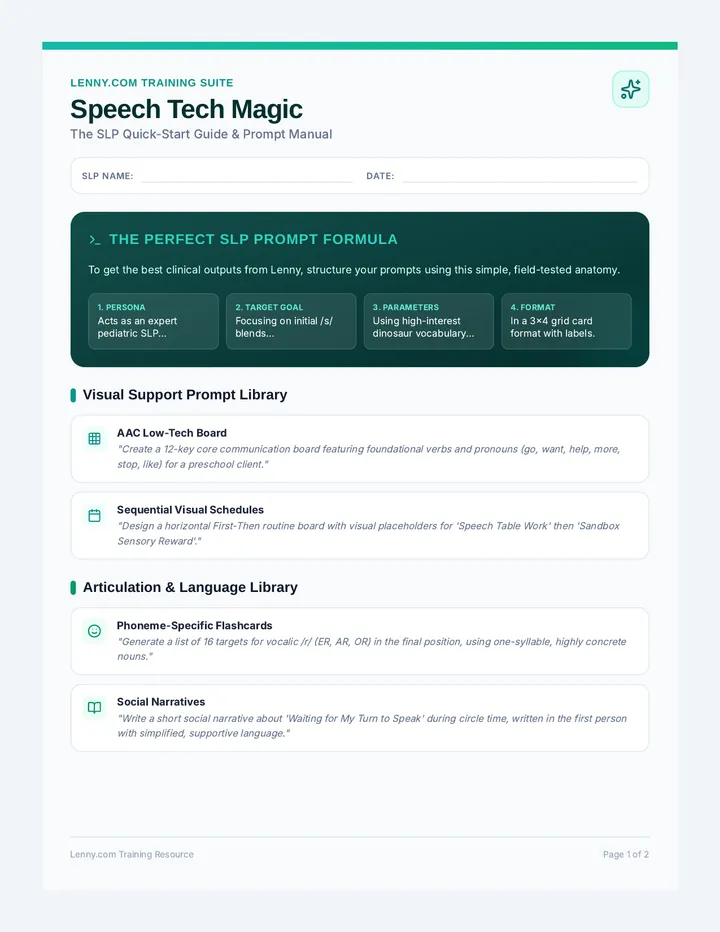
A comprehensive 2-page print-and-go reference handout and quick-start guide containing prompt formulas, sample templates, and design tips for SLPs using Lenny.com.
An interactive slide presentation introducing Speech-Language Pathologists to Lenny.com features, including visual supports, articulation materials, and IEP helpers.
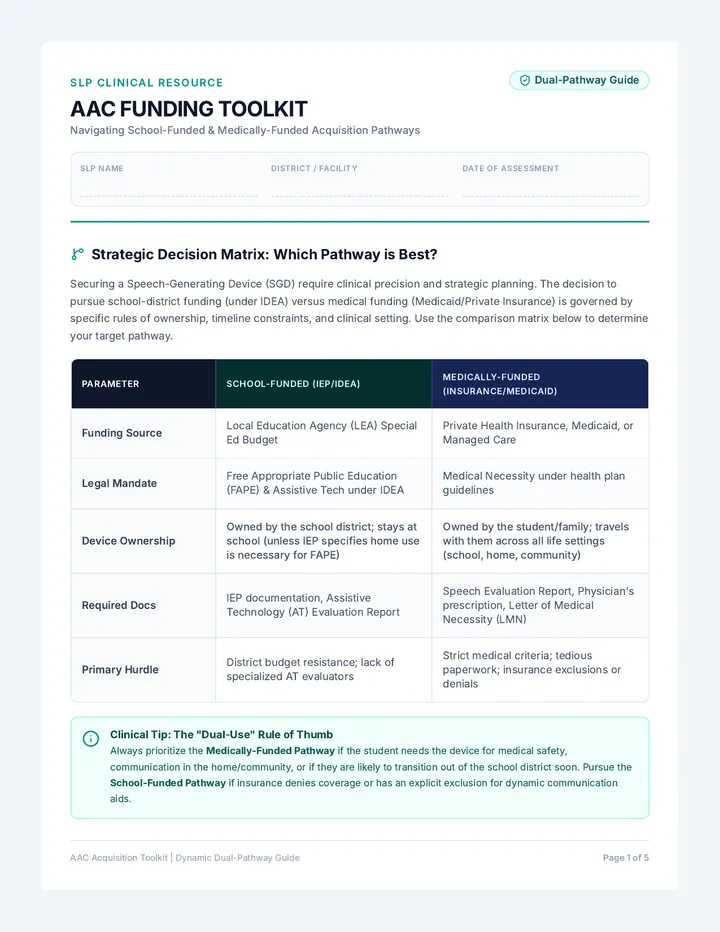
A 5-page print-ready clinical toolkit for SLPs navigating school-funded and medically-funded AAC acquisition. Includes comparison tables, step-by-step checklists, insurance phone scripts, IEP meeting scripts, letter templates, and a dynamic device trial data collection sheet.
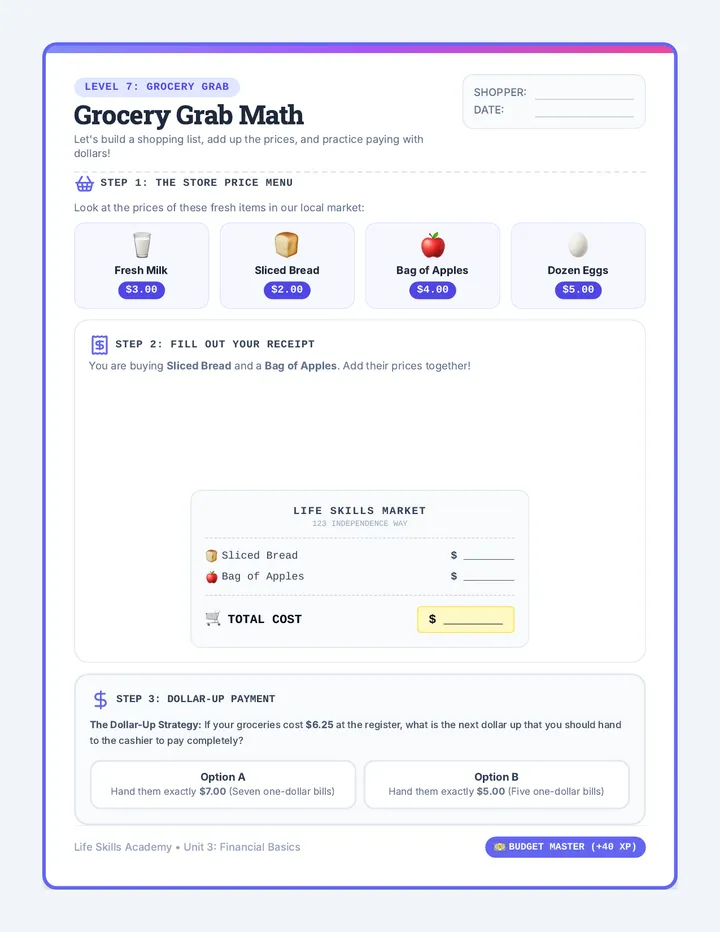
A functional math and budgeting worksheet designed for students with intellectual disabilities. Teaches grocery list creation, basic price addition, and the 'next dollar up' payment strategy.
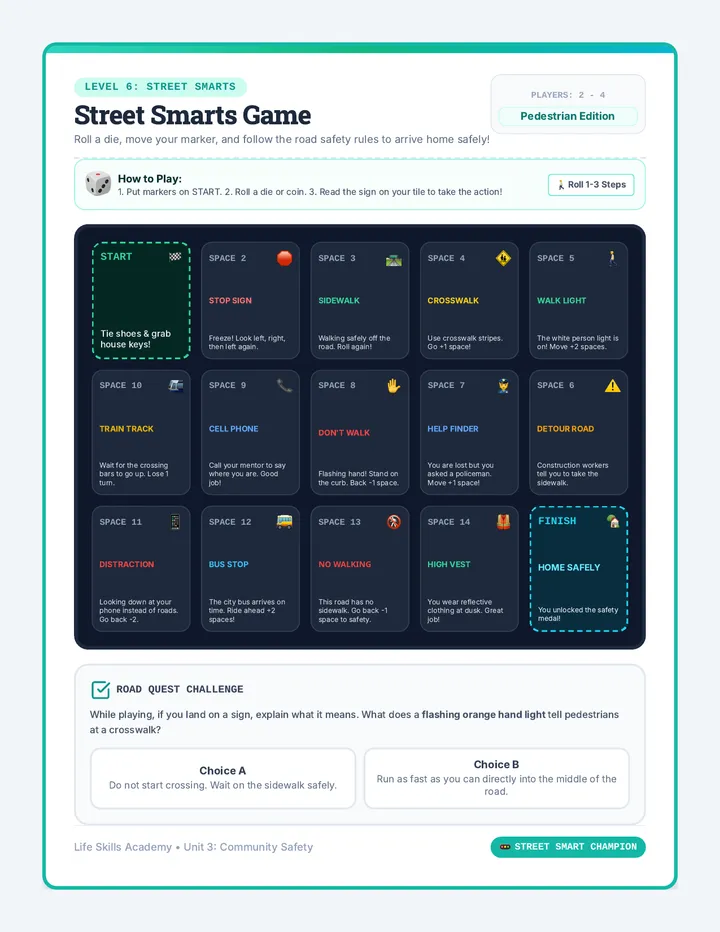
A printable, gamified pedestrian safety board game that teaches students with intellectual disabilities to read community safety signs, crosswalk signals, and find helpers.
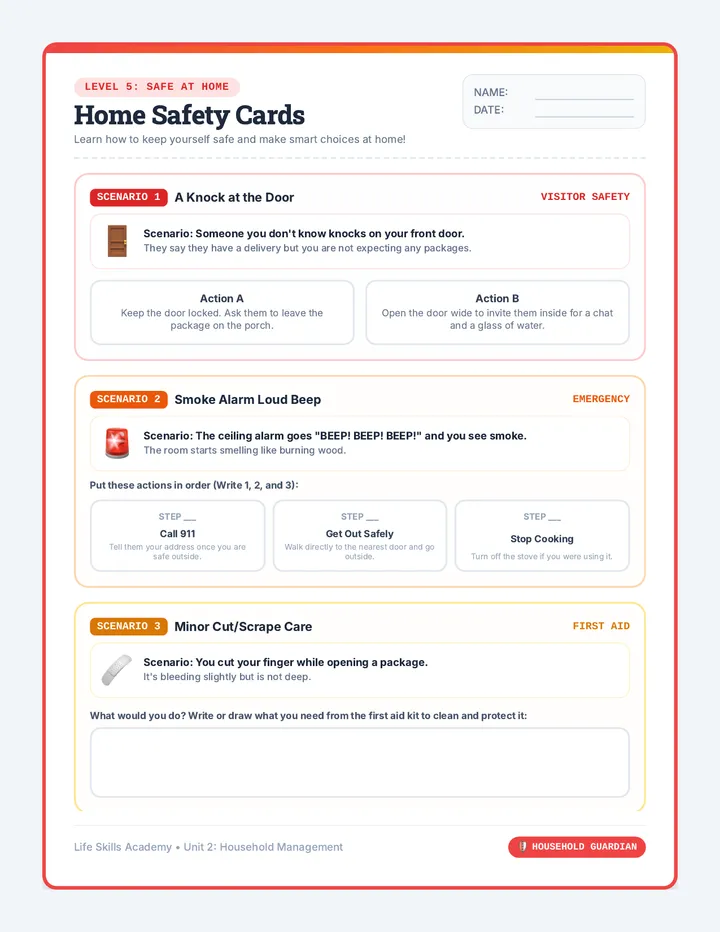
Differentiated safety scenario cards focused on key emergency responses for students with intellectual disabilities, covering strangers at the door, smoke alarms, and basic first aid.
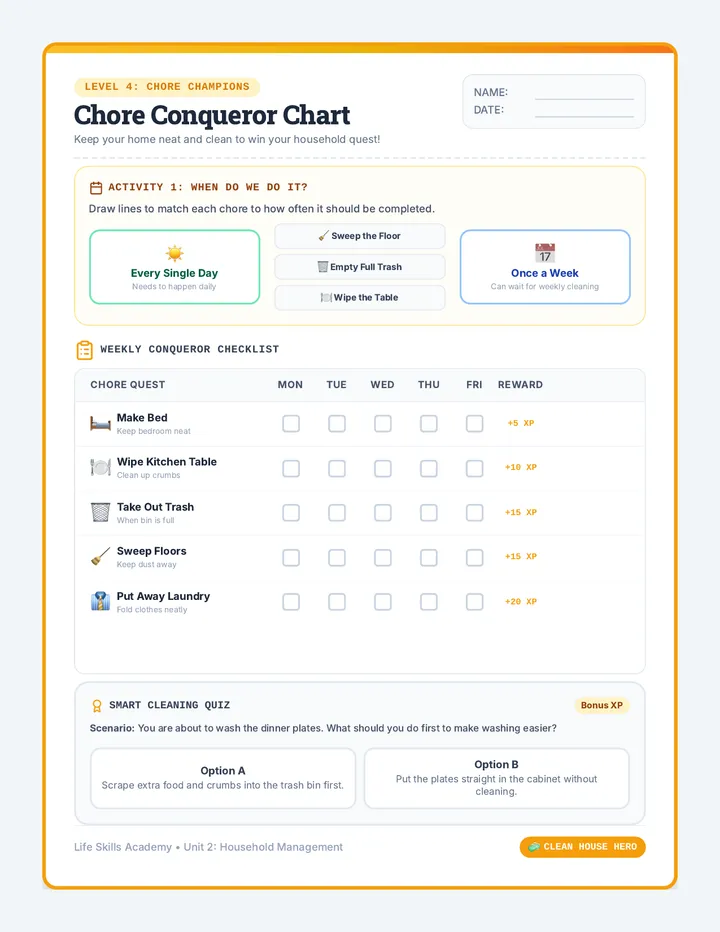
A daily and weekly household chore planner designed for students with intellectual disabilities. Features a visual frequency sorter and clear tracking checkboxes for essential housekeeping tasks.
An interactive slide deck for teaching kitchen safety, featuring bold visual scenarios and large, readable text designed for group discussion.
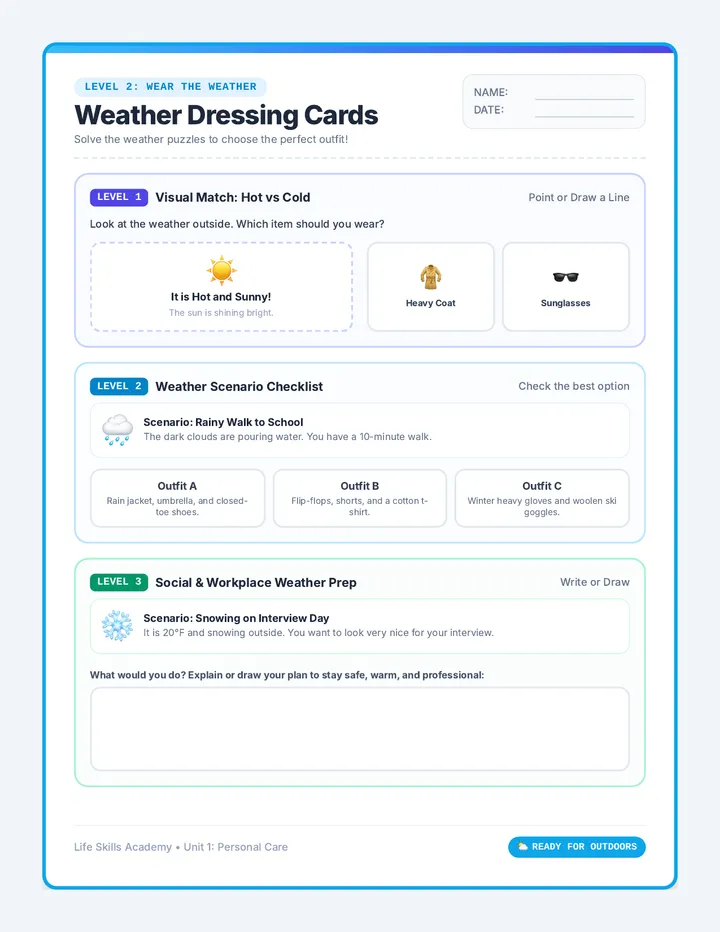
Differentiated weather dressing task cards featuring three levels of independence to help students with intellectual disabilities select appropriate clothing for various weather conditions and scenarios.
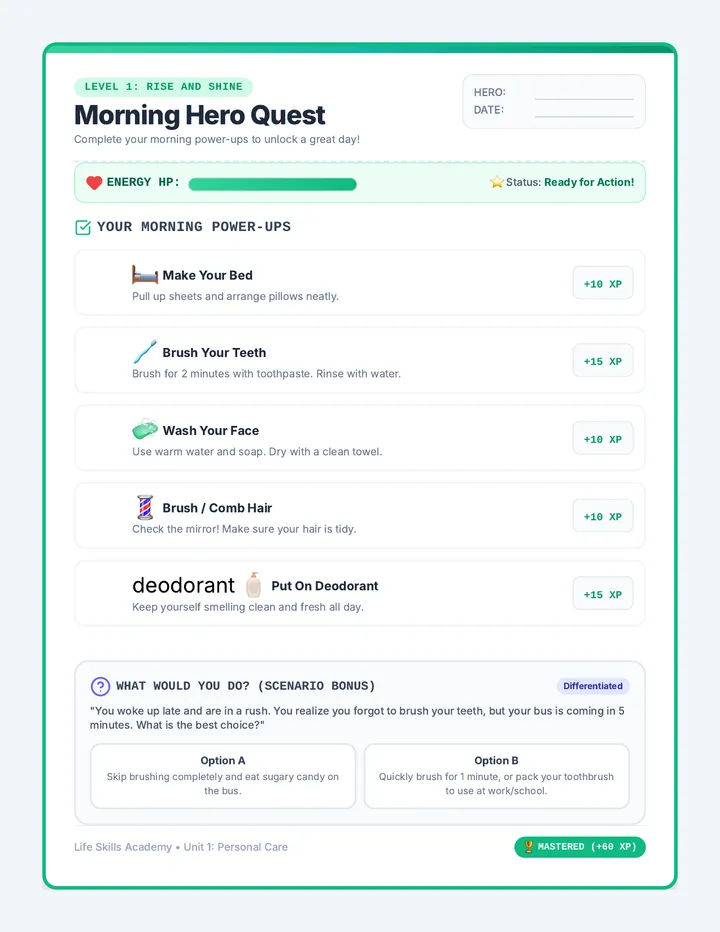
A gamified morning routine tracking sheet styled as a retro video game 'level-up' quest. Helps students with intellectual disabilities independently track personal hygiene and self-care steps with visual checklists and simple scenarios.
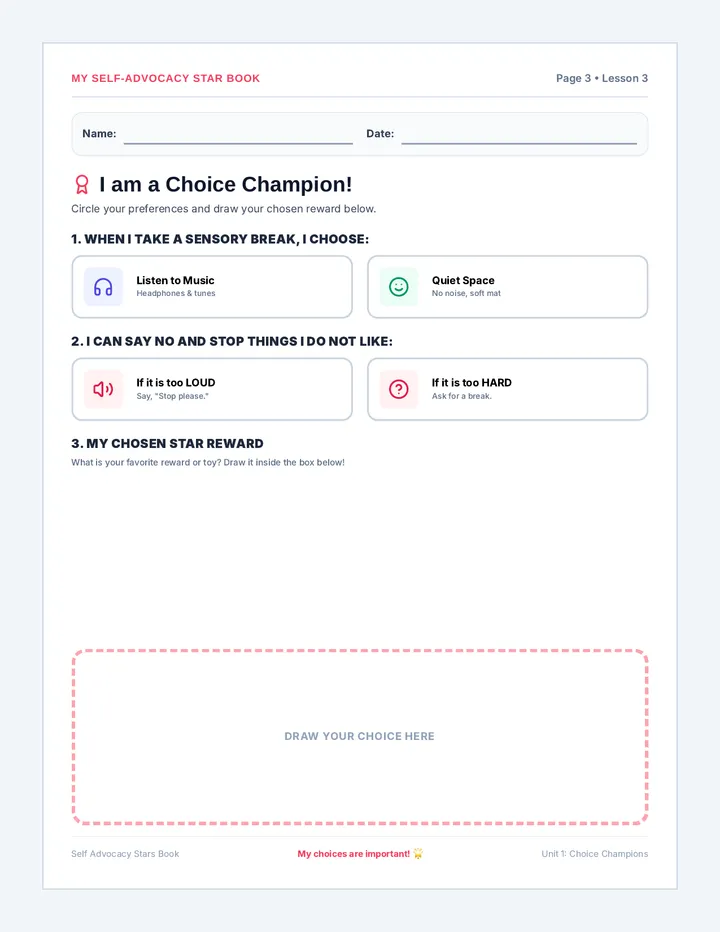
A student choice booklet page for Lesson 3: Choice Champions. Students circle their preference for daily tasks and breaks, mark their boundaries, and draw their chosen reward on a white student canvas.
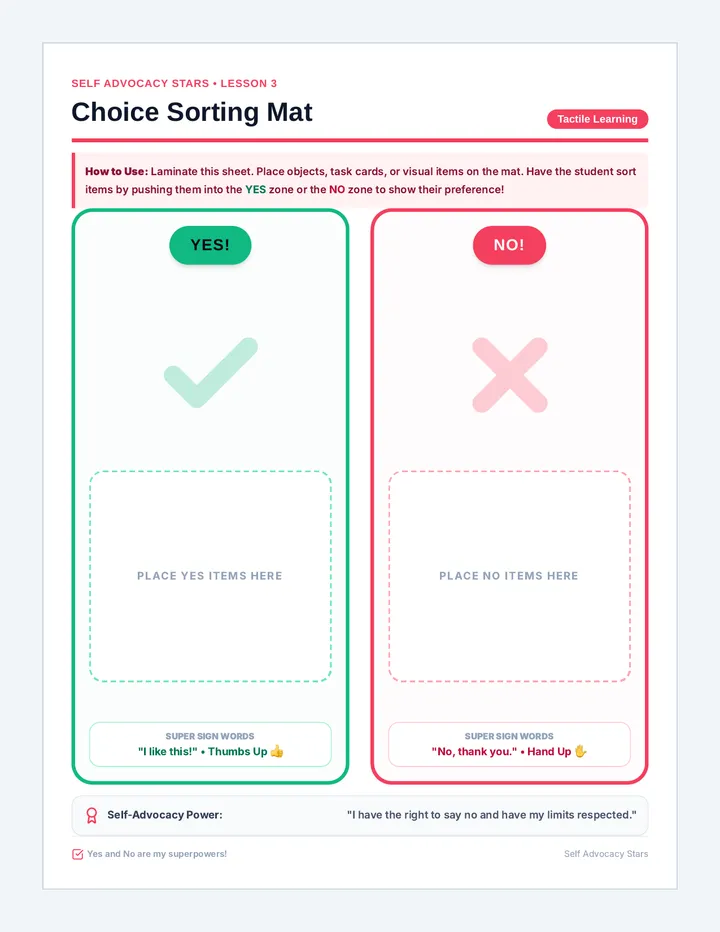
Printable Choice Sorting Mat for Lesson 3: Choice Champions. A dual-category tactile mat dividing space into high-contrast 'YES' and 'NO' sections for students to place physical objects or cards to express preferences.
Visual presentation slides for Lesson 3: Choice Champions. Focuses on setting personal boundaries, choosing preferences, and practicing saying "Yes" or "No" with confidence and support.
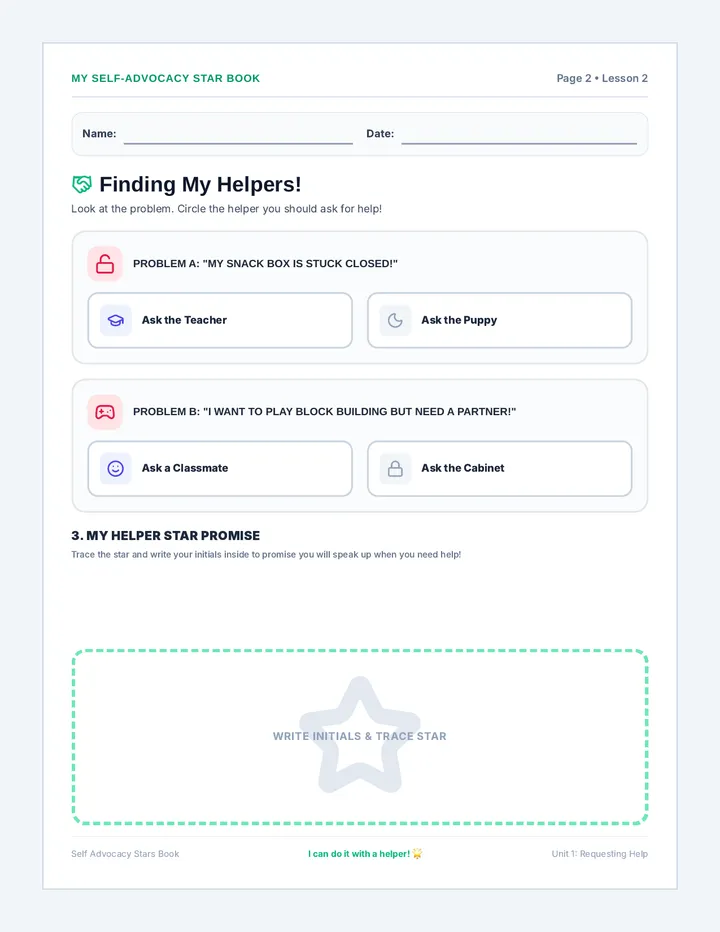
A student reflection and match-up worksheet for Lesson 2: Help Helpers. Students identify when they need help, circle the correct helper, and sign their Help Star commitment.
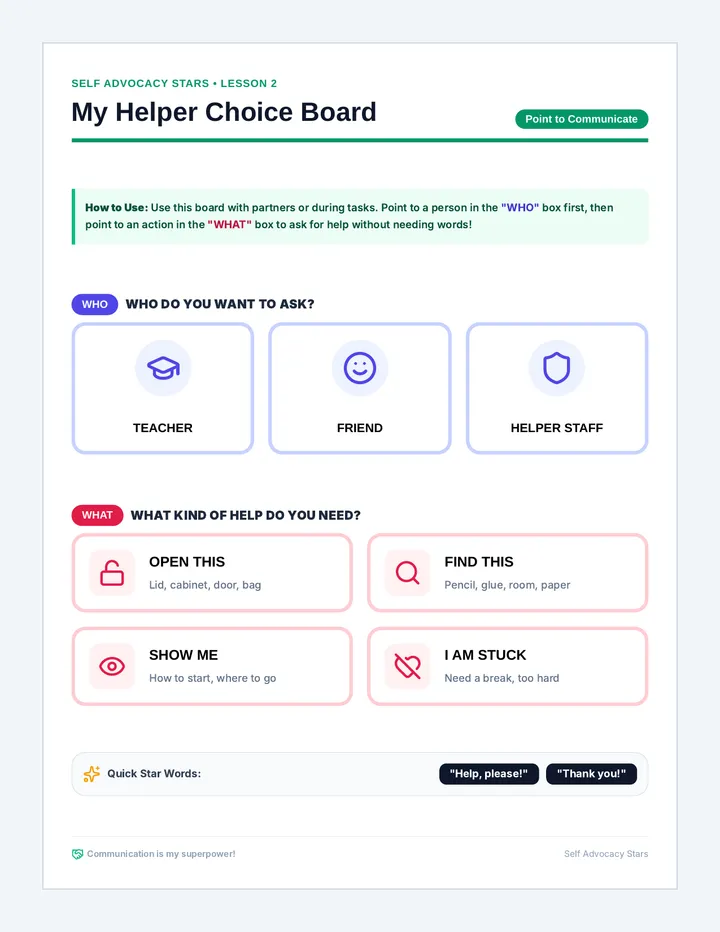
Printable Helper Choice Board for Lesson 2: Help Helpers. A high-contrast, dual-category communication board helping students point to who they want to ask for help and what type of support they need.
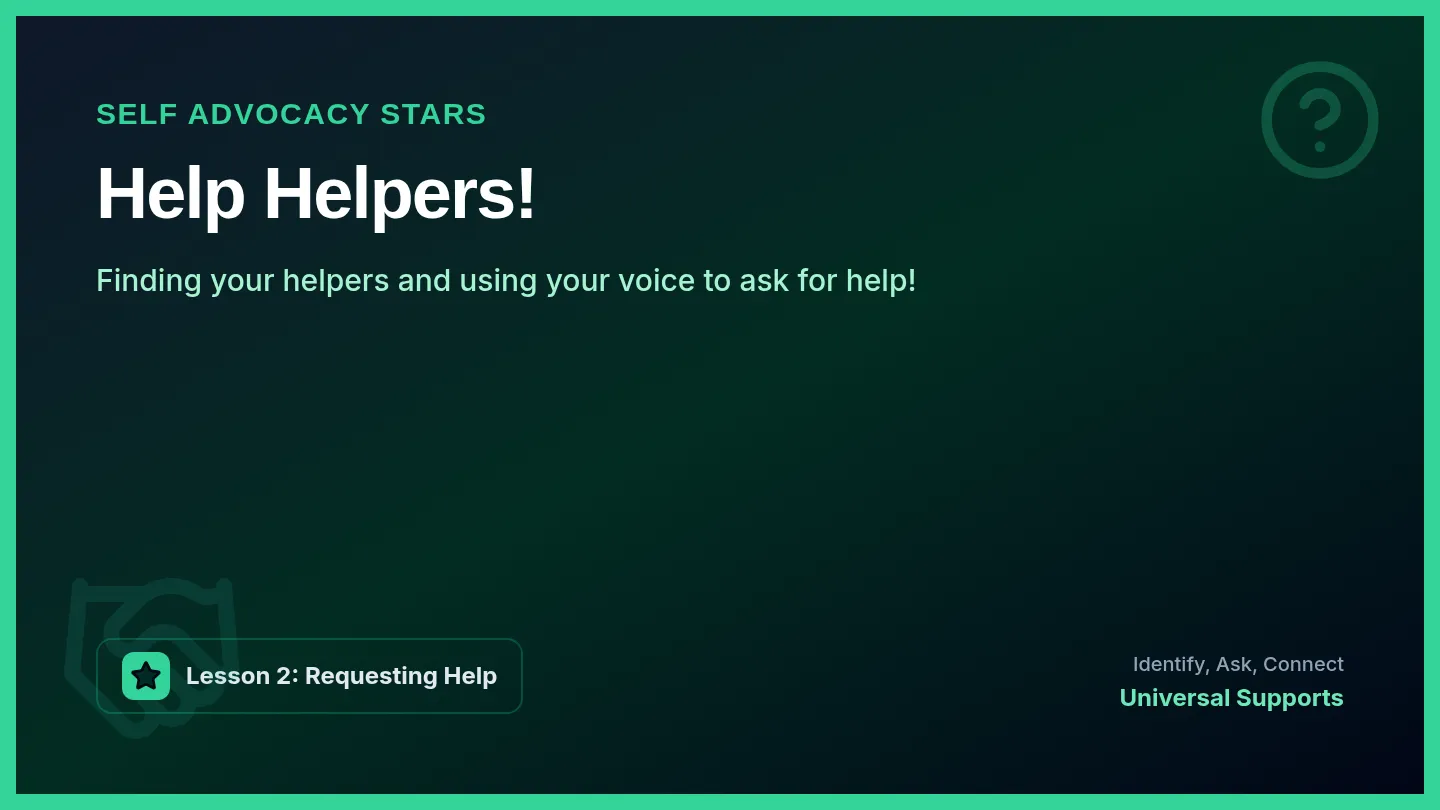
Visual presentation slides for Lesson 2: Help Helpers. Focuses on identifying when students need help, who to ask, and how to communicate that request with simple visual scaffolds.
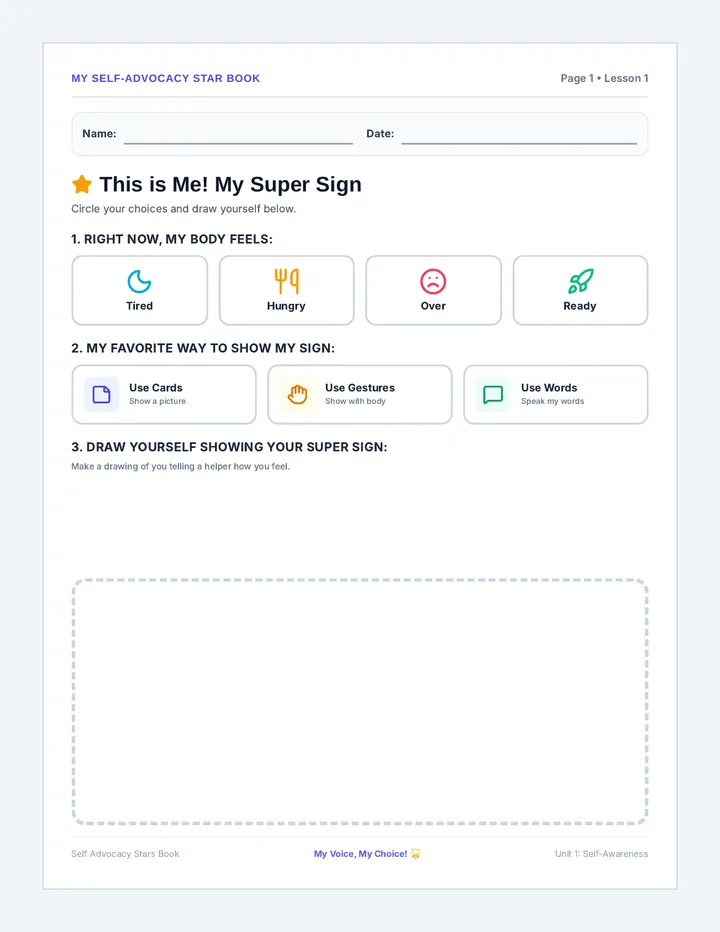
A visual reflection sheet and communication booklet page for Lesson 1: My Super Sign. Students check in on how their body feels, select their preferred communication style, and draw themselves using their super sign.
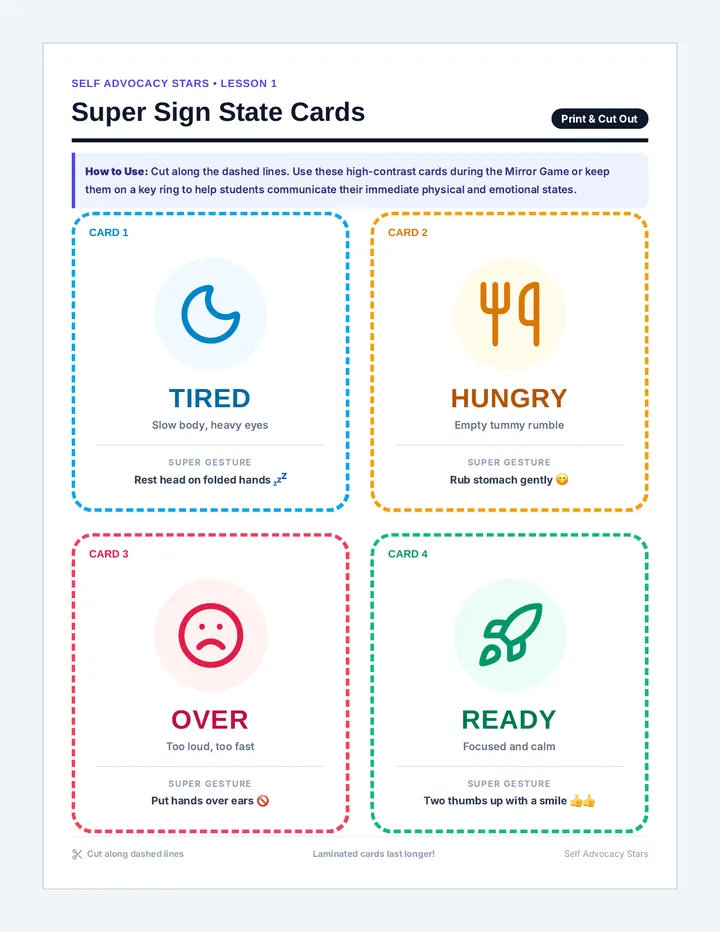
Printable game cards for Lesson 1: My Super Sign. Features a 4-card set of high-contrast state cards with clear icons, descriptive labels, and physical gesture guidelines to support non-verbal, gestural, and verbal expression.
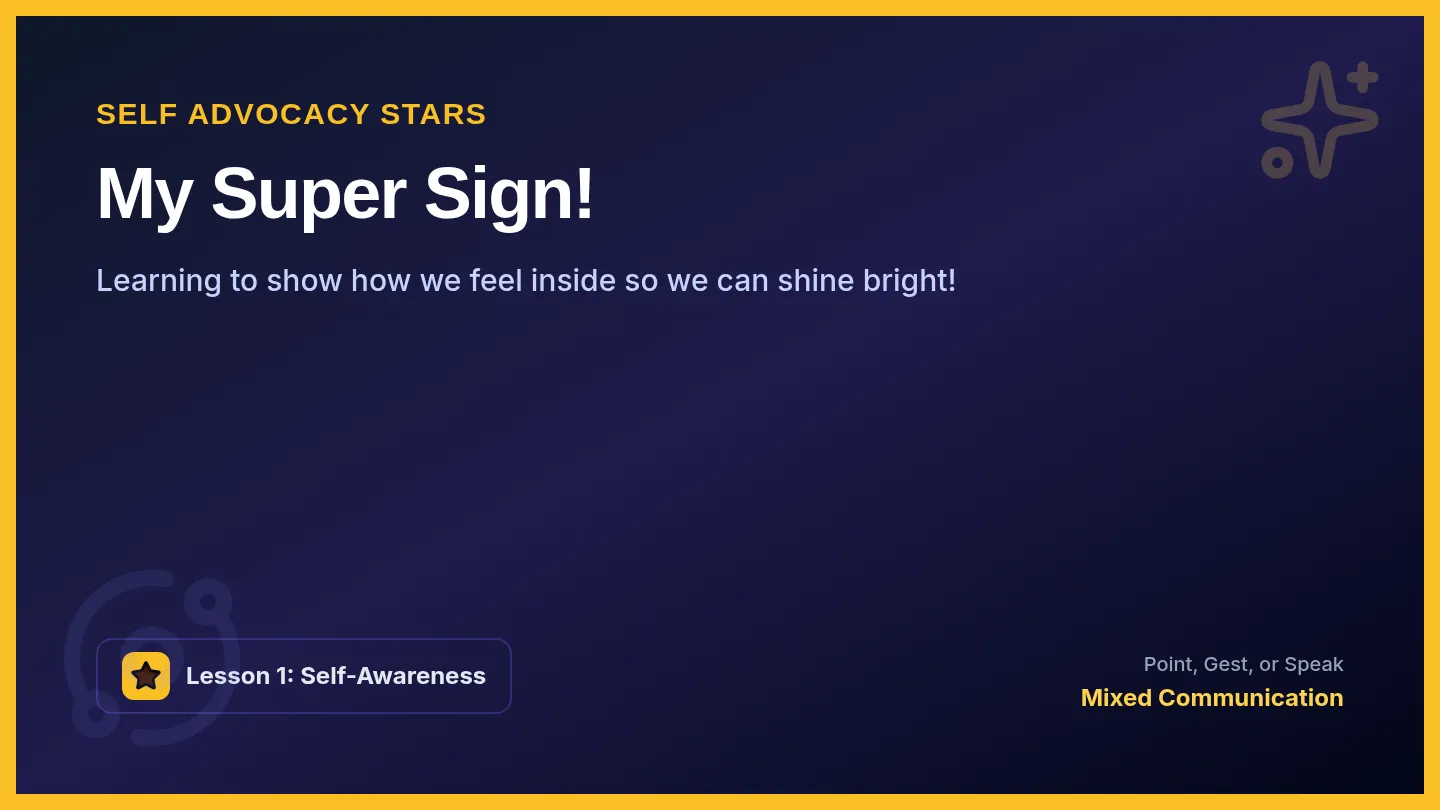
Visual presentation slides for Lesson 1: My Super Sign. Features high-contrast cosmic superhero themes, huge text, clear visual cues, and guided group prompts to help students identify and express physical and emotional states.
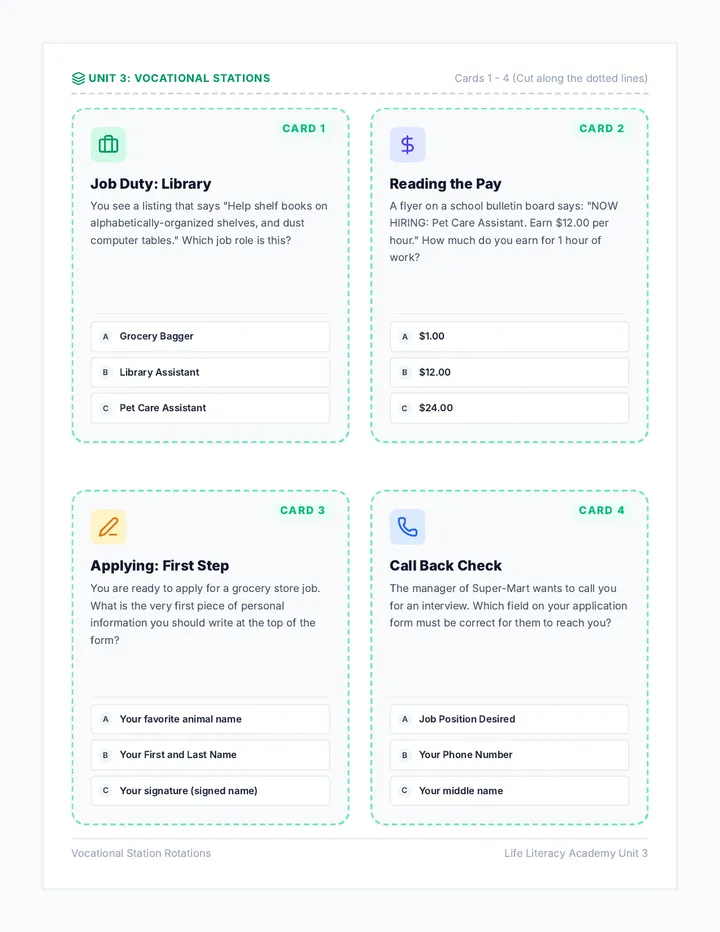
A 2-page collection of task cards (8 total) with vocational scenarios, application matching, and sequencing prompts.
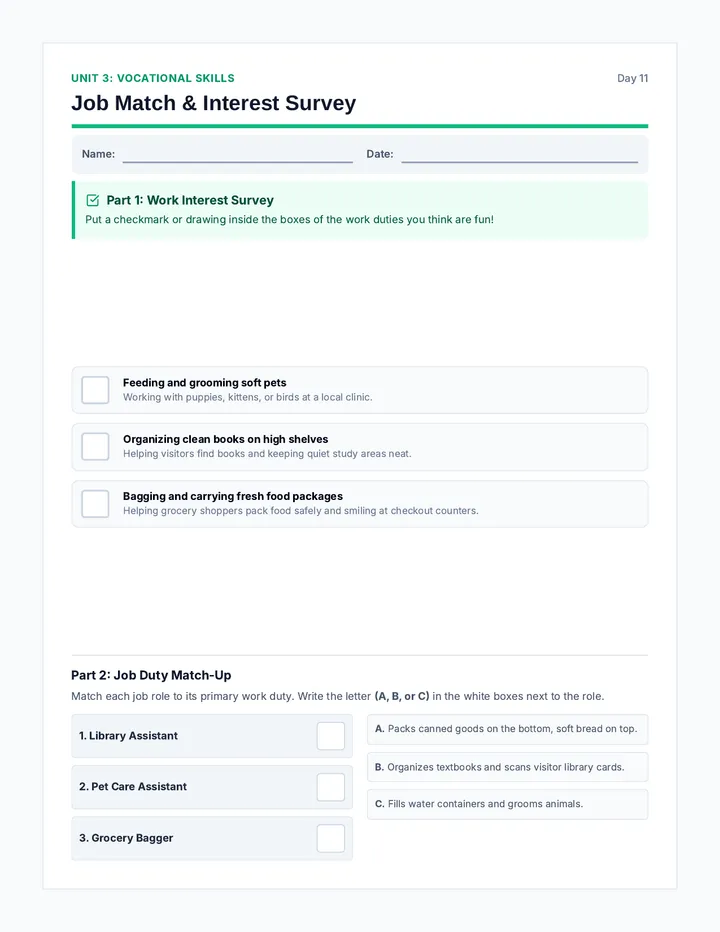
A 4-page student worksheet packet for Vocational Skills and Job Applications. It covers job interest inventory, simplified job posting comprehension, step-by-step job application practice, and a work sequence ordering activity.
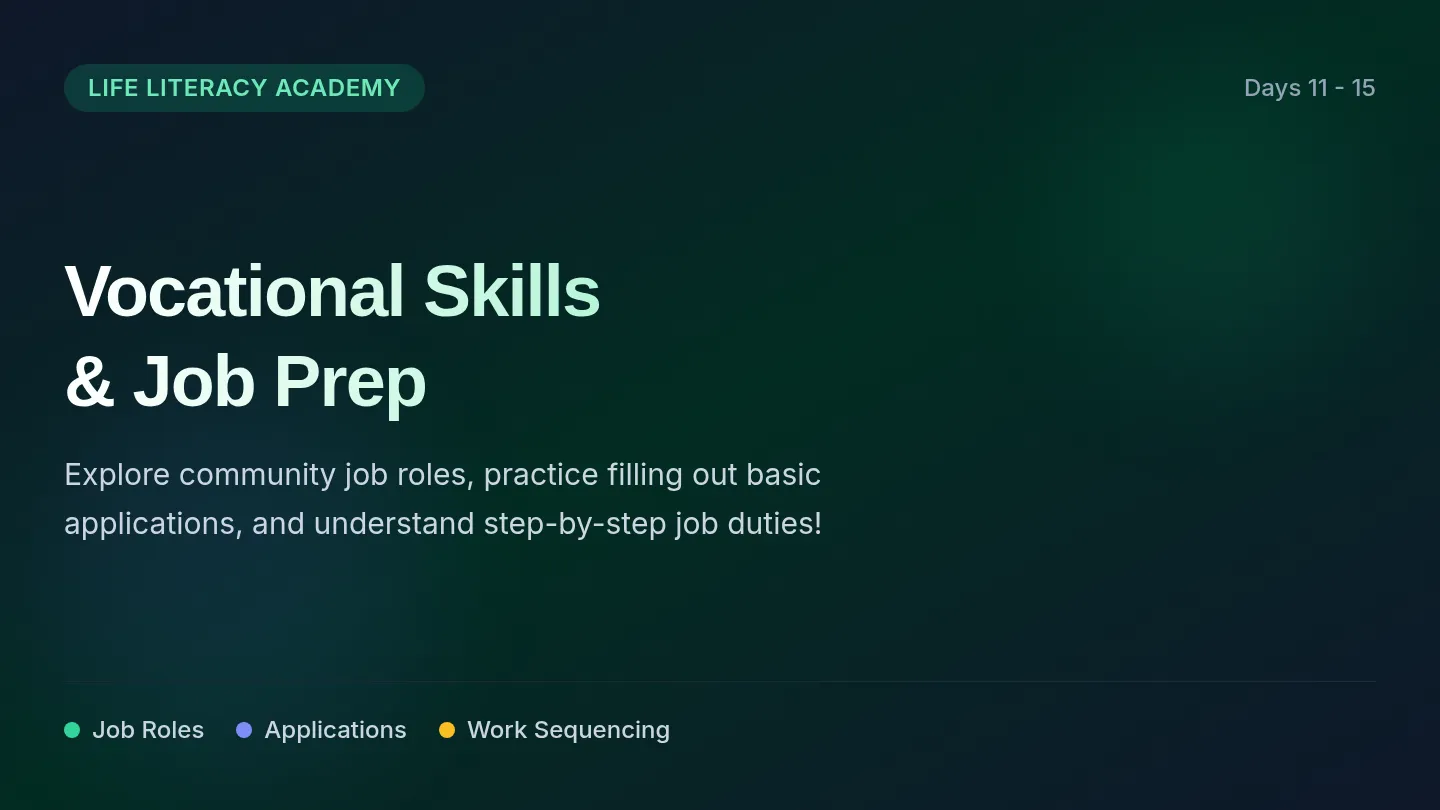
A 6-slide presentation for Days 11 to 15 of the Vocational Skills and Job Applications lesson. It covers work roles, job postings, simple application forms, task sequencing, and finding the main theme/goal of work.
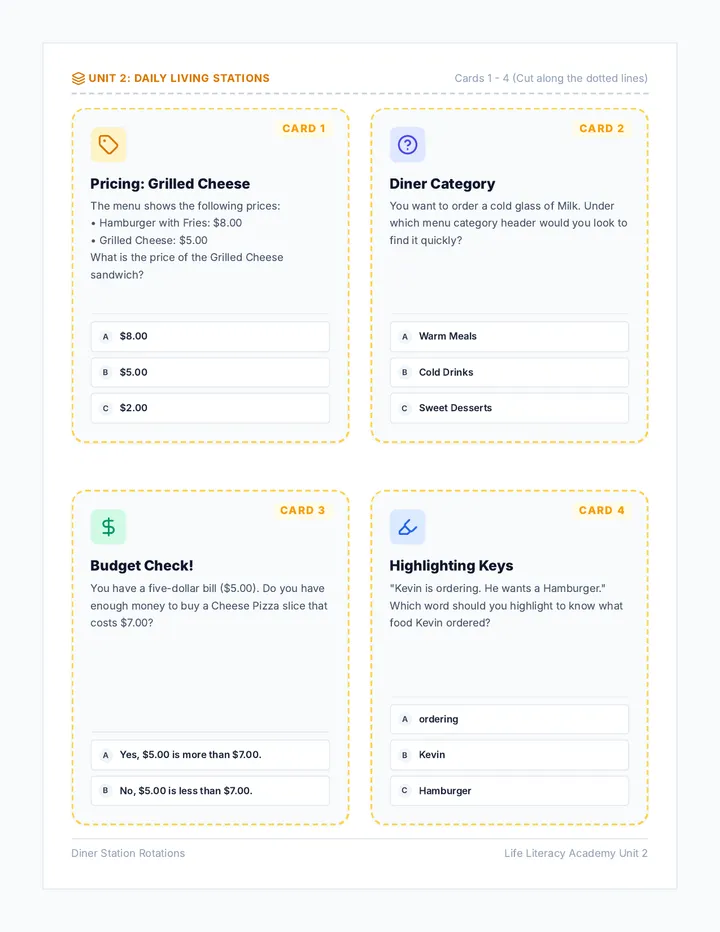
A 2-page collection of menu-reading and inferencing task cards (8 total) for independent practice stations.
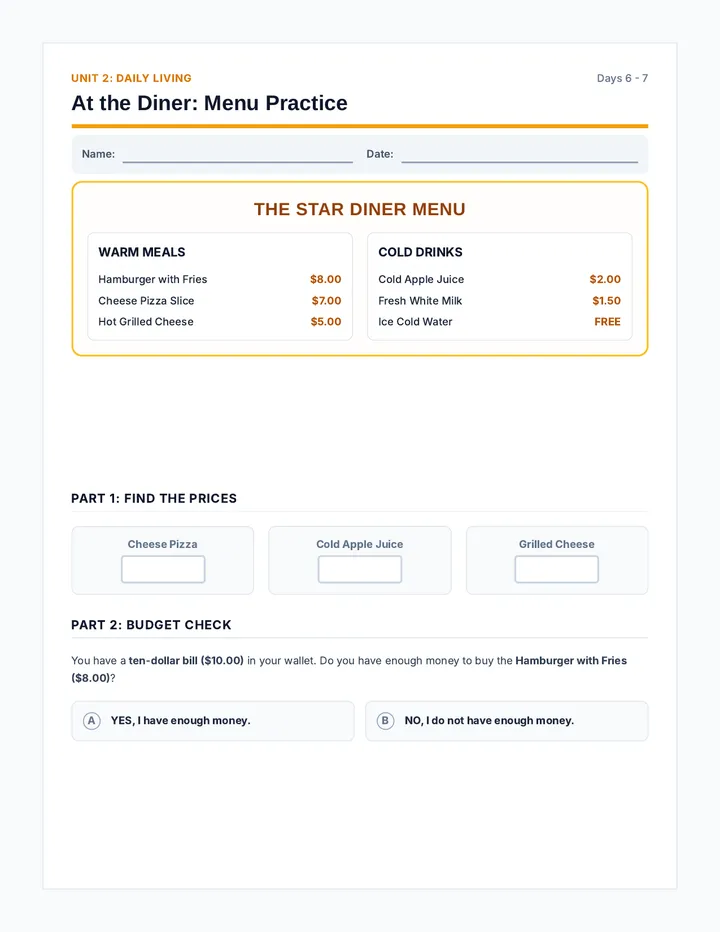
A 4-page student worksheet packet for Daily Living and Menus. It covers menu reading (finding specific items, simple math), text-highlighting exercises, inferencing card activities, and reading passages with WH questions.
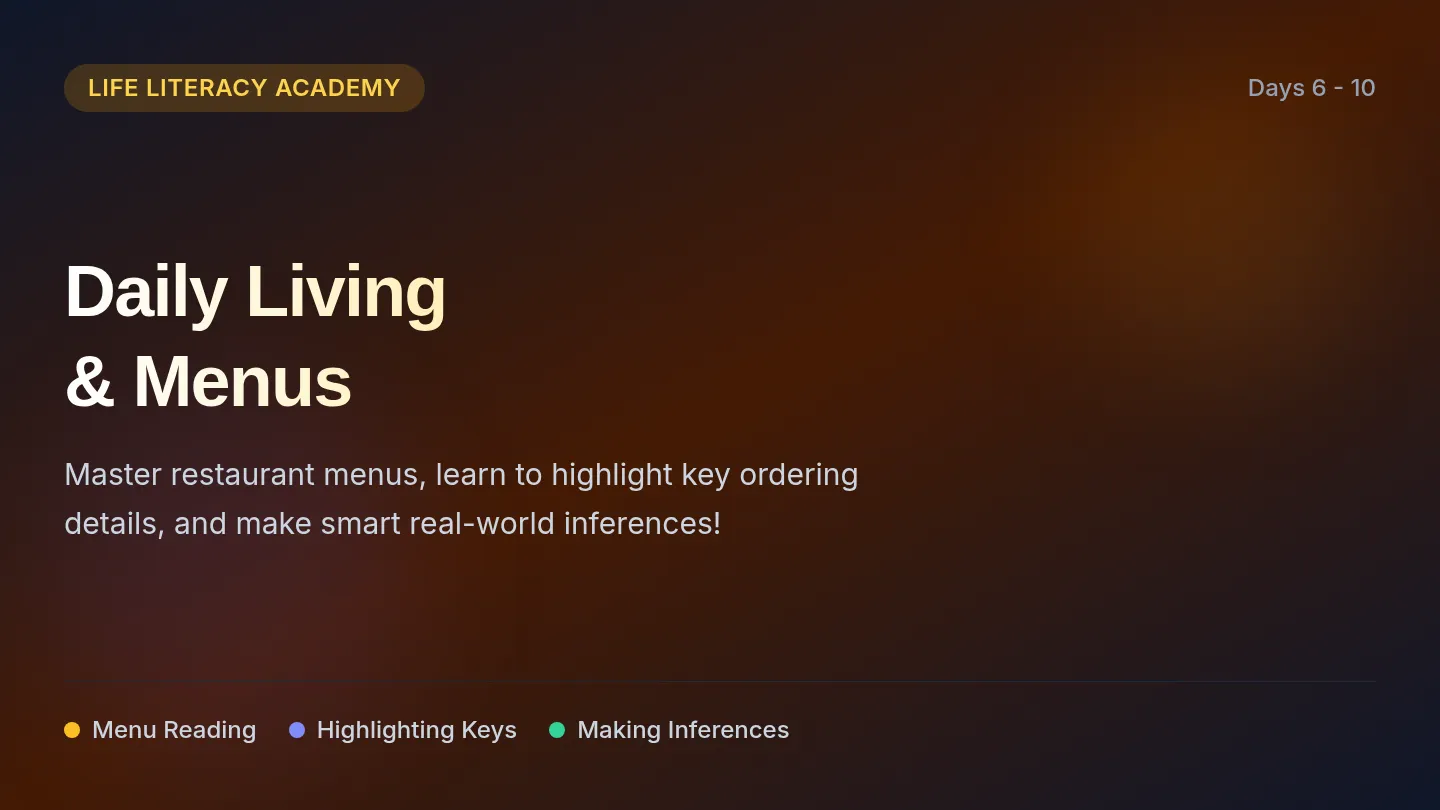
A 6-slide presentation for Days 6 to 10 of the Daily Living and Menus lesson. It covers menu navigation, highlighting key information, making inferences from real-world situations, and literary comprehension.
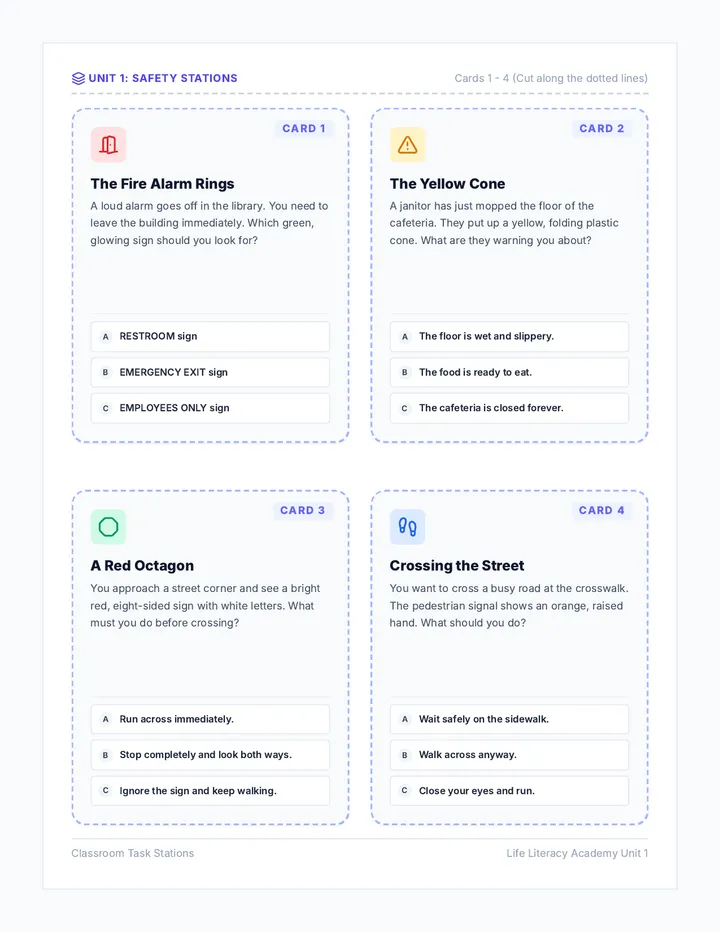
A 2-page printable activity pack containing 8 safety sign and schedule reading task cards (4 per page in a grid) for small groups, partner activities, or independent practice stations.
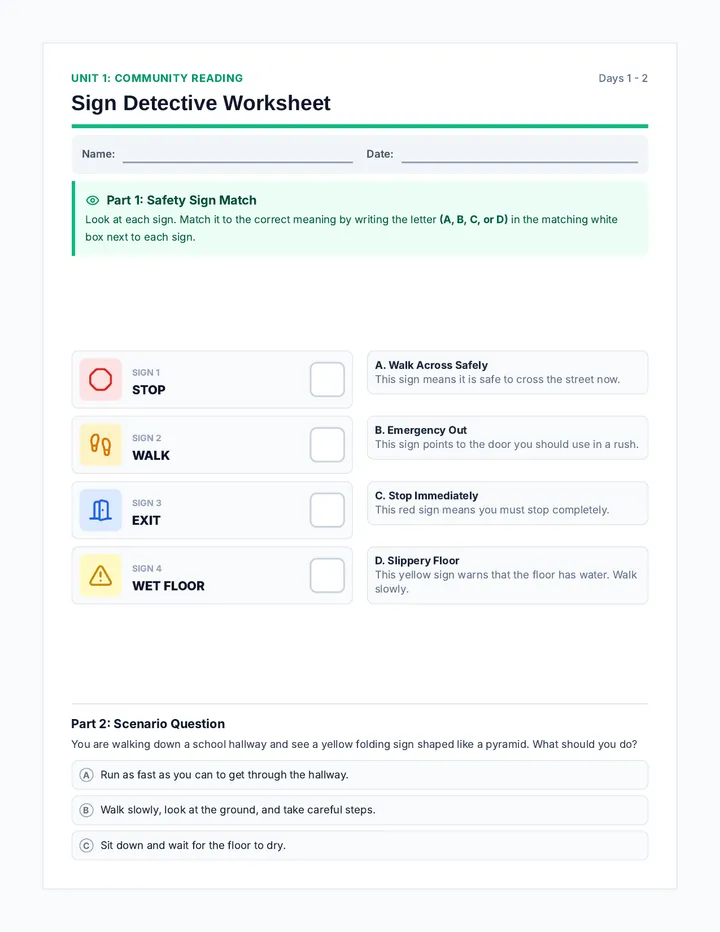
A 4-page printable student workbook for Days 1 to 5. It contains safety sign matching, transit schedule reading, WH-question comprehension on an adapted story, and step-by-step sequencing exercises with handwriting space.
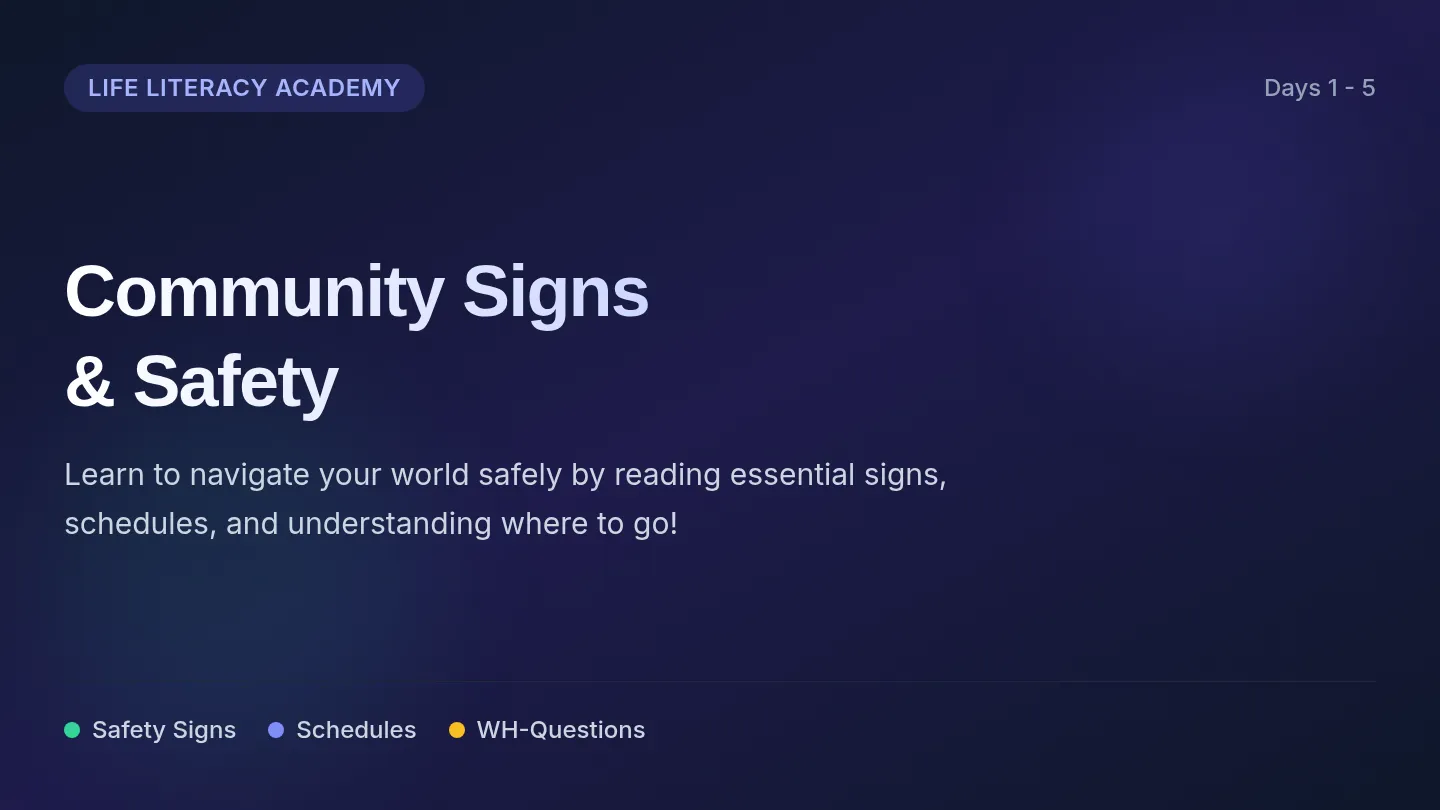
An interactive 6-slide presentation for Days 1 to 5 of the Community Signs and Safety lesson. It introduces critical community safety signs, reading schedules, and answering WH questions with large visuals and accessible text for late elementary to high school students with intellectual disabilities.
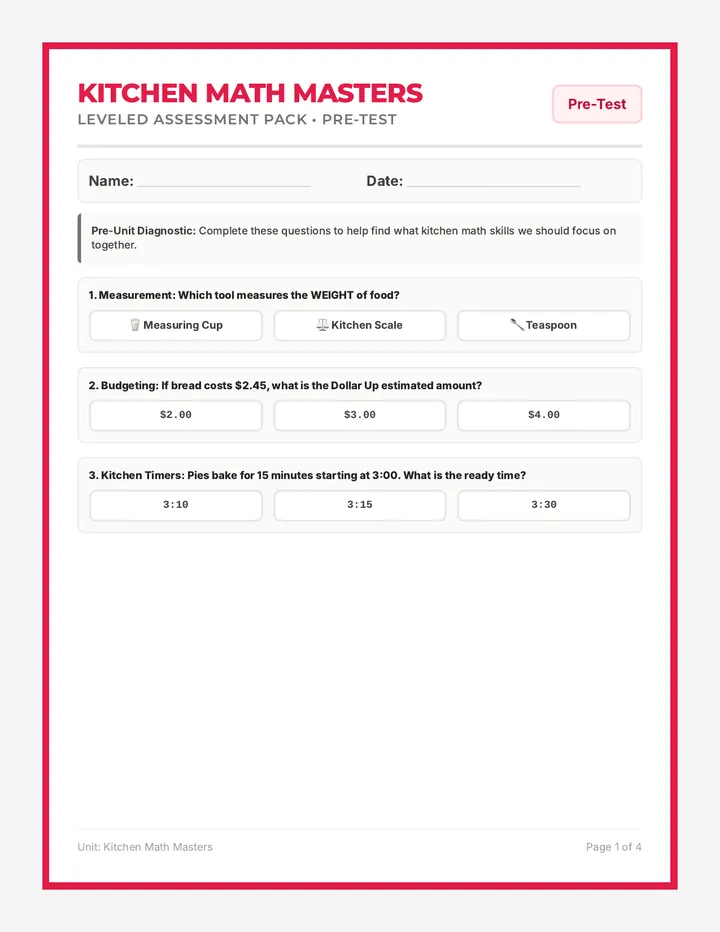
A 4-page functional math assessment packet containing a diagnostic pre-test, weekly checks, summative post-test, and a hands-on kitchen math rubrics/observational checklist.
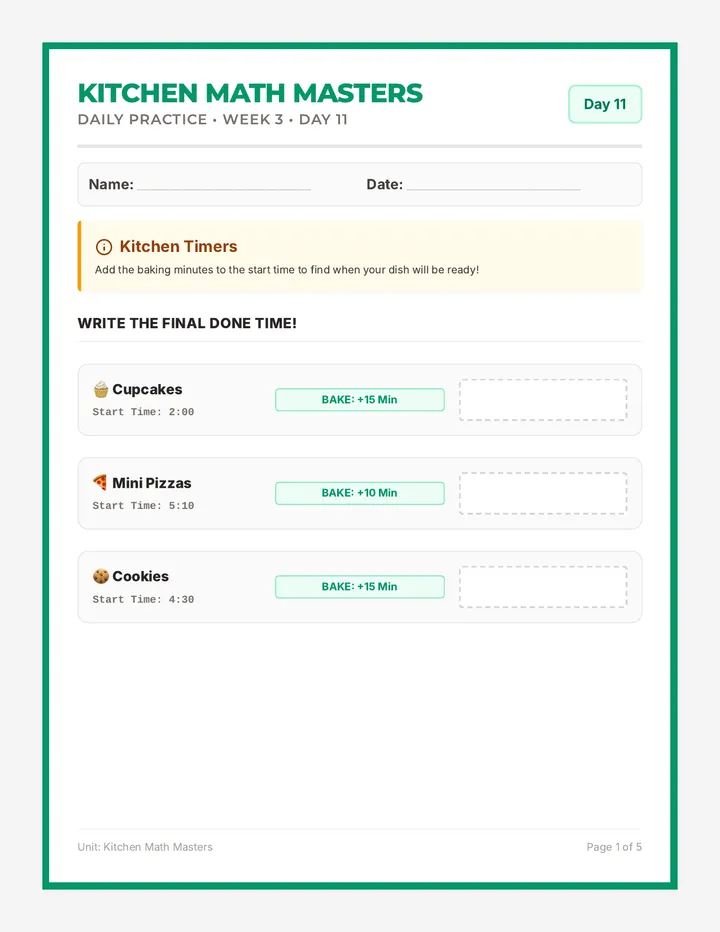
A 5-page student worksheet packet containing one dedicated, scaffolded daily practice page for Days 11 to 15. Topics include Kitchen Timers, Cooking Time Adjustments, Food Label Servings, Café Order Receipts, and Diner Operations.
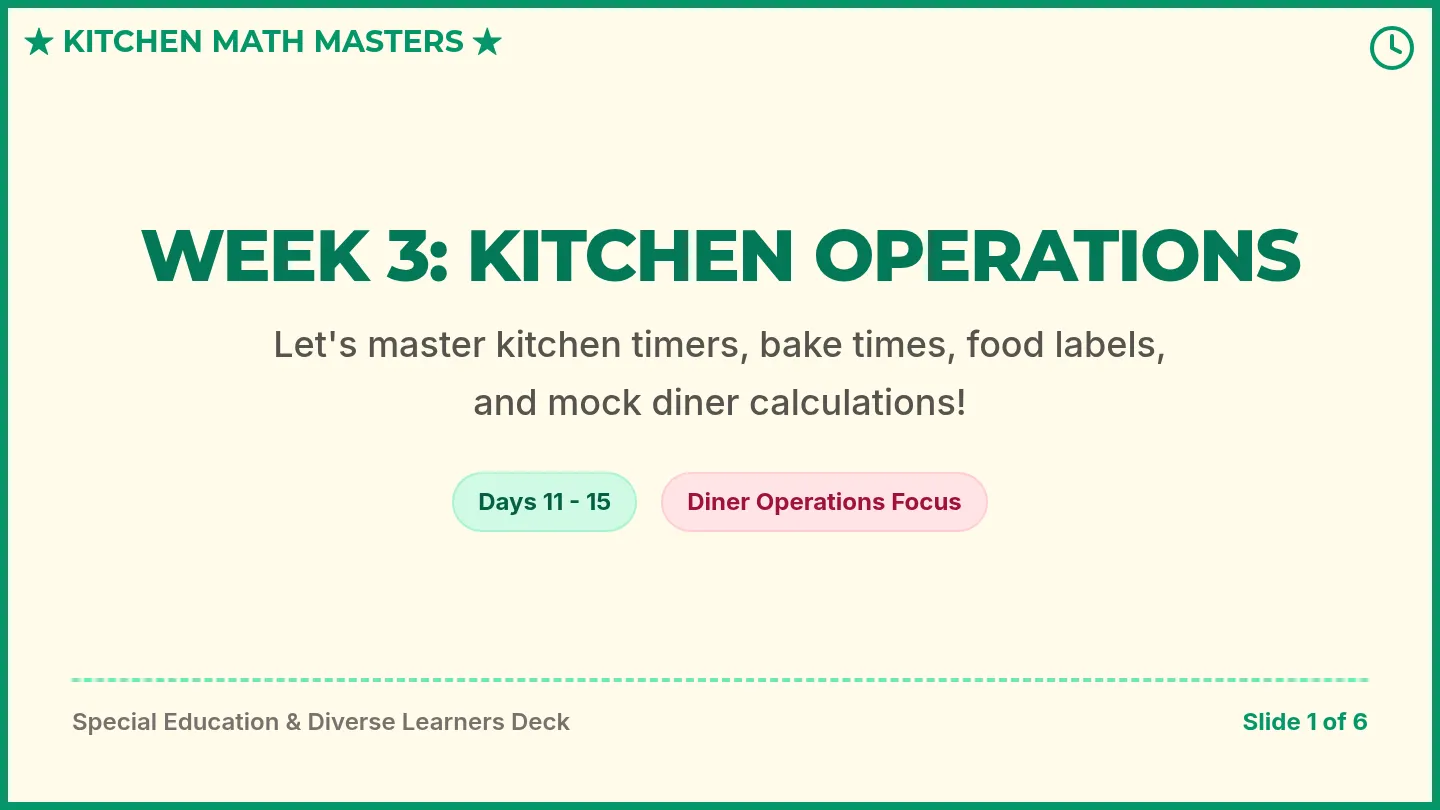
A visual presentation for Week 3 instruction. Focuses on digital timers, adding cooking minutes, reading serving labels, taking café order totals, and simulated kitchen operations.
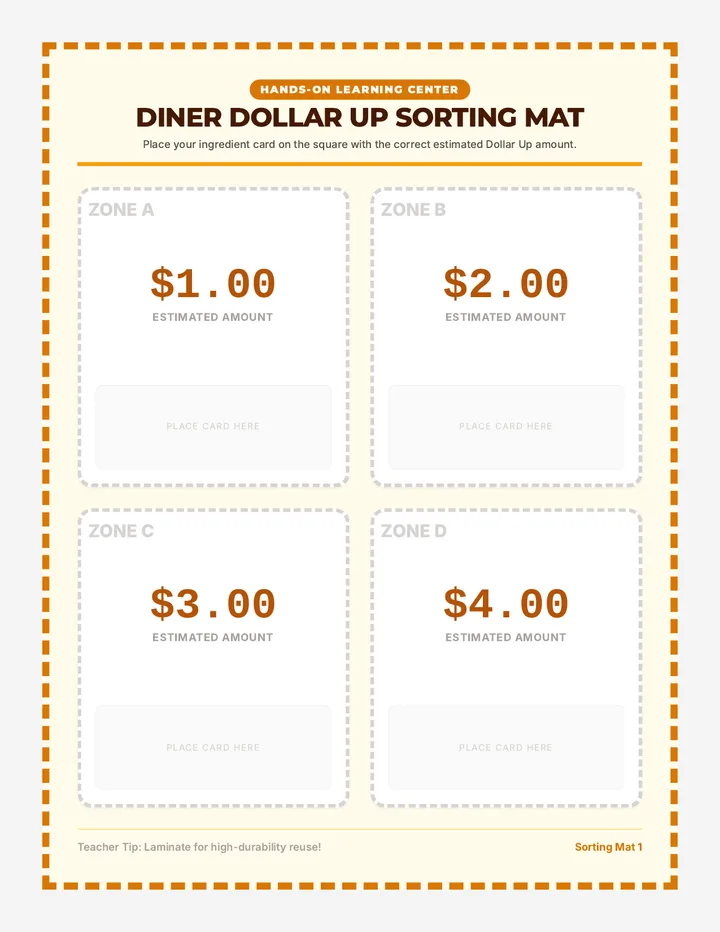
A printable set of hands-on classroom resources including a Dollar Up sorting mat, fractional measurement matching mat, and 12 beautifully designed recipe ingredient price cards to cut out and sort.
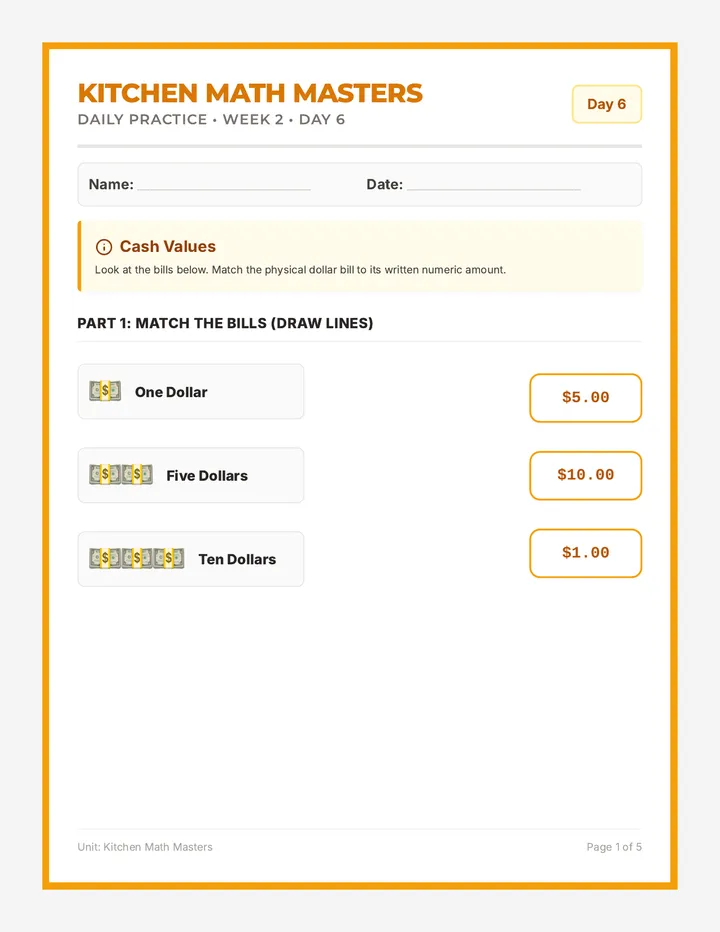
A 5-page student worksheet packet containing one dedicated, scaffolded daily practice page for Days 6 to 10. Topics include Money Identification, the Dollar Up Method, Coupons, Addition of Prices, and Calculating Change.
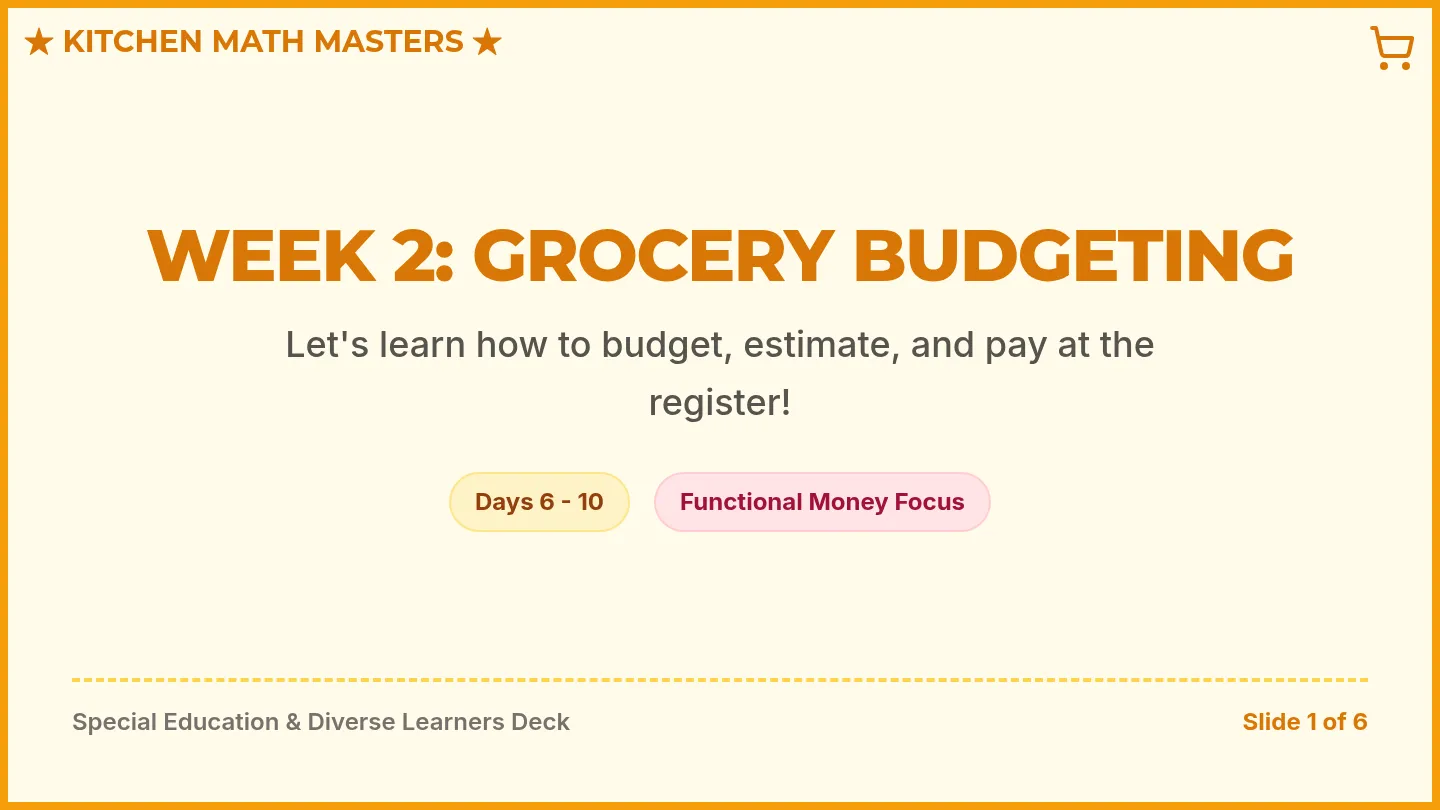
A visual presentation for Week 2 instruction. Teaches Special Education students money identification, the Dollar Up method, grocery addition, coupon subtraction, and calculating register change using large fonts and vivid visual anchors.
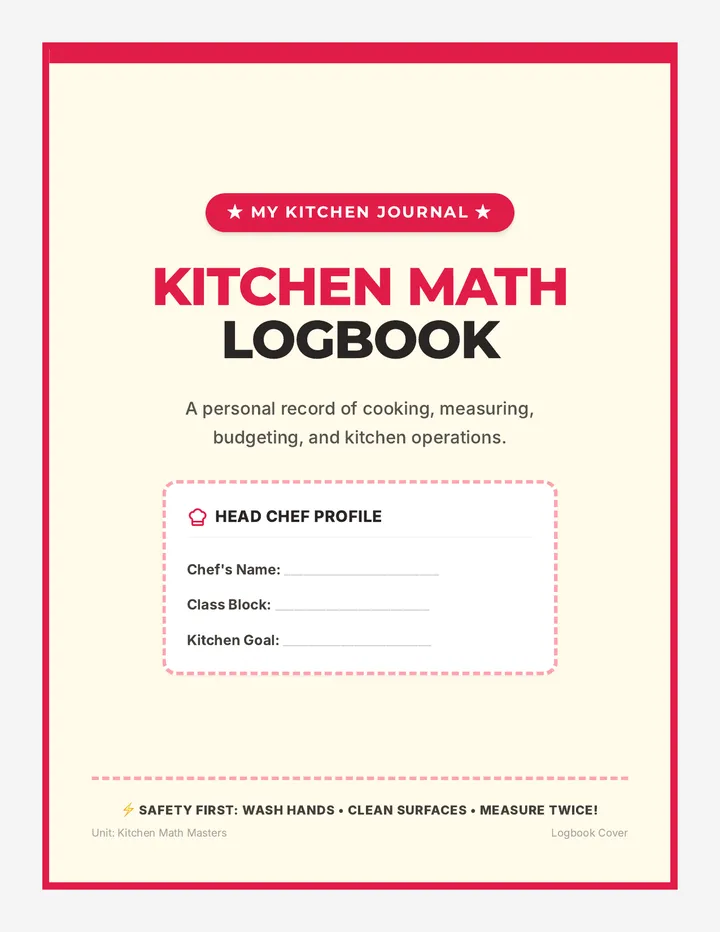
A cohesive, packet-style journal students use throughout the entire unit to track recipes, reflect on physical cooking sessions, record food items, budget totals, and rate their kitchen confidence.
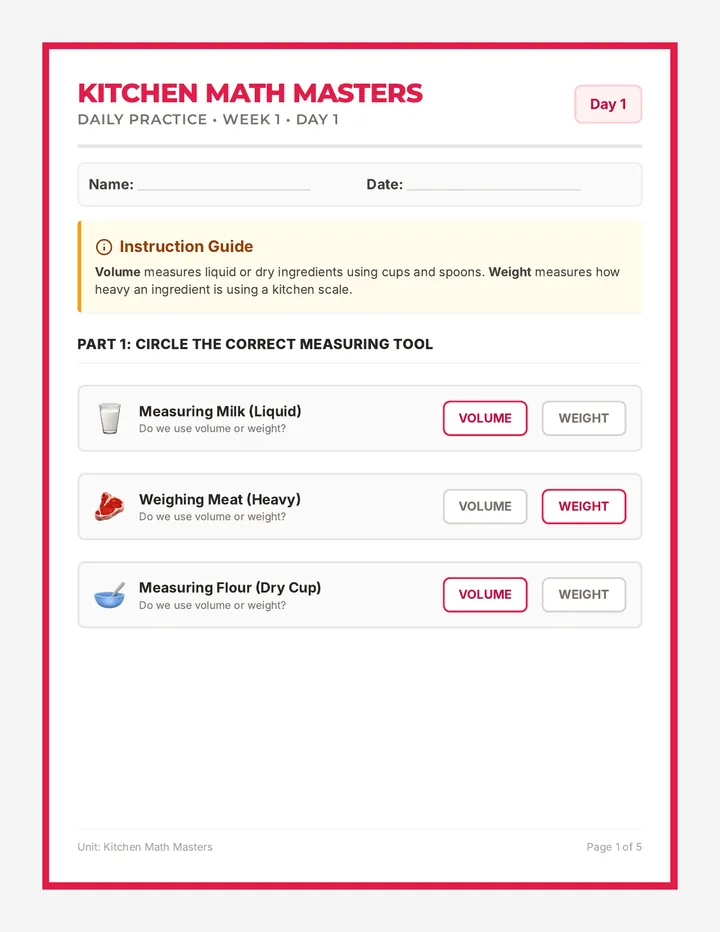
A 5-page student worksheet packet containing one dedicated, scaffolded daily practice page for Days 1 to 5. Topics include Volume vs. Weight, Whole Measures, Visual Fractions, Doubling, and Halving.
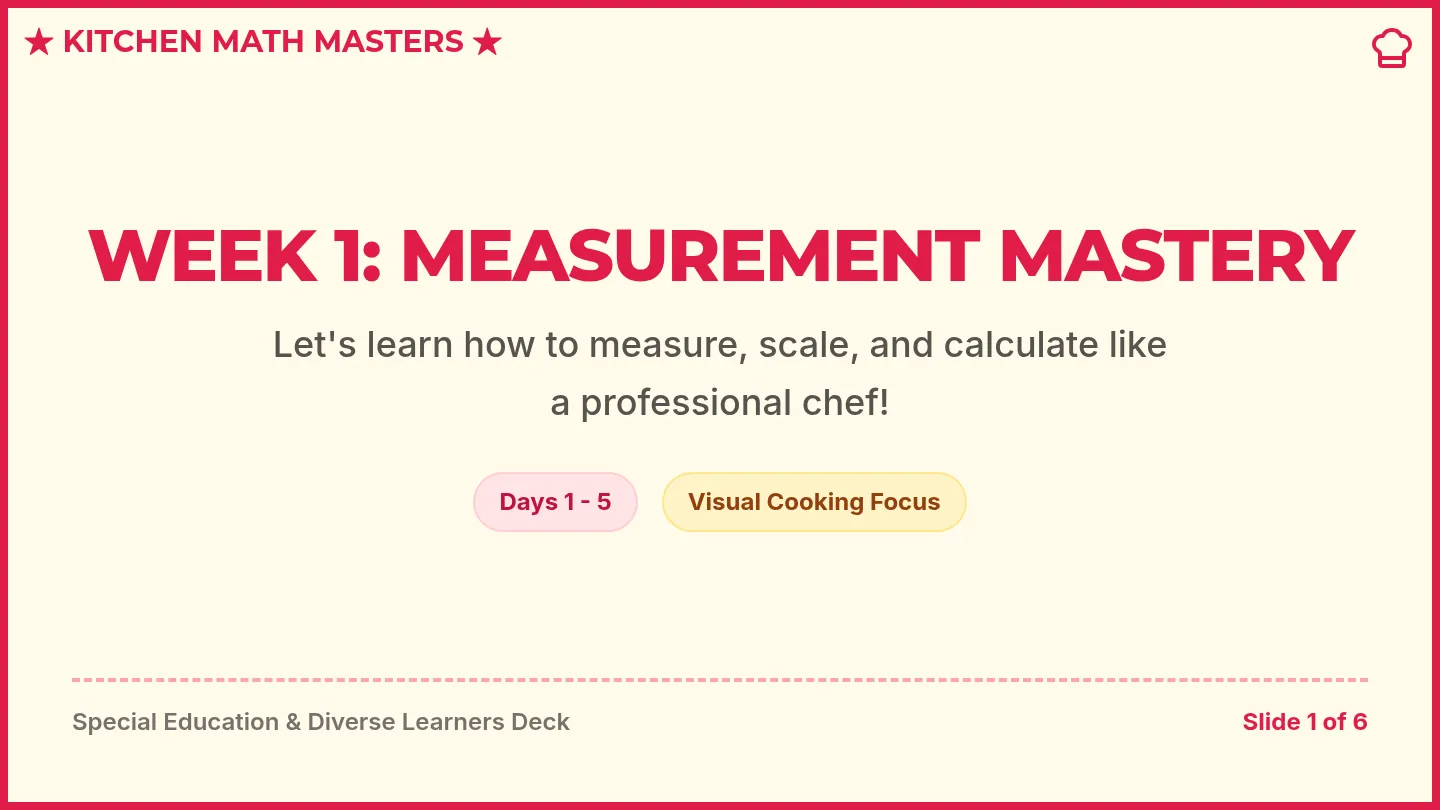
A highly visual presentation for Week 1 instruction. Contains large, clear diagrams and simple text to teach Volume vs. Weight, Whole Measures, Visual Fractions, Doubling, and Halving with step-by-step instructional prompts.
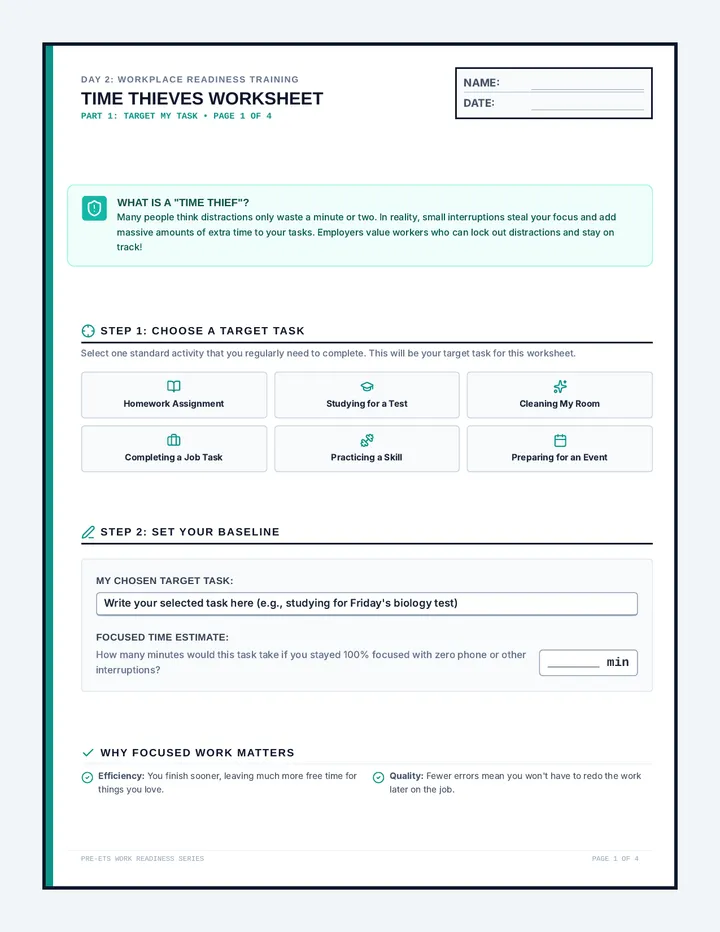
A 4-page student-facing worksheet designed to help students identify common "time thieves" (distractions), calculate the actual time needed to complete a task with distractions, and create a personal action plan to minimize interruptions.
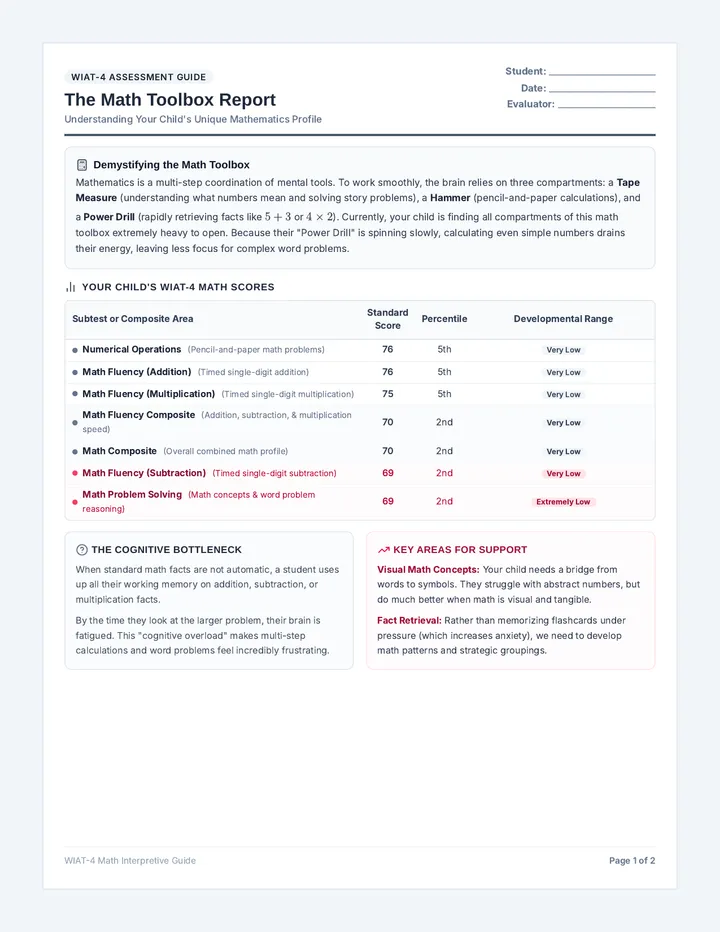
A 2-page, parent-friendly report explaining a student's WIAT-4 Math scores. It translates complex clinical test results into an encouraging 'Math Toolbox' analogy, outlining how difficulties in fact fluency and mental calculation interact, and offering hands-on home supports and essential school accommodations.
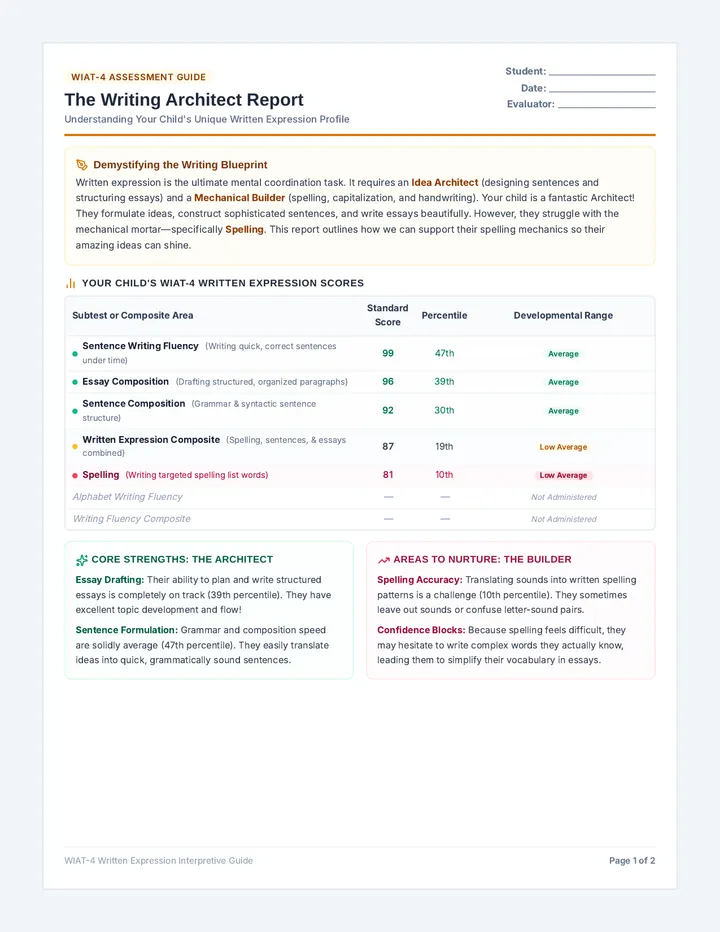
A 2-page, parent-friendly report explaining a student's WIAT-4 Written Expression scores. It translates complex clinical test results into an encouraging 'Writing Architect' analogy, highlighting strong composition and sentence fluency, while outlining actionable home strategies for spelling mechanics.
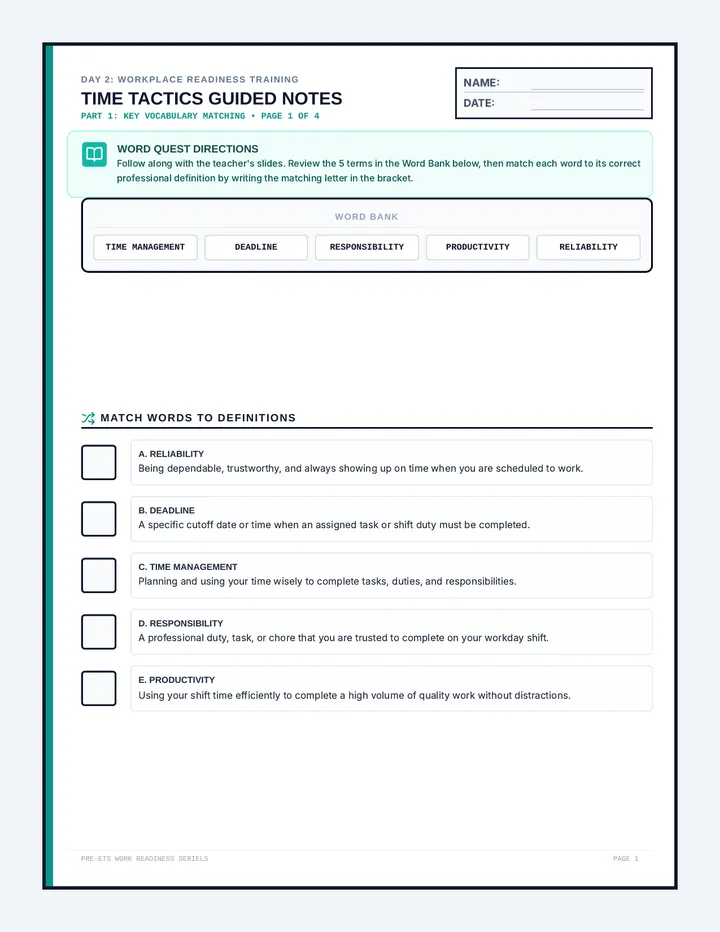
A 4-page student guided notes packet for Day 2 Workplace Time Tactics. Page 1 contains key vocabulary matching, Page 2 covers fill-in-the-blank direct instruction notes, Page 3 features two real-life delay scenarios, and Page 4 guides personal time management reflections.