Lenny.com
Explore
Create
ActivitiesNewCurriculumNewMathEnglish Language ArtsScience & EngineeringSocial StudiesGlobal LanguagesHealth & Physical EducationSpecial EducationCounseling & Life SkillsArts & CreativityESL
Lenny.com
Lenny.com
Explore
Create
ActivitiesNewCurriculumNewMathEnglish Language ArtsScience & EngineeringSocial StudiesGlobal LanguagesHealth & Physical EducationSpecial EducationCounseling & Life SkillsArts & CreativityESL
Lenny.com
Lenny.com

Solutions

Lenny for EducatorsLenny for SchoolsLenny for Districts

Product

ExploreSign inCreateSupportAbout

Resources

Getting startedMTSS Acceleration Program

Newsletters

School Funding Newsletter

© 2026 Lenny Learning Inc.

TermsPrivacyAccessibility
LinkedInInstagramX
Lenny
MathNumbers & CountingCounting ObjectsNumber NamesComparing NumbersNumber OperationsCounting SequenceNumbers 0-10Place Value Understanding and SystemAdd and Subtract Within 20Addition and Subtraction ConceptsAddition and Subtraction EquationsAddition and Subtraction ProblemsFoundations for MultiplicationMultiplication and Division PropertiesMultiply and Divide Within 100Multiplication and Division ProblemsFactors and MultiplesProperties of OperationsPatterns and RelationshipsGenerate and Analyze PatternsMulti-Digit ArithmeticPlace Value OperationsMulti-Digit and Decimal OperationsNumerical ExpressionsFour Operations and PatternsFour Operations Problem SolvingMeasurement & DataMeasurable AttributesMeasuring LengthsMeasure and Estimate Lengths in Standard UnitsRelate Addition and Subtraction to LengthClassifying and Counting ObjectsTime and MoneyArea Concepts and MeasurementPerimeter and Area MeasuresAngle Concepts and MeasurementTime, Volume, and MassMeasurement Unit ConversionsGeometryIdentifying ShapesShapes and AttributesShape Attributes and ReasoningShapes and CompositionClassifying 2D FiguresGeometric Figures and RelationshipsLines, Angles, and ShapesAngle, Area, and VolumeGeometric MeasurementVolume of 3D ShapesCoordinate Plane ApplicationsTransformations in the PlaneCongruence and SimilarityUnderstand congruence in terms of rigid motionsSimilarity and TransformationsProve Theorems Involving SimilarityPythagorean TheoremTrigonometry for General TrianglesMake Geometric ConstructionsProve Geometric TheoremsTheorems About CirclesFind Arc Lengths And Areas of Sectors of CirclesVolume FormulasRelationships Between Two-Dimensional and Three-Dimensional ObjectsProve Simple Geometric Theorems AlgebraicallyTranslate Between Geometric Description and Equation for Conic SectionApply Geometric Concepts in Modeling SituationsFractions & DecimalsFractions as NumbersBuilding FractionsFraction Equivalence and OrderingAdding and Subtracting FractionsMultiplying and Dividing FractionsDividing FractionsDecimal FractionsMulti-Digit Computation and FactorsAdd, Subtract, Multiply, and Divide Rational NumbersRational Number SystemIrrational Numbers and ApproximationsRatiosRatios and ProportionsProportional RelationshipsUnit RateAlgebraAlgebraic ExpressionsGenerate Equivalent ExpressionsQuantitative RelationshipsProportional Relationships and Linear EquationsEquations and InequalitiesEquation Solving and ReasoningLinear Equations and SystemsGraph Equations and InequalitiesSystems of EquationsReal-World Algebraic ProblemsQuantitative Reasoning with UnitsExpression StructureEquivalent Expression FormsRadicals and Integer ExponentsRational ExponentsRational and Irrational NumbersPolynomial OperationsPolynomial IdentitiesPolynomial Zeros and FactorsRational ExpressionsComplex Number OperationsComplex Numbers in PolynomialsComplex Numbers on PlaneStatistics & ProbabilityRepresent and Interpret DataData DistributionsStatistical VariabilityProbability ModelsCompound Event ProbabilitiesStatistical SamplingInterpret Categorical and Quantitative DataBivariate Data PatternsInterpret Linear ModelsComparing Two PopulationsRandom Processes in StatisticsIndependence and Conditional ProbabilityExpected ValuesProbability-Based Decision MakingStatistical Inference and ConclusionsFunctionsFunction Concepts and NotationDefine and Compare FunctionsInterpret Functions in ContextAnalyze Function RepresentationsModel Relationships with FunctionsIdentify Linear vs Exponential GrowthDistinguish Between Function TypesCompare Growth RatesInterpret Function ExpressionsBuild Functions from RelationshipsConstruct and Model FunctionsTransform and Combine FunctionsModel Comparison and SelectionSolve Exponential EquationsTrigonometryTrigonometric Ratios Involving Right TrianglesTrigonometric Functions and Unit CircleModel with Trigonometric FunctionsTrigonometric IdentitiesVectors & MatricesIntroduction to Vectors and MatricesVector QuantitiesVector OperationsMatrix OperationsCalculusLimits and ContinuityDerivative Concepts and NotationDerivative Rules and TechniquesApplications of DerivativesOptimization ProblemsRelated RatesCurve Sketching and AnalysisIntegration Concepts and NotationAntiderivatives and Indefinite IntegralsDefinite Integrals and AreaFundamental Theorem of CalculusIntegration TechniquesApplications of IntegrationDifferential EquationsSequences and SeriesParametric and Polar FunctionsVector-Valued Functions

Slope Intercept Graphic Organizer

Un organizador gráfico visual de una sola diapositiva que enseña a los estudiantes cómo graficar ecuaciones lineales en forma pendiente-intersección (y = mx + b) mediante cuatro pasos codificados por color y un ejemplo resuelto en el plano cartesiano. Diseñado en formato horizontal listo para pegar en una diapositiva o imprimir en horizontal.

TFTerry Fung Ching

You might also like

Card Shark Slides

Card Shark Academy

A 6-day project-based unit where student groups of 3-5 master a classic card game (Hearts, Gin Rummy, Euchre, or Oh Hell), design a peer-teaching method, and lead the class in learning and playing each game.

SH

Sarah Hurdle

14
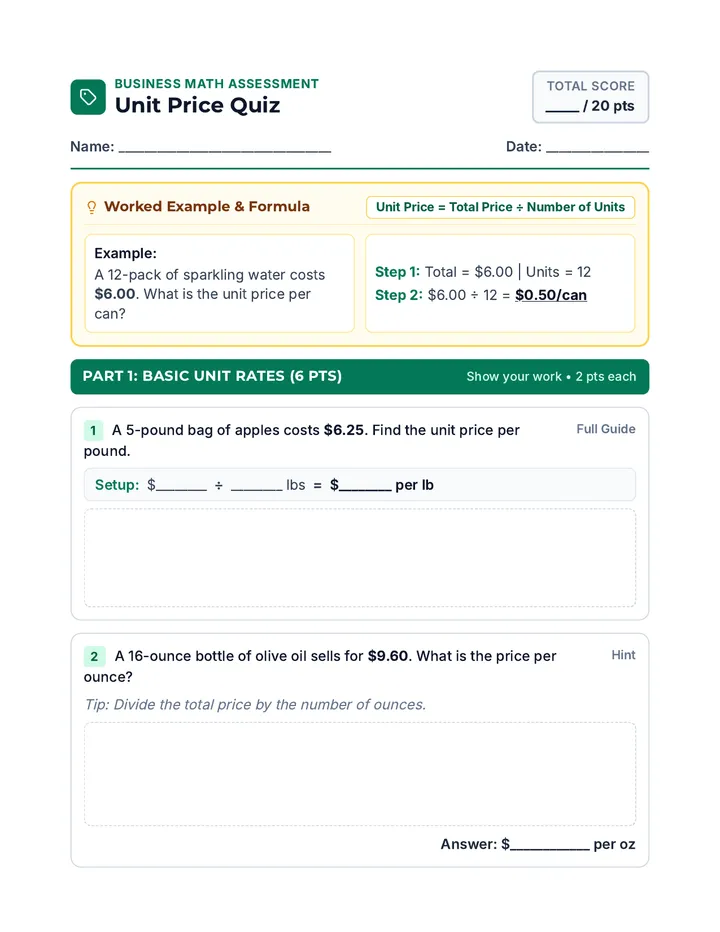
Unit Price Quiz

Smart Shopper Math

A scaffolded business math assessment lesson focused on calculating unit rates, comparing package prices to find the best buy, and applying unit pricing to realistic shopping and budgeting scenarios. Includes a printable quiz with gradually reduced supports and a complete worked-solution answer key.

S

stewart

2
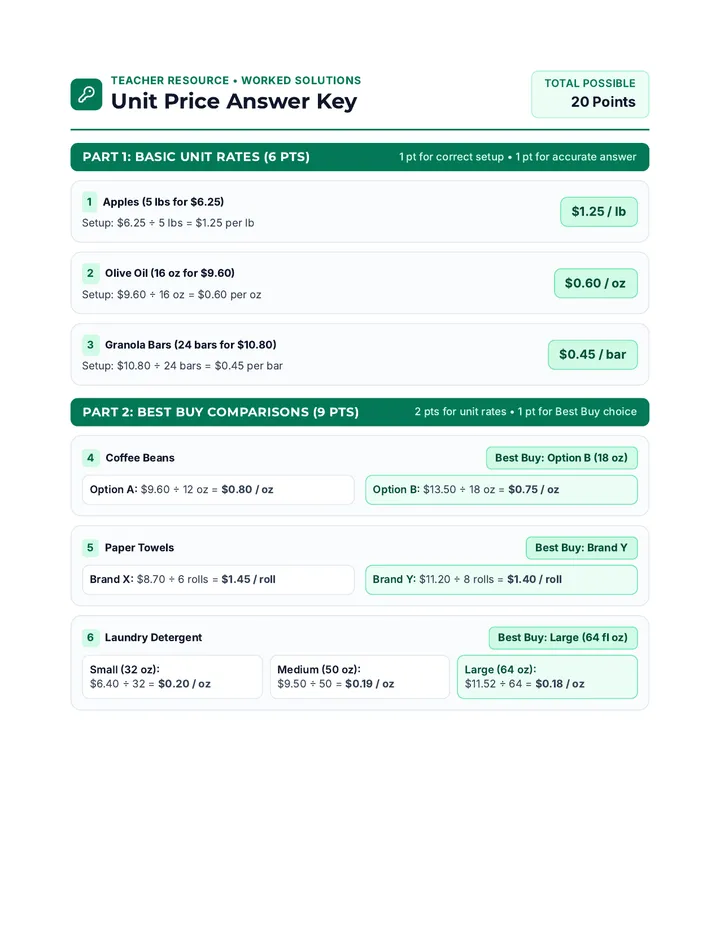
Unit Price Answer Key

Unit Price Answer Key

A 2-page teacher answer key for the Unit Price Quiz with complete step-by-step worked solutions, point-value breakdowns (20 points total), and common student misconception notes for grading and reteaching.

S

stewart

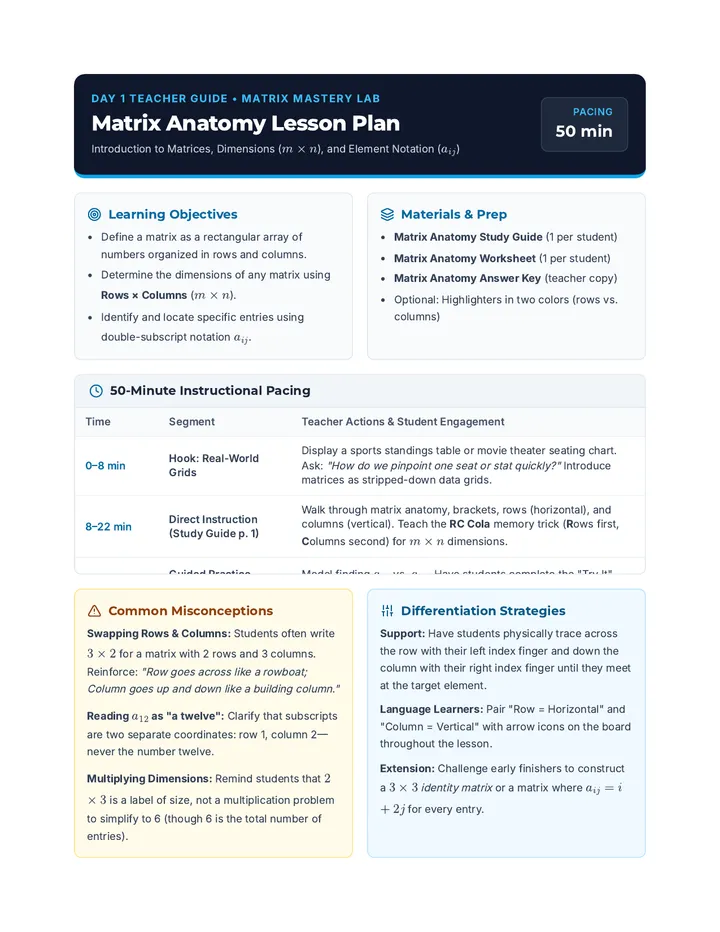
Matrix Anatomy Lesson Plan

Matrix Mastery Lab

A 3-day instructional sequence introducing matrices, their dimensions and element notation, matrix addition and subtraction, and scalar multiplication. Each day pairs a teacher lesson plan with a student learning guide, practice worksheet, and answer key.

MR

Mahuya Roy Chowdhury

12
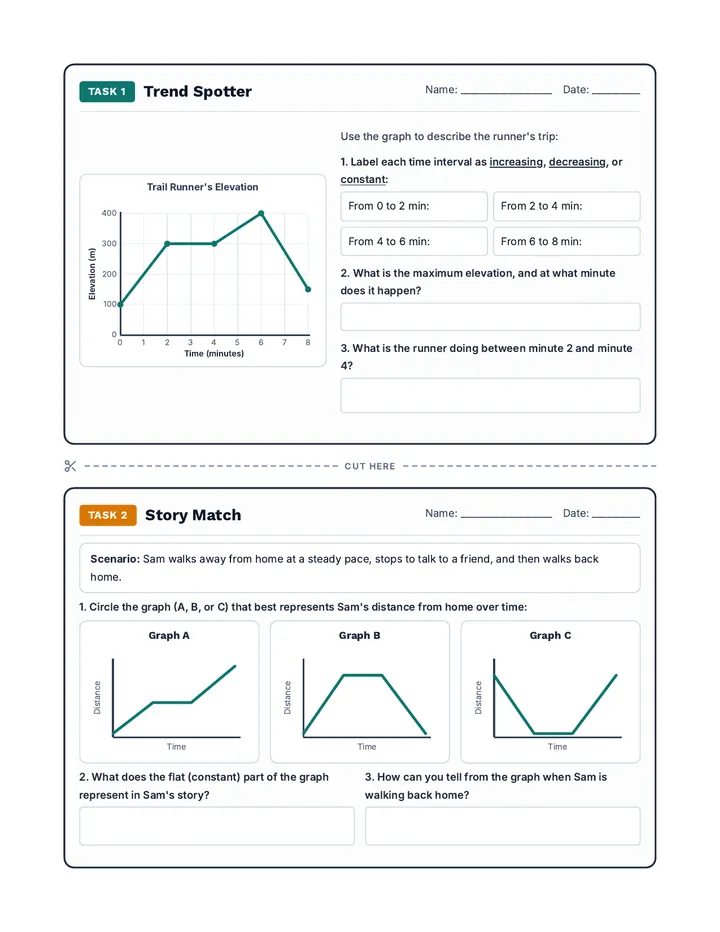
Graph Stories Task Worksheet

Graph Stories Tasks

A task-based lesson exploring qualitative features of functions—increasing, decreasing, and constant intervals, visual straight vs. curved (linear vs. nonlinear) shapes, inequality notation, sketching from context, and endpoint extrema. Includes a cut-apart 6-task worksheet and a complete answer key.

E

ebecker

2
Unit Price Quiz

Unit Price Quiz

A 4-page printable, scaffolded unit price quiz for business math students in 12pt font with generous blank workspace. Features a worked example, basic unit rate problems with fading scaffolds, best-buy package comparisons, and realistic multi-step budgeting word problems.

S

stewart

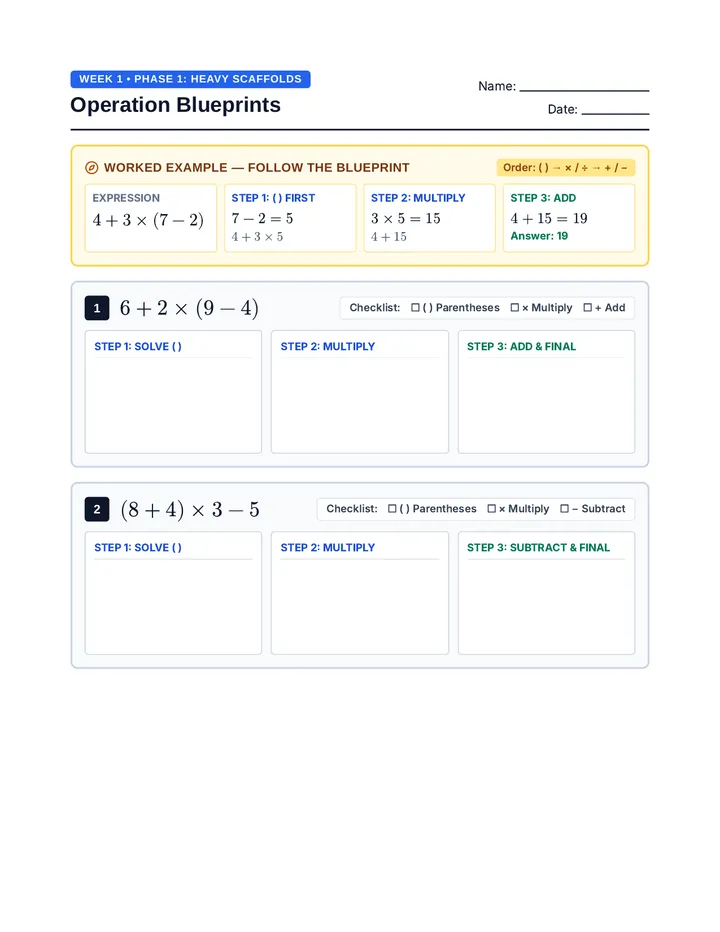
Week 1 Blueprints Worksheet

Order of Operations Mastery

A 9-week gradual-release sequence targeting multi-step order of operations using a step-by-step strategy. Scaffolds fade systematically from full worked examples and labeled step boxes in Weeks 1–3 to independent problem solving with minimal adult prompting in Weeks 7–9, supporting an 80% accuracy goal.

JF

Jessi Fazio Scott

24
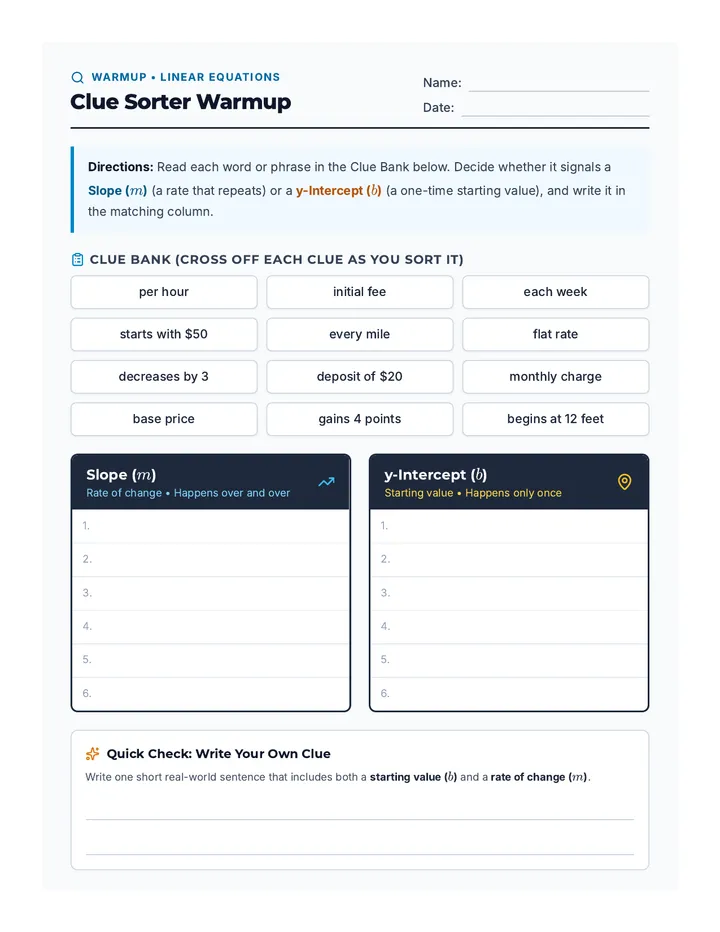
Clue Sorter Warmup

Line Clues

Students decode real-world word problems into linear equations in slope-intercept form (y = mx + b) by distinguishing rate-of-change clues from starting-value clues, then graph the resulting lines on coordinate planes.

L

Logan-Greene

4
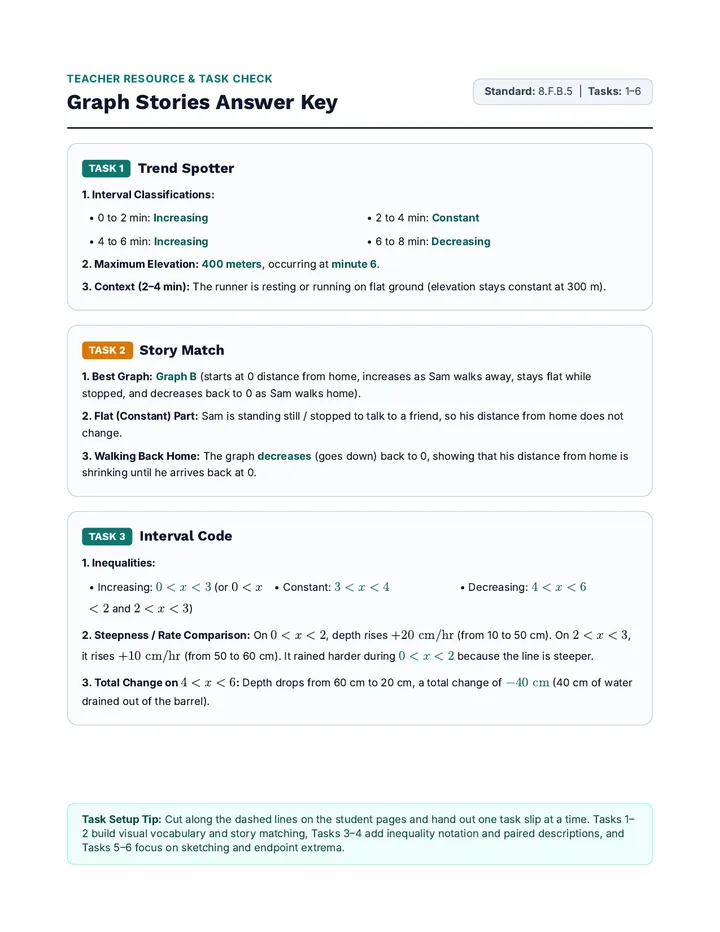
Graph Stories Answer Key

Graph Stories Answer Key

A 2-page teacher answer key and task facilitation guide for the Graph Stories Task Worksheet. Provides complete solutions, inequality notation, qualitative story-matching explanations, and the completed sketch for Task 5.

E

ebecker

Earn It Slides

Can I Afford It

A two-day high school resource math unit where students budget for a gaming console and games by tracking weekly earnings, expenses, and bundle trade-offs. Includes daily instructional slides, student worksheets, and teacher guides with pacing and answer keys.

SH

Stacey Hersch

6
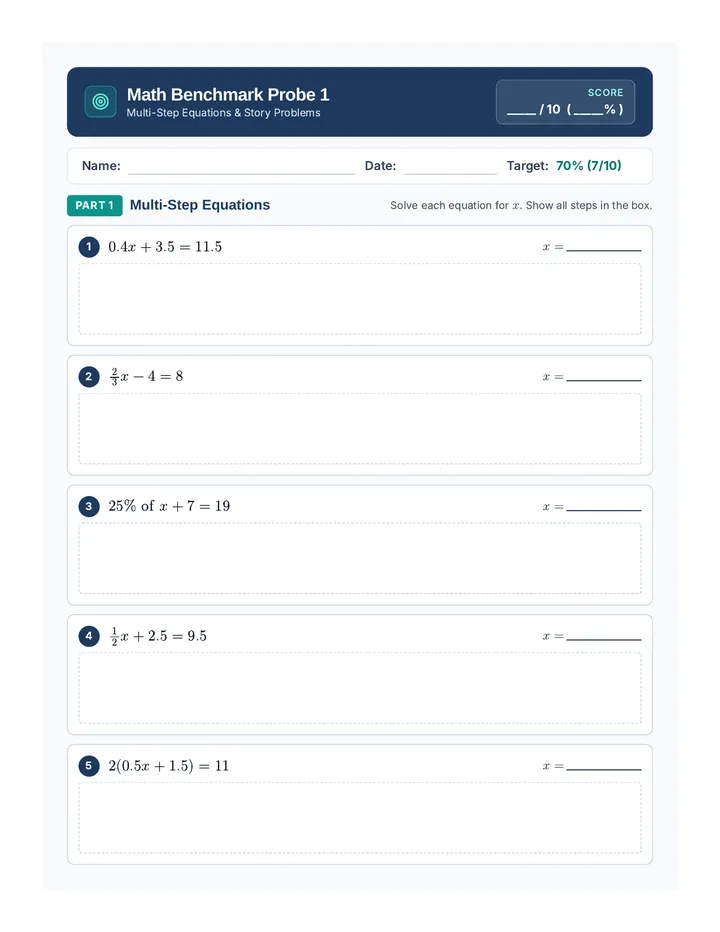
Math Benchmark Probe One

Equation Mastery Probes

A set of three parallel progress-monitoring goal probes and an answer key with a data tracker aligned to the IEP goal for solving multi-step equations and story problems with percentages, fractions, and decimals at 70% accuracy.

RC

Robin Cronin

4
Graph Stories Task Worksheet

Graph Stories Task Worksheet

A 3-page printable worksheet divided into 6 distinct, cut-apart task chunks (2 per page) separated by dashed cut lines. Progresses sequentially through 8.F.B.5 skills from identifying increasing/decreasing/constant intervals and matching qualitative stories to graphs, to inequality notation, multi-feature sketching, and endpoint extrema on a line segment.

E

ebecker