Scaffolded Math Goal Bank
Grade 3 Special Education & Intervention Resource
Scaffolded 3rd-Grade Math Goal Bank
Domains Covered
3.OA • 3.NF • 3.G
IEP-Ready Goal Formula
Replace bracketed text [like this] to individualize each goal for a student’s present levels, accommodations, and assessment schedule.
1. Condition / Support 2. Student 3. Observable Skill 4. Criteria & Tool
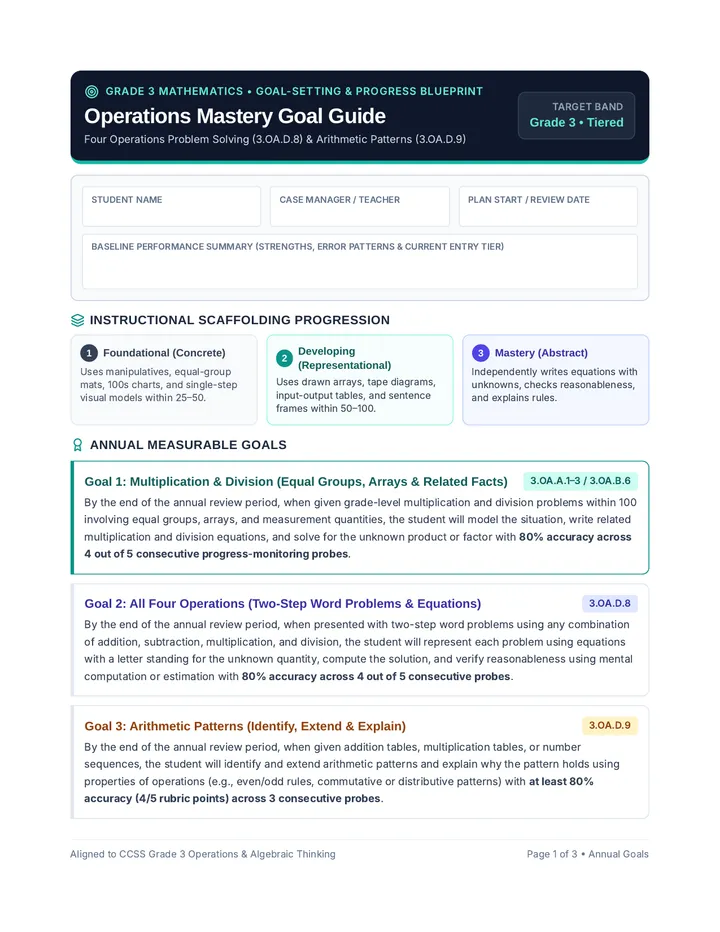
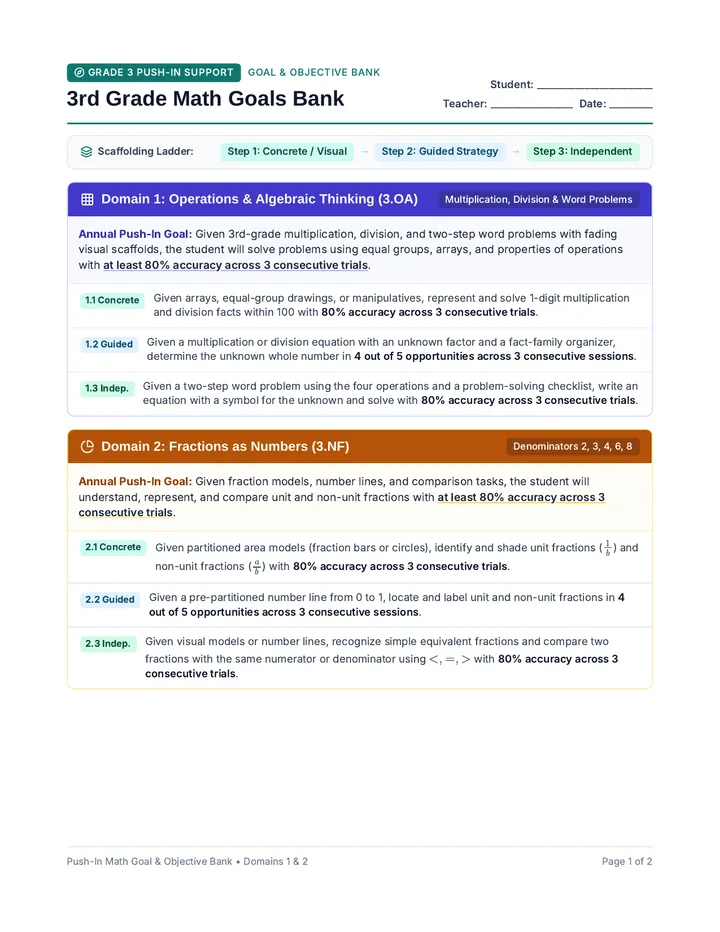
Scaffolded Levels
L1 Emerging Concrete manipulatives & modeling
L2 Developing Visual models & minimal prompts
L3 Independent Abstract, unprompted mastery
Domain 1: Operations & Algebraic Thinking (3.OA)
Part 1 of 2
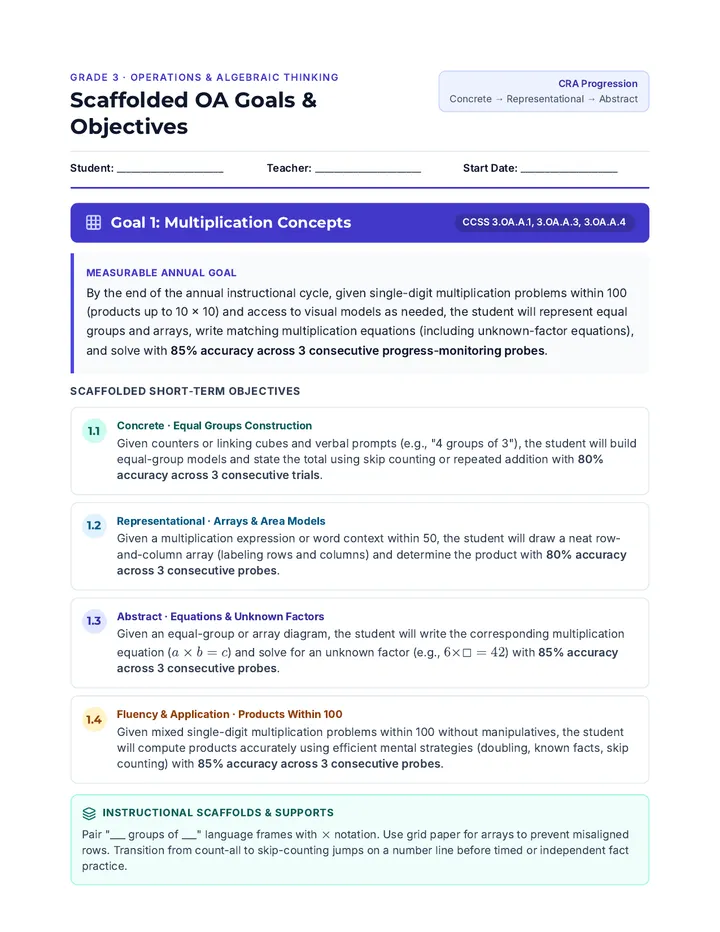
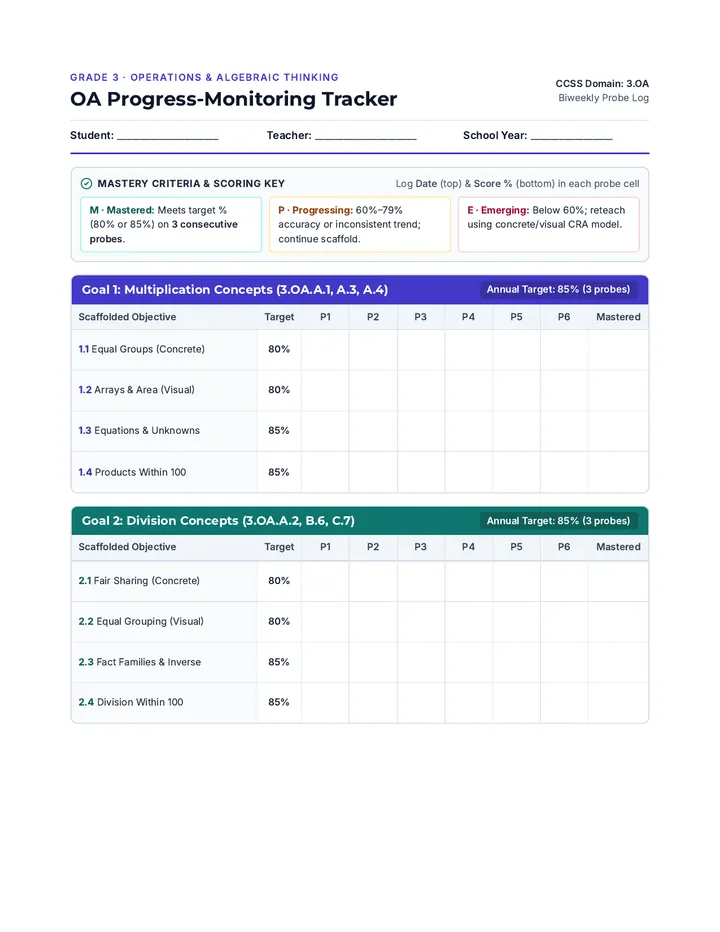
1.1 Equal Groups, Arrays & Multiplication/Division Concepts
3.OA.A.1 – 3.OA.A.2
L1 Emerging
Given concrete manipulatives (e.g., counters, snap cubes) and a teacher-modeled example, [Student] will build equal groups or arrays to represent single-digit multiplication and fair-share division situations and state the total or group size in [3 out of 4 trials] across [3 consecutive sessions], as measured by [observational checklists].
L2 Developing
Given visual supports (e.g., grid paper, pre-drawn array frames) and a verbal prompt to identify groups and items per group, [Student] will write and solve multiplication and division equations within 100 for equal-group problems with [80% accuracy] across [3 consecutive probes], as measured by [work samples].
L3 Independent
Independently, without manipulatives or teacher prompting, [Student] will interpret, model, and solve multiplication and division word problems within 100 involving equal groups, arrays, and measurement quantities with [85% accuracy] across [4 consecutive assessments], as measured by [curriculum-based probes].
1.2 Unknowns in Multiplication & Division Equations
3.OA.A.4
L1 Emerging
Given a multiplication or division equation with a missing number in the product/quotient position (e.g., \(3 \times 4 = \square\)) and a multiplication chart or counters, [Student] will determine the unknown whole number with [75% accuracy] across [3 consecutive trials], as measured by [teacher-made probes].
L2 Developing
Given a fact-family triangle or visual reference card, [Student] will determine the unknown whole number in any position of a multiplication or division equation (e.g., \(8 \times \square = 48\)) with [80% accuracy] across [3 consecutive probes], as measured by [weekly skill checks].
L3 Independent
Independently, [Student] will solve for an unknown whole number in any position across mixed multiplication and division equations and justify the solution using inverse operations with [90% accuracy] across [4 consecutive assessments], as measured by [unit benchmarks].
Domain 1: Operations & Algebraic Thinking (3.OA)
Part 2 of 2
1.3 Properties of Operations & Fluency Within 100
3.OA.B.5 – 3.OA.C.7
L1 Emerging
Given skip-counting strips or array cards and guided verbal prompts, [Student] will recall or derive multiplication and related division facts for factors 0, 1, 2, 5, and 10 with [75% accuracy] across [3 consecutive sessions], as measured by [untimed fact probes].
L2 Developing
Given a strategy anchor chart (commutative, associative, or distributive property), [Student] will apply properties of operations to solve multiplication and division facts within 100 (factors 0–10) with [80% accuracy] across [3 consecutive probes], as measured by [fluency checks].
L3 Independent
Independently, without reference charts, [Student] will fluently multiply and divide within 100 using strategies and known facts, achieving [90% accuracy] across [4 consecutive assessments], as measured by [curriculum-based fluency probes].
1.4 Two-Step Word Problems & Arithmetic Patterns
3.OA.D.8 – 3.OA.D.9
L1 Emerging
Given a two-step word problem read aloud and broken into Step 1 and Step 2 boxes with operation cue cards, [Student] will identify the correct operations and solve each step with [3 out of 4 problems] correct across [3 consecutive sessions], as measured by [guided work samples].
L2 Developing
Given a problem-solving graphic organizer (e.g., CUBES or tape diagram template), [Student] will represent and solve two-step word problems using the four operations with a letter standing for the unknown quantity with [80% accuracy] across [3 consecutive probes], as measured by [teacher-scored rubrics].
L3 Independent
Independently, [Student] will solve two-step word problems using all four operations, write equations with a letter for the unknown, and assess reasonableness using mental estimation with [85% accuracy] across [4 consecutive assessments], as measured by [district benchmarks].
Progress Monitoring Note — Operations & Algebraic Thinking
When fading scaffolds from Level 1 to Level 2, track both accuracy and prompt level (full model → visual cue → independent). For word problems, separate computation errors from operation-selection errors so instruction targets the true barrier.
Domain 2: Fractions as Numbers (3.NF)
Denominators 2, 3, 4, 6, 8
2.1 Unit Fractions & Part-Whole Area Models
3.NF.A.1
L1 Emerging
Given tactile fraction tiles or pre-partitioned shape cutouts and a verbal model, [Student] will identify equal parts of a whole and match unit fractions (\(\frac{1}{2}, \frac{1}{3}, \frac{1}{4}\)) to shaded models in [4 out of 5 trials] across [3 consecutive sessions], as measured by [data sheets].
L2 Developing
Given a visual anchor chart defining numerator and denominator, [Student] will write and shade fractions \(\frac{a}{b}\) (denominators 2, 3, 4, 6, 8) to represent \(a\) parts of size \(\frac{1}{b}\) with [80% accuracy] across [3 consecutive probes], as measured by [work samples].
L3 Independent
Independently, [Student] will partition wholes into equal parts, represent unit and non-unit fractions symbolically and visually, and explain why unequal parts do not form valid fractions with [85% accuracy] across [4 consecutive assessments], as measured by [unit assessments].
2.2 Fractions on a Number Line (0 to 1 & Beyond)
3.NF.A.2
L1 Emerging
Given a pre-partitioned number line from 0 to 1 aligned directly beneath a fraction strip, [Student] will count equal intervals from 0 and label unit and non-unit fractions with [75% accuracy] across [3 consecutive sessions], as measured by [teacher-made probes].
L2 Developing
Given an unmarked number line from 0 to 1 and a prompt to count spaces rather than tick marks, [Student] will partition the interval into \(b\) equal parts and plot \(\frac{a}{b}\) with [80% accuracy] across [3 consecutive probes], as measured by [weekly skill checks].
L3 Independent
Independently, [Student] will partition number lines from 0 to 1 (and whole-number intervals beyond 1) to locate, label, and represent fractions as points and distances from 0 with [85% accuracy] across [4 consecutive assessments], as measured by [curriculum-based probes].
2.3 Equivalent Fractions & Fraction Comparisons
3.NF.A.3
L1 Emerging
Given aligned fraction bars or stacked number lines, [Student] will visually match equivalent fractions (e.g., \(\frac{1}{2} = \frac{2}{4}\)) and compare two fractions with like denominators using <, =, or > in [4 out of 5 trials] across [3 consecutive sessions], as measured by [observational data].
L2 Developing
Given blank fraction strip templates or number lines, [Student] will generate simple equivalent fractions, express whole numbers as fractions (e.g., \(3 = \frac{3}{1}\)), and compare fractions with the same numerator or denominator with [80% accuracy] across [3 consecutive probes], as measured by [work samples].
L3 Independent
Independently, [Student] will justify fraction equivalence and compare two fractions with the same numerator or same denominator using symbols (<, =, >) and written/verbal reasoning about same-sized wholes with [85% accuracy] across [4 consecutive assessments], as measured by [rubric-scored probes].
Domain 3: Geometry (3.G)
Shape Attributes & Equal Areas
3.1 Classifying 2D Shapes & Quadrilaterals by Attributes
3.G.A.1
L1 Emerging
Given tactile pattern blocks, a right-angle tester (index card corner), and a visual attribute checklist, [Student] will sort 2D polygons by number of sides and identify quadrilaterals in [4 out of 5 trials] across [3 consecutive sessions], as measured by [observational checklists].
L2 Developing
Given a quadrilateral hierarchy chart or vocabulary word bank (parallel sides, right angles, equal sides), [Student] will classify rhombuses, rectangles, and squares by shared attributes with [80% accuracy] across [3 consecutive probes], as measured by [work samples].
L3 Independent
Independently, [Student] will categorize shapes into larger categories (e.g., quadrilaterals), draw examples of quadrilaterals that do not belong to subcategories (e.g., trapezoids/kites), and justify classifications using geometric attributes with [85% accuracy] across [4 consecutive assessments], as measured by [unit assessments].
3.2 Partitioning Shapes into Parts with Equal Areas
3.G.A.2
L1 Emerging
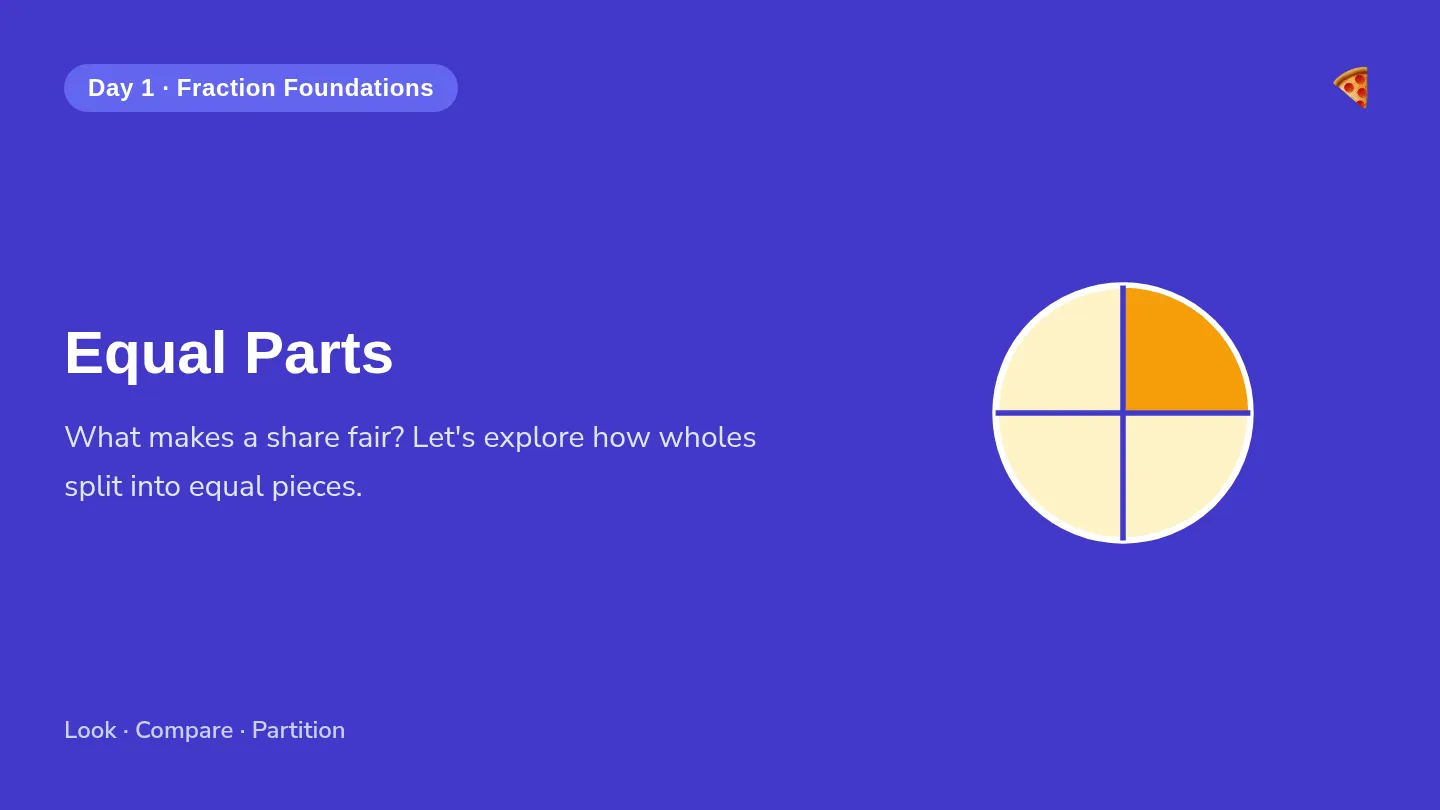
Given grid-paper shapes or foldable paper cutouts and a teacher-modeled example, [Student] will partition rectangles and circles into 2 or 4 equal-area parts and state the unit fraction (\(\frac{1}{2}\) or \(\frac{1}{4}\)) in [4 out of 5 trials] across [3 consecutive sessions], as measured by [work samples].
L2 Developing
Given dot-grid or square-grid templates, [Student] will partition shapes into 2, 3, 4, 6, or 8 equal-area parts and label each part as \(\frac{1}{b}\) of the whole area with [80% accuracy] across [3 consecutive probes], as measured by [teacher-made probes].
L3 Independent
Independently, [Student] will partition shapes into parts with equal areas (including non-congruent equal-area partitions on grids) and express the area of each part as a unit fraction of the whole with [85% accuracy] across [4 consecutive assessments], as measured by [curriculum-based probes].
IEP Customization Bank: Plug-and-Play Conditions & Supports
Concrete & Visual Supports
- Base-ten blocks / counters
- Fraction tiles & number lines
- Multiplication / fact-family charts
- Right-angle corner tester
Presentation & Prompting
- Word problems read aloud
- Color-coded operation cues
- Step-by-step graphic organizer
- Chunked 2-step workspace
Response & Measurement
- Verbal or gestural explanation
- Untimed fluency probes
- Scribe or speech-to-text
- Bi-weekly CBM work samples