Scaffolded OA Goals Guide
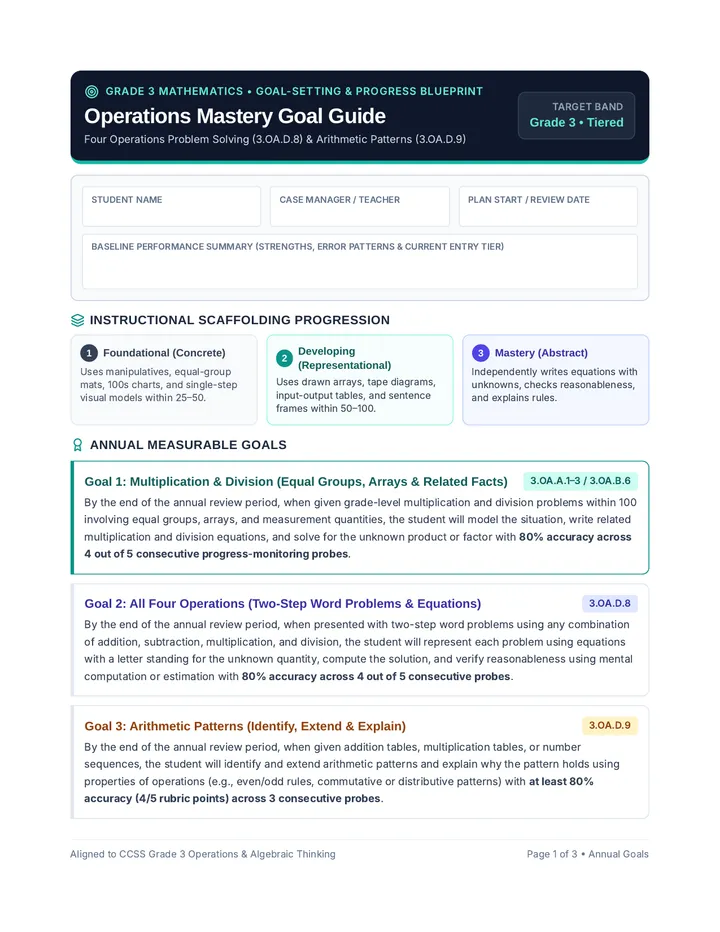
Grade 3 · Operations & Algebraic Thinking
Scaffolded OA Goals & Objectives
CRA Progression
Concrete → Representational → Abstract
Student: ______________________
Teacher: ______________________
Start Date: ____________________
Goal 1: Multiplication Concepts
CCSS 3.OA.A.1, 3.OA.A.3, 3.OA.A.4
Measurable Annual Goal
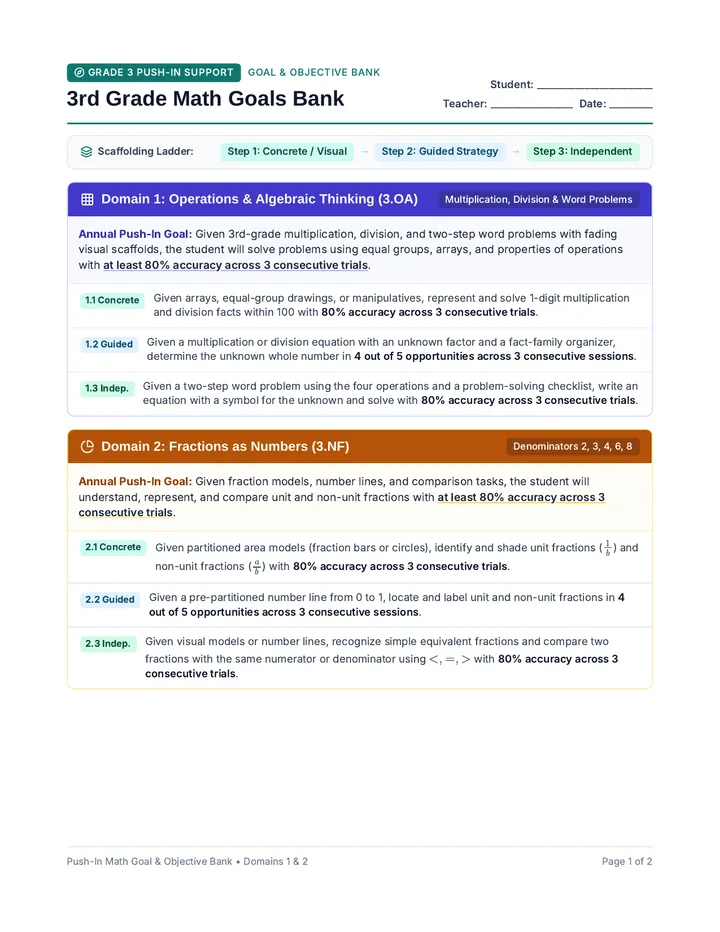
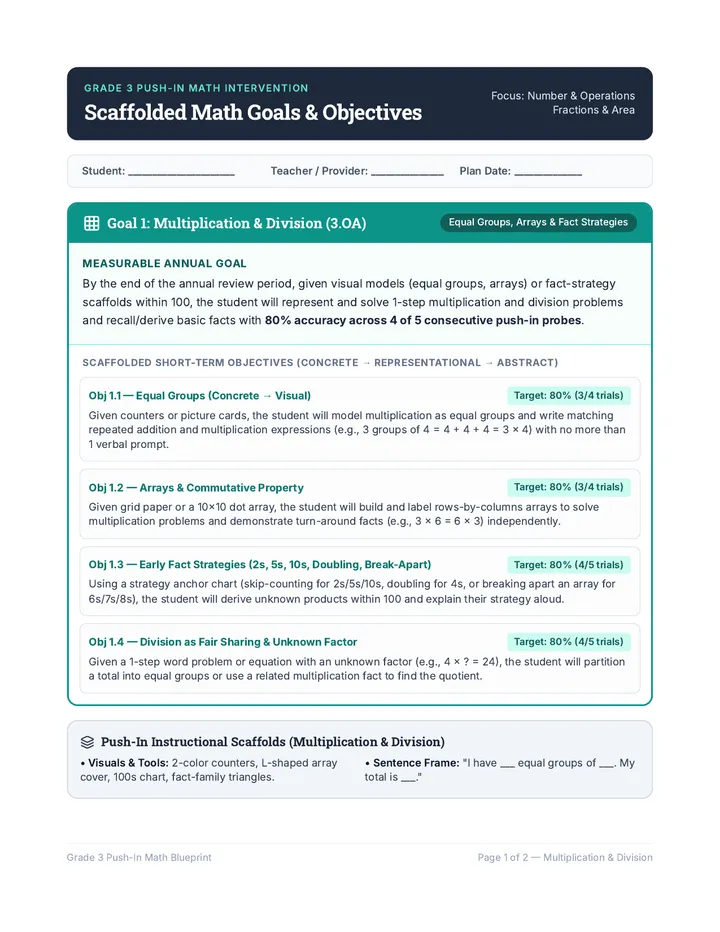
By the end of the annual instructional cycle, given single-digit multiplication problems within 100 (products up to 10 × 10) and access to visual models as needed, the student will represent equal groups and arrays, write matching multiplication equations (including unknown-factor equations), and solve with 85% accuracy across 3 consecutive progress-monitoring probes.
Scaffolded Short-Term Objectives
1.1
Concrete · Equal Groups Construction
Given counters or linking cubes and verbal prompts (e.g., "4 groups of 3"), the student will build equal-group models and state the total using skip counting or repeated addition with 80% accuracy across 3 consecutive trials.
1.2
Representational · Arrays & Area Models
Given a multiplication expression or word context within 50, the student will draw a neat row-and-column array (labeling rows and columns) and determine the product with 80% accuracy across 3 consecutive probes.
1.3
Abstract · Equations & Unknown Factors
Given an equal-group or array diagram, the student will write the corresponding multiplication equation (\(a \times b = c\)) and solve for an unknown factor (e.g., \(6 \times \square = 42\)) with 85% accuracy across 3 consecutive probes.
1.4
Fluency & Application · Products Within 100
Given mixed single-digit multiplication problems within 100 without manipulatives, the student will compute products accurately using efficient mental strategies (doubling, known facts, skip counting) with 85% accuracy across 3 consecutive probes.
Instructional Scaffolds & Supports
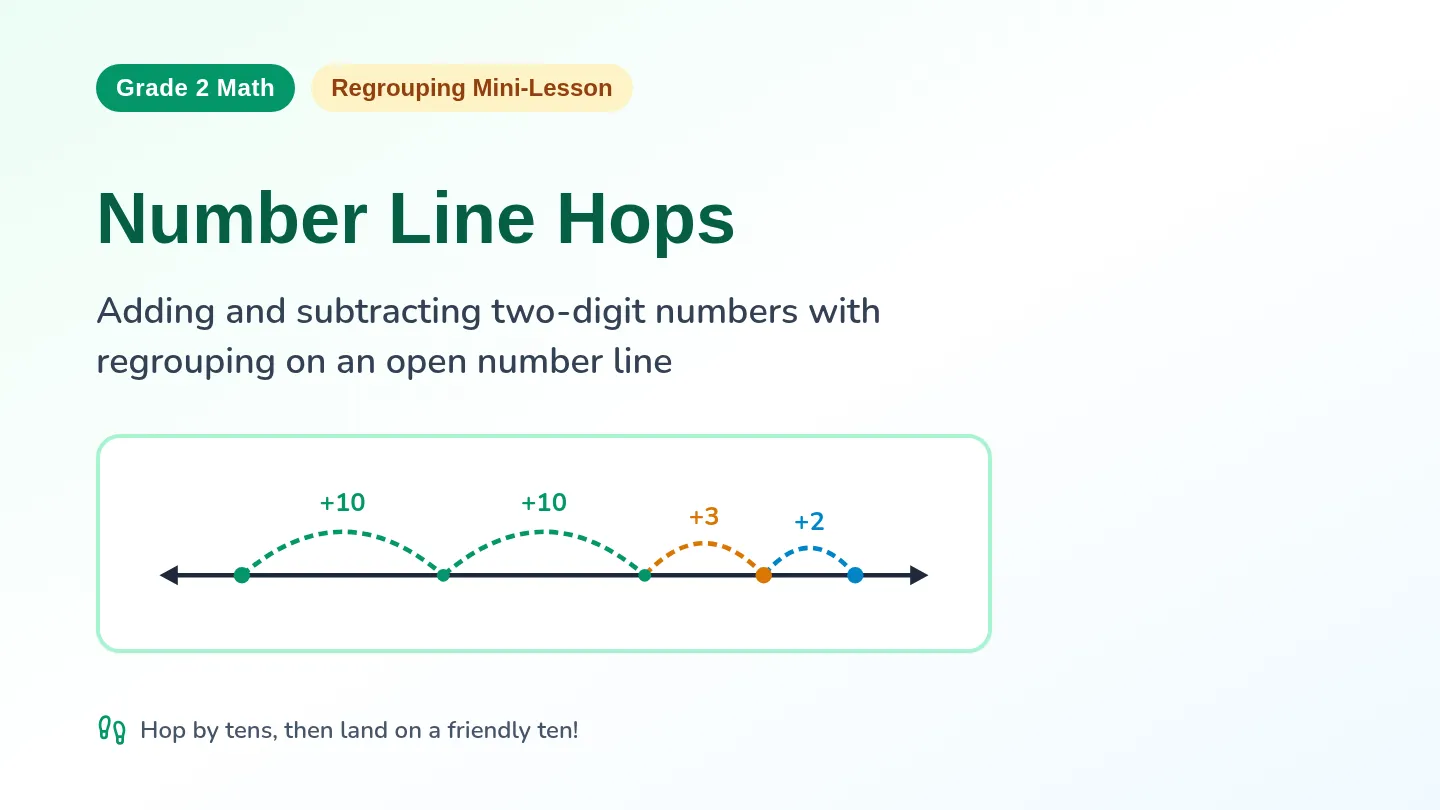
Pair "___ groups of ___" language frames with \( \times \) notation. Use grid paper for arrays to prevent misaligned rows. Transition from count-all to skip-counting jumps on a number line before timed or independent fact practice.
Goal 2: Division Concepts
CCSS 3.OA.A.2, 3.OA.B.6, 3.OA.C.7
Measurable Annual Goal
By the end of the annual instructional cycle, given whole-number division problems with dividends up to 100, the student will interpret division as both fair sharing (partitive) and equal grouping (measurement), relate division to unknown-factor multiplication, and compute quotients with 85% accuracy across 3 consecutive progress-monitoring probes.
Scaffolded Short-Term Objectives
2.1
Concrete · Fair Sharing (Partitive Division)
Given a set of up to 36 manipulatives and a specified number of groups, the student will deal items equally into containers/mats to find the size of each group and state the result with 80% accuracy across 3 consecutive trials.
2.2
Representational · Equal Grouping (Measurement Division)
Given a total and a group size within 50, the student will draw equal groups or repeated-subtraction jumps on a number line to determine how many groups can be formed with 80% accuracy across 3 consecutive probes.
2.3
Abstract · Inverse Relationship & Fact Families
Given a division equation (e.g., \(32 \div 4 = \square\)), the student will rewrite it as a related unknown-factor multiplication equation (\(4 \times \square = 32\)) and solve for the quotient with 85% accuracy across 3 consecutive probes.
2.4
Fluency & Application · Division Within 100
Given mixed division equations within 100 (divisors 1–10) without manipulatives, the student will compute quotients accurately and verify answers using multiplication with 85% accuracy across 3 consecutive probes.
Sharing vs. Grouping Frames
Explicitly contrast "How many in each group?" (sharing) with "How many groups can I make?" (grouping) using color-coded sorting mats.
Fact-Family Bridge
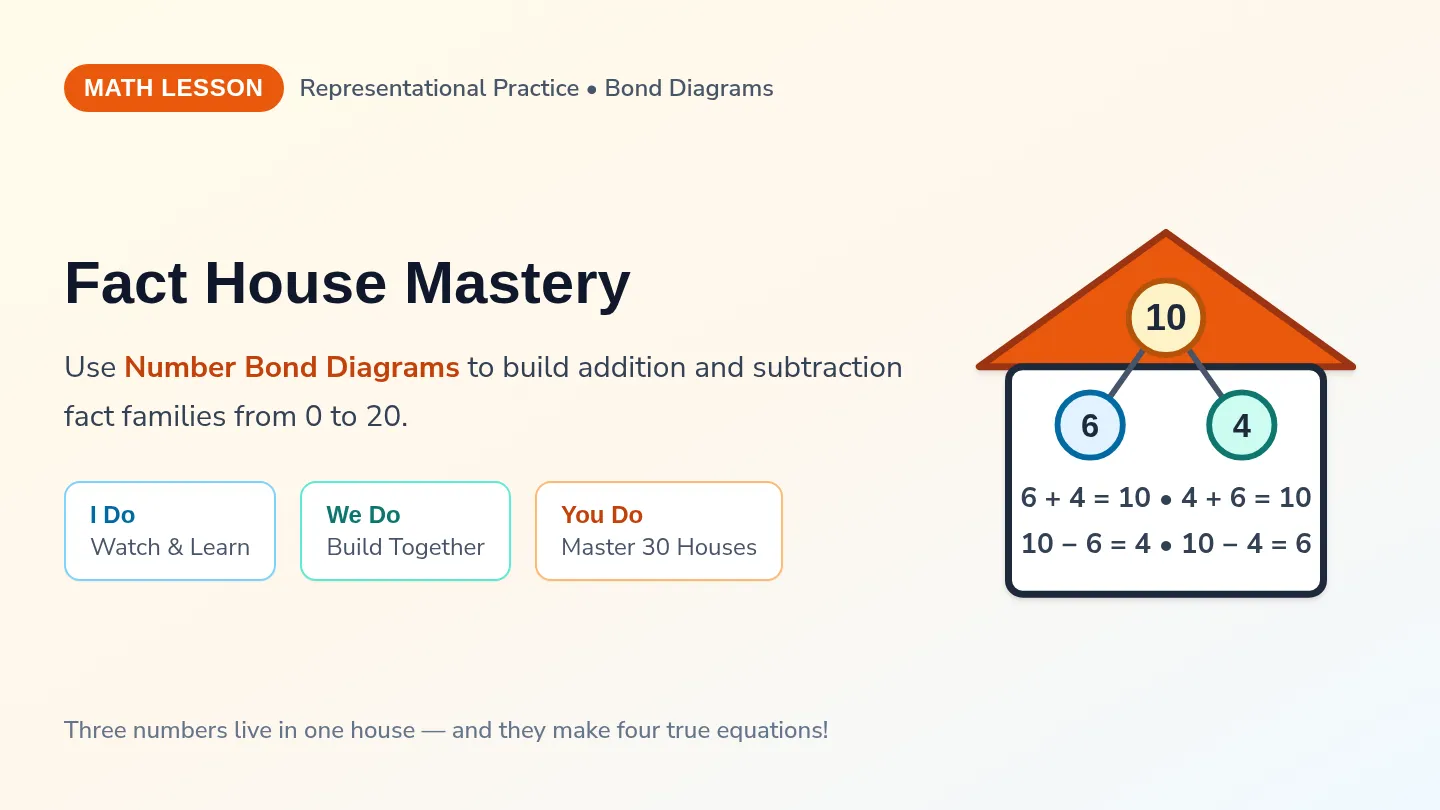
Use number-bond triangles (Total at top, Factors at base) so students see \(a \times b = c\) and \(c \div a = b\) as two views of one relationship.
Goal 3: One- & Two-Step Problem Solving
CCSS 3.OA.A.3, 3.OA.D.8
Measurable Annual Goal
By the end of the annual instructional cycle, given grade-level one- and two-step word problems involving the four operations (+, −, ×, ÷), the student will represent the problem with a visual model and equation using a letter for the unknown quantity, compute the solution, and assess reasonableness with 80% accuracy across 3 consecutive progress-monitoring probes.
Scaffolded Short-Term Objectives
3.1
Concrete/Visual · Operation Selection in One-Step Problems
Given one-step word problems across all four operations and a tape-diagram (bar model) template, the student will identify knowns, unknowns, and the correct operation with 80% accuracy across 3 consecutive trials.
3.2
Representational · Equations With Unknown Variables
Given a one-step multiplication or division word problem, the student will write a matching equation using a letter (e.g., \(n\) or \(p\)) for the unknown in any position and solve with 80% accuracy across 3 consecutive probes.
3.3
Guided Abstract · Two-Step Problems (Scaffolded Graphic Organizer)
Given a two-step word problem and a two-part organizer ("Step 1: Find the hidden question" / "Step 2: Solve for the final answer"), the student will write two equations and compute the final answer with 80% accuracy across 3 consecutive probes.
3.4
Independent Mastery · Two-Step Problems & Reasonableness
Given mixed two-step word problems without a graphic organizer, the student will independently model, solve, label units, and verify reasonableness using estimation or rounding with 80% accuracy across 3 consecutive probes.
Problem-Solving Scaffolds
Teach students to read without numbers first ("Numberless Word Problems") to identify the action/relationship before calculating. Highlight "hidden question" cues in two-step problems and require a brief reasonableness check ("Does my answer make sense?").
Goal 4: Arithmetic Patterns & Properties
CCSS 3.OA.B.5, 3.OA.D.9
Measurable Annual Goal
By the end of the annual instructional cycle, given arithmetic patterns (addition/multiplication tables, input-output rules) and multi-factor or unfamiliar multiplication expressions, the student will identify and explain patterns using properties of operations (commutative, associative, distributive) to compute and justify solutions with 80% accuracy across 3 consecutive progress-monitoring probes.
Scaffolded Short-Term Objectives
4.1
Concrete/Visual · Commutative Property (Turn-Around Facts)
Given an array rotated 90° or a factor pair, the student will demonstrate and write equivalent multiplication equations (e.g., \(3 \times 7 = 7 \times 3\)) with 85% accuracy across 3 consecutive trials.
4.2
Representational · Distributive Property (Break-Apart Arrays)
Given an unfamiliar multiplication fact (e.g., \(8 \times 7\)) on grid paper, the student will split the array into two known facts (e.g., \((5 \times 7) + (3 \times 7)\)) and sum the partial products with 80% accuracy across 3 consecutive probes.
4.3
Abstract · Associative Property (Regrouping 3 Factors)
Given three-factor multiplication expressions (e.g., \(3 \times 5 \times 2\)), the student will use parentheses to group friendly factors first and compute the product with 80% accuracy across 3 consecutive probes.
4.4
Reasoning · Arithmetic Patterns & Justification
Given a highlighted row/column in an addition or multiplication table or an input-output pattern, the student will extend the pattern and explain the rule (e.g., even/odd, multiples of 5/9) with 80% accuracy across 3 consecutive probes.
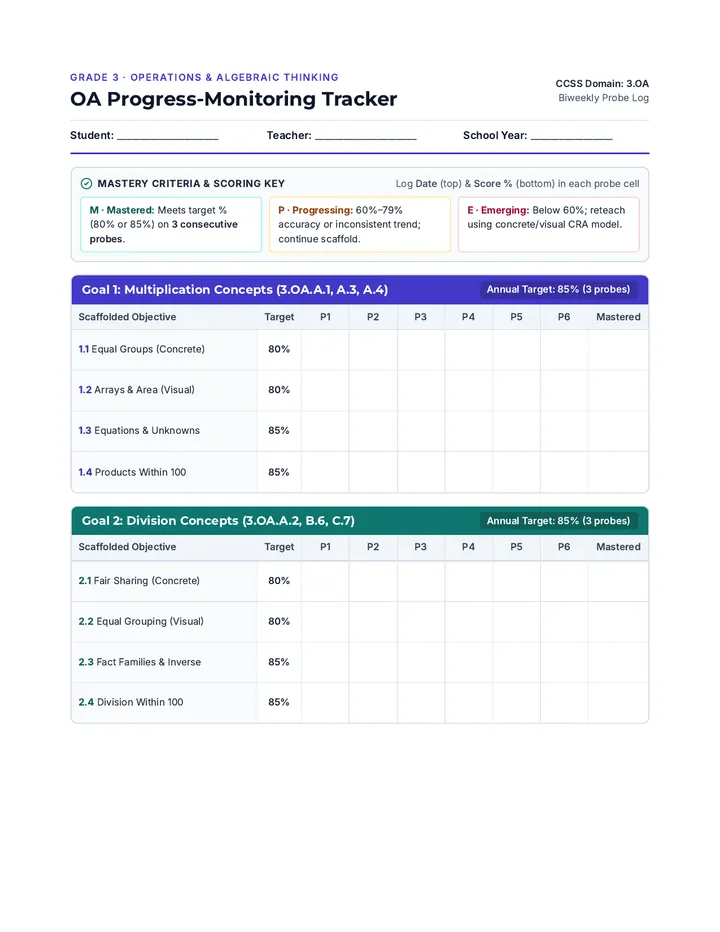
Domain Mastery & Progress-Monitoring Summary
Standard: 3 Consecutive Probes
| Goal Area |
CCSS Focus |
Annual Target |
Probe Cadence |
| 1. Multiplication Concepts |
3.OA.A.1, A.3, A.4 |
85% (3 probes) |
Biweekly (5–10 items) |
| 2. Division Concepts |
3.OA.A.2, B.6, C.7 |
85% (3 probes) |
Biweekly (5–10 items) |
| 3. Problem Solving |
3.OA.A.3, D.8 |
80% (3 probes) |
Biweekly (4–6 problems) |
| 4. Patterns & Properties |
3.OA.B.5, D.9 |
80% (3 probes) |
Biweekly (5–8 items) |