Operations Mastery Goal Guide
Grade 3 Mathematics • Goal-Setting & Progress Blueprint
Operations Mastery Goal Guide
Four Operations Problem Solving (3.OA.D.8) & Arithmetic Patterns (3.OA.D.9)
Target Band
Grade 3 • Tiered
Student Name
Case Manager / Teacher
Plan Start / Review Date
Baseline Performance Summary (Strengths, Error Patterns & Current Entry Tier)
Instructional Scaffolding Progression
1 Foundational (Concrete)
Uses manipulatives, equal-group mats, 100s charts, and single-step visual models within 25–50.
2 Developing (Representational)
Uses drawn arrays, tape diagrams, input-output tables, and sentence frames within 50–100.
3 Mastery (Abstract)
Independently writes equations with unknowns, checks reasonableness, and explains rules.
Annual Measurable Goals
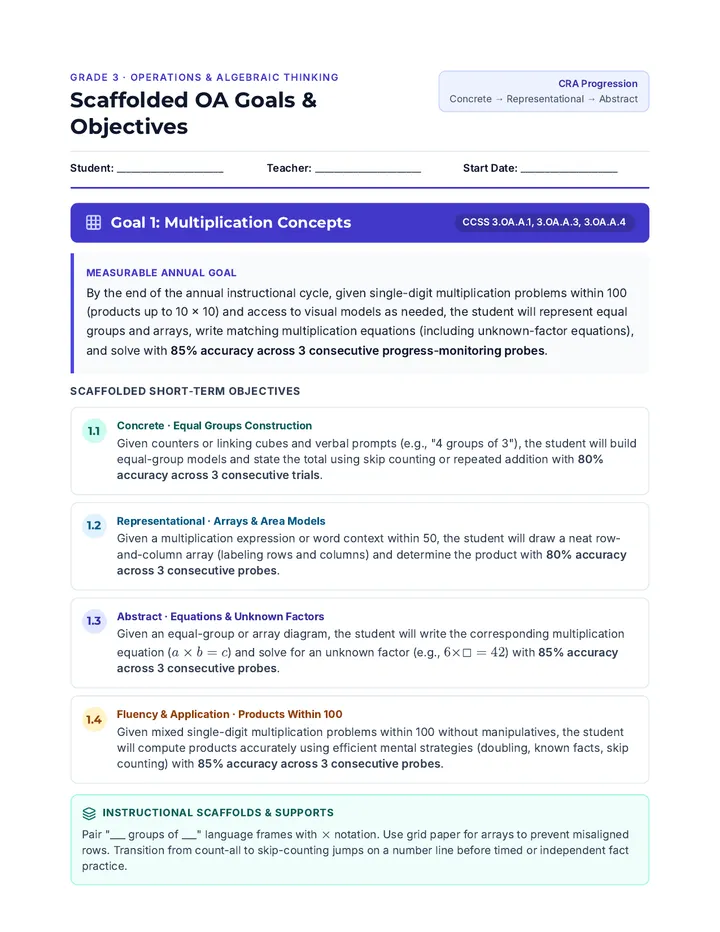
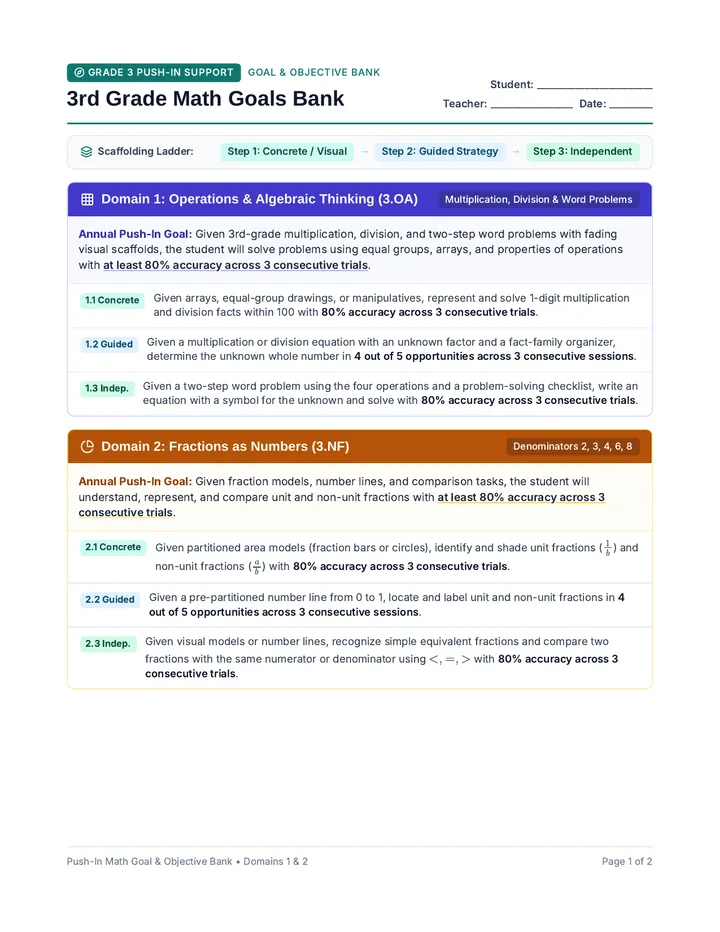
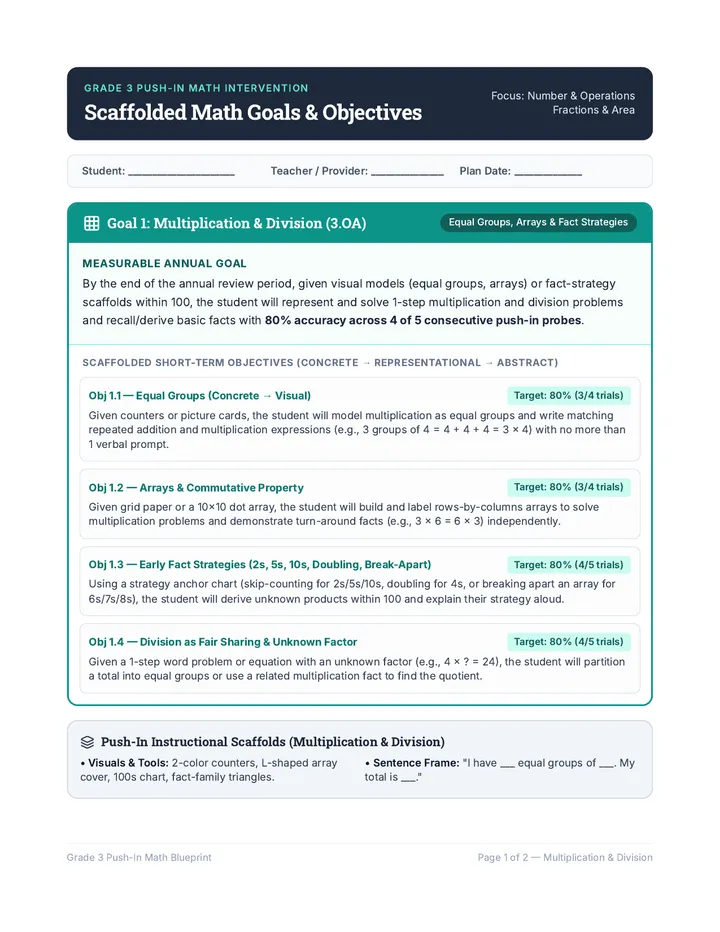
Goal 1: Multiplication & Division (Equal Groups, Arrays & Related Facts) 3.OA.A.1–3 / 3.OA.B.6
By the end of the annual review period, when given grade-level multiplication and division problems within 100 involving equal groups, arrays, and measurement quantities, the student will model the situation, write related multiplication and division equations, and solve for the unknown product or factor with 80% accuracy across 4 out of 5 consecutive progress-monitoring probes.
Goal 2: All Four Operations (Two-Step Word Problems & Equations) 3.OA.D.8
By the end of the annual review period, when presented with two-step word problems using any combination of addition, subtraction, multiplication, and division, the student will represent each problem using equations with a letter standing for the unknown quantity, compute the solution, and verify reasonableness using mental computation or estimation with 80% accuracy across 4 out of 5 consecutive probes.
Goal 3: Arithmetic Patterns (Identify, Extend & Explain) 3.OA.D.9
By the end of the annual review period, when given addition tables, multiplication tables, or number sequences, the student will identify and extend arithmetic patterns and explain why the pattern holds using properties of operations (e.g., even/odd rules, commutative or distributive patterns) with at least 80% accuracy (4/5 rubric points) across 3 consecutive probes.
Aligned to CCSS Grade 3 Operations & Algebraic Thinking Page 1 of 3 • Annual Goals
Scaffolded Measurable Objectives
Progressive benchmarks from concrete/visual supports to independent grade-level mastery
Benchmarks A • B • C
Track A: Multiplication & Division (Equal Groups & Arrays) Supports Goal 1
Obj A1 • Tier 1
Concrete Modeling: Using counters or equal-group mats, the student will build and solve 1-step multiplication and division problems within 25 with 80% accuracy across 3 consecutive probes.
Obj A2 • Tier 2
Arrays & Fact Families: Given a drawn array or graphic organizer, the student will write two multiplication and two related division equations within 50 with 80% accuracy across 3 consecutive probes.
Obj A3 • Tier 3
Unknown-Factor Mastery: Independently solve multiplication and division word problems within 100 (unknown product, group size, or number of groups) with 80% accuracy across 4 of 5 trials.
Track B: All Four Operations (Problem Solving & Equations) Supports Goal 2
Obj B1 • Tier 1
Operation Selection: Using an operation-action chart (+, −, ×, ÷), the student will select the correct operation and solve 1-step word problems within 50 with 80% accuracy across 3 consecutive probes.
Obj B2 • Tier 2
Two-Step Tape Diagrams: Using a tape diagram (bar model) template, the student will solve 2-step problems combining two operations and write an equation with a letter variable with 75% accuracy across 3 probes.
Obj B3 • Tier 3
Reasonableness & Independence: Independently solve 2-step word problems across all four operations, write matching equations with unknowns, and justify reasonableness via estimation with 80% accuracy across 4 of 5 trials.
Track C: Arithmetic Patterns (Identify, Extend & Explain) Supports Goal 3
Obj C1 • Tier 1
Identify & Extend: Using a highlighted 100s chart or multiplication table, the student will identify and extend skip-counting and constant-change patterns (+2, +5, +10, ×2, ×5) with 80% accuracy across 3 consecutive probes.
Obj C2 • Tier 2
Rule Statements: Given an input-output table or operation chart, the student will state the arithmetic rule using a structured sentence frame (e.g., "When the input increases by 1, the output...") with 80% accuracy across 3 probes.
Obj C3 • Tier 3
Property-Based Explanations: Independently explain why arithmetic patterns occur (e.g., even × odd = even, multiples of 4 are double multiples of 2) using operation properties, scoring 4/5 rubric points across 3 consecutive probes.
Move to next tier once student achieves ≥80% on 3 consecutive probes Page 2 of 3 • Scaffolded Objectives
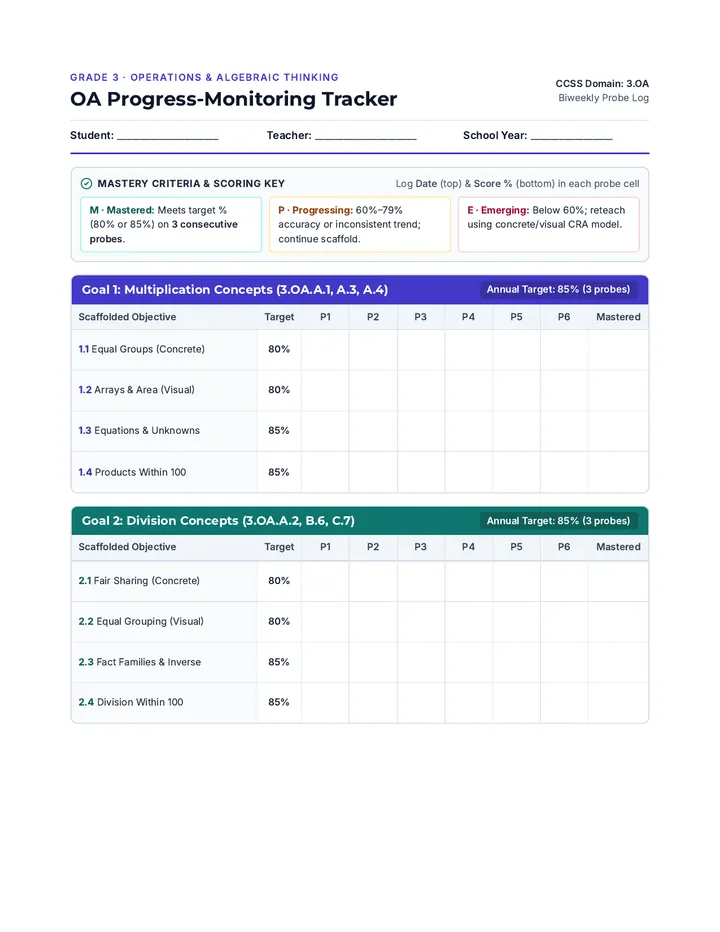
Progress-Monitoring Criteria & Data Log
Standardized probe schedule, decision rules, and handwritten tracking record
Biweekly Probes
Schedule & Format
Administer a 5-item CBM probe every 2 weeks (4 computation/word problems + 1 pattern explanation).
Mastery Criterion
≥80% (4/5) on 3 consecutive probes at the current tier advances the student to the next objective.
Intervention Trigger
<60% (≤2/5) on 2 consecutive probes triggers a step-down to concrete/visual scaffolds & error analysis.
Student Progress Data Log
Support Key: C = Concrete • R = Representational • A = Abstract
| Date |
Objective |
Score (/5) |
Support |
Error Pattern / Next Instructional Step |
|
|
|
|
|
|
|
|
|
|
|
|
|
|
|
|
|
|
|
|
|
|
|
|
|
|
|
|
|
|
|
|
|
|
|
|
|
|
|
|
Quick-Reference Scaffolding Toolkit
Multiplication & Division
- Color-coded rows/columns on grid paper
- Fact-family triangle cards
- Think-multiplication prompts for division
All Four Operations
- Part-part-whole & comparison bar models
- Step 1 / Step 2 graphic organizer boxes
- Estimation check ("Does it make sense?")
Arithmetic Patterns
- Highlighted multiplication & 100s charts
- "I notice..., because..." sentence stems
- Even/odd & doubling visual proofs
Grade 3 Operations Mastery • Progress Monitoring Record Page 3 of 3 • Data & Scaffolds