Fraction Equation Teacher Script 7th Grade Math • 15-Minute Scripted Lesson
Fraction Equation Sprint: Teacher Script
NC.7.EE.4
NC Standard (NC.7.EE.4)
Use variables to represent quantities in a real-world or mathematical problem, and construct simple equations and inequalities to solve problems by reasoning about the quantities (solving one-step equations \(x + p = q\) and \(px = q\) with rational fractions).
Learning Target
"I can solve one-step equations with fractions by using manipulative models and inverse operations."
Materials & Prep Checklist
Teacher Materials
☐ Document camera or whiteboard + markers
☐ Balance mat + mystery \(x\)-cup (or \(x\)-tile)
☐ Fraction tiles (\(\frac{1}{3}, \frac{1}{4}, \frac{1}{6}\) sets) & unit counters
☐ Classroom timer (for 3-min You Do & 2-min Exit Ticket)
Student / Pair Materials
☐ 1 set of fraction tiles/bars per pair
☐ Fraction Equation Practice Sheet (1 per student)
☐ Fraction Equation Exit Ticket slip (1 per student)
☐ Pencil (optional: mini whiteboard for We Do)
15-Minute Pacing Overview
Time
Phase
Focus & Student Action
0:00 – 2:00
Launch & Setup
Unpack Learning Target; connect balance scale concept to fraction bars.
2:00 – 6:00
I Do (Modeling)
Teacher models \(x + \frac{1}{4} = \frac{3}{4}\) and \(\frac{2}{3}x = 4\) with fraction bars & equations.
6:00 – 10:00
We Do (Guided)
Partner/class solve \(y - \frac{1}{3} = \frac{5}{6}\) and \(\frac{3}{4}m = 6\) using manipulatives & boards.
10:00 – 13:00
You Do (Independent)
Students complete 3 independent problems while teacher circulates.
13:00 – 15:00
Exit Ticket
2-problem mastery check + quick wrap-up.
Part 1: Launch & Balance Hook (Minutes 0:00 – 2:00)
2 Mins
[SAY]: "Eyes up front! Today we are tackling a 7th-grade power skill: solving one-step equations with fractions. Read our Learning Target with me on three—one, two, three: 'I can solve one-step equations with fractions by using manipulative models and inverse operations.' "
[DO]: Point to the physical balance mat (or draw a balance scale on the board) and hold up a mystery cup labeled \(x\) and a \(\frac{1}{4}\) fraction tile.
[SAY]: "Remember, an equal sign acts just like a balanced scale. Whatever sits on the left side has the exact same total value as the right side. Today, the numbers are fractions—and our rule doesn't change: to keep the scale balanced, whatever we do to one side, we must do to the exact other side. "
[ASK]: "Quick turn-and-talk, 15 seconds: If I have a mystery cup plus a \(\frac{1}{4}\) tile on the left, how do I get the mystery cup all by itself?"
Expected Student Response: "Take away the \(\frac{1}{4}\) tile from both sides!" • Teacher Follow-up: "Spot on! We undo addition with subtraction. Let's watch how that looks with our fraction tiles."
Part 2: I Do — Modeling with Manipulatives (Minutes 2:00 – 6:00)
4 Mins • Teacher Models
Model A (Additive): \(x + \frac{1}{4} = \frac{3}{4}\)
Manipulative: Balance Mat + Fraction Tiles
Board / Document Camera Visual
Left Side
\(x\)
\(\frac{1}{4}\)
Remove \(\frac{1}{4}\)
=
Right Side
\(\frac{1}{4}\)
\(\frac{1}{4}\)
\(\frac{1}{4}\)
Remove \(\frac{1}{4}\) → \(\frac{2}{4} = \frac{1}{2}\) left!
[SAY]: "Watch my hands first—pencils down. On the left side of my mat, I place one \(x\)-tile and one \(\frac{1}{4}\)-tile. On the right side, I place three \(\frac{1}{4}\)-tiles to show \(\frac{3}{4}\). My goal is to isolate \(x\)—get it completely alone."
[DO]: Physically slide one \(\frac{1}{4}\)-tile off the left side, then immediately slide one \(\frac{1}{4}\)-tile off the right side.
[SAY]: "Because I subtracted \(\frac{1}{4}\) from the left, I must subtract \(\frac{1}{4}\) from the right to stay balanced. Look at what's left: \(x\) equals two \(\frac{1}{4}\)-tiles, which is \(\frac{2}{4}\). And we always simplify: \(\frac{2}{4}\) simplifies to \(\frac{1}{2}\). Let's check mentally: \(\frac{1}{2} + \frac{1}{4} = \frac{3}{4}\). True!"
Model B (Multiplicative): \(\frac{2}{3}x = 4\)
Manipulative: Fraction Bar + Unit Counters
Part-Whole Bar Model Visual
1 Whole \(x\)-bar split into thirds:
\(\frac{1}{3}x = 2\)
\(\frac{1}{3}x = 2\)
\(\frac{1}{3}x = 2\)
← Shaded \(\frac{2}{3}x = 4\) counters → Whole \(x = 6\)
Algebraic Step:
\(\frac{3}{2} \cdot \frac{2}{3}x = 4 \cdot \frac{3}{2}\)
\(x = \frac{12}{2} = 6\)
[SAY]: "Now watch what happens when a fraction is multiplying \(x\): \(\frac{2}{3}x = 4\). This says two-thirds of my mystery bar equals 4 counters. I draw a bar split into 3 equal thirds, and I shade 2 of those thirds."
[DO]: Place 4 unit counters evenly across the 2 shaded thirds (2 counters in each third).
[SAY]: "If 2 equal parts hold 4 counters total, how many counters go in each third? Two! And since every third is equal, the unshaded third must also hold 2 counters. So the whole \(x\)-bar equals \(2 + 2 + 2 = 6\)! Algebraically, we just divided by 2 and multiplied by 3—which is the exact same thing as multiplying both sides by the reciprocal \(\frac{3}{2}\) ."
Part 3: We Do — Guided Practice Script (Minutes 6:00 – 10:00)
4 Mins • Guided Together
Setup: Students have their Fraction Equation Practice Sheet and fraction tiles/bars in pairs. Teacher works on the board while prompting choral responses and partner checks.
Guided Problem 1: \(y - \frac{1}{3} = \frac{5}{6}\)
Focus: Inverse of Subtraction + Common Denominator
[SAY]: "Let's try Problem 1 on your sheet together. Read it aloud: \(y - \frac{1}{3} = \frac{5}{6}\). First question—what operation is happening to \(y\)?" (Pause for choral response: "Subtraction!") "Yes! So what is the inverse operation that undoes subtracting \(\frac{1}{3}\)?" (Choral: "Add \(\frac{1}{3}\)!")
[DO]: Write \(+\frac{1}{3}\) under both sides on the board. Have pairs place \(\frac{5}{6}\)-tiles and a \(\frac{1}{3}\)-tile side-by-side.
[SAY]: "On the left, \(-\frac{1}{3} + \frac{1}{3}\) cancels to zero, leaving \(y\) alone. On the right, we have \(\frac{5}{6} + \frac{1}{3}\). Hold up your \(\frac{1}{3}\) tile next to your \(\frac{1}{6}\) tiles. How many sixths fit inside \(\frac{1}{3}\)?" (Call on a student: "Two sixths!")
[SAY]: "Write \(\frac{5}{6} + \frac{2}{6}\) on your paper. Add the numerators: \(5 + 2 = 7\), keep the denominator 6. So \(y = \frac{7}{6}\), or \(1\frac{1}{6}\). Give me a thumbs up if your tiles match \(1\frac{1}{6}\)!"
Common Misconception Alert: Watch for students adding denominators (\(\frac{5}{6} + \frac{1}{3} = \frac{6}{9}\)). Redirect immediately using the fraction tiles: "Can sixths and thirds be added without trading for matching tile sizes?"
Guided Problem 2: \(\frac{3}{4}m = 6\)
Focus: Bar Model + Reciprocal
[SAY]: "Look at Guided Problem 2: \(\frac{3}{4}m = 6\). With your partner, draw a bar model in the box on your sheet. How many total equal parts should we split our \(m\)-bar into?" (Wait 5 sec; choral: "4 parts!") "And how many of those fourths equal 6?" (Choral: "3 parts!")
[DO]: Circulate for 20 seconds to check that pairs drew 4 boxes and shaded 3 of them to equal 6.
[SAY]: "If 3 shaded boxes equal 6, what goes inside each box? Whisper to your partner." (Wait 5 sec; call on a pair: "2!") "Yes, \(6 \div 3 = 2\). Fill in 2 in all four boxes. What is the value of the whole bar \(m\)?" (Choral: "8!")
[SAY]: "Now write the algebraic shortcut right beside your bar model: multiply both sides by the reciprocal of \(\frac{3}{4}\), which is \(\frac{4}{3}\). Let's compute \(6 \cdot \frac{4}{3} = \frac{24}{3} = 8\). Both the model and the algebra give us \(m = 8\)!"
Check for Understanding: Ask: "Why did we multiply by \(\frac{4}{3}\) instead of \(\frac{3}{4}\)?" Listen for: "Because \(\frac{4}{3} \cdot \frac{3}{4} = 1\), which leaves \(1m\) by itself!"
Part 4 & 5: You Do & Exit Ticket Script (Minutes 10:00 – 15:00)
5 Mins Total
Part 4: You Do — Independent Practice (Minutes 10:00 – 13:00)
3 Mins
[SAY]: "Now it's your turn to show what you know. Complete the 3 Independent Practice problems at the bottom of your sheet silently. You may use your fraction tiles or draw a bar model if you get stuck. You have 3 minutes—go!"
[DO]: Set a 3-minute timer. Walk the room looking for: (1) common denominators on #1 and #2, and (2) flipping to the reciprocal \(\frac{5}{2}\) on #3. Quietly prompt struggling students: "What operation is attached to the variable? How do we undo it?"
[SAY]: (At 12:45) "Wrap up your last step in 15 seconds. Check that your fractions are simplified!"
Part 5: Exit Ticket & Wrap-Up (Minutes 13:00 – 15:00)
2 Mins
[SAY]: "Pencils up, eyes on me. Clear your desks except for a pencil and your Exit Ticket. You have 2 minutes to solve these two quick problems on your own so I can see how ready we are for tomorrow. Circle your confidence level at the bottom and turn it in to the basket on your way out!"
[DO]: Collect Exit Tickets at the door and sort into two piles using the worked key on Pages 5–6.
Quick Differentiation & Next-Step Sorting
Scaffold (Struggling Learners)
Keep fraction tiles on desks during You Do for concrete verification.
Provide a pre-drawn blank bar model for \(\frac{2}{5}k = 6\) so students focus on partitioning into 5ths.
Use color-coded highlighters to mark the inverse operation on both sides.
Extension (Early Finishers)
Challenge: Write a real-world word problem that matches \(\frac{2}{5}k = 6\).
Preview negative rational coefficients: \(-\frac{2}{3}x = 4\).
Exit Ticket 2/2 → Ready for mixed numbers & two-step equations tomorrow.
Full Worked-Out Teacher Key: See Pages 5–6 for step-by-step solutions and written explanations for every problem.
Teacher Worked Key: I Do & We Do Examples
Page 1 of 2
I Do — Model A: \(x + \frac{1}{4} = \frac{3}{4}\)
Answer: \(x = \frac{1}{2}\)
\(x + \frac{1}{4} = \frac{3}{4}\)
\(- \frac{1}{4} \quad - \frac{1}{4}\)
\(x = \frac{2}{4} = \frac{1}{2}\)
Check: \(\frac{1}{2} + \frac{1}{4} = \frac{2}{4} + \frac{1}{4} = \frac{3}{4}\) ✓
Written Explanation: Because \(\frac{1}{4}\) is added to \(x\), use the inverse operation (subtraction) to isolate \(x\). Subtract \(\frac{1}{4}\) from both sides to keep the equation balanced. Since the denominators are already the same (4), subtract the numerators: \(3 - 1 = 2\), giving \(\frac{2}{4}\). Simplify \(\frac{2}{4}\) by dividing numerator and denominator by 2 to get \(x = \frac{1}{2}\).
I Do — Model B: \(\frac{2}{3}x = 4\)
Answer: \(x = 6\)
\(\frac{2}{3}x = 4\)
\(\frac{3}{2} \cdot \frac{2}{3}x = 4 \cdot \frac{3}{2}\)
\(x = \frac{12}{2} = 6\)
Check: \(\frac{2}{3}(6) = \frac{12}{3} = 4\) ✓
Written Explanation: In the bar model, 2 out of 3 equal parts equal 4, so each \(\frac{1}{3}\) part equals \(4 \div 2 = 2\); all 3 parts together equal \(3 \times 2 = 6\). Algebraically, undo multiplying by \(\frac{2}{3}\) by multiplying both sides by its reciprocal, \(\frac{3}{2}\). Because \(\frac{3}{2} \cdot \frac{2}{3} = 1\), \(x\) is isolated, and \(4 \cdot \frac{3}{2} = \frac{12}{2} = 6\).
We Do — Problem 1: \(y - \frac{1}{3} = \frac{5}{6}\)
Answer: \(y = \frac{7}{6}\) or \(1\frac{1}{6}\)
\(y - \frac{1}{3} = \frac{5}{6}\)
\(+ \frac{1}{3} \quad + \frac{1}{3}\)
\(y = \frac{5}{6} + \frac{2}{6}\)
\(y = \frac{7}{6} = 1\frac{1}{6}\)
Check: \(\frac{7}{6} - \frac{2}{6} = \frac{5}{6}\) ✓
Written Explanation: Since \(\frac{1}{3}\) is subtracted from \(y\), add \(\frac{1}{3}\) to both sides. To add \(\frac{5}{6} + \frac{1}{3}\), convert \(\frac{1}{3}\) into an equivalent fraction with a common denominator of 6 by multiplying top and bottom by 2: \(\frac{1}{3} = \frac{2}{6}\). Add the numerators (\(5 + 2 = 7\)) over 6 to get \(\frac{7}{6}\), or \(1\frac{1}{6}\).
We Do — Problem 2: \(\frac{3}{4}m = 6\)
Answer: \(m = 8\)
\(\frac{3}{4}m = 6\)
\(\frac{4}{3} \cdot \frac{3}{4}m = 6 \cdot \frac{4}{3}\)
\(m = \frac{24}{3} = 8\)
Check: \(\frac{3}{4}(8) = \frac{24}{4} = 6\) ✓
Written Explanation: Using a bar model, split \(m\) into 4 equal fourths; 3 shaded fourths equal 6, so each fourth equals \(6 \div 3 = 2\), making the whole bar \(4 \times 2 = 8\). Algebraically, multiply both sides by the reciprocal \(\frac{4}{3}\) to isolate \(m\), giving \(6 \cdot \frac{4}{3} = \frac{24}{3} = 8\).
Teacher Worked Key: You Do & Exit Ticket
Page 2 of 2
You Do #1: \(x + \frac{2}{5} = \frac{4}{5}\)
Answer: \(x = \frac{2}{5}\)
\(x + \frac{2}{5} = \frac{4}{5}\)\(x = \frac{2}{5}\)
Written Explanation: Subtract \(\frac{2}{5}\) from both sides to undo addition. Because both fractions share a denominator of 5, subtract the numerators (\(4 - 2 = 2\)) to get \(x = \frac{2}{5}\). Check: \(\frac{2}{5} + \frac{2}{5} = \frac{4}{5}\).
You Do #2: \(a - \frac{1}{2} = \frac{3}{4}\)
Answer: \(a = \frac{5}{4}\) or \(1\frac{1}{4}\)
\(a - \frac{1}{2} = \frac{3}{4}\)\(\frac{5}{4}\)
Written Explanation: Add \(\frac{1}{2}\) to both sides to undo subtraction. Rewrite \(\frac{1}{2}\) with a common denominator of 4 as \(\frac{2}{4}\). Add \(\frac{3}{4} + \frac{2}{4} = \frac{5}{4}\) (or \(1\frac{1}{4}\)). Check: \(1\frac{1}{4} - \frac{2}{4} = \frac{3}{4}\).
You Do #3: \(\frac{2}{5}k = 6\)
Answer: \(k = 15\)
\(\frac{2}{5}k = 6\)\(k = \frac{30}{2} = 15\)
Written Explanation: Multiply both sides by the reciprocal of \(\frac{2}{5}\), which is \(\frac{5}{2}\). On the right, \(6 \cdot \frac{5}{2} = \frac{30}{2} = 15\). (Bar model check: 2 fifths = 6, so 1 fifth = 3, and 5 fifths = \(5 \times 3 = 15\).)
Exit Ticket #1: \(p + \frac{1}{3} = \frac{5}{6}\)
Answer: \(p = \frac{1}{2}\)
\(p + \frac{1}{3} = \frac{5}{6}\)\(\frac{1}{2}\)
Written Explanation: Subtract \(\frac{1}{3}\) from both sides. Convert \(\frac{1}{3}\) to \(\frac{2}{6}\) so both fractions have a denominator of 6. Subtract \(\frac{5}{6} - \frac{2}{6} = \frac{3}{6}\), then simplify by dividing by 3 to get \(p = \frac{1}{2}\).
Exit Ticket #2: \(\frac{3}{5}n = 9\)
Answer: \(n = 15\)
\(\frac{3}{5}n = 9\)\(n = \frac{45}{3} = 15\)
Written Explanation: Multiply both sides by the reciprocal \(\frac{5}{3}\) to undo multiplying by \(\frac{3}{5}\). Compute \(9 \cdot \frac{5}{3} = \frac{45}{3} = 15\). (Bar model check: 3 fifths equal 9, so each fifth equals \(9 \div 3 = 3\), and all 5 fifths equal \(5 \times 3 = 15\).)
Fraction Equation Warm Up Name:
Date:
2-Minute Warm-Up: Brain Starter
Complete both quick questions before we begin today's fraction equations.
2–3 Mins
1. Solve for \(x\) and keep the scale balanced:
\(x + 4 = 11\)
2. Find an equivalent fraction with denominator 6:
\(\frac{1}{3} = \frac{\square}{6}\)
Challenge Thought: How would you use Question 1's strategy if the \(4\) and \(11\) were fractions instead?
Cut Here
Name:
Date:
2-Minute Warm-Up: Brain Starter
Complete both quick questions before we begin today's fraction equations.
2–3 Mins
1. Solve for \(x\) and keep the scale balanced:
\(x + 4 = 11\)
2. Find an equivalent fraction with denominator 6:
\(\frac{1}{3} = \frac{\square}{6}\)
Challenge Thought: How would you use Question 1's strategy if the \(4\) and \(11\) were fractions instead?
Equation Balance Mat Hands-On Equation Workspace
Equation Balance Mat
Golden Rule: Keep Both Sides Equal!
Left Side
=
Right Side
Optional Cut-Out Tiles (Variables & Fractions)
Cut along dashed lines if physical tiles are unavailable
\(x\)
\(y\)
\(\frac{1}{4}\)
\(\frac{1}{4}\)
\(\frac{1}{4}\)
\(\frac{1}{3}\)
\(\frac{1}{6}\)
\(\frac{1}{6}\)
Variable Tiles Cutout Sheet Printable Manipulatives • Pair with Fraction Tiles
Variable Tiles Cutout Sheet
Cut Along Dashed Lines
Standard \(x\)-Tiles (20 Tiles)
Ink-friendly light fill • Sized for Equation Balance Mat
\(x\)
\(x\)
\(x\)
\(x\)
\(x\)
\(x\)
\(x\)
\(x\)
\(x\)
\(x\)
\(x\)
\(x\)
\(x\)
\(x\)
\(x\)
\(x\)
\(x\)
\(x\)
\(x\)
\(x\)
Additional Lesson Variable Tiles (8 Tiles)
Matches Practice Sheet & Exit Ticket variables
\(y\)
\(m\)
\(a\)
\(k\)
\(p\)
\(n\)
\(y\)
\(m\)
Solving with Models Guide Visual Anchor Chart & Worked Models
Solving Fraction Equations with Models
NC.7.EE.4
Model 1: Balance Mat & Fraction Tiles — \(y - \frac{1}{3} = \frac{5}{6}\)
Solution: \(y = \frac{7}{6} = 1\frac{1}{6}\)
Left Side (Add \(\frac{1}{3}\) to cancel \(-\frac{1}{3}\))
\(y\)
\(-\frac{1}{3}\)
\(+\frac{1}{3}\)
Zero pair cancels → \(y\) alone
=
Right Side (Trade \(\frac{1}{3}\) for two \(\frac{1}{6}\) tiles)
\(\frac{1}{6}\)
\(\frac{1}{6}\)
\(\frac{1}{6}\)
\(\frac{1}{6}\)
\(\frac{1}{6}\)
\(\frac{1}{6}\)
\(\frac{1}{6}\)
Total: seven \(\frac{1}{6}\)-tiles = \(\frac{7}{6} = 1\frac{1}{6}\)
Written Explanation: To isolate \(y\), add a \(+\frac{1}{3}\) tile to both sides of the balance mat. On the left, \(-\frac{1}{3}\) and \(+\frac{1}{3}\) form a zero pair and cancel out. On the right, we cannot combine \(\frac{1}{6}\)-tiles and a \(\frac{1}{3}\)-tile directly because their sizes differ, so we trade the \(\frac{1}{3}\)-tile for two equivalent \(\frac{1}{6}\)-tiles. Counting all tiles on the right gives \(\frac{5}{6} + \frac{2}{6} = \frac{7}{6}\), or \(1\frac{1}{6}\).
Model 2: Part-Whole Bar Model — \(\frac{3}{4}m = 6\)
Solution: \(m = 8\)
1 Whole \(m\)-bar partitioned into 4 equal fourths (3 shaded parts = 6):
\(\frac{1}{4}m = 2\)
\(\frac{1}{4}m = 2\)
\(\frac{1}{4}m = 2\)
\(\frac{1}{4}m = 2\)
← 3 shaded fourths = 6 total (\(6 \div 3 = 2\) each) → Whole \(m = 4 \times 2 = 8\)
Written Explanation: The denominator (4) tells us to split the whole \(m\)-bar into 4 equal parts. The numerator (3) tells us that 3 of those parts together equal 6. Divide 6 equally among the 3 shaded parts: \(6 \div 3 = 2\) in each part. Since all fourths are equal, the unshaded fourth also equals 2, so the whole bar is \(m = 4 \times 2 = 8\).
Model 3: Part-Whole Bar Model — \(\frac{2}{5}k = 6\)
Solution: \(k = 15\)
1 Whole \(k\)-bar partitioned into 5 equal fifths (2 shaded parts = 6):
\(\frac{1}{5}k = 3\)
\(\frac{1}{5}k = 3\)
\(\frac{1}{5}k = 3\)
\(\frac{1}{5}k = 3\)
\(\frac{1}{5}k = 3\)
← 2 shaded fifths = 6 (\(6 \div 2 = 3\) each) → Whole \(k = 5 \times 3 = 15\)
Written Explanation: Split the \(k\)-bar into 5 equal fifths. Shade 2 fifths to represent \(\frac{2}{5}k = 6\). Sharing 6 equally between 2 parts gives \(6 \div 2 = 3\) per fifth. Because every fifth has the same value of 3, all 5 fifths together equal \(5 \times 3 = 15\). This matches multiplying by the reciprocal: \(6 \cdot \frac{5}{2} = 15\).
Fraction Equation Practice Sheet Name:
Date:
Fraction Equation Practice
NC.7.EE.4
Learning Target: I can solve one-step equations with fractions by using manipulative models and inverse operations.
We Do Guided Practice
Solve together using fraction tiles or bar models.
1. Solve for \(y\):
\(y - \frac{1}{3} = \frac{5}{6}\)
2. Solve for \(m\) (draw a bar model + equation):
\(\frac{3}{4}m = 6\)
You Do Independent Practice
Show all steps. Simplify your final answers.
1. Solve for \(x\):
\(x + \frac{2}{5} = \frac{4}{5}\)
2. Solve for \(a\):
\(a - \frac{1}{2} = \frac{3}{4}\)
3. Solve for \(k\):
\(\frac{2}{5}k = 6\)
Fraction Equation Exit Ticket Name:
Date:
Exit Ticket: Fraction Equations
Target: I can solve one-step equations with fractions using models & inverse operations.
NC.7.EE.4
1. Solve for \(p\) (show your steps):
\(p + \frac{1}{3} = \frac{5}{6}\)
2. Solve for \(n\) (model or reciprocal):
\(\frac{3}{5}n = 9\)
How confident do you feel? (Circle one)
[ ] Got it! [ ] Almost there [ ] Need more practice
Cut Here
Name:
Date:
Exit Ticket: Fraction Equations
Target: I can solve one-step equations with fractions using models & inverse operations.
NC.7.EE.4
1. Solve for \(p\) (show your steps):
\(p + \frac{1}{3} = \frac{5}{6}\)
2. Solve for \(n\) (model or reciprocal):
\(\frac{3}{5}n = 9\)
How confident do you feel? (Circle one)
[ ] Got it! [ ] Almost there [ ] Need more practice
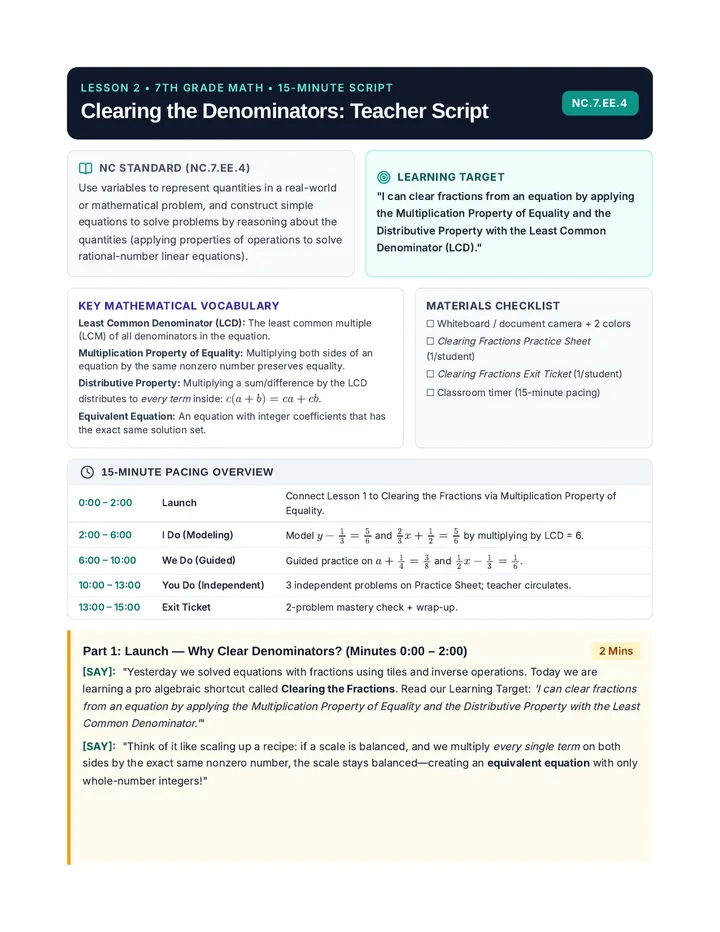
Clearing Fractions Teacher Script Lesson 2 • 7th Grade Math • 15-Minute Script
Clearing the Denominators: Teacher Script
NC.7.EE.4
NC Standard (NC.7.EE.4)
Use variables to represent quantities in a real-world or mathematical problem, and construct simple equations to solve problems by reasoning about the quantities (applying properties of operations to solve rational-number linear equations).
Learning Target
"I can clear fractions from an equation by applying the Multiplication Property of Equality and the Distributive Property with the Least Common Denominator (LCD)."
Key Mathematical Vocabulary
Least Common Denominator (LCD): The least common multiple (LCM) of all denominators in the equation.Multiplication Property of Equality: Multiplying both sides of an equation by the same nonzero number preserves equality.Distributive Property: Multiplying a sum/difference by the LCD distributes to every term inside: \(c(a + b) = ca + cb\).Equivalent Equation: An equation with integer coefficients that has the exact same solution set.
Materials Checklist
☐ Whiteboard / document camera + 2 colors
☐ Clearing Fractions Practice Sheet (1/student)
☐ Clearing Fractions Exit Ticket (1/student)
☐ Classroom timer (15-minute pacing)
15-Minute Pacing Overview
Part 1: Launch — Why Clear Denominators? (Minutes 0:00 – 2:00)
2 Mins
[SAY]: "Yesterday we solved equations with fractions using tiles and inverse operations. Today we are learning a pro algebraic shortcut called Clearing the Fractions . Read our Learning Target: 'I can clear fractions from an equation by applying the Multiplication Property of Equality and the Distributive Property with the Least Common Denominator.' "
[SAY]: "Think of it like scaling up a recipe: if a scale is balanced, and we multiply every single term on both sides by the exact same nonzero number, the scale stays balanced—creating an equivalent equation with only whole-number integers!"
Part 2: I Do — Modeling Clearing the Denominators (Minutes 2:00 – 6:00)
4 Mins • Teacher Models
Model A (One-Step): \(y - \frac{1}{3} = \frac{5}{6}\)
LCD of 3 and 6 is 6
\(y - \frac{1}{3} = \frac{5}{6}\)
\(6\left(y - \frac{1}{3}\right) = 6\left(\frac{5}{6}\right)\)
\(6(y) - 6\left(\frac{1}{3}\right) = 6\left(\frac{5}{6}\right)\)
\(6y - 2 = 5\)
\(6y = 7 \implies\) \(y = \frac{7}{6}\)
[SAY]: "Look at the denominators: 3 and 6. What is their Least Common Denominator? 6 . By the Multiplication Property of Equality , I multiply both sides by 6."
[SAY]: "Now apply the Distributive Property to every term —including the variable \(y\)! \(6 \cdot y = 6y\). \(6 \cdot \frac{1}{3} = 2\). \(6 \cdot \frac{5}{6} = 5\). Notice all fractions vanished! We now have \(6y - 2 = 5\), which gives \(6y = 7\), so \(y = \frac{7}{6}\)—the exact same answer we got yesterday!"
Model B (Two-Step Bridge): \(\frac{2}{3}x + \frac{1}{2} = \frac{5}{6}\)
LCD of 3, 2, and 6 is 6
\(\frac{2}{3}x + \frac{1}{2} = \frac{5}{6}\)
\(6\left(\frac{2}{3}x + \frac{1}{2}\right) = 6\left(\frac{5}{6}\right)\)
\(6\left(\frac{2}{3}x\right) + 6\left(\frac{1}{2}\right) = 6\left(\frac{5}{6}\right)\)
\(4x + 3 = 5\)
\(4x = 2 \implies\) \(x = \frac{2}{4} = \frac{1}{2}\)
[SAY]: "Here is why mathematicians love this method—look at \(\frac{2}{3}x + \frac{1}{2} = \frac{5}{6}\). The denominators are 3, 2, and 6, so the LCD is 6 ."
[DO]: Draw distribution arrows from 6 to all three terms.
[SAY]: "Distribute 6 to every term: \(6 \cdot \frac{2}{3}x = 4x\), \(6 \cdot \frac{1}{2} = 3\), and \(6 \cdot \frac{5}{6} = 5\). Our equivalent equation is \(4x + 3 = 5\). Subtract the constant term 3 from both sides to get \(4x = 2\), then divide by the coefficient 4: \(x = \frac{2}{4} = \frac{1}{2}\)."
Critical Misconception Alert: Students often multiply only the fraction terms by the LCD and forget to multiply integer terms or standalone variables (e.g., turning \(y - \frac{1}{3} = \frac{5}{6}\) into \(y - 2 = 5\)). Emphasize: "Every term inside the parentheses gets multiplied by the LCD—no term left behind!"
Parts 3–5: We Do, You Do & Exit Ticket Script (Minutes 6:00 – 15:00)
9 Mins Total
Part 3: We Do — Guided Practice (Minutes 6:00 – 10:00)
4 Mins
[SAY]: "Let's do Guided Problem 1 together: \(a + \frac{1}{4} = \frac{3}{8}\). Look at denominators 4 and 8. What is the Least Common Denominator?" (Choral: "8!") "Multiply every term on both sides by 8: \(8(a) + 8\left(\frac{1}{4}\right) = 8\left(\frac{3}{8}\right)\). What is our equivalent integer equation?" (Choral: "\(8a + 2 = 3\)!") "Subtract 2 from both sides: \(8a = 1\), divide by 8: \(a = \frac{1}{8}\)."
[SAY]: "Now Guided Problem 2: \(\frac{1}{2}x - \frac{1}{3} = \frac{1}{6}\). Denominators are 2, 3, and 6—what is the LCD?" (Choral: "6!") "Distribute 6 to all three terms with your partner: \(6\left(\frac{1}{2}x\right) - 6\left(\frac{1}{3}\right) = 6\left(\frac{1}{6}\right)\). That gives \(3x - 2 = 1\). Add 2: \(3x = 3\), so \(x = 1\)!"
Part 4: You Do — Independent Practice (Minutes 10:00 – 13:00)
3 Mins
[SAY]: "Complete the 3 Independent Practice problems silently. First write LCD = ___ in the box, then show the Multiplication Property of Equality and Distributive Property to clear every fraction before solving. You have 3 minutes—go!"
[DO]: Circulate and check that students multiply the integer \(2\) in Problem 2 (\(\frac{3}{4}k + \frac{1}{2} = 2\)) by the LCD of 4 to get \(8\).
Part 5: Exit Ticket & Wrap-Up (Minutes 13:00 – 15:00)
2 Mins
[SAY]: "Pencils up! Clear your desks for the 2-minute Exit Ticket. Show your LCD and your equivalent whole-number equation for both problems, then circle your confidence level on the way out."
Wrap-Up Summary: Multiplying both sides by the LCD uses the Multiplication Property of Equality + Distributive Property to transform rational equations into equivalent integer equations.
Teacher Worked Key: We Do, You Do & Exit Ticket
Lesson 2 Key
We Do #1: \(a + \frac{1}{4} = \frac{3}{8}\) (LCD = 8)\(a = \frac{1}{8}\)
Explanation: Multiply every term by LCD 8 via the Multiplication Property of Equality and Distributive Property to get \(8a + 2 = 3\), then use inverse operations.
We Do #2: \(\frac{1}{2}x - \frac{1}{3} = \frac{1}{6}\) (LCD = 6)\(x = 1\)
Explanation: Distribute LCD 6 to all three terms (\(6 \cdot \frac{1}{2}x = 3x\), \(6 \cdot \frac{1}{3} = 2\), \(6 \cdot \frac{1}{6} = 1\)) to form the equivalent equation \(3x - 2 = 1\), then solve.
You Do #1: \(m - \frac{2}{5} = \frac{3}{10}\) (LCD = 10)\(m = \frac{7}{10}\)
Explanation: Multiply every term by LCD 10 (\(10 \cdot m = 10m\), \(10 \cdot \frac{2}{5} = 4\), \(10 \cdot \frac{3}{10} = 3\)). Add 4 to both sides and divide by coefficient 10.
You Do #2: \(\frac{3}{4}k + \frac{1}{2} = 2\) (LCD = 4)\(k = 2\)
Explanation: Multiply all terms—including the constant \(2\)—by LCD 4 to obtain \(3k + 2 = 8\). Subtract 2 (\(3k = 6\)) and divide by 3 to get \(k = 2\).
You Do #3: \(\frac{2}{3}n - \frac{1}{6} = \frac{5}{6}\) (LCD = 6)\(n = \frac{3}{2}\)
Explanation: Multiply every term by LCD 6 to get \(4n - 1 = 5\). Add 1 (\(4n = 6\)), divide by 4, and simplify \(\frac{6}{4}\) to \(\frac{3}{2}\) (or \(1\frac{1}{2}\)).
Exit #1: \(x + \frac{1}{3} = \frac{3}{4}\) (LCD = 12)\(x = \frac{5}{12}\)
Explanation: The LCD of 3 and 4 is 12. Distribute 12 to every term (\(12x + 4 = 9\)), subtract 4 (\(12x = 5\)), and divide by 12 to get \(x = \frac{5}{12}\).
Exit #2: \(\frac{1}{2}p - \frac{1}{4} = \frac{3}{8}\) (LCD = 8)\(p = \frac{5}{4}\)
Explanation: Multiply all terms by LCD 8 to clear denominators (\(4p - 2 = 3\)). Add 2 (\(4p = 5\)) and divide by 4 to get \(p = \frac{5}{4}\) (or \(1\frac{1}{4}\)).
Clearing Fractions Warm Up Name:
Date:
2-Minute Warm-Up: LCM & Distributing
Complete all three quick prompts to warm up for Clearing the Denominators.
2–3 Mins
1. Find the LCM (LCD) of:
\(2, \; 3, \text{ and } 6\)
2. Distribute:
\(4(2x + 3)\)
3. Distribute:
\(6\left(\frac{2}{3}x + \frac{1}{2}\right)\)
Notice & Wonder: What happened to the fractions in Question 3 after you distributed the \(6\)?
Cut Here
Name:
Date:
2-Minute Warm-Up: LCM & Distributing
Complete all three quick prompts to warm up for Clearing the Denominators.
2–3 Mins
1. Find the LCM (LCD) of:
\(2, \; 3, \text{ and } 6\)
2. Distribute:
\(4(2x + 3)\)
3. Distribute:
\(6\left(\frac{2}{3}x + \frac{1}{2}\right)\)
Notice & Wonder: What happened to the fractions in Question 3 after you distributed the \(6\)?
Clearing Fractions Vocabulary Sheet Student Reference & Anchor Chart
Clearing the Denominators: Math Vocabulary
NC.7.EE.4
1
Least Common Denominator (LCD)
The Least Common Multiple (LCM) of all denominators in an equation. Multiplying by the LCD turns every fraction into a whole number.
Example: For \(x + \frac{1}{3} = \frac{3}{4}\), the denominators are \(3\) and \(4\), so LCD = \(12\) .
2
Multiplication Property of Equality
Multiplying both sides of an equation by the exact same nonzero number keeps the equation balanced and preserves equality.
Example: If \(y - \frac{1}{3} = \frac{5}{6}\), then \(6\left(y - \frac{1}{3}\right) = 6\left(\frac{5}{6}\right)\) .
3
Distributive Property
Multiplying a sum or difference by a number distributes to every term inside the parentheses: \(c(a + b) = ca + cb\).
Example: \(6\left(\frac{2}{3}x + \frac{1}{2}\right) = 6\left(\frac{2}{3}x\right) + 6\left(\frac{1}{2}\right) = \) \(4x + 3\) .
4
Equivalent Equation
Two equations that have the exact same solution . Clearing denominators creates a simpler equivalent equation using only integers.
Example: \(\frac{2}{3}x + \frac{1}{2} = \frac{5}{6}\) and \(4x + 3 = 5\) both have solution \(x = \frac{1}{2}\).
5
Coefficient & Constant Term
A coefficient is the number multiplying a variable. A constant term is a standalone number with no variable.
In \(4x + 3 = 5\): \(4\) is the coefficient of \(x\); \(3\) and \(5\) are constants .
6
Inverse Operations
Opposite operations that undo each other to isolate the variable once all denominators have been cleared.
Pairs: Addition (\(\leftrightarrow\)) Subtraction | Multiplication (\(\leftrightarrow\)) Division.
4-Step Strategy: ① Find LCD → ② Multiply Both Sides → ③ Distribute to Every Term → ④ Solve with Inverse Operations
Clearing Fractions Practice Sheet Name:
Date:
Clearing the Denominators Practice
NC.7.EE.4
Learning Target: I can clear fractions from an equation by applying the Multiplication Property of Equality and the Distributive Property with the Least Common Denominator (LCD) .
We Do Guided Practice
Identify the LCD, multiply every term, then solve.
1. Solve for \(a\): LCD = ______
\(a + \frac{1}{4} = \frac{3}{8}\)
2. Solve for \(x\): LCD = ______
\(\frac{1}{2}x - \frac{1}{3} = \frac{1}{6}\)
You Do Independent Practice
Show your LCD, equivalent integer equation, and final simplified answer.
1. Solve for \(m\):
LCD = ______
\(m - \frac{2}{5} = \frac{3}{10}\)
2. Solve for \(k\):
LCD = ______
\(\frac{3}{4}k + \frac{1}{2} = 2\)
3. Solve for \(n\):
LCD = ______
\(\frac{2}{3}n - \frac{1}{6} = \frac{5}{6}\)
Clearing Fractions Exit Ticket Name:
Date:
Exit Ticket: Clearing the Denominators
Target: I can clear fractions using the LCD and Multiplication Property of Equality.
NC.7.EE.4
1. Clear & solve for \(x\): LCD = ____
\(x + \frac{1}{3} = \frac{3}{4}\)
2. Clear & solve for \(p\): LCD = ____
\(\frac{1}{2}p - \frac{1}{4} = \frac{3}{8}\)
How confident do you feel? (Circle one)
[ ] Got it! [ ] Almost there [ ] Need more practice
Cut Here
Name:
Date:
Exit Ticket: Clearing the Denominators
Target: I can clear fractions using the LCD and Multiplication Property of Equality.
NC.7.EE.4
1. Clear & solve for \(x\): LCD = ____
\(x + \frac{1}{3} = \frac{3}{4}\)
2. Clear & solve for \(p\): LCD = ____
\(\frac{1}{2}p - \frac{1}{4} = \frac{3}{8}\)
How confident do you feel? (Circle one)
[ ] Got it! [ ] Almost there [ ] Need more practice