A warm-up worksheet for students to reflect on personal focus strategies and motivators.
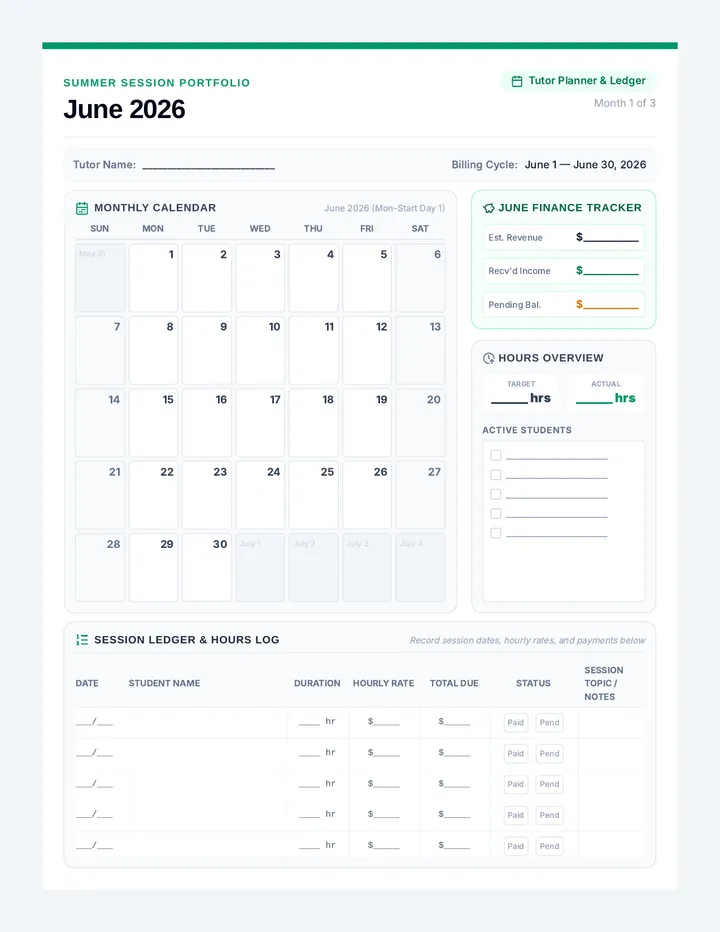
A premium, printable 4-page Tutor Session Log and Calendar Portfolio for June, July, and August 2026. Includes beautifully formatted monthly calendars (Sunday-Saturday) with generous handwriting space, integrated student trackers, monthly hours and income logs, and a master summer student directory with policy guides. Designed in a sophisticated Slate Blue and Emerald green theme with clean lines, icons, and structured tables.
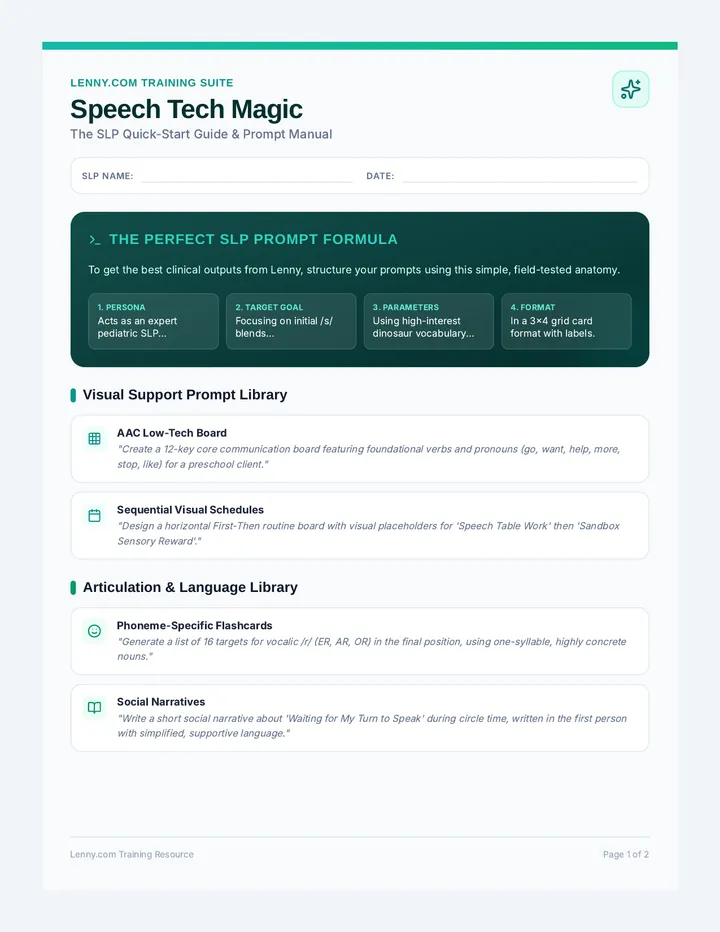
A comprehensive 2-page print-and-go reference handout and quick-start guide containing prompt formulas, sample templates, and design tips for SLPs using Lenny.com.
An interactive slide presentation introducing Speech-Language Pathologists to Lenny.com features, including visual supports, articulation materials, and IEP helpers.
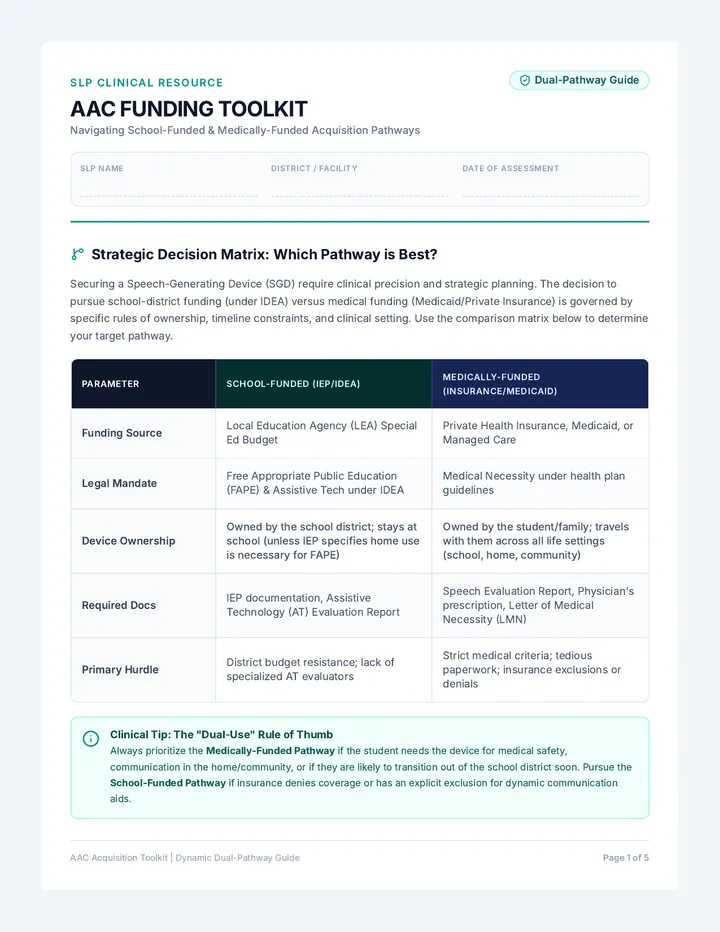
A 5-page print-ready clinical toolkit for SLPs navigating school-funded and medically-funded AAC acquisition. Includes comparison tables, step-by-step checklists, insurance phone scripts, IEP meeting scripts, letter templates, and a dynamic device trial data collection sheet.
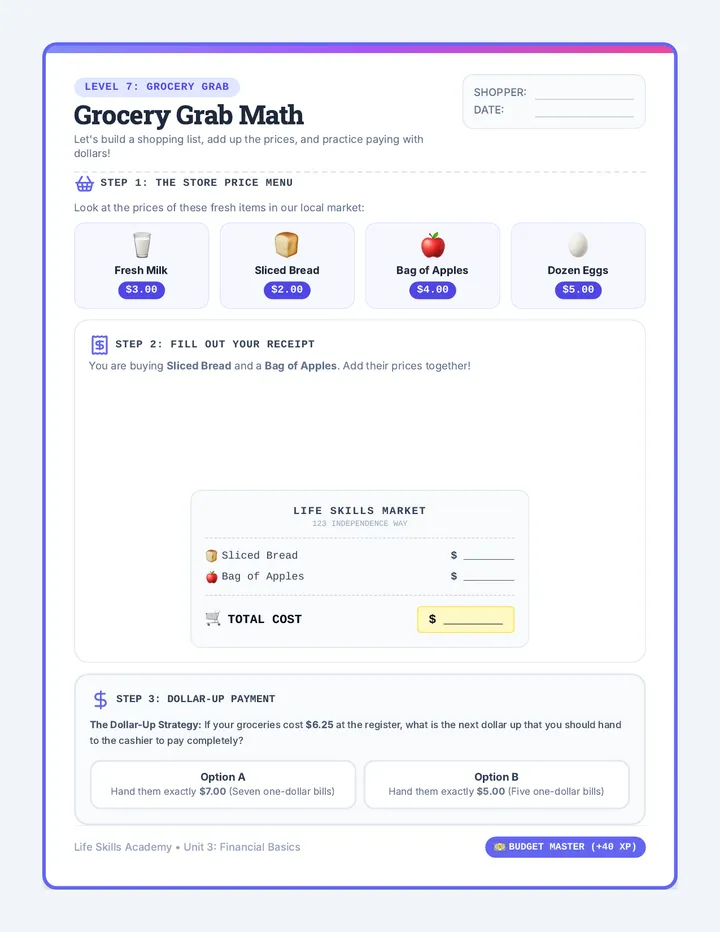
A functional math and budgeting worksheet designed for students with intellectual disabilities. Teaches grocery list creation, basic price addition, and the 'next dollar up' payment strategy.
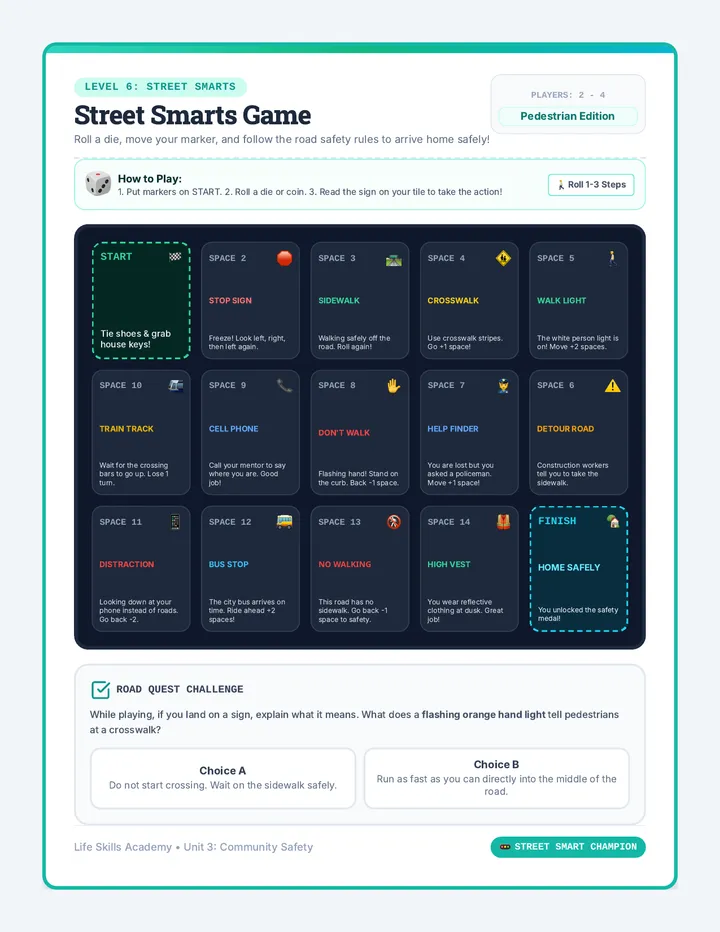
A printable, gamified pedestrian safety board game that teaches students with intellectual disabilities to read community safety signs, crosswalk signals, and find helpers.
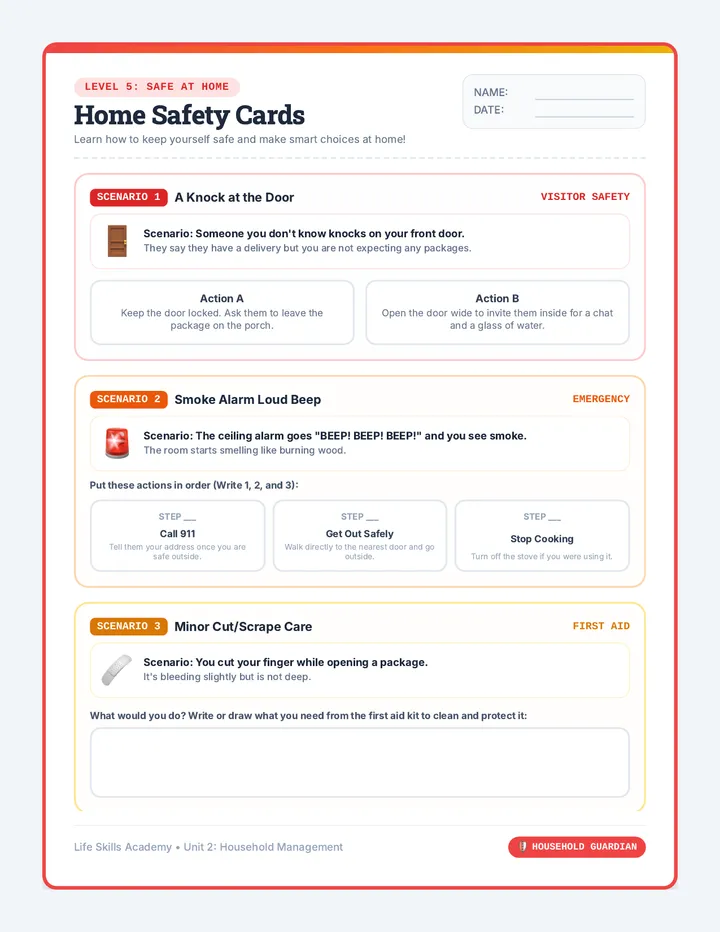
Differentiated safety scenario cards focused on key emergency responses for students with intellectual disabilities, covering strangers at the door, smoke alarms, and basic first aid.
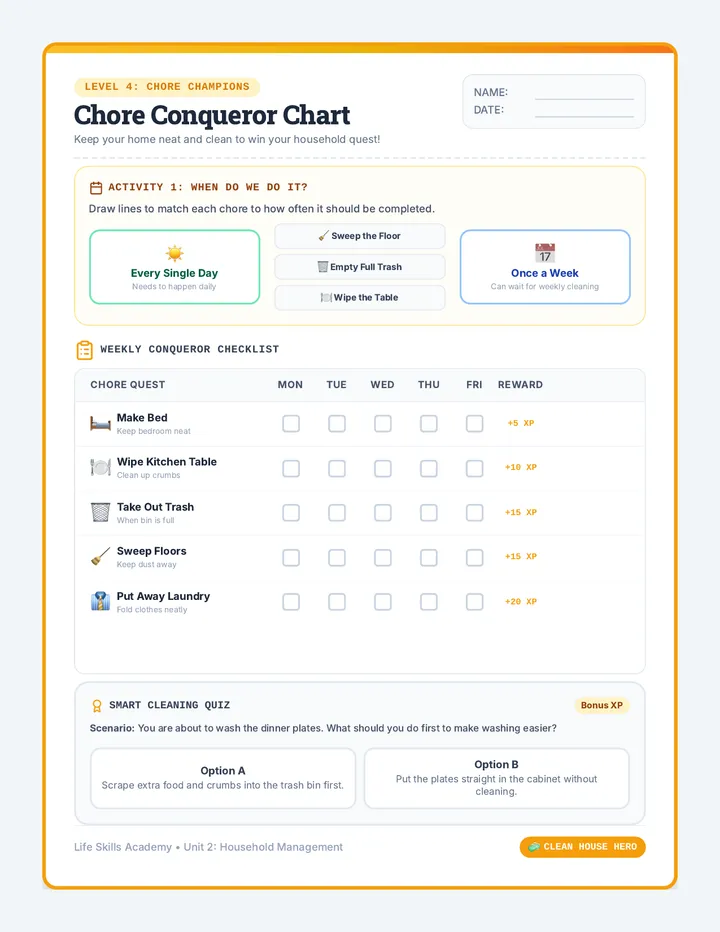
A daily and weekly household chore planner designed for students with intellectual disabilities. Features a visual frequency sorter and clear tracking checkboxes for essential housekeeping tasks.
An interactive slide deck for teaching kitchen safety, featuring bold visual scenarios and large, readable text designed for group discussion.
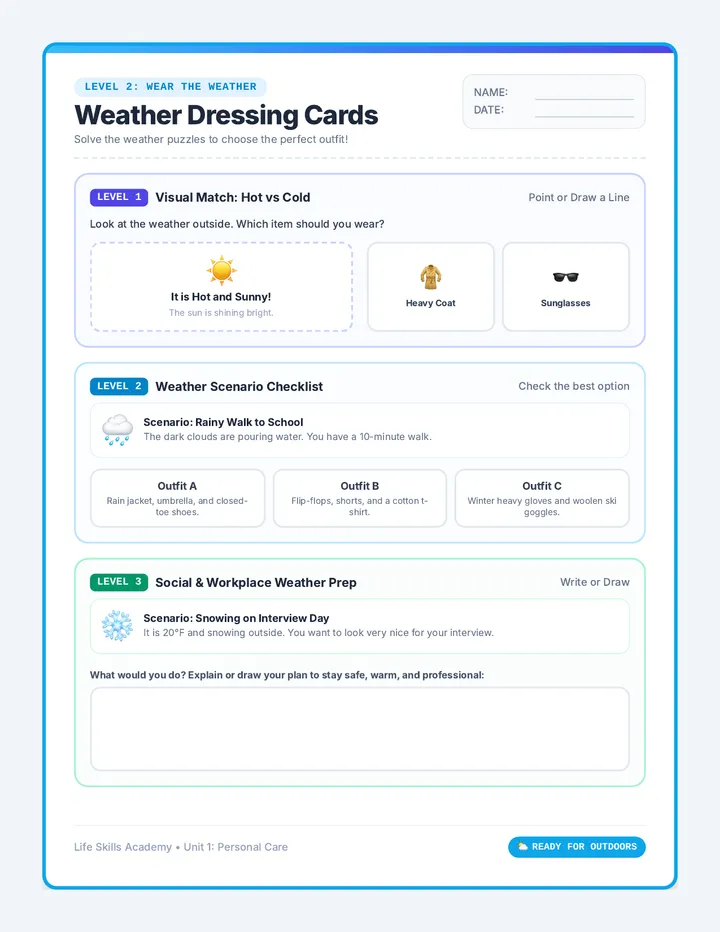
Differentiated weather dressing task cards featuring three levels of independence to help students with intellectual disabilities select appropriate clothing for various weather conditions and scenarios.
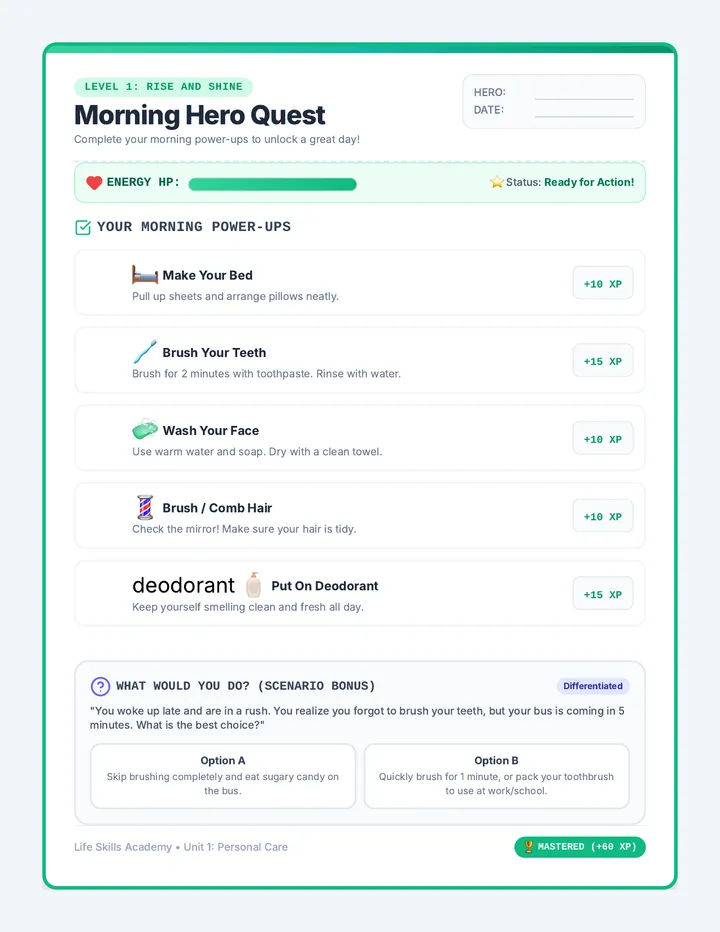
A gamified morning routine tracking sheet styled as a retro video game 'level-up' quest. Helps students with intellectual disabilities independently track personal hygiene and self-care steps with visual checklists and simple scenarios.
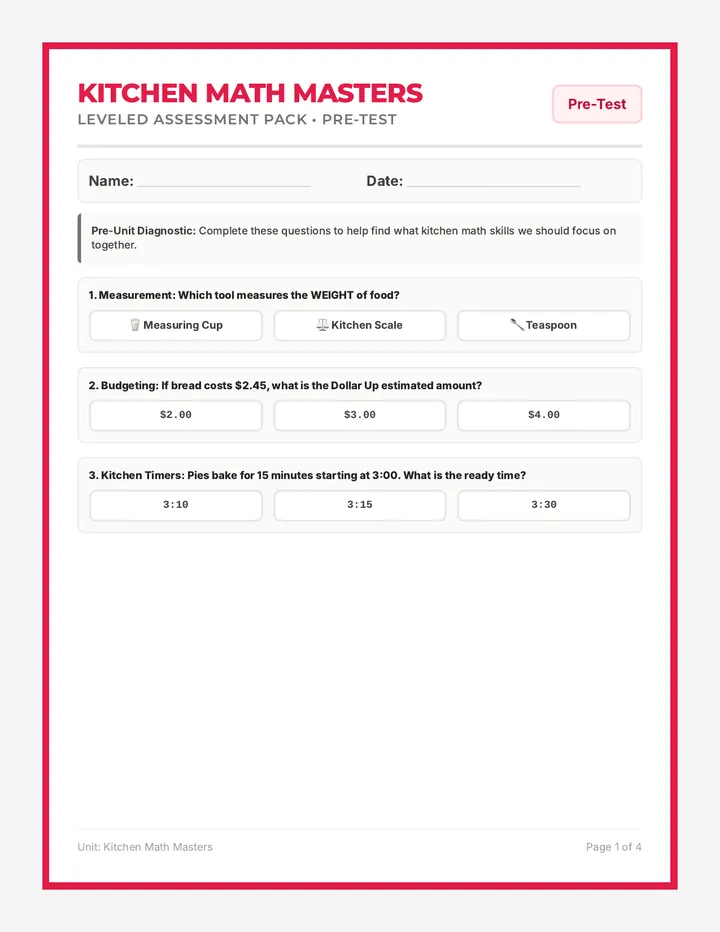
A 4-page functional math assessment packet containing a diagnostic pre-test, weekly checks, summative post-test, and a hands-on kitchen math rubrics/observational checklist.
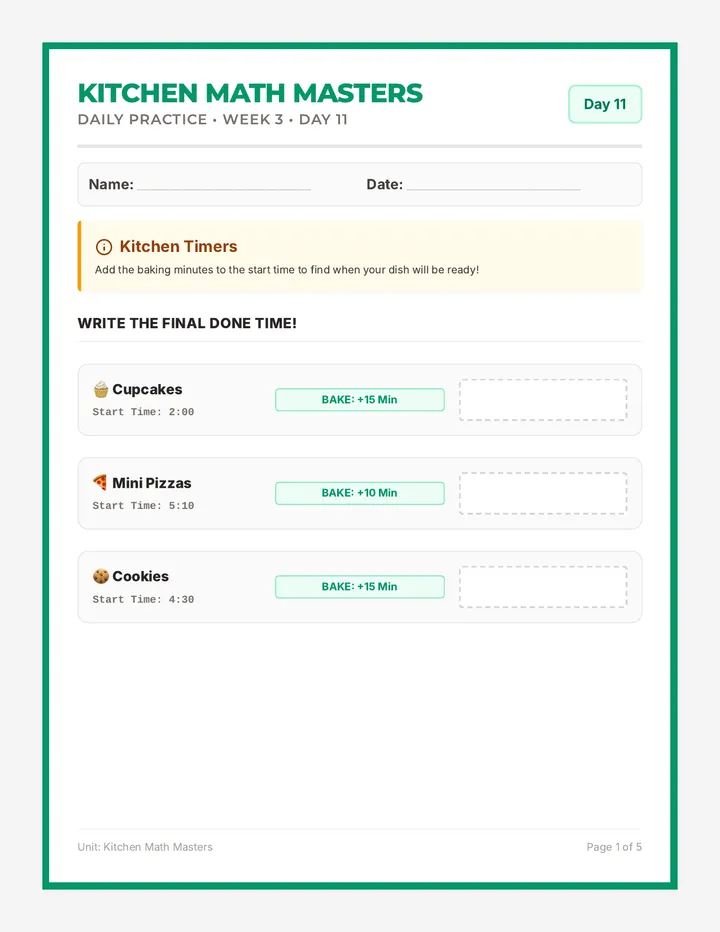
A 5-page student worksheet packet containing one dedicated, scaffolded daily practice page for Days 11 to 15. Topics include Kitchen Timers, Cooking Time Adjustments, Food Label Servings, Café Order Receipts, and Diner Operations.
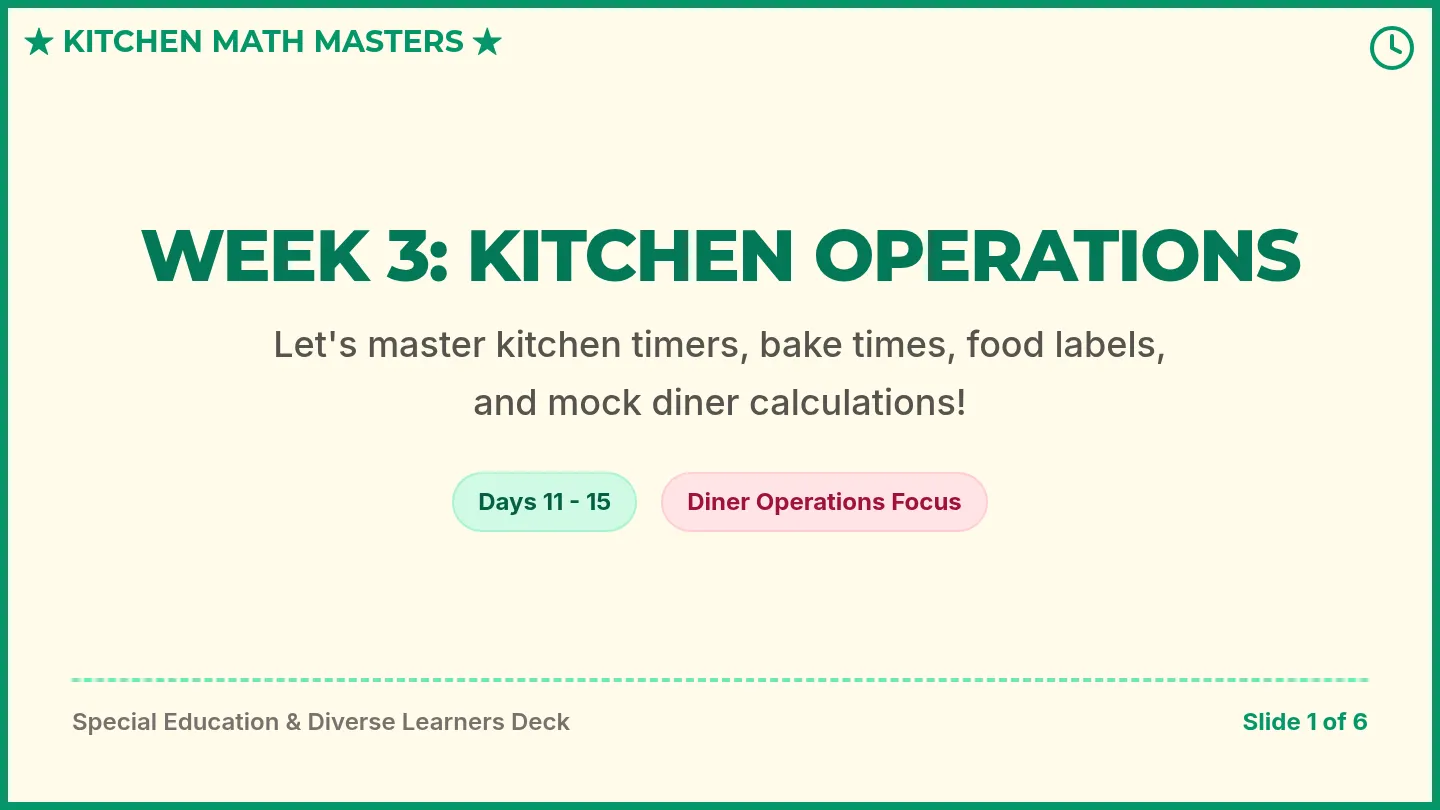
A visual presentation for Week 3 instruction. Focuses on digital timers, adding cooking minutes, reading serving labels, taking café order totals, and simulated kitchen operations.
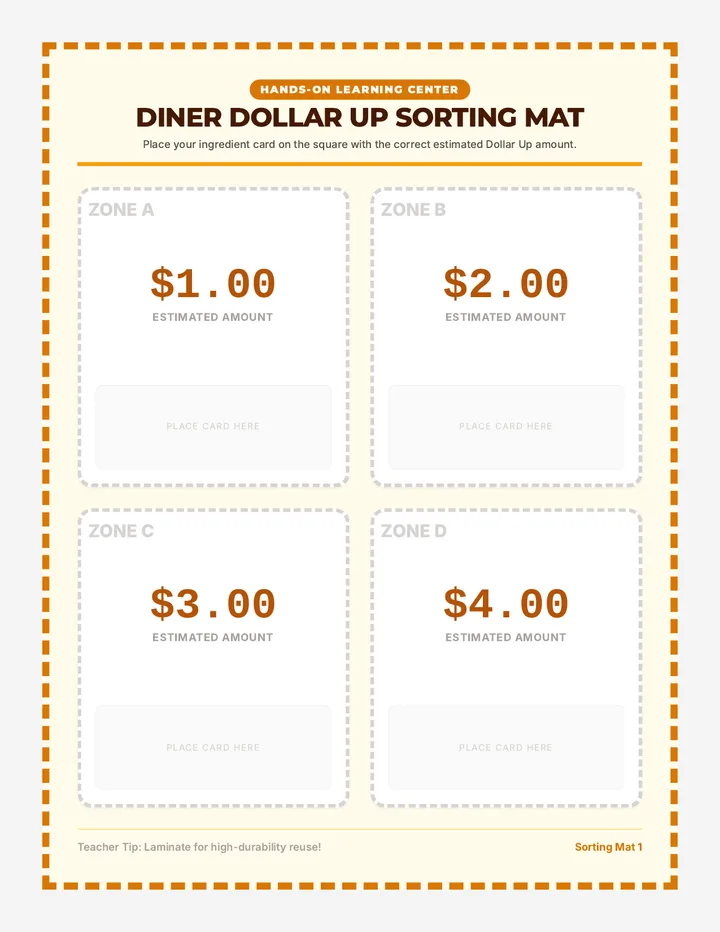
A printable set of hands-on classroom resources including a Dollar Up sorting mat, fractional measurement matching mat, and 12 beautifully designed recipe ingredient price cards to cut out and sort.
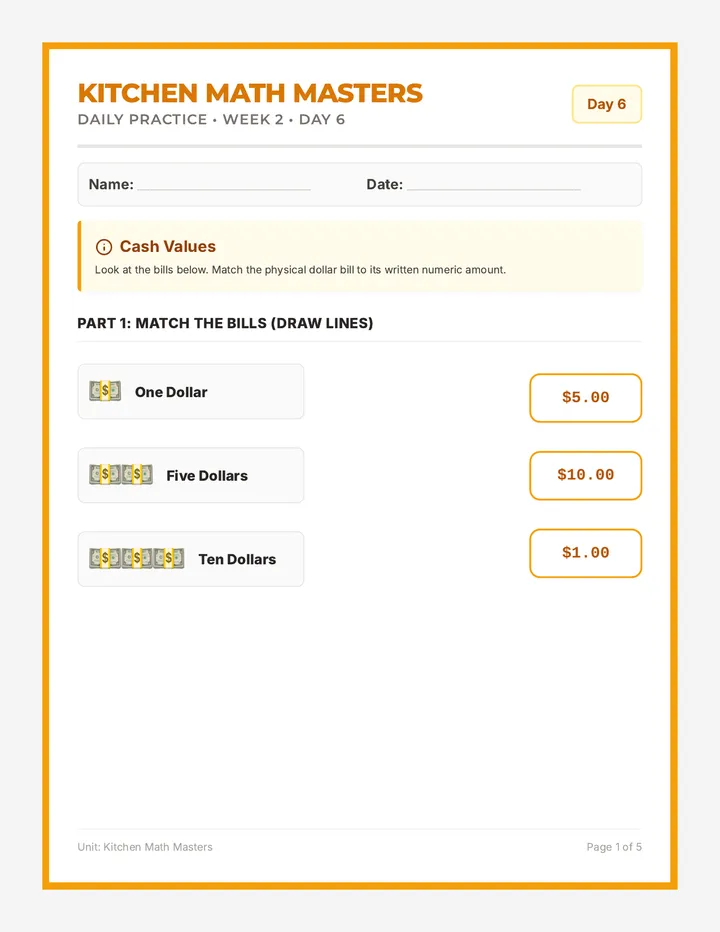
A 5-page student worksheet packet containing one dedicated, scaffolded daily practice page for Days 6 to 10. Topics include Money Identification, the Dollar Up Method, Coupons, Addition of Prices, and Calculating Change.
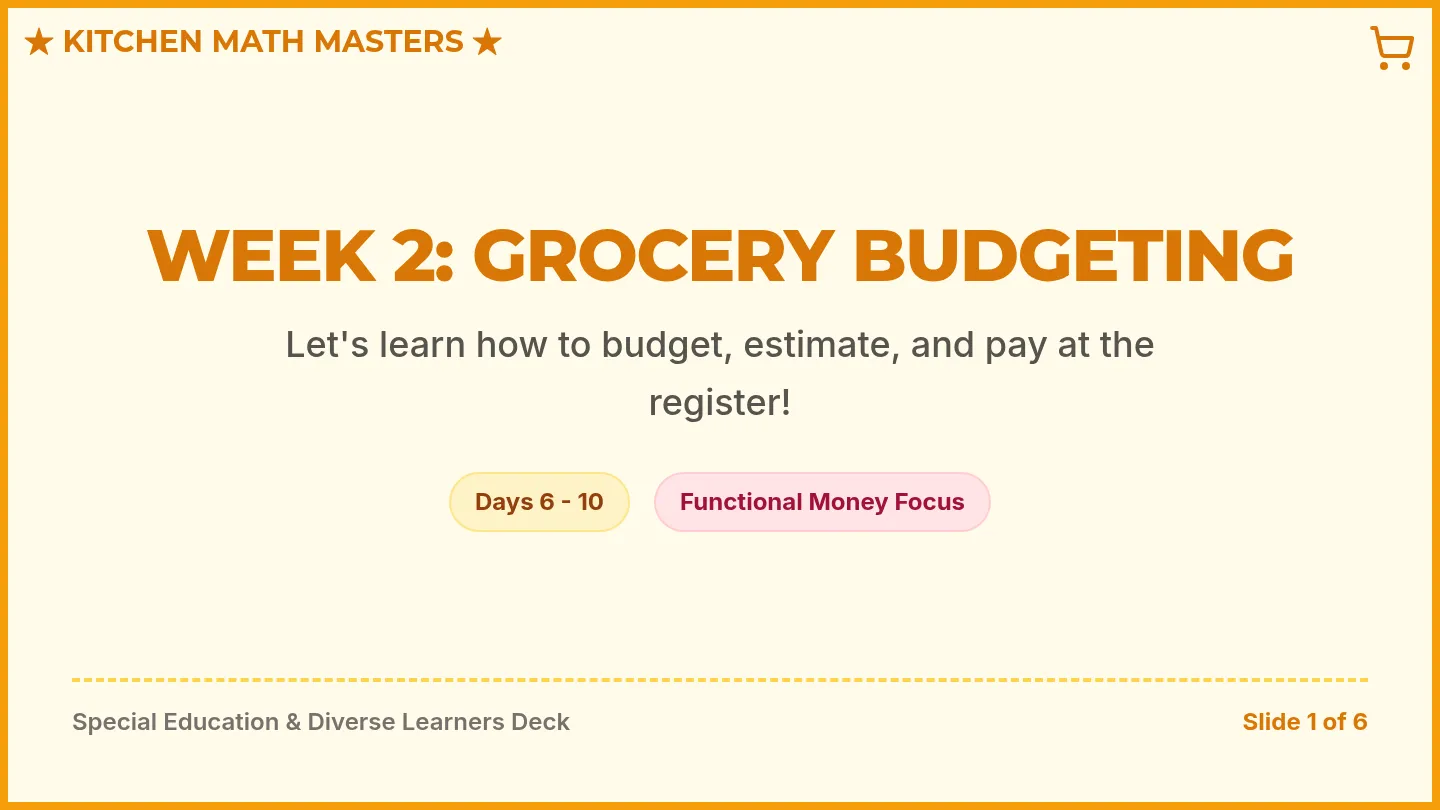
A visual presentation for Week 2 instruction. Teaches Special Education students money identification, the Dollar Up method, grocery addition, coupon subtraction, and calculating register change using large fonts and vivid visual anchors.
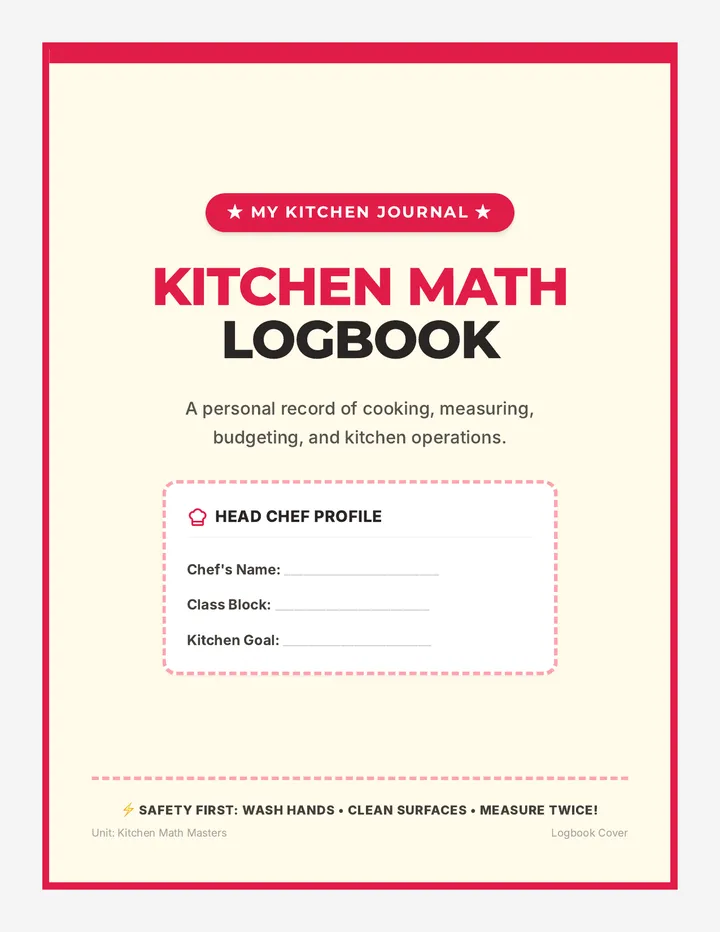
A cohesive, packet-style journal students use throughout the entire unit to track recipes, reflect on physical cooking sessions, record food items, budget totals, and rate their kitchen confidence.
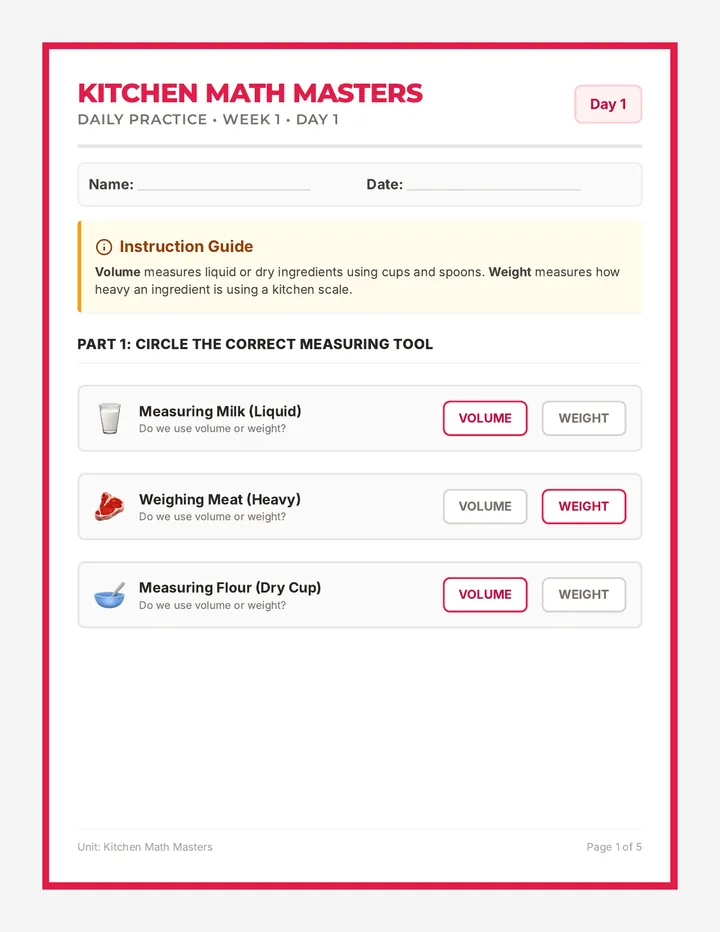
A 5-page student worksheet packet containing one dedicated, scaffolded daily practice page for Days 1 to 5. Topics include Volume vs. Weight, Whole Measures, Visual Fractions, Doubling, and Halving.
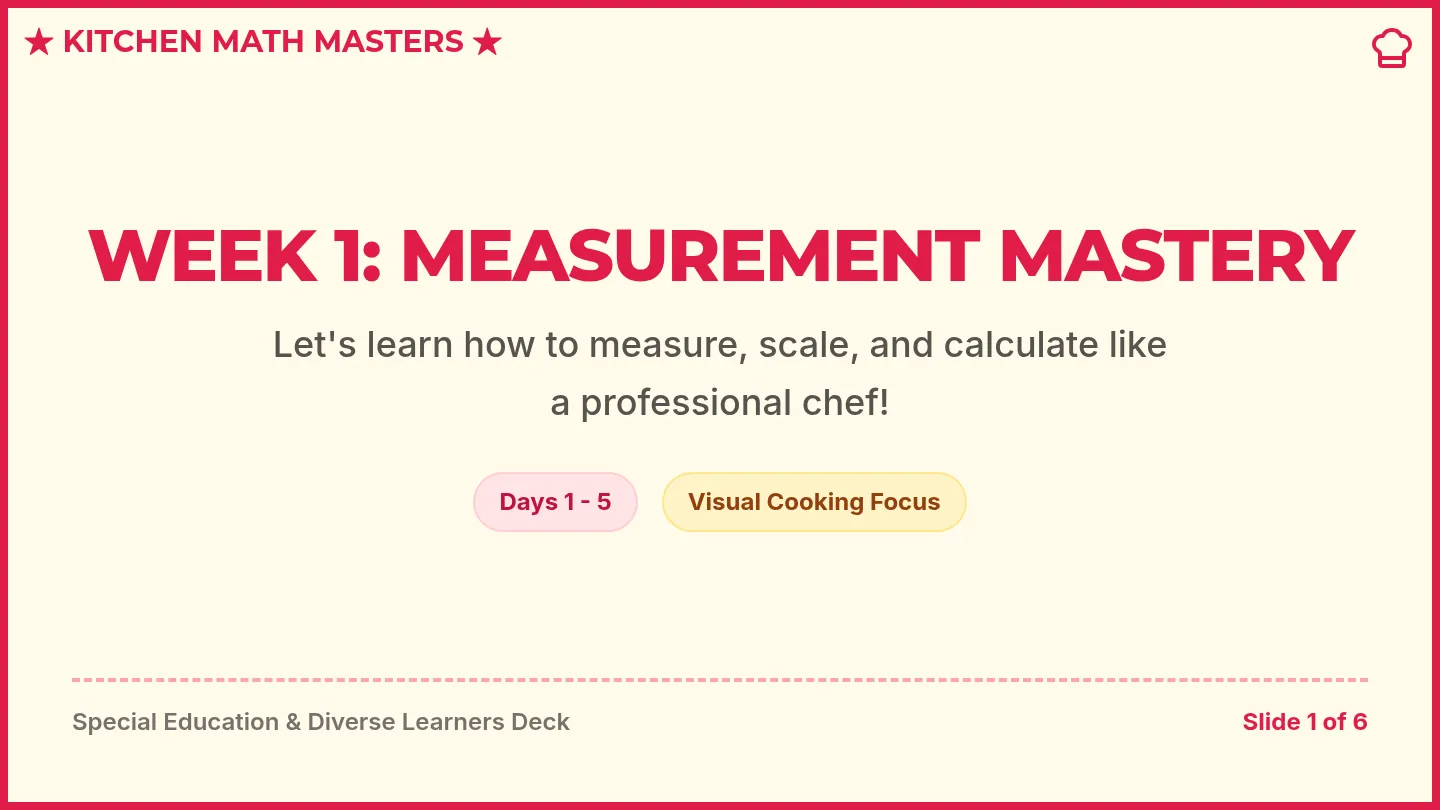
A highly visual presentation for Week 1 instruction. Contains large, clear diagrams and simple text to teach Volume vs. Weight, Whole Measures, Visual Fractions, Doubling, and Halving with step-by-step instructional prompts.
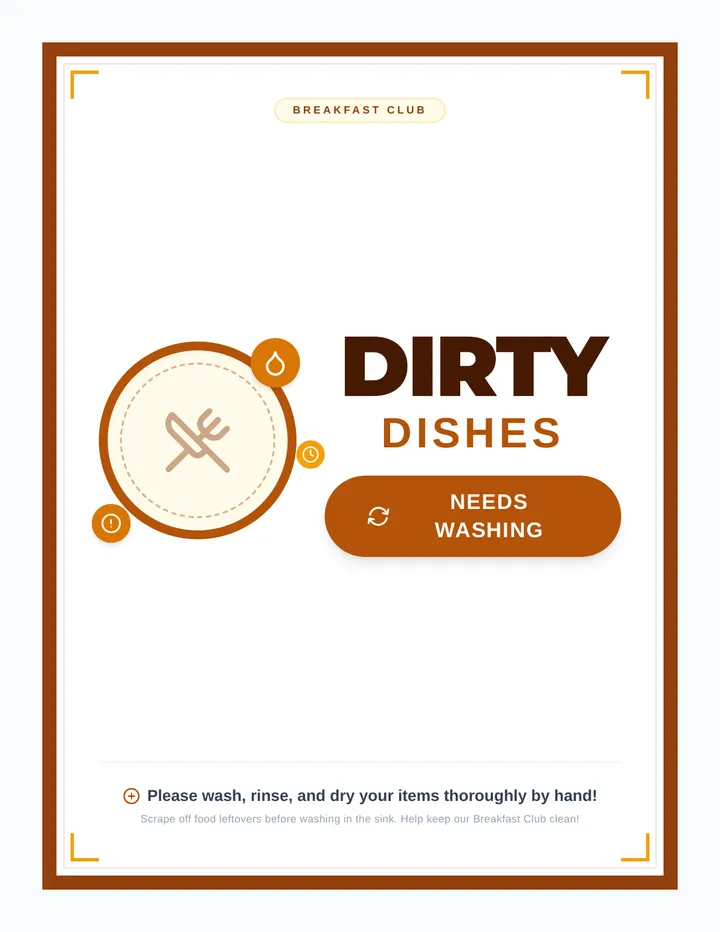
A high-contrast, visually striking printable sign for dirty or used dishes. Designed in a modern terracotta-rust and amber palette, it perfectly balances and complements the Clean Dishes Sign to prevent kitchen confusion.
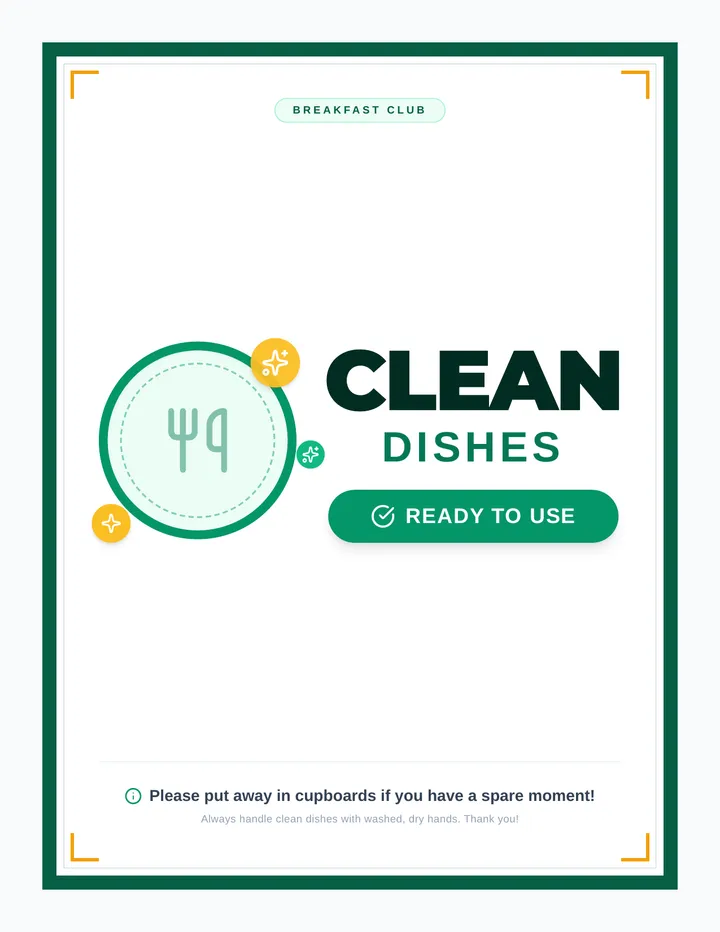
A highly visible, beautifully designed landscape printable sign for clean dishes. Featuring a modern sage-green and gold aesthetic with elegant typography and clear illustrations, it makes kitchen organization effortless and stylish.
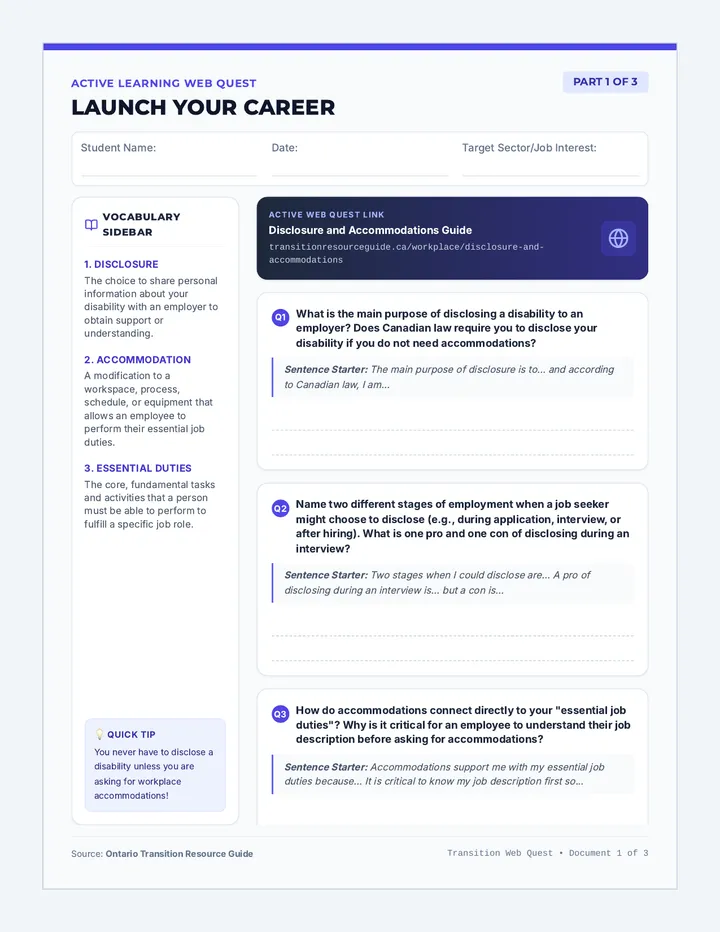
A premium 3-page printable student web quest focused on Workplace Transition. Each page targets a specific focus area: Disclosure & Accommodations, Employment Rights & Standards, and Succeeding on the Job. Includes defined vocabulary sidebars, direct web links, and scaffolded sentence starters for short-answer questions.
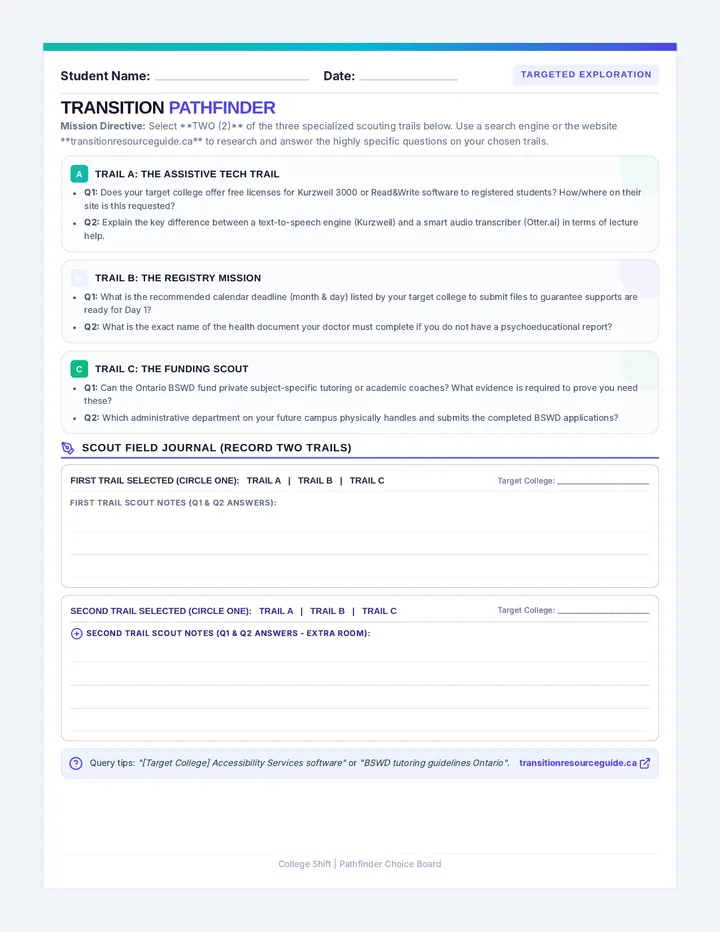
A 1-page visual choice board (document format) that offers three targeted research pathways with specific, concrete transition questions. Students select two paths to investigate assistive technology, intake rules, or BSWD funding rules, and complete their notes in stacked, full-width journal boxes with extra space for the second entry.
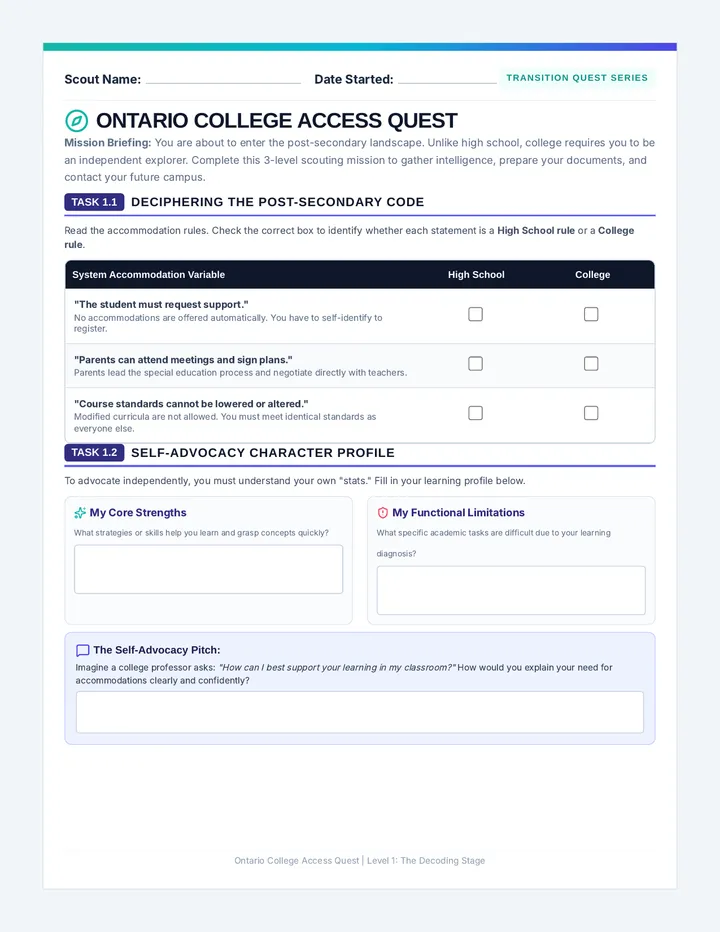
A highly engaging, 3-page independent transition quest (document format) that frames post-secondary preparation as a series of structured scouting tasks. Students research Ontario college accessibility rules, inventory their documentation, explore the BSWD bursary, draft an introductory email, and evaluate their progress with an integrated grading rubric.
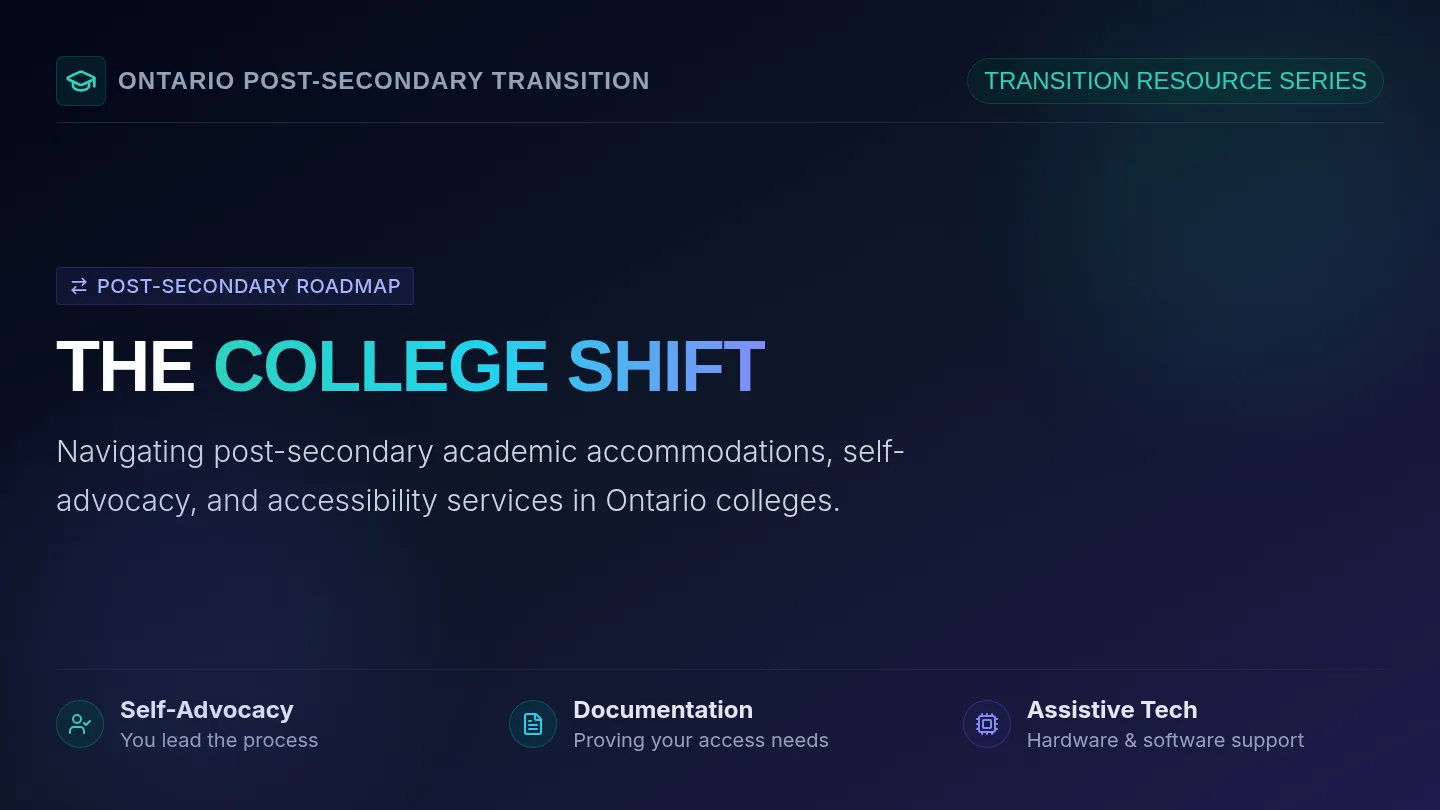
A comprehensive 5-slide presentation designed to guide students through the legal, administrative, and practical differences between high school and college accommodations in Ontario. It details documentation requirements, assistive technology tools, and Ontario-specific funding opportunities like the BSWD.
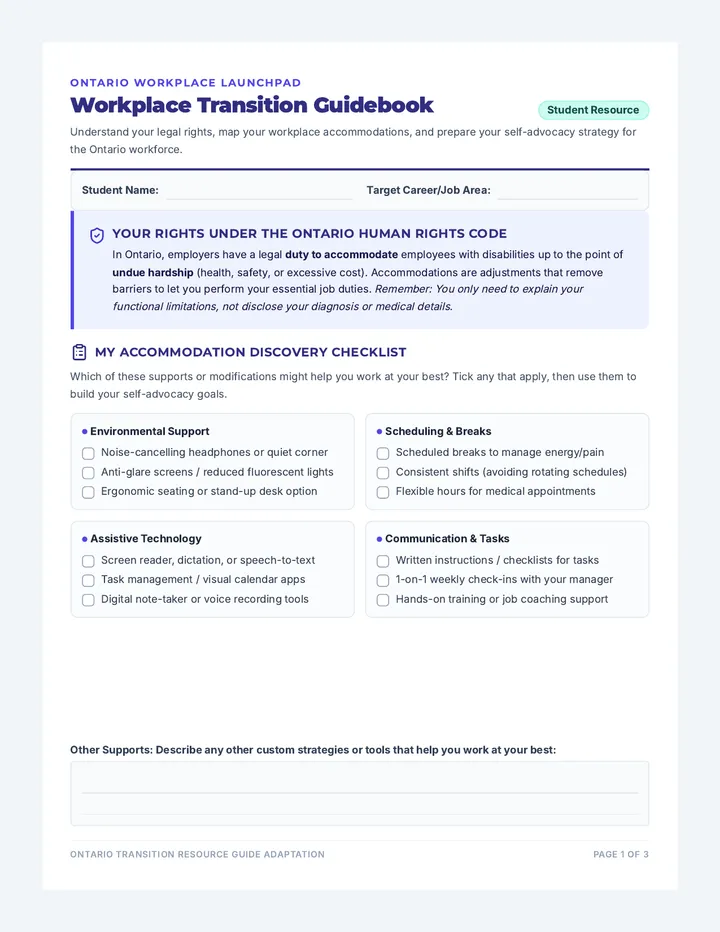
A student-facing 3-page interactive transition workbook designed specifically for Ontario. It features Ontario Human Rights Code guidelines, accommodation self-assessments, a customizable disclosure decision pathway, and structured self-advocacy scripting worksheets.
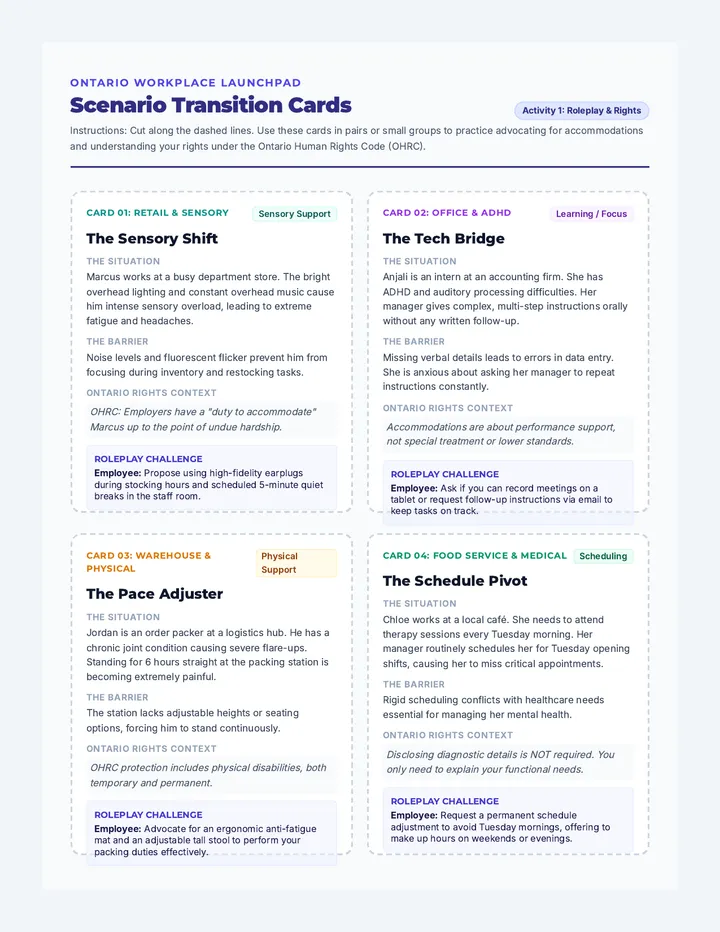
A collection of 6 printable roleplay cards depicting real-world Ontario workplace scenarios, accommodations, and rights-focused discussions under the Ontario Human Rights Code, along with a roleplay reflection sheet.
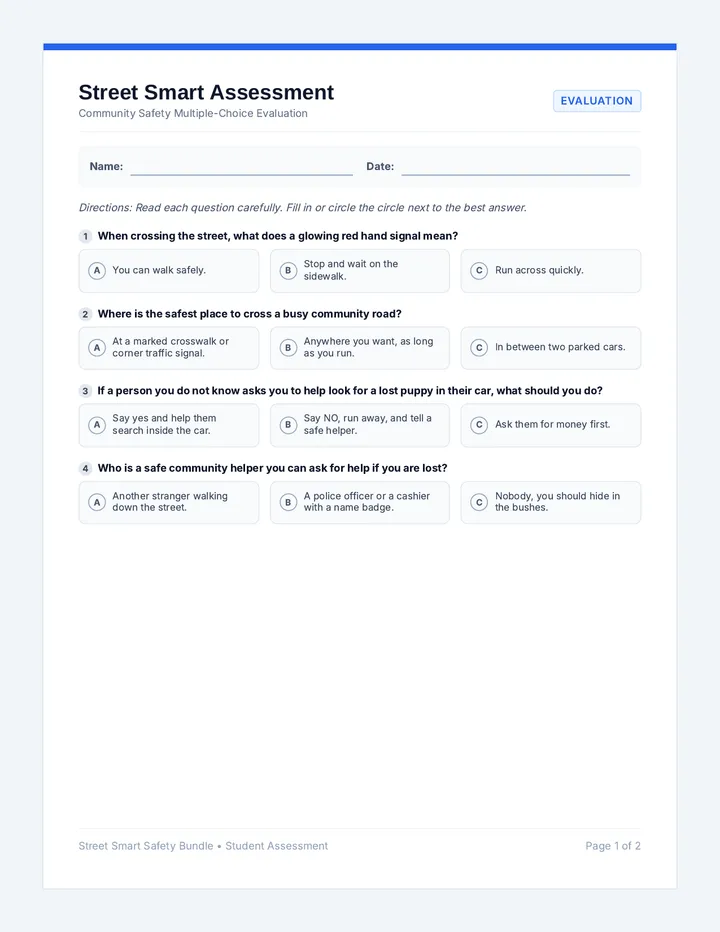
A 2-page student community safety assessment containing 8 scenario-based multiple-choice questions covering traffic safety, strangers, emergencies, and navigating lost situations. Features high-contrast, accessible layouts for life skills students.
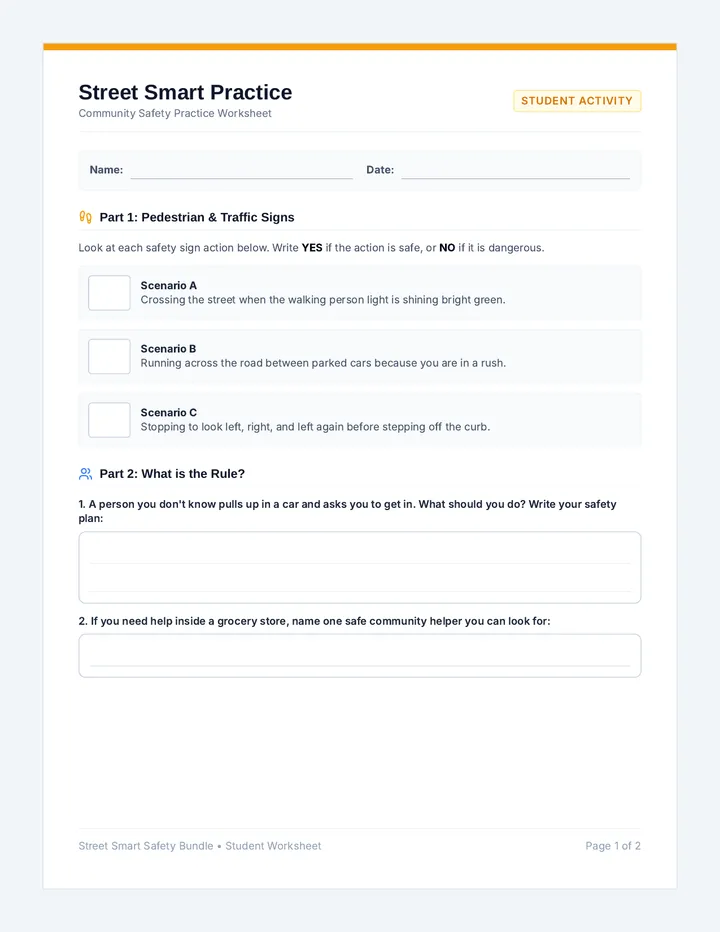
A 2-page practice worksheet for life skills students. Contains scenario-based exercises, sign definitions, and safety plan responses to reinforce community traffic, stranger, emergency, and navigation skills.
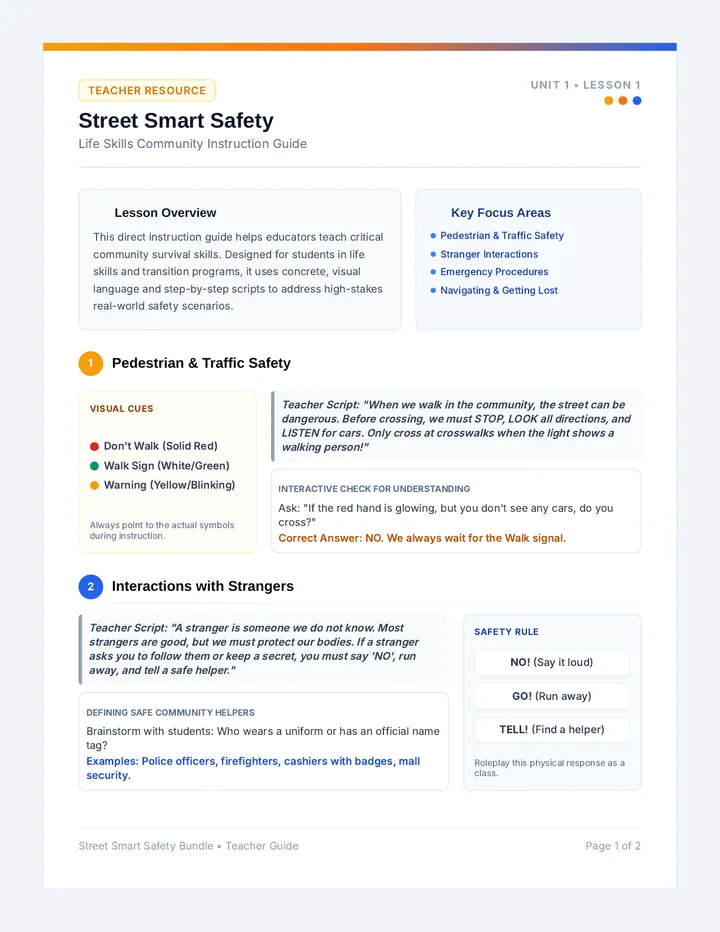
A 2-page direct instruction guide for teachers to lead lessons on community safety, covering traffic signals, interactions with strangers, emergencies, and navigating public spaces. Includes teaching scripts, discussion prompts, and differentiation tips for life skills classrooms.
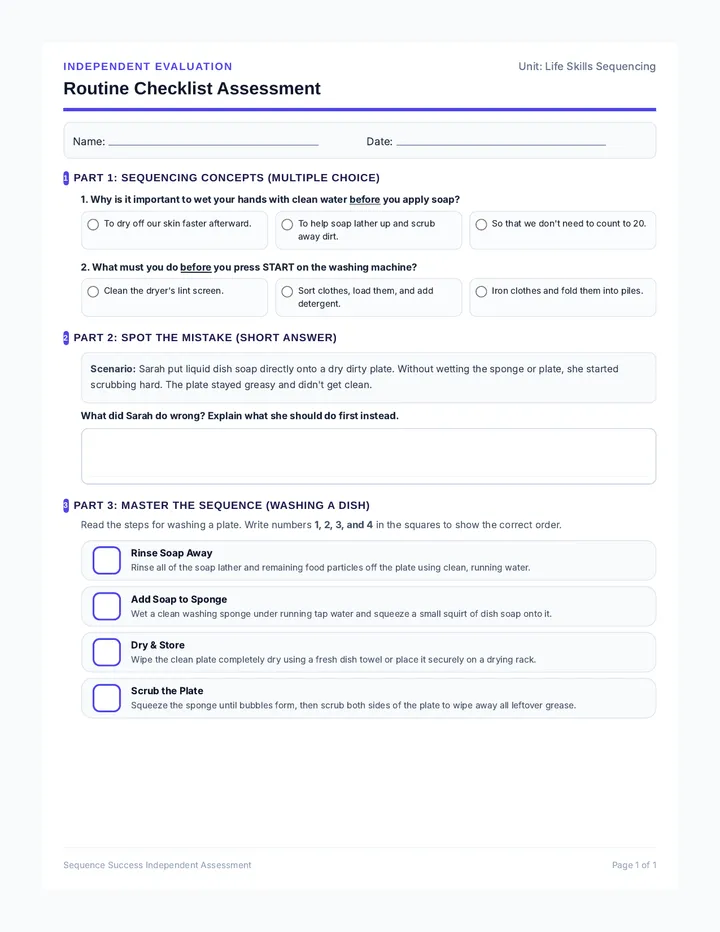
A 1-page independent student assessment worksheet. It evaluates conceptual understanding of task sequencing and includes multiple-choice questions, a 'spot the mistake' written scenario, and a 4-step ordering question for washing a dirty dish.
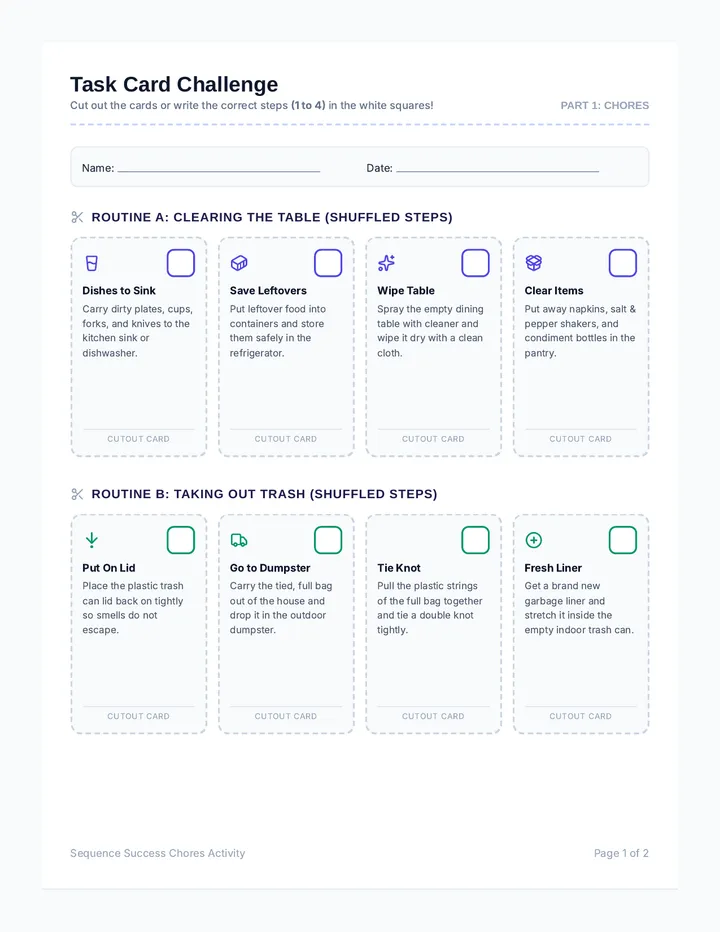
A 2-page student task card activity sheet. Contains four separate routines (Clearing the Table, Taking Out the Trash, Brushing Teeth, and Getting Ready for Bed), each broken down into 4 randomized step cards with dotted cutting lines and blank number boxes for students to order from 1 to 4.
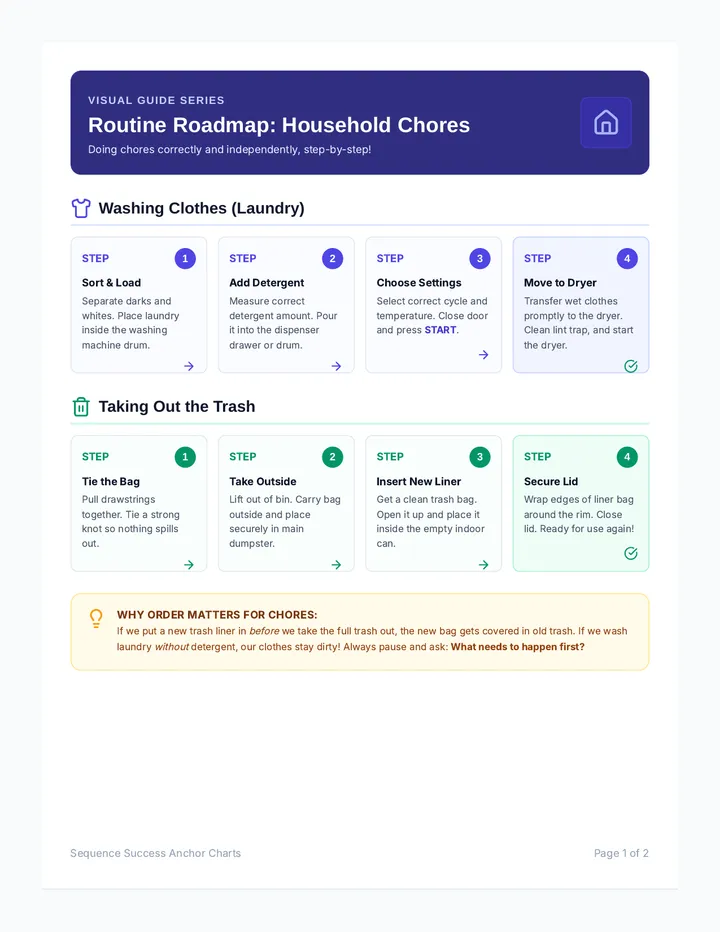
A 2-page visual anchor chart for transition-aged students. Page 1 displays step-by-step roadmaps for household chores (Washing Clothes and Taking Out Trash). Page 2 covers self-care and hygiene (Washing Hands and Getting Dressed for Work). Uses bold step numbers, clear icons, and readable descriptions.
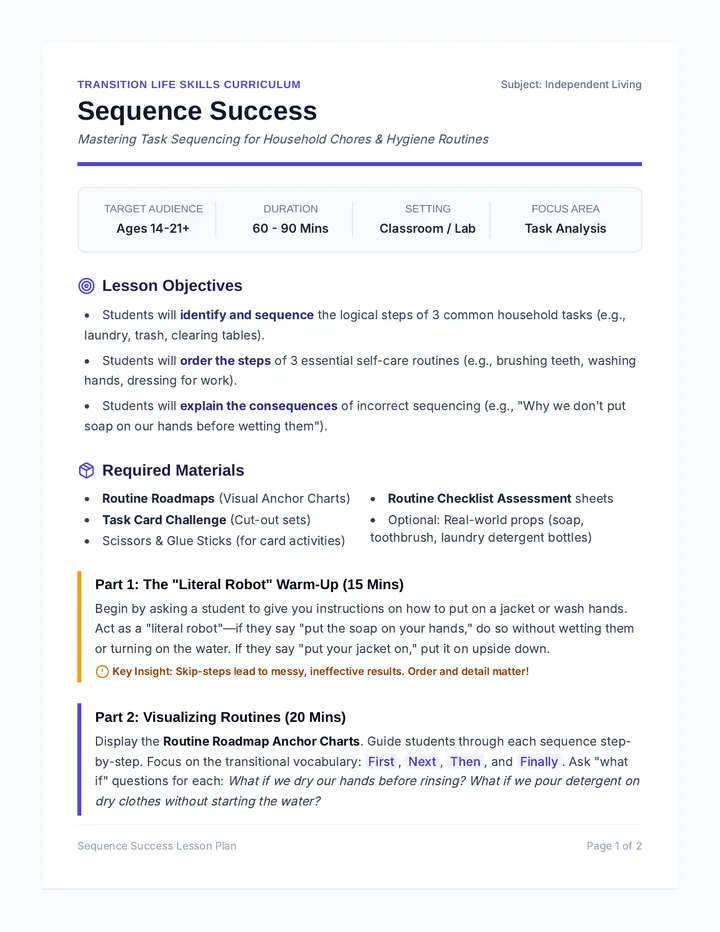
A 2-page print-ready teacher facilitation guide and lesson plan for instructing transition-aged students on task sequencing. It outlines learning objectives, materials, step-by-step instructional procedures, and specific pedagogical strategies.