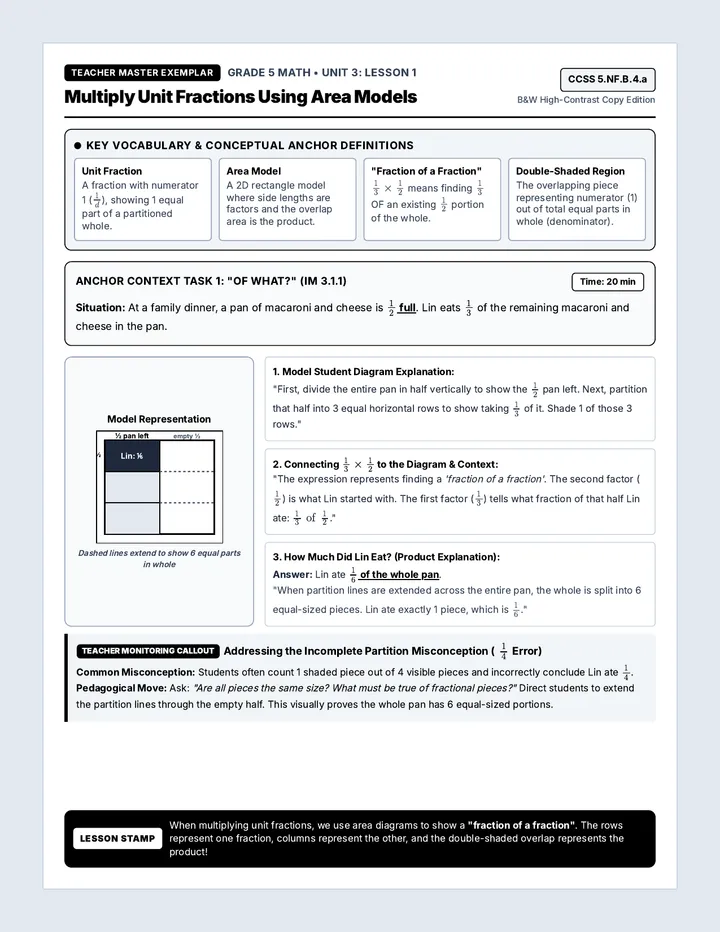
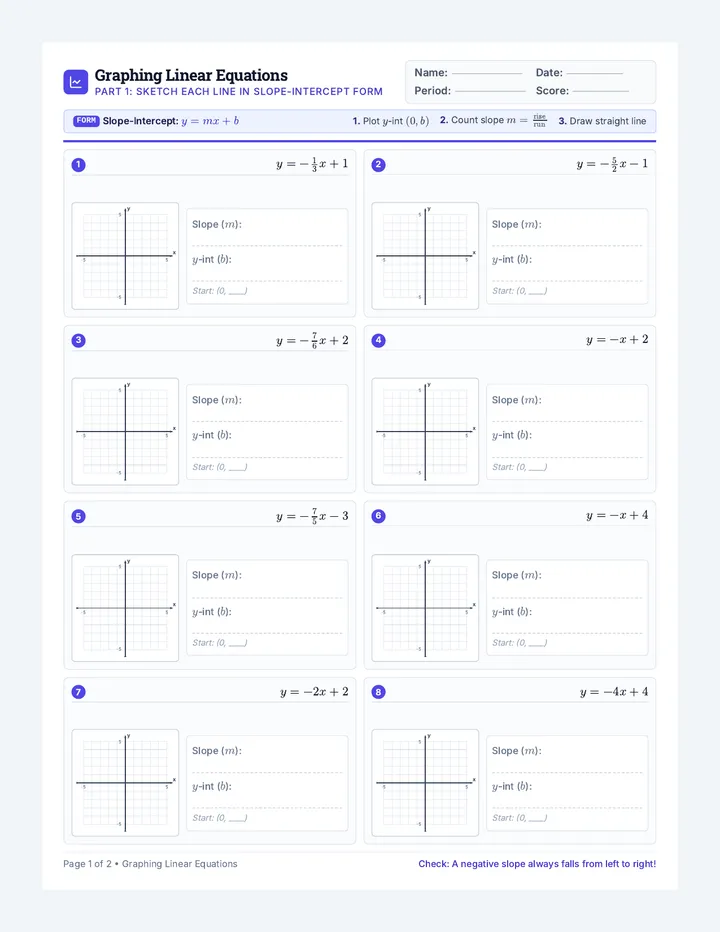
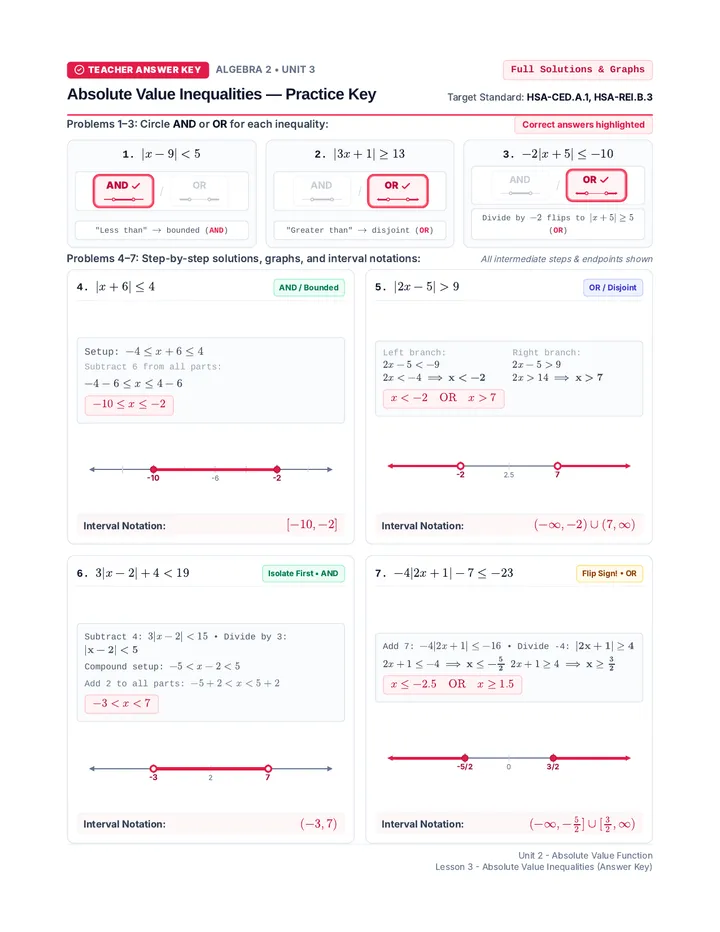
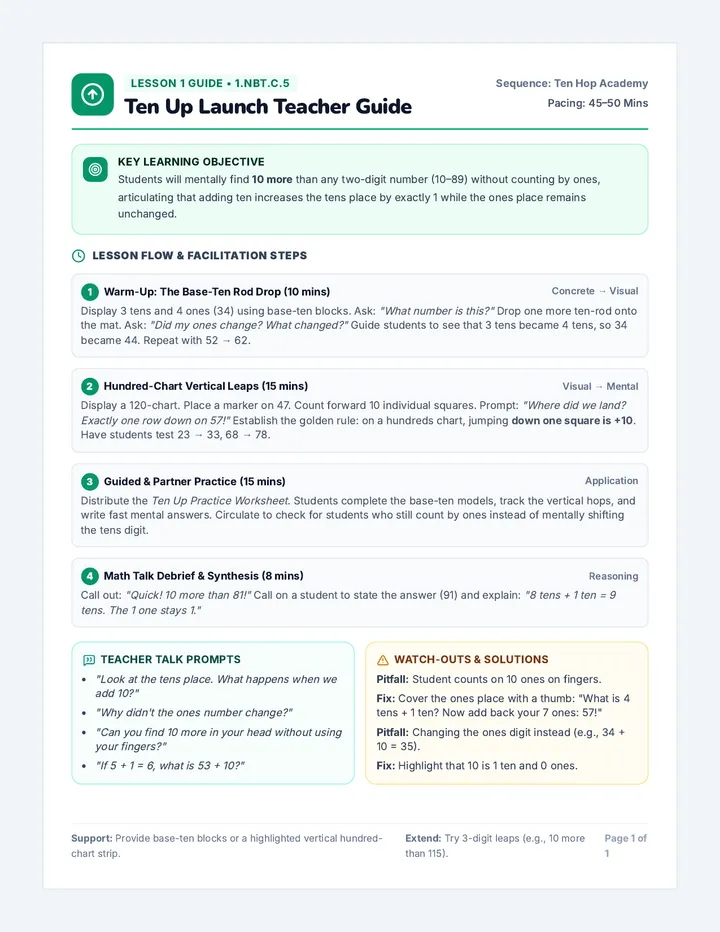
Equation Anatomy Lesson Plan
Pre-Algebra • Grade 6–7
Equation Anatomy Lesson Plan
Standard: CCSS.MATH.6.EE.A.2
Duration: 55 Minutes
Lesson Type Vocabulary & Concept
Key Focus Expression vs Equation
Grouping Whole • Pairs • Solo
Prep Level Low (Highlighters + Cards)
Essential Question
How does dissecting the anatomy of an algebraic statement help us interpret mathematical relationships and solve equations?
Student Learning Targets (SWBAT)
- Identify and define variable, coefficient, constant, and term in mathematical expressions and equations.
- Distinguish clearly between an algebraic expression and an algebraic equation using the equals sign criterion.
- Construct original expressions and equations conforming to specified architectural criteria (e.g., 3 terms, coefficient of -4).
Visual Anchor • Equation Anatomy Diagram
Display on Front Board
6 x − 4 = 20
COEFFICIENT Number multiplied by variable (\(6\))
VARIABLE Symbol for unknown value (\(x\))
CONSTANTS Fixed numbers without variables (\(-4, 20\))
TERMS Separated by + or − (\(6x, -4\))
Left Side: \(6x - 4\) → Expression (No equals sign; phrase)
Whole Statement: \(6x - 4 = 20\) → Equation (Has “=”; full sentence)
Core Vocabulary Matrix • Definitions & Diagnostic Cues
Explicit Instruction Reference
Variable x, y, n
A letter or symbol representing an unknown or changing quantity.
Kid Definition: “The mystery box we need to solve for.”
Coefficient 5x → 5
The numerical factor multiplied directly in front of a variable.
Rule Alert: If variable stands alone (\(y\)), coefficient is 1.
Constant +7, -3
A standalone numerical value that never changes its value.
Sign Rule: The sign (+ or −) belongs to the constant!
Term Parts
A single number, variable, or product of both, separated by + or −.
Counting Tip: Circle each block with its operation sign.
Expression No =
A mathematical phrase combining terms without an equal sign.
Analogy: Expression = phrase; Equation = complete sentence.
Instructional Pacing Breakdown (55 Min Total) Materials: 4-color highlighters, index cards, mini-whiteboards
Hook / Warm-Up 8 Mins • Mystery Code
Direct “I Do” 12 Mins • Color Dissect
Guided “We Do” 15 Mins • Whiteboards
Partner “You Do” 12 Mins • Card Sort
Exit & Debrief 8 Mins • Autopsy Slip
PAGE 2
Instructional Delivery, Diagnostic Fixes & Supports
Pre-Algebra • Equation Anatomy
Step-by-Step Instructional Sequence
1
The Mystery Bag Hook (8 Min)
Engage & Activate
Display a physical brown paper bag marked with a giant “?” (containing 5 mystery marbles) plus 3 loose marbles outside. Write on board: \(m + 3\). Ask: “What does the bag represent? What does the 3 represent?” Introduce variable as the bag and constant as the loose marbles. Now place a scale balanced with 8 marbles: \(m + 3 = 8\). Ask: “How did adding the equals sign turn a phrase into a balance equation?”
2
Direct Instruction: The Color-Coded Dissection Protocol (12 Min)
Teacher Modeling (“I Do”)
Write on board: \(7y - 15 = 20\). Model the “Sign Snuggle” method: Draw a vertical cut before each \(+\) or \(−\) sign to isolate terms: \([+7y]\) and \([-15]\).
Rule 1 (The Snuggle): The operation sign in front belongs to that term! \(-15\) is a negative constant.
Rule 2 (Invisible 1): If a variable stands alone (\(x\)), write a ghostly “1” in front: \(1x\).
Rule 3 (The Wall): The equals sign separates the left expression from the right expression.
3
Guided Practice: Whiteboard Rapid-Fire Rounds (15 Min)
Collaborative (“We Do”)
Students hold up mini-whiteboards on signal: Round A: Identify the coefficient in \(-8w + 12\). (Listen for “8” vs “-8”). Round B: How many terms are in \(4a - 3b + 9\)? (Count 3 terms). Round C: Is \(14 - 2k\) an expression or an equation? Why? Students turn-and-talk to justify with sentence starter: “This is an expression because there is no equals sign.”
4
Partner “Equation Architect” Challenge (12 Min)
Application (“You Do”)
Pairs receive prompt cards with blueprint requirements: “Build an equation that has: variable \(p\), coefficient \(-3\), constant \(+10\), and total value \(25\).” Partners construct: \(-3p + 10 = 25\), color-code each element, and swap with another pair to verify and audit.
Common Misconceptions & Diagnostic Interventions
“There is no coefficient in \(x\)”
Students think no number written means coefficient is 0.
Fix: Write \(0 \cdot x = 0\) (disappears!). Then show \(1 \cdot x = x\). The invisible multiplier is always 1.
Dropping Negative Signs
In \(12 - 5x\), student says the coefficient is 5 instead of \(-5\).
Fix: Have students physically box terms including the preceding sign: \([+12]\) and \([-5x]\).
Expression vs. Equation Mixup
Calling \(3x + 7\) an equation or trying to “solve” it.
Fix: EQUAtion requires EQUAl sign. An expression is an open phrase; equation has a target balance.
Tiered Accommodations & Universal Supports
Multilingual Learners (ELL / ML)
- Provide cognates: variable / variable, constante / constante.
- Use physical color highlighters (Yellow = Coeff, Blue = Var, Green = Const).
- Provide sentence stems for oral explanations.
Struggling / IEP Accommodations
- Pre-segmented equation templates with color outlines.
- Limit initial expressions to positive 2-term sets before negatives.
- Keep visual vocabulary anchor strip taped to student desk.
Advanced / Early Finishers
- Introduce fractional/decimal coefficients (e.g., \(0.75x - \frac{1}{2} = 9\)).
- Identify terms in expressions with multiple variables (\(3x^2 - 4xy + 8y\)).
- Challenge: Write a word problem matching their architectural equation.
End-of-Lesson Formative Assessment
Exit Ticket: “Equation Autopsy”
Given \(8 - 3y = 29\): (1) Identify coefficient. (2) Identify constant(s). (3) How many terms? (4) Why is this an equation?
Mastery Benchmark 4/4 on Autopsy = Proficient