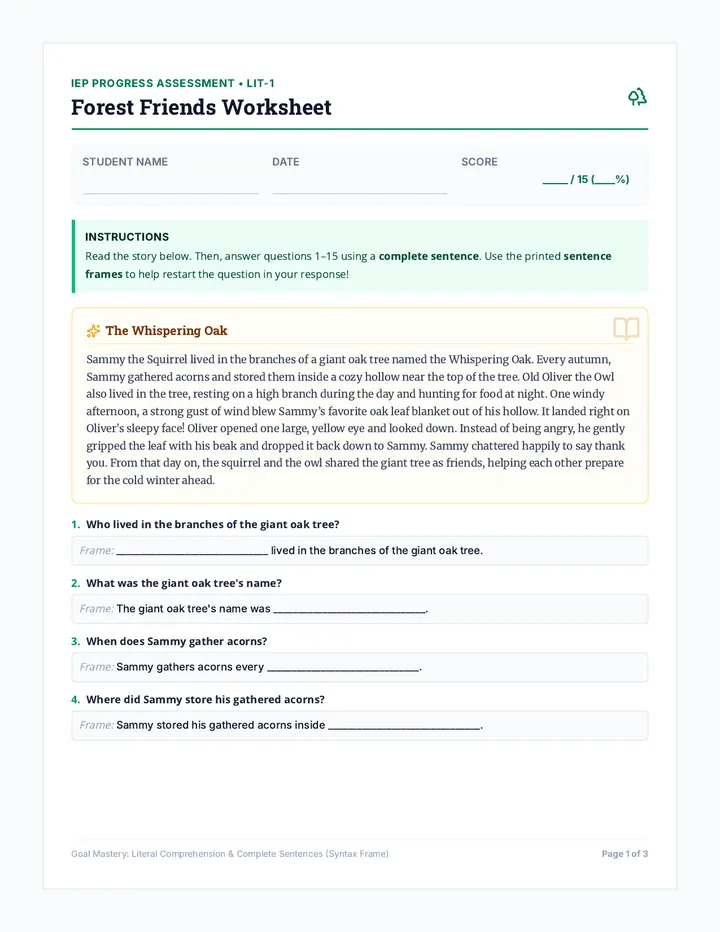
A detective-themed worksheet for 5th-grade resource room students. Includes vocabulary matching, a "Table Test" graphic organizer, and a practice paragraph with sentence starters to scaffold writing.
A teacher guide for Lesson 4 focused on joint attention and exploration routines using the core words 'Open' and 'Look'.
A student activity sheet for joint attention exploration, featuring large visual prompts for 'Open' and 'Look' alongside a mystery box tracking area.
A teacher guide for Lesson 3 focusing on social interactions, turn-taking, and transition management using core words 'Mine', 'You', 'Turn', and 'Finished'.
Visual aids for turn-taking, waiting, and finishing activities, specifically designed to support the core words 'Mine', 'You', 'Turn', and 'Finished'.
A teacher resource guide focused on modeling preferences and self-advocacy (Like, Don't Like, Help), featuring the 'Oops Strategy' and sensory exploration activities.
An engaging student worksheet for categorizing preferences into 'Like' and 'Don't Like', featuring 8 cut-out sensory and activity cards to practice commenting and self-advocacy.
A teacher-facing instructional guide for Lesson 1, detailing specific play routines and modeling strategies for the core words 'Go', 'Stop', 'More', and 'Want'.
Essential visual supports for daily routines, featuring a First-Then-Next schedule strip, a customizable choice board, and 12 fringe vocabulary cut-out cards for activities and needs.
A high-contrast, color-coded communication board featuring 12 essential core words plus functional pragmatics like 'Yes', 'No', and 'Listen to Me' to support emerging AAC users.
Fully revised 16-page student workbook for the Syllable Squad mission. Updated Week 2, Day 3 with the "Syllable Spotlight" activity, including a word hunt within the fluency passage and new orbital mapping boxes for "Famous" and "Hero". Standardized font sizes and generous handwriting areas throughout. Optimized for high-contrast 8.5x11 printing.
A comprehensive 16-page student workbook for the Syllable Squad phonics mission. Features revised word counts and item lists to perfectly match teacher manuals, expanded handwriting areas, standardized font sizing to prevent overflow, fixed typos, and high-contrast layouts. Optimized for 8.5x11 printing with no activity breaks across pages.
A completely revised and polished 16-page student workbook for the Syllable Squad mission. Features standard column spacing to prevent text overflow, generous handwriting lines, clear vertical spacing for labeling vowels/consonants, and consistent weekly styling. Optimized for high-contrast 8.5x11 printing with no activity breaks.
A comprehensive 16-page student workbook for the Syllable Squad phonics mission. Features revised word counts and item lists to perfectly match teacher manuals, expanded handwriting areas, standardized 2xl/3xl font sizing, and high-contrast layouts. Optimized for 8.5x11 printing with no activity breaks across pages.
Fully revised 16-page student workbook for the Syllable Squad mission. All formatting issues addressed: standardized 2xl/3xl font sizes for handwriting boxes to prevent text overflow, consistent word counts (12 for mapping, 8 for dictation, 6 for slice, 4 for building), and optimized high-contrast layouts. print-ready 8.5x11 format.
A completely redesigned 16-page student workbook for the Syllable Squad mission. Features large, readable text, significantly expanded handwriting areas, high-contrast layouts for printing, and consistent weekly styling. Optimized for 8.5x11 without activity breaks.
A comprehensive 16-page student workbook for the Syllable Squad phonics mission. Includes sequence-level placement and final missions, plus daily practice activities for 5 major syllable types (Closed, Open, Magic E, R-Controlled, and Consonant-le), optimized for high-quality 8.5x11 printing with no page breaks within activities.
A graduation certificate awarded to students who have demonstrated mastery of personal space boundaries and social interaction protocols.
Scenario-based role-play task cards for practicing personal space and permission protocols in common classroom situations.
Week 4 slides for identifying non-verbal 'Stop' and 'Go' cues in teacher body language.
Week 3 slides teaching the 'Stop, Look, Ask, Wait' protocol for requesting permission to touch or enter space with teachers.
A categorization activity for students to distinguish between peer social boundaries and professional teacher boundaries, reinforcing the 'Teacher Zone' concept.
Week 2 slides teaching the difference between peer space and 'Professional Space' with teachers, including the importance of the teacher's desk boundary.
Lanyard-sized visual cue cards for teachers to use as non-verbal reminders for students during classroom interactions, reinforcing personal space and permission protocols.
A student worksheet for identifying personal space boundaries and evaluating classroom scenarios using the 'Mission Success' vs. 'Re-calibrate' framework.
Week 1 introductory slides for students, defining personal space and the 3-foot/arm's-length rule with high-contrast visuals and social scenarios.
A comprehensive 6-week curriculum overview for teaching personal space and permission-to-touch skills, featuring weekly objectives, core strategies, and specific teacher-focused social scenarios.
A collaborative transition planning tool used to synthesize student interests and teacher observation data into concrete post-secondary vocational goals and action steps.
A professional teacher-facing observation tool to document behavioral evidence of student interests and functional skills during community-based or vocational activities. Features a skill level key and engagement metrics.
A two-page student-facing career interest inventory using a blueprint theme. It features visual icons and checklists to help students identify their preferred environments, vocational interests, and community-based career goals.
A modified exit ticket assessment for students with dysgraphia, using multiple-choice and word bank formats to reduce writing pressure.
An independent practice worksheet for students with dysgraphia, featuring circling options and fill-in-the-blank sentences to reduce writing load.
A modified graphic organizer for students with dysgraphia, featuring larger writing spaces and a word bank to reduce writing load.
A teacher-facing guide providing specific strategies and accommodations for students with dysgraphia during the 'Word Lab Wonders' lesson.
Visual communication supports for students, including a choice board template, desk strips for Yes/No and core words, and large modeling icons.
A visual slide deck to support the Voice Voyagers curriculum, featuring high-contrast modeling slides for Yes/No, Help, Go, and More.
Step-by-step facilitation plans for Lessons 6 through 10 of the Voice Voyagers curriculum, focusing on generalization and complex social interactions.
A step-by-step facilitation guide for SLPs to implement Lesson 5: Yes No Discovery, focusing on simple affirmation and rejection.
A step-by-step facilitation guide for SLPs to implement Lesson 4: Help Heroes, focusing on the core word "HELP" for problem-solving.
A step-by-step facilitation guide for SLPs to implement Lesson 3: More Magic, focusing on requesting continuation using the "MORE" symbol.
A step-by-step facilitation guide for SLPs to implement Lesson 2: Power Play, focusing on the core word "GO" during movement activities.
A step-by-step facilitation guide for SLPs to implement Lesson 1: Choice Champions, focusing on choice-making between two preferred items using TouchChat.
A collaboration handout for general education teachers explaining how to support the student's specific sentence-writing IEP goal. It includes Roblox-themed engagement hooks, quick scaffolding techniques, and verbal prompting scripts.
A teacher's guide providing instructional strategies for low-fluency students, IEP goal alignment, and a trial tracker for data collection. includes specific tips for using Roblox themes to motivate student writing.
A print-ready Roblox-themed worksheet featuring a word bank and graded sentence frames (full support to independent). Designed to help students draft three sentences with checklists for capitalization and end punctuation. Includes chunked directions for clear task management.
A visually engaging Roblox-themed slide deck designed to teach sentence structure, capitalization, and punctuation to students. It includes modeling, guided practice with word blocks, and a student self-check list.
A celebratory certificate to award to first-grade students once they demonstrate successful use of the Feelings Navigator Chart and verbal communication skills. Designed to reinforce positive behavior and provide a sense of achievement.
A comprehensive teacher facilitation guide for the Calm Communication lesson, including step-by-step instructional sequences, behavioral management tips for eloping and screaming, and an observation log to track student progress.
A set of 6 role-play scenario cards specifically for first graders, focusing on common school triggers like transitions, difficult tasks, and social conflicts. Each card provides a "Practice" section to help students use verbal communication instead of eloping or screaming.
A visual feelings chart designed for first graders, featuring four color-coded emotion zones (Calm, Sad, Worried, Angry) with corresponding "I can say" prompts to encourage verbal communication over eloping or screaming.