A comprehensive teacher data sheet for monthly progress monitoring of advanced affixes and derivational endings (-sion, -ture, -able, -ify, etc.). Tracks 15 real and 5 nonsense words.
A short exit ticket to assess Oliver's ability to identify a single irrelevant detail and record three key details from a fiction paragraph, aligned with his IEP goal.
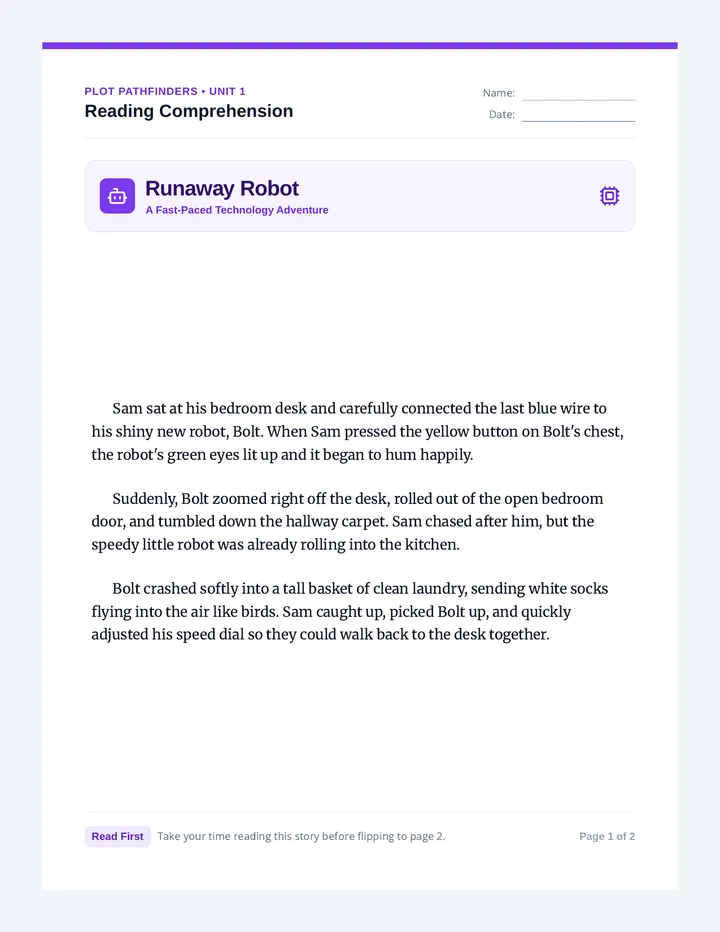
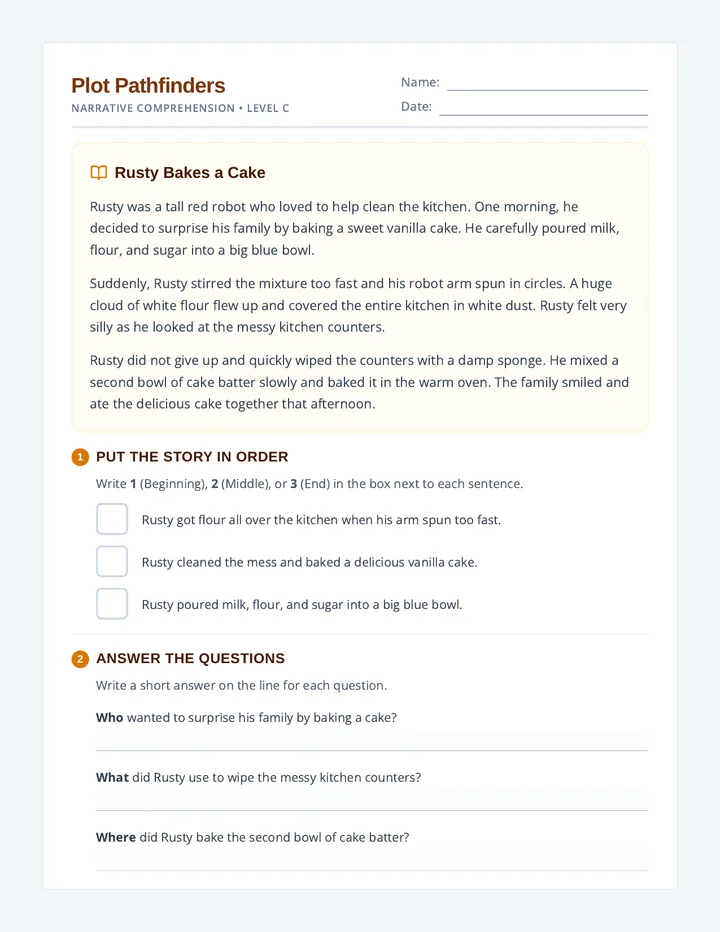
A student worksheet featuring a three-paragraph fiction story and an 'Umbrella' graphic organizer for recording three key details while filtering out irrelevant information.
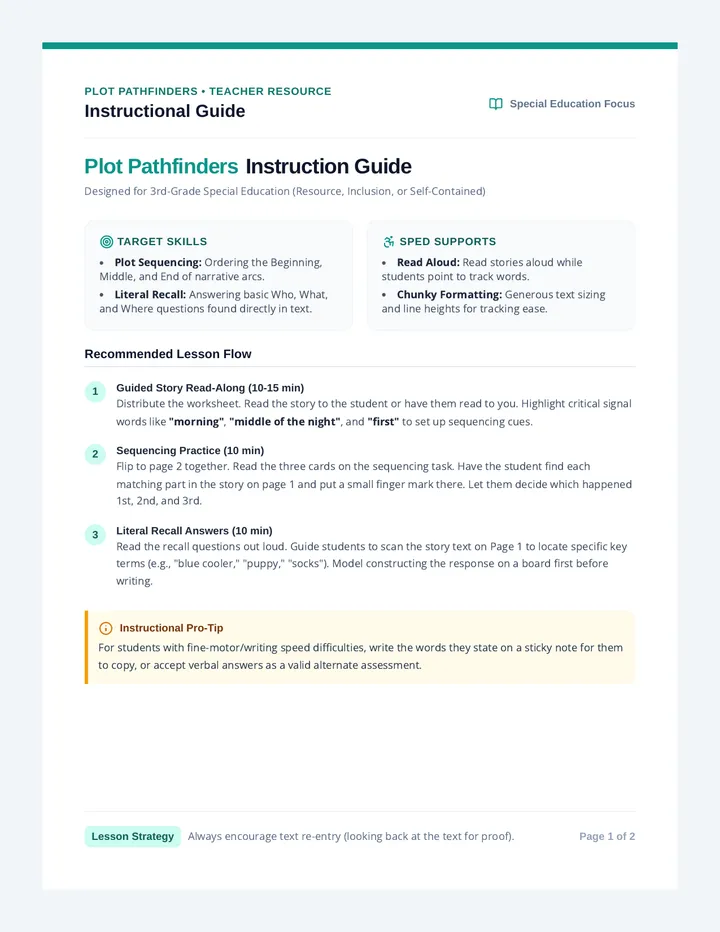
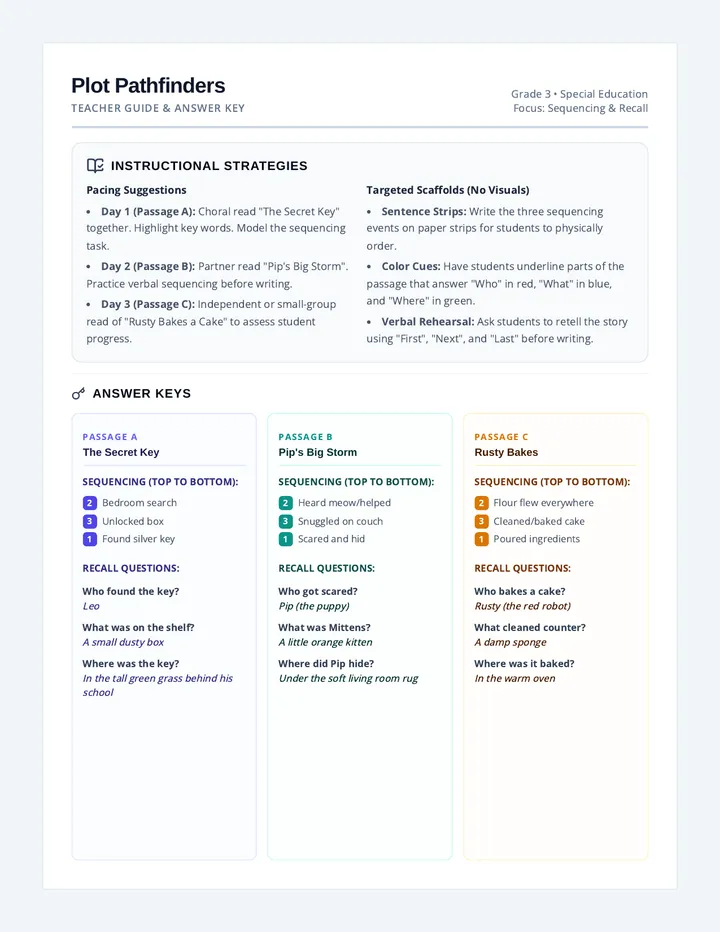
A teacher guide providing instructional scripts, IEP goal alignment, and a clear answer key for the 'The Secret of the Old Oak' activity.
A visual presentation for Oliver that introduces the Main Idea Umbrella concept, contrasting key details with less relevant information using a clear weather-based metaphor.
A discovery worksheet for The Giver that levels up the language to a 3rd-grade level, requiring students to identify elements of Sameness, define key vocabulary, and provide short written analyses of community roles.
A reading companion for Chapters 1-2 of The Giver, featuring narrative summaries at a 3rd-grade reading level, visual anchors, and short-response comprehension questions.
Vocabulary flashcards for The Giver with leveled-up definitions suitable for a 3rd-grade reading level, featuring parts of speech and clear visual anchors.
A visually engaging slide deck exploring the core concepts of The Giver, specifically the trade-offs of Sameness and the Community's structure, using language accessible to 3rd-grade readers.
A comprehensive teacher's guide for reading The Giver (Chapters 1-2) aloud, leveled for students with 3rd-grade reading skills. It includes specific text-based prompts and instructional strategies for vocabulary and sentence expansion.
A professional teacher's guide for facilitating restorative conversations after a behavioral incident. It includes the purpose of reflection, implementation steps, and a restorative questioning framework.
A detailed, two-page restorative reflection form designed to help students analyze the impact of their actions, take another's perspective, and identify concrete steps for repairing harm after a specific incident.
A modified, low-text worksheet for The Giver focusing on the concept of Sameness and Jonas's feelings, featuring large visuals and minimal decoding requirements.
A graphic-novel style summary of Chapters 1 and 2 of The Giver, using high-impact visuals and simple sentence structures for low-decoding students.
High-contrast, picture-based vocabulary cards for key terms in The Giver, designed to provide visual anchors for students with decoding challenges.
A visually impactful slide deck introducing the world of The Giver, focusing on the concepts of Community and Sameness with large text and clear icons for accessibility.
A comprehensive teacher's guide for reading The Giver (Chapters 1-2) aloud, including specific discussion prompts and instructional strategies tailored for students with low decoding levels but high cognitive engagement.
Teacher-facing answer key and instructional guide for the Pinstripe Playbook lesson, featuring step-by-step math solutions and literacy grading prompts.
A creative final activity where students design their own Yankees trading card, integrating self-reflection and creative writing as a low-pressure exit ticket.
A math worksheet providing structured 3-digit subtraction problems with regrouping, framed within engaging Yankee Stadium scenarios to maintain interest for students with attentional needs.
A literacy-focused handout featuring a reading passage about Derek Jeter and structured writing prompts, including a 'Manager's Choice' scenario to build creative writing skills and confidence.
Interactive slides designed to introduce the Yankees theme, teach 3-digit subtraction with regrouping through visual aids, and provide structured brain breaks for students with attentional challenges.
A teacher's guide for implementing the Routine Rituals lesson. It includes instructional steps, preparation tips, and differentiation strategies specifically for teaching life skills to teenagers.
A planning questionnaire for life skills students to specify their hygiene routine needs. This "mini questionnaire" format allows students to select items and specify preferred brands or styles, and includes choices for shower/bath timing and method. Now optimized for handwriting space, accessibility, and contrast.
A minimalist, age-appropriate morning and night routine template for high schoolers. It features empty dashed boxes for students to glue images of hygiene steps, organized in AM Refresh and PM Reset columns. Increased to 7 slots per side to accommodate more steps. Now includes the user-requested motivation checklist with improved accessibility.
Teacher guide for the Operation Overdrive assessment, optimized for 8.5x11 printing on a single page. Includes a condensed answer key, a re-sized progress tracker, and a new observation section that uses all available vertical space. Fixed overflow issues to ensure professional layout.
A three-trial assessment document featuring multiplication and division word problems. Each trial includes 5 problems (4 single-step and 1 multi-step), making 80% accuracy an easily trackable benchmark. Workspace areas and vertical spacing have been increased to optimally use the 8.5x11 page layout. Workspace background changed to pure white for better handwriting contrast. Phrasing in Trial 1 Problem 5 made more consistent. Workspace consistency improved across all problems. Final answer lines adjusted for reliable printing.
A precise high-school level answer key with brief instructional explanations for teacher use.
A sophisticated 10-question high-school level quiz focusing on neurobiology, dopamine, cognitive overload, and EF strategies.
A high-school level cognitive flexibility activity focusing on procrastination, critical feedback, and semantic set-shifting. Terminology aligned with the "Brain HQ" presentation. Fits on 1 page with large work areas.
A high-school level working memory worksheet featuring advanced inverse processing, mental sorting of task priorities, and dual-task screen-time calculations.
An expanded 10-slide high-school level presentation covering neurobiology, working memory, dopamine, screen time impacts, and practical organization strategies. Explicitly aligned with the "Plan B, C, D" terminology from the Pivot activity.
A comprehensive high-school level teacher facilitation guide for the 'Brain Upgrade' lesson, including pacing, talking points, and a materials checklist. Explicitly aligned with the visual slides and individual activities.
A teacher guide for implementing and customizing the four portable emotion and strategy coreboards. Includes board overviews, implementation steps, and differentiation strategies.
Full-page printable emotion and strategy coreboards (Basic, Complex, Calming, and Coping) featuring clear emoji visuals and high-contrast color coding for school use. Replaced abstract "Sensory" strategy with concrete "Stomp Feet" visual and renamed "Wall Push" to "Push". Updated "Stretch" emoji for clarity. Adjusted font sizes for better text fit.
A student-facing reading sheet featuring 15 real words and 5 nonsense words focusing on advanced affixes and derivational endings. Large, readable format designed for progress monitoring. Fixed card overlap issues.