Discrete and continuous-time stochastic models, including Markov chains and Poisson processes. Examines stationarity, autocorrelation, and transition probabilities to analyze systems evolving over time.
This sequence bridges the gap between discrete mathematics and quantitative finance, focusing on the application of geometric series to asset valuation, loan amortization, and risk management. Graduate students will develop the mathematical foundations for pricing complex financial instruments and understanding market dynamics.
A graduate-level exploration of expected value through the lens of measure theory, covering Lebesgue integration, fundamental inequalities, convergence theorems, and conditional expectation using Sigma-algebras.
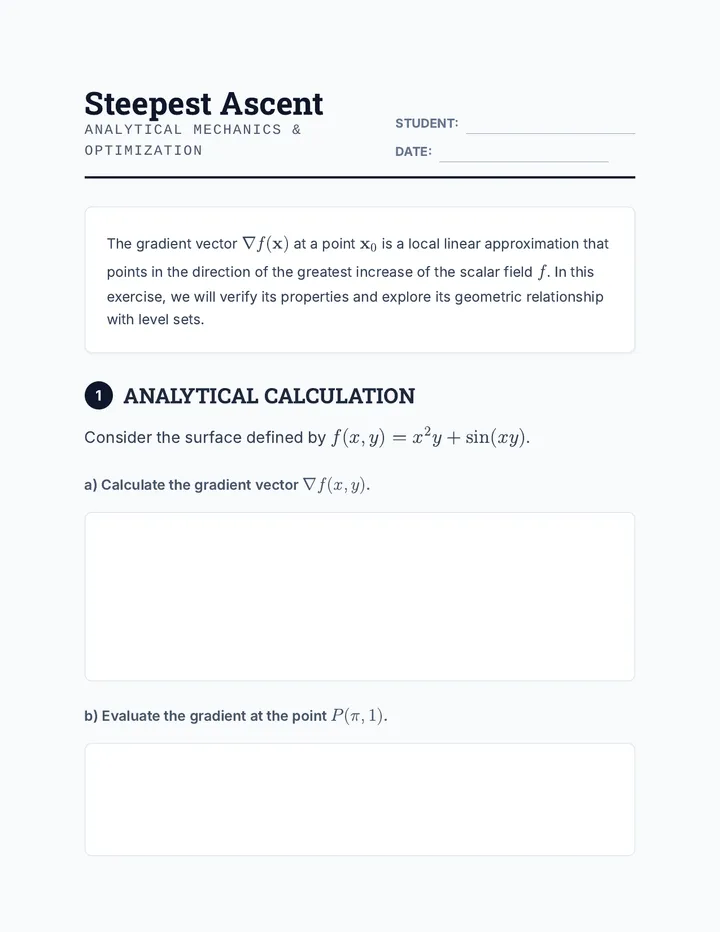
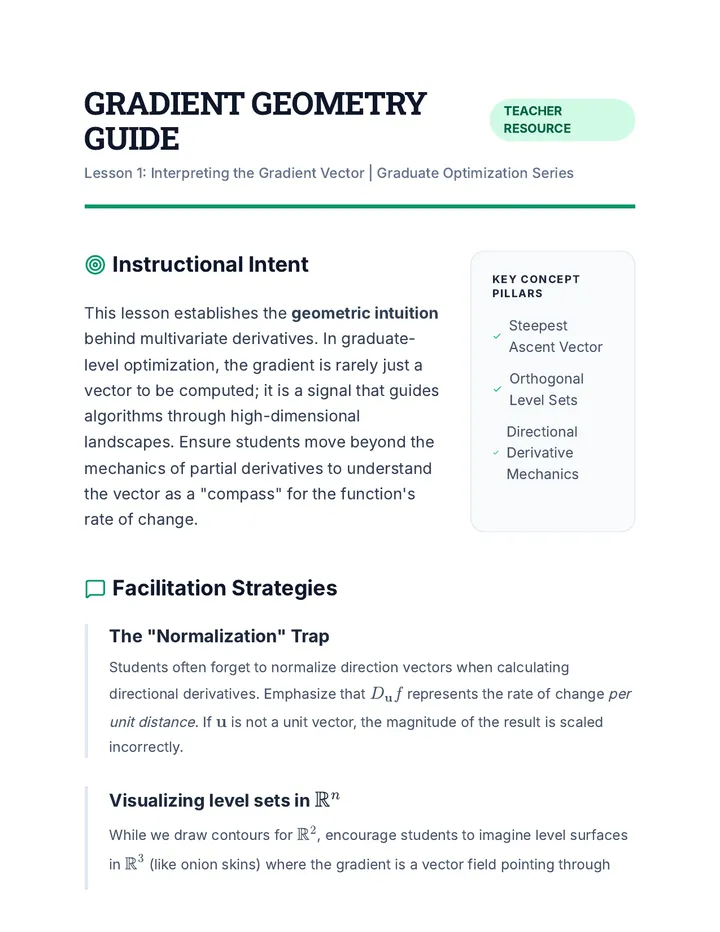
A graduate-level sequence exploring the gradient vector as the foundational tool for modern optimization. Students move from the geometric interpretation of multivariate derivatives to the implementation of stochastic algorithms used in machine learning.
An advanced graduate-level exploration of stochastic processes, covering discrete and continuous-time Markov chains, Poisson processes, and queueing theory. The sequence bridges theoretical rigor with computational application through simulations and real-world modeling.
An advanced graduate-level sequence exploring the mathematical foundations and computational applications of stochastic processes, from discrete-time Markov chains to Monte Carlo simulations.
A comprehensive introduction to Time Series Analysis for 12th-grade students, focusing on random processes, autocorrelation, stationarity, and smoothing techniques. Students move from basic random walks to understanding complex dependencies in temporal data.
A project-based exploration of stochastic modeling, focusing on Queueing Theory and Monte Carlo simulations. Students design and build computational models to optimize real-world systems like traffic flow and service lines.
A 12th-grade statistics sequence exploring Poisson processes, transitioning from discrete counts to continuous time intervals and waiting times. Students will investigate arrival rates, the exponential distribution, and the unique memoryless property through inquiry and simulation.
A high-level exploration of stochastic processes, focusing on how random systems reach equilibrium. Students will master Markov chains, steady-state algebra, and real-world applications like Google's PageRank algorithm.
A comprehensive sequence for 12th-grade students on discrete-time Markov chains, covering state diagrams, transition matrices, and n-step probability calculations using matrix algebra.
A graduate-level sequence exploring continuous-time stochastic processes through the lens of computational simulation. Students transition from discrete to continuous time models, focusing on Poisson processes, CTMCs, and queuing theory with a strong emphasis on empirical validation and theoretical rigor.
A graduate-level exploration of the mathematical foundations of discrete-time Markov chains, focusing on state classification, limiting behavior, and time reversibility. This sequence emphasizes formal derivation, proofs, and the application of linear algebra to stochastic systems.