6 Congruent Faces
Face Breakdown (Net)
Face 1: 6 × 6 = 36 cm²
Face 2: 6 × 6 = 36 cm²
Face 3: 6 × 6 = 36 cm²
Face 4: 6 × 6 = 36 cm²
Face 5: 6 × 6 = 36 cm²
Face 6: 6 × 6 = 36 cm²
All 6 faces are 6 cm × 6 cm
Teacher Solution Notes:
Each square face has an area of \(6 \times 6 = 36\text{ cm}^2\). Since there are 6 congruent faces in the unfolded net:
Total SA = 6 × 36 cm² = 216 cm²
Area of 1 face = 36 cm²
Total SA =
216 cm²
6
Matching Pairs on Net
Face Matching Guide
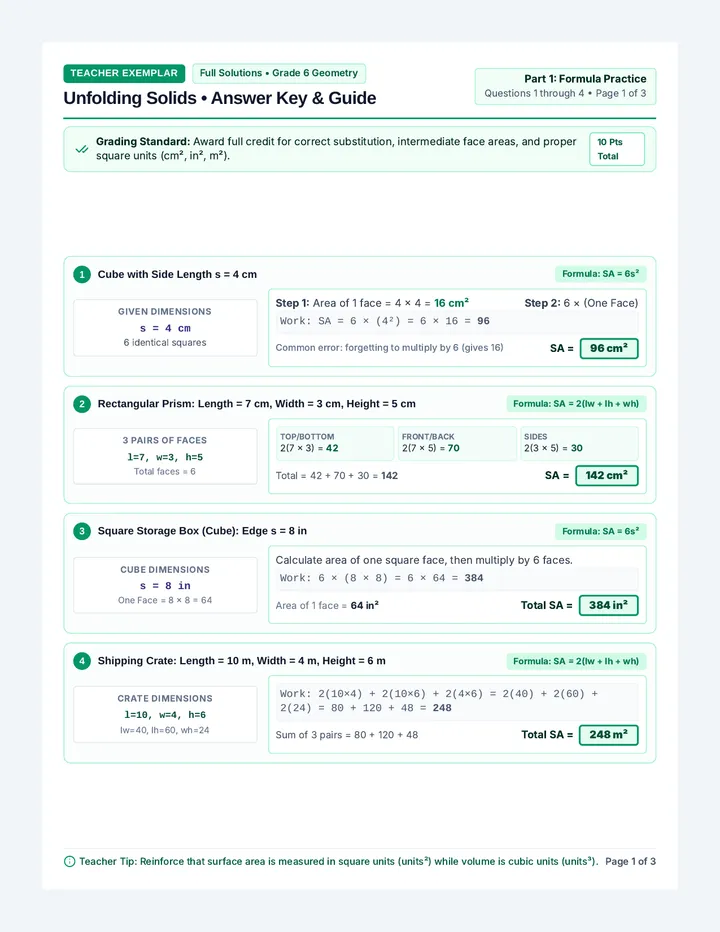
Top & Bottom Faces: 2 × (6 × 4) = 48 cm²
Front & Back Faces: 2 × (6 × 2) = 24 cm²
Left & Right Wings: 2 × (4 × 2) = 16 cm²
Complete Summation:
Sum the 3 pairs of matching rectangles calculated from the unfolded net:
Total SA = 48 + 24 + 16 = 88 cm²
Check: 2(lw + lh + wh) = 2(24 + 12 + 8) = 2(44) = 88 cm².
Add all 6 faces: 48 + 24 + 16
Total SA =
88 cm²
7
Sum of Net Faces
Face Dimensions Breakdown
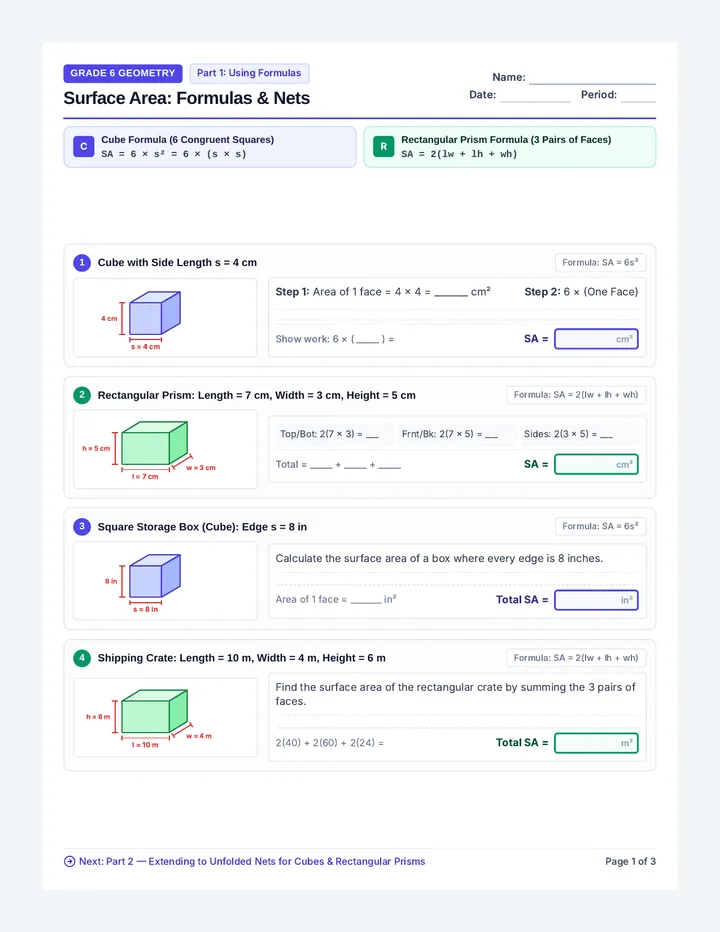
Top & Bottom (9 × 3): 2 × 27 = 54 cm²
Front & Back (9 × 5): 2 × 45 = 90 cm²
Left & Right (5 × 3): 2 × 15 = 30 cm²
Complete Summation:
Add each calculated component together:
Total SA = 54 + 90 + 30 = 174 cm²
Instructional note: Remind students that dimensions of wings (5 × 3) must match height and width of the connecting center faces.
Sum: 54 + 90 + 30
Total SA =
174 cm²
Next: Solutions for Triangular Prisms (Questions 8, 9, and 10) Page 2 of 3
Teacher Exemplar Part 3: Triangular Prisms
Questions 8, 9, 10 Page 3 of 3
Core Formula Structure: Total SA = 2 × (½ × b × h) + (s₁ + s₂ + s₃) × Length
Always 5 faces: 2 triangles + 3 rectangles
8
Right Triangle: Legs 3 & 4
Detailed Face Breakdown
2 Triangular Bases (Legs 4 and 3): 2 × (½ × 4 × 3) = 2 × 6 = 12 cm²
3 Rectangular Faces (Length 8 cm): (3 × 8) + (4 × 8) + (5 × 8) = 24 + 32 + 40 = 96 cm²
Notice: 2 × ½ cancel out: 4 × 3 = 12
Total Surface Area Calculation:
Total SA = Triangles (12) + Rectangles (96) = 108 cm²
Key Misconception: Students often accidentally use hypotenuse (5) as the height. Remind them that in a right triangle, the two perpendicular legs (3 and 4) are the base and height!
12 + 96 =
Total SA =
108 cm²
9
Right Triangle: Legs 6 & 8
Detailed Face Breakdown
2 Triangular Bases (Legs 8 and 6): 2 × (½ × 8 × 6) = 2 × 24 = 48 cm²
3 Rectangular Faces (Length 5 cm): (6 × 5) + (8 × 5) + (10 × 5) = 30 + 40 + 50 = 120 cm²
Perimeter of base × length: (6+8+10) × 5 = 24 × 5 = 120
Total Surface Area Calculation:
Total SA = Triangles (48) + Rectangles (120) = 168 cm²
Shortcut Method: Lateral Area = Perimeter of triangle × Length of prism = \((6 + 8 + 10) \times 5 = 120\text{ cm}^2\). Total SA \(= 48 + 120 = 168\text{ cm}^2\).
48 + 120 =
Total SA =
168 cm²
10
Isosceles: Slant Sides = 5 cm
Detailed Face Breakdown
2 Isosceles Triangular Bases (b = 6, h = 4): 2 × (½ × 6 × 4) = 2 × 12 = 24 cm²
3 Rectangular Faces (Length 7 cm): (5 × 7) + (6 × 7) + (5 × 7) = 35 + 42 + 35 = 112 cm²
2 slanted rectangles (5×7) + 1 bottom rectangle (6×7)
Total Surface Area Calculation:
Total SA = Triangles (24) + Rectangles (112) = 136 cm²
Critical Distinction: Remind students that the perpendicular height (4 cm) is ONLY used to find the triangle area. The slant side (5 cm) is used for the rectangle dimensions!
24 + 112 =
Total SA =
136 cm²
Grade 6 Geometry Exemplar • Unfolding Solids Mastery Guide Page 3 of 3