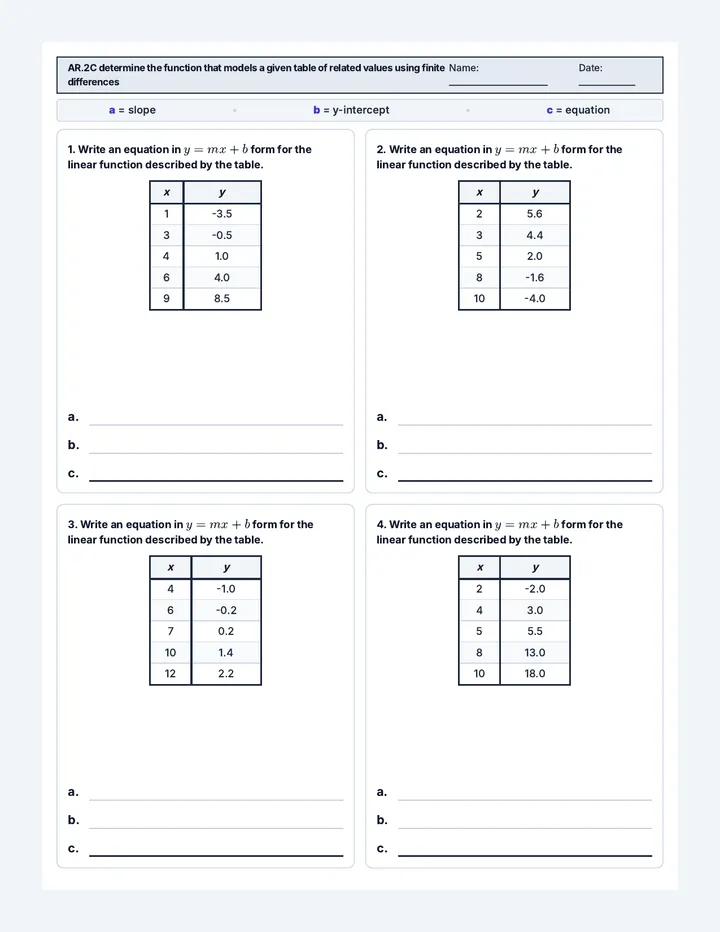
Intercept Navigator Guided Practice AR.3A Key Attributes Tables & Linear Equations
Finding the y-Intercept & Writing Equations
Name:
Date:
y-Intercept (\(b\)): Point on y-axis where \(x = 0 \rightarrow (0, b)\).
Slope (\(m\)): Rate of change \(\frac{\Delta y}{\Delta x}\).
Equation Form: \(y = mx + b\)
Model
Step-by-Step Solution Walkthrough
Study each step from table to equation
+1 +1 +1
+1 +1 +1
y-intercept: \(x = 0\)
1 Find Slope (\(m\))
Rate of change:
\(m = \frac{+1}{+1} = 1\)
2 Find \(y\)-Int (\(b\))
When \(x = 0\):
\(b = 1\)
3 Coordinates
Ordered pair:
( 0 , 1 )
4 Equation
\(y = mx + b\):
\(y = x + 1\)
Problem 1
Guided Practice
Use margin space around table for scratchwork
Analyze the table:
y-Intercept
( , )
1 Slope (\(m\)):
Write differences next to \(x\) and \(y\). Constant rate:
\(m =\)
2 y-Intercept (\(b\)):
Find the row where \(x = 0\). The matching \(y\)-value is:
\(b =\)
3 Attributes:
What are the coordinates of the x-intercept where \(y = 0\)?
( , )
4 Write the Equation:
Substitute \(m\) and \(b\) into slope-intercept form (\(y = mx + b\)):
y =
Problem 2
Independent Practice
Use margin space around table for scratchwork
Analyze the table:
y-Intercept
( , )
1 Slope (\(m\)):
Calculate row change in \(x\) and \(y\). Rate of change:
\(m =\)
2 y-Intercept (\(b\)):
Find \(x = 0\) in the table. The matching output is:
\(b =\)
3 Attributes:
What are the coordinates of the x-intercept where \(y = 0\)?
( , )
4 Write the Equation:
Substitute \(m\) and \(b\) into slope-intercept form (\(y = mx + b\)):
y =
Full Linear Workflow: 1. Calculate rate \(m\) \(\rightarrow\) 2. Identify \(b\) at \(x = 0\) \(\rightarrow\) 3. State intercepts \(\rightarrow\) 4. Write \(y = mx + b\).
Page 1 of 1
Intercept Navigator Answer Key Teacher Answer Key AR.3A Key Attributes
Finding the y-Intercept & Writing Equations
Solutions & Facilitation Notes Aligned to Grade 8 / Algebra 1 TEKS AR.3A
Key Concept: y-intercept is always \((0, b)\); students often confuse it with x-intercept \((a, 0)\).
Mastery Check: Ensure students write \(y = mx + b\) with correct signs.
Model Solution
Step-by-Step Solution Walkthrough
Class Demonstration Example
+1 +1 +1
+1 +1 +1
y-intercept: \(x = 0 \rightarrow y = 1\)
1 Find Slope (\(m\))
Rate of change:
\(m = \frac{+1}{+1} = \mathbf{1}\)
2 Find \(y\)-Int (\(b\))
When \(x = 0\):
\(b = \mathbf{1}\)
3 Coordinates
Ordered pair:
\(\mathbf{(0, 1)}\)
4 Equation
\(y = mx + b\):
\(y = x + 1\)
Problem 1 Key
Guided Practice Solutions
Slope \(m = 2\), Intercept \(b = 4\)
Solved Table:
+1 +1 +1
+2 +2 +2
y-Intercept
( 0 , 4 )
1 Slope (\(m\)):
\(\Delta y = +2\), \(\Delta x = +1 \rightarrow\) Constant rate:
\(m =\) 2
2 y-Intercept (\(b\)):
Look where \(x = 0\). The matching \(y\)-value is:
\(b =\) 4
3 Attributes & Trap Check:
The point \((-2, 0)\) has \(y = 0\), so it is the x-intercept .
x-int: (-2, 0)
4 Final Equation:
Substitute \(m = 2\) and \(b = 4\) into \(y = mx + b\):
\(y = 2x + 4\)
Problem 2 Key
Independent Practice Solutions
Negative rate of change: \(m = -3\), \(b = 6\)
Solved Table:
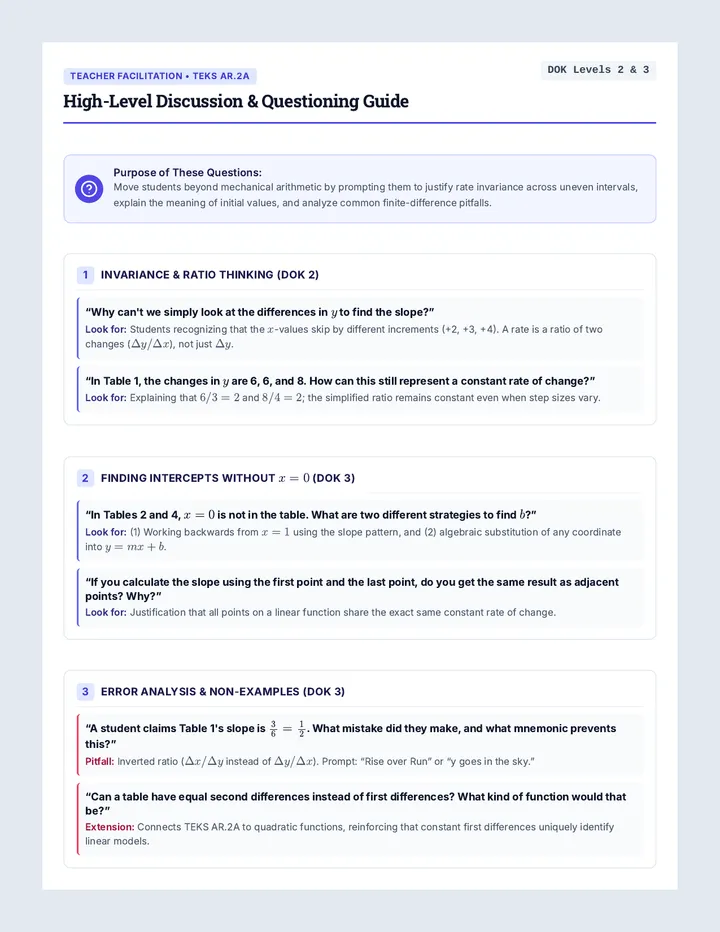
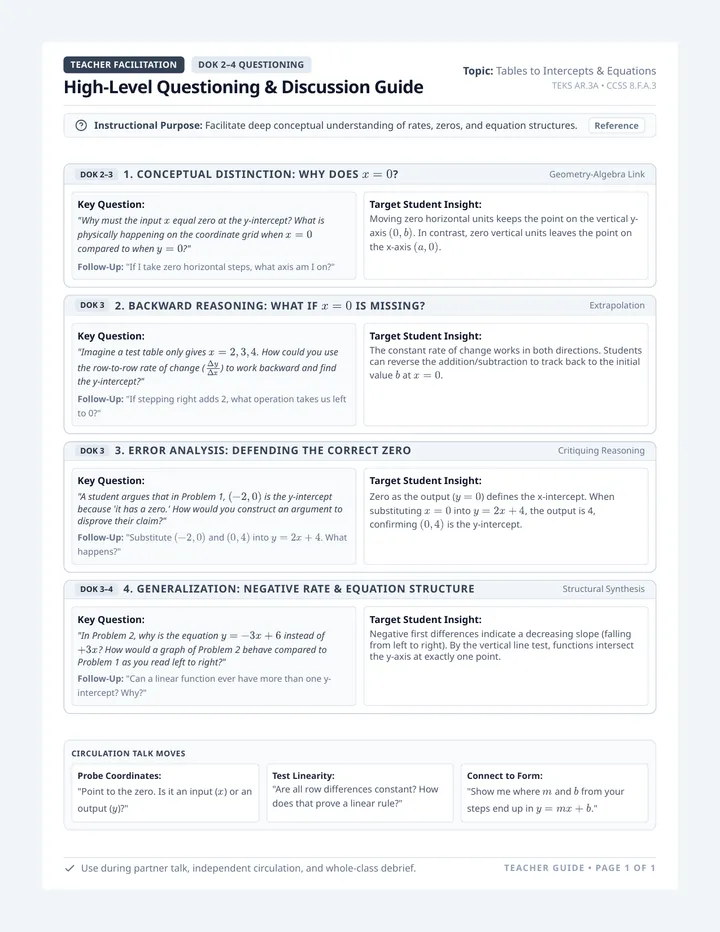
Table Intercepts Questioning Guide Teacher Facilitation DOK 2–4 Questioning
High-Level Questioning & Discussion Guide
Topic: Tables to Intercepts & Equations
Instructional Purpose: Facilitate deep conceptual understanding of rates, zeros, and equation structures.
Reference
DOK 2–3
1. Conceptual Distinction: Why Does \(x = 0\)?
Geometry-Algebra Link
Key Question:
"Why must the input \(x\) equal zero at the y-intercept? What is physically happening on the coordinate grid when \(x = 0\) compared to when \(y = 0\)?"
Follow-Up: "If I take zero horizontal steps, what axis am I on?"
Target Student Insight:
Moving zero horizontal units keeps the point on the vertical y-axis \((0, b)\). In contrast, zero vertical units leaves the point on the x-axis \((a, 0)\).
DOK 3
2. Backward Reasoning: What if \(x = 0\) Is Missing?
Extrapolation
Key Question:
"Imagine a test table only gives \(x = 2, 3, 4\). How could you use the row-to-row rate of change (\(\frac{\Delta y}{\Delta x}\)) to work backward and find the y-intercept?"
Follow-Up: "If stepping right adds 2, what operation takes us left to 0?"
Target Student Insight:
The constant rate of change works in both directions. Students can reverse the addition/subtraction to track back to the initial value \(b\) at \(x = 0\).
DOK 3
3. Error Analysis: Defending the Correct Zero
Critiquing Reasoning
Key Question:
"A student argues that in Problem 1, \((-2, 0)\) is the y-intercept because 'it has a zero.' How would you construct an argument to disprove their claim?"
Follow-Up: "Substitute \((-2, 0)\) and \((0, 4)\) into \(y = 2x + 4\). What happens?"
Target Student Insight:
Zero as the output (\(y=0\)) defines the x-intercept. When substituting \(x = 0\) into \(y = 2x + 4\), the output is 4, confirming \((0, 4)\) is the y-intercept.
DOK 3–4
4. Generalization: Negative Rate & Equation Structure
Structural Synthesis
Key Question:
"In Problem 2, why is the equation \(y = -3x + 6\) instead of \(+3x\)? How would a graph of Problem 2 behave compared to Problem 1 as you read left to right?"
Follow-Up: "Can a linear function ever have more than one y-intercept? Why?"
Target Student Insight:
Negative first differences indicate a decreasing slope (falling from left to right). By the vertical line test, functions intersect the y-axis at exactly one point.