Lenny.com
Explore
Create
ActivitiesNewMathEnglish Language ArtsScience & EngineeringSocial StudiesGlobal LanguagesHealth & Physical EducationSpecial EducationCounseling & Life SkillsArts & CreativityESL
Lenny.com
Lenny.com
Explore
Create
ActivitiesNewMathEnglish Language ArtsScience & EngineeringSocial StudiesGlobal LanguagesHealth & Physical EducationSpecial EducationCounseling & Life SkillsArts & CreativityESL
Lenny.com
Lenny.com

Solutions

Lenny for EducatorsLenny for SchoolsLenny for Districts

Product

ExploreSign inCreateSupportAbout

Resources

Getting startedMTSS Acceleration Program

© 2026 Lenny Learning Inc.

TermsPrivacyAccessibility
LinkedInInstagramX
Lenny
MathNumbers & CountingCounting ObjectsNumber NamesComparing NumbersNumber OperationsCounting SequenceNumbers 0-10Place Value Understanding and SystemAdd and Subtract Within 20Addition and Subtraction ConceptsAddition and Subtraction EquationsAddition and Subtraction ProblemsFoundations for MultiplicationMultiplication and Division PropertiesMultiply and Divide Within 100Multiplication and Division ProblemsFactors and MultiplesProperties of OperationsPatterns and RelationshipsGenerate and Analyze PatternsMulti-Digit ArithmeticPlace Value OperationsMulti-Digit and Decimal OperationsNumerical ExpressionsFour Operations and PatternsFour Operations Problem SolvingMeasurement & DataMeasurable AttributesMeasuring LengthsMeasure and Estimate Lengths in Standard UnitsRelate Addition and Subtraction to LengthClassifying and Counting ObjectsTime and MoneyArea Concepts and MeasurementPerimeter and Area MeasuresAngle Concepts and MeasurementTime, Volume, and MassMeasurement Unit ConversionsGeometryIdentifying ShapesShapes and AttributesShape Attributes and ReasoningShapes and CompositionClassifying 2D FiguresGeometric Figures and RelationshipsLines, Angles, and ShapesAngle, Area, and VolumeGeometric MeasurementVolume of 3D ShapesCoordinate Plane ApplicationsTransformations in the PlaneCongruence and SimilarityUnderstand congruence in terms of rigid motionsSimilarity and TransformationsProve Theorems Involving SimilarityPythagorean TheoremTrigonometry for General TrianglesMake Geometric ConstructionsProve Geometric TheoremsTheorems About CirclesFind Arc Lengths And Areas of Sectors of CirclesVolume FormulasRelationships Between Two-Dimensional and Three-Dimensional ObjectsProve Simple Geometric Theorems AlgebraicallyTranslate Between Geometric Description and Equation for Conic SectionApply Geometric Concepts in Modeling SituationsFractions & DecimalsFractions as NumbersBuilding FractionsFraction Equivalence and OrderingAdding and Subtracting FractionsMultiplying and Dividing FractionsDividing FractionsDecimal FractionsMulti-Digit Computation and FactorsAdd, Subtract, Multiply, and Divide Rational NumbersRational Number SystemIrrational Numbers and ApproximationsRatiosRatios and ProportionsProportional RelationshipsUnit RateAlgebraAlgebraic ExpressionsGenerate Equivalent ExpressionsQuantitative RelationshipsProportional Relationships and Linear EquationsEquations and InequalitiesEquation Solving and ReasoningLinear Equations and SystemsGraph Equations and InequalitiesSystems of EquationsReal-World Algebraic ProblemsQuantitative Reasoning with UnitsExpression StructureEquivalent Expression FormsRadicals and Integer ExponentsRational ExponentsRational and Irrational NumbersPolynomial OperationsPolynomial IdentitiesPolynomial Zeros and FactorsRational ExpressionsComplex Number OperationsComplex Numbers in PolynomialsComplex Numbers on PlaneStatistics & ProbabilityRepresent and Interpret DataData DistributionsStatistical VariabilityProbability ModelsCompound Event ProbabilitiesStatistical SamplingInterpret Categorical and Quantitative DataBivariate Data PatternsInterpret Linear ModelsComparing Two PopulationsRandom Processes in StatisticsIndependence and Conditional ProbabilityExpected ValuesProbability-Based Decision MakingStatistical Inference and ConclusionsFunctionsFunction Concepts and NotationDefine and Compare FunctionsInterpret Functions in ContextAnalyze Function RepresentationsModel Relationships with FunctionsIdentify Linear vs Exponential GrowthDistinguish Between Function TypesCompare Growth RatesInterpret Function ExpressionsBuild Functions from RelationshipsConstruct and Model FunctionsTransform and Combine FunctionsModel Comparison and SelectionSolve Exponential EquationsTrigonometryTrigonometric Ratios Involving Right TrianglesTrigonometric Functions and Unit CircleModel with Trigonometric FunctionsTrigonometric IdentitiesVectors & MatricesIntroduction to Vectors and MatricesVector QuantitiesVector OperationsMatrix OperationsCalculusLimits and ContinuityDerivative Concepts and NotationDerivative Rules and TechniquesApplications of DerivativesOptimization ProblemsRelated RatesCurve Sketching and AnalysisIntegration Concepts and NotationAntiderivatives and Indefinite IntegralsDefinite Integrals and AreaFundamental Theorem of CalculusIntegration TechniquesApplications of IntegrationDifferential EquationsSequences and SeriesParametric and Polar FunctionsVector-Valued Functions

Stunt Park Math

A high-octane 30-minute math mini-lesson where students investigate real-world applications of angles in archery, force and rebound height on a giant bounce pad, and distance and velocity along an extreme zip line. Students act as stunt safety inspectors calculating trajectory tolerances, impact dynamics, and motion profiles before approving a safe park layout.

AAalicia accapezzato

Station 3

Zip Line Distance & Velocity

Pacing: 19:00 – 26:00

Flight Path Dimensions

Right Triangle Cable Span

Horizontal Run (\(a\)): 80.0 Meters

Vertical Drop (\(b\)): 24m − 6m = 18.0 Meters

Test Run Transit Time (\(t\)): 5.0 Seconds

Formulas: \(c = \sqrt{a^2 + b^2}\)  |  \(v_{\text{avg}} = \frac{c}{t}\)

Velocity Audit Tasks

    1. Find true diagonal cable distance \(c\) using Pythagoras.
    1. Calculate average velocity in meters per second (m/s).
    1. Convert velocity to km/h (\(\times 3.6\)). Is it within the 60 km/h limit?

🛑 Braking Clearance: Magnetic catch requires ≥ 15m runout buffer.

Dossier: Complete Station 3 on Page 1 Cable Distance \(\approx 82.0\text{ m}\) • Speed \(\approx 16.4\text{ m/s}\) (59.0 km/h)


Synthesis

Layout Audit: Alpha vs. Beta

Pacing: 26:00 – 29:00

Layout Alpha

FLAW DETECTED

• Archery Range: Pointed toward access path with only 6° safety clearance (Code requires ≥ 15°).

• Zip Line Braking: Landing zone is 8m before perimeter fence (Code requires ≥ 15m).

• Bounce Pad: Positioned adjacent to zip line support anchor (collision risk).

❌ Fails State Safety Inspection

Layout Beta

OPTIMIZED

• Archery Range: Oriented into reinforced earth berm with 22° clear margin.

• Zip Line Braking: Full 18m straight-line runout with emergency magnetic arrestor.

• Bounce Pad: 12m perimeter fall buffer with padded perimeter zone.

✅ Meets 100% Code Compliance

Turn to Page 2 of your Inspector Dossier Verify compliance checks and state your engineering rationale!


Final Certification & Debrief

Final 60 Seconds

Inspector Sign-Off Protocol

Before submitting your dossier, make sure both engineering inspectors have signed the certification stamp and verified all three mathematical tolerances.

Archery Angle

2.9° Elevation

Max Bounce Force

4,508 N (<5 kN)

Zip Cable Speed

16.4 m/s (59 km/h)

Apex Stunt Park Engineering Review Submit Dossier to Lead Inspector (Teacher)

Engineering Audit: Plan a Safe Setup

Phase 2: Layout Optimization

Compare two proposed park configurations against municipal safety codes. Calculate angular clear-zones, runout braking margins, and fall perimeter buffers to identify the compliant blueprint.

Layout Alpha (Current Draft)

Option A

🎯 Archery Direction: Toward East Fence

• Overshoot safety angle cone: 8° from centerline
• Lateral distance to main pedestrian pathway: 5.5 m

🚡 Zip Line Landing: 8.0 m Braking Runout

• Distance from brake trolley to boundary fence: 8.0 m

🎪 Bounce Pad Buffer: 4.5 m Perimeter

• Clearance to adjacent zip line steel anchor: 3.0 m

Layout Beta (Proposed Revision)

Option B

🎯 Archery Direction: Toward North Berm

• Overshoot safety angle cone: 22° into earth berm
• Lateral distance to pedestrian pathway: 28.0 m

🚡 Zip Line Landing: 18.0 m Braking Runout

• Distance from brake trolley to boundary fence: 18.0 m

🎪 Bounce Pad Buffer: 10.0 m Perimeter

• Clearance to nearest structure/tower: 12.0 m

1. Braking Distance Safety Check:

At \(16.4\text{ m/s}\), magnetic braking requires stopping distance \(d_{\text{stop}} = \frac{v^2}{2a}\). With emergency deceleration \(a = 12\text{ m/s}^2\), calculate minimum safe runout distance (\(d_{\text{stop}} = \frac{16.4^2}{24} = \frac{269}{24}\)). Which layout provides adequate clearance?

2. Archery Angle Clearance Check:

State code mandates a minimum safety overshoot cone angle of ≥ 15.0° on both sides of target line without pedestrian foot traffic. Which layout satisfies this code? Show evidence:

Safety Code Audit Matrix

Safety FeatureMandated StandardLayout AlphaLayout Beta
Archery Safety Cone≥ 15.0° Clear Sector[   ] Pass   [   ] Fail[   ] Pass   [   ] Fail
Zip Line Braking Runout≥ 12.0 m Buffer Zone[   ] Pass   [   ] Fail[   ] Pass   [   ] Fail
Bounce Pad Perimeter≥ 6.0 m Obstacle Clearance[   ] Pass   [   ] Fail[   ] Pass   [   ] Fail

Final Inspector Determination Official Municipal Sign-off

I hereby recommend [   ] Layout Alpha     [   ] Layout Beta for official park construction.

Engineering Justification (Cite mathematical proof from calculations above):

Lead Inspector Signature: ____________________________ Clearance Status: [   ] APPROVED   [   ] REJECTED

Apex Safety Engineering • Field Verification Page 2 of 2


Layout Beta has 18.0 m buffer:

2. Archery Angle Clearance Verdict:

• Layout Alpha: \(8.0^\circ\) clear cone < \(15.0^\circ\) mandated standard → FAIL (Path is only 5.5m away).
• Layout Beta: \(22.0^\circ\) clear cone ≥ \(15.0^\circ\) mandated standard → PASS (Targets point safely into earth berm).

Code StandardLayout AlphaLayout BetaInspector Analysis
Archery Cone (≥ 15°)FAIL (8°)PASS (22°)Alpha points toward walking traffic; Beta points to berm.
Zip Braking Runout (≥ 12m)FAIL (8.0m)PASS (18.0m)Alpha runout is 3.2m shorter than stopping distance (11.2m).
Bounce Buffer (≥ 6m)FAIL (4.5m)PASS (10.0m)Alpha has metal anchor 3m away; Beta has 12m clear space.

Final Inspector Approval: LAYOUT BETA IS APPROVED. Students must cite at least two mathematical proofs (e.g. \(11.2\text{ m} > 8\text{ m}\) braking hazard, and \(22^\circ \ge 15^\circ\) archery clearance) for full credit.

Apex Engineering Solutions Key • Total Score: 20 Points Confidential Teacher Material
You might also like

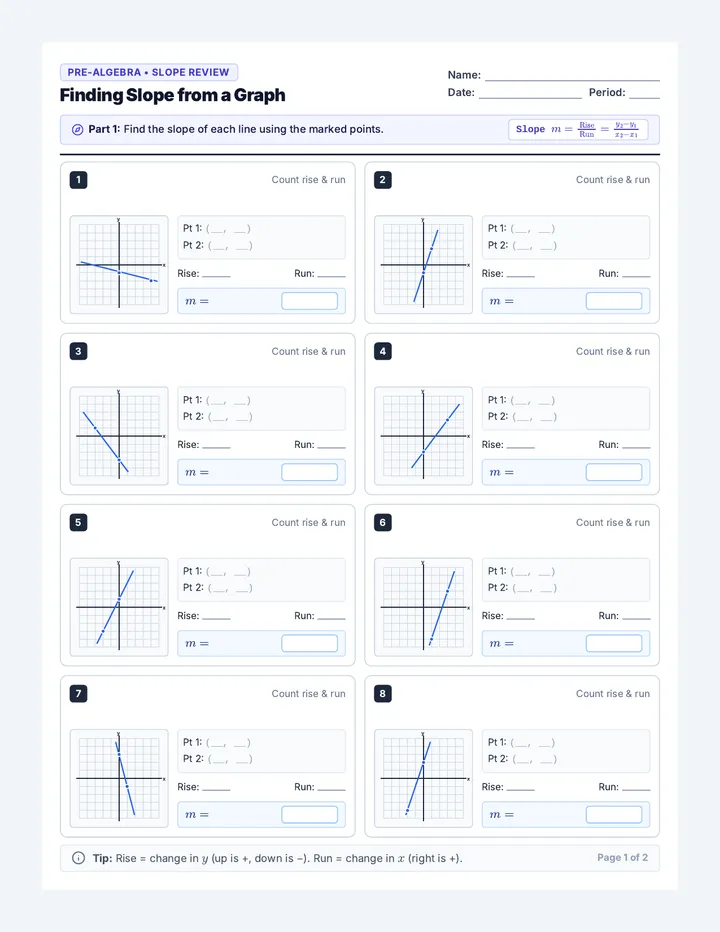
Slope Review Practice Worksheet

Pre-Algebra Concepts

A comprehensive pre-algebra and introductory geometry sequence covering linear equations, slope analysis, and coordinate plane transformations.

FM

Fernando Mancini

6
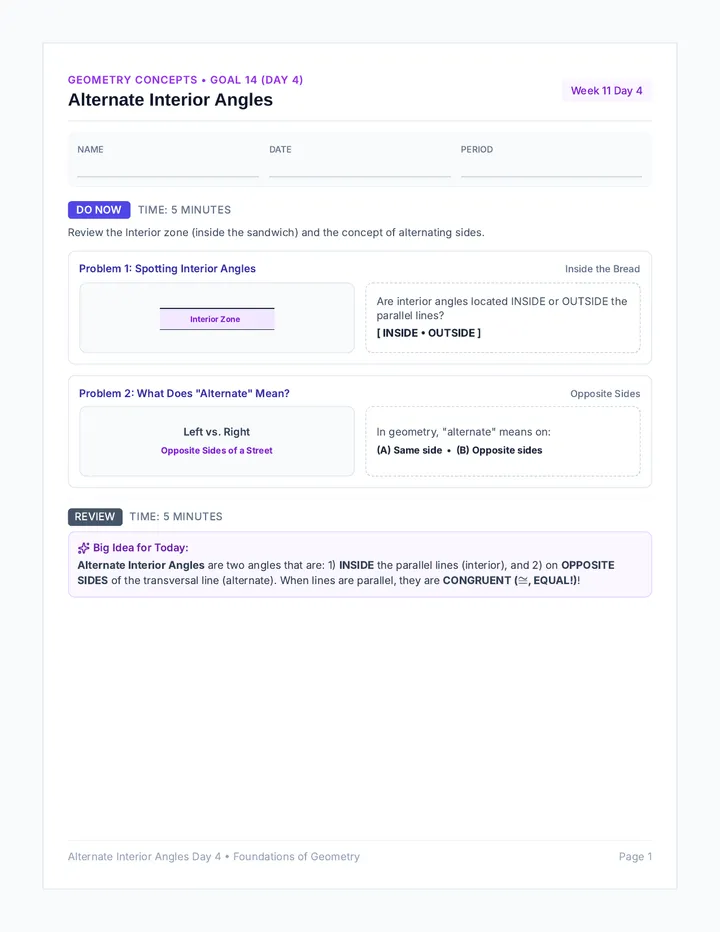
Alternate Interior Day 4 Student Packet

Alternate Interior Day Four

Day 4 of Goal 14 on identifying and naming alternate interior angles formed when parallel lines are cut by a transversal, designed for SPED students. Focuses on the inside zigzag 'Z-shape' model, opposite sides of the transversal, and congruence rules.

D

deeohnny.jackson

2
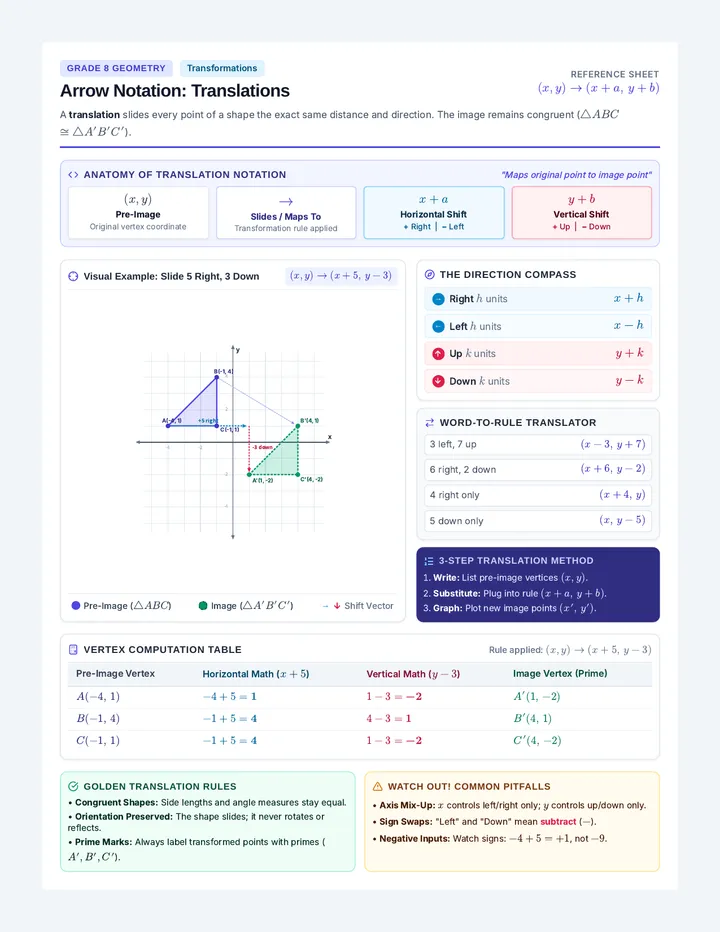
Shape Shifts Reference Sheet

Shape Shifts Reference Sheet

A comprehensive Grade 8 reference sheet explaining coordinate plane translations and arrow notation, featuring color-coded algebraic rules, a labeled coordinate grid diagram, vertex calculation table, and direction compass.

JD

Jenna Dzioba

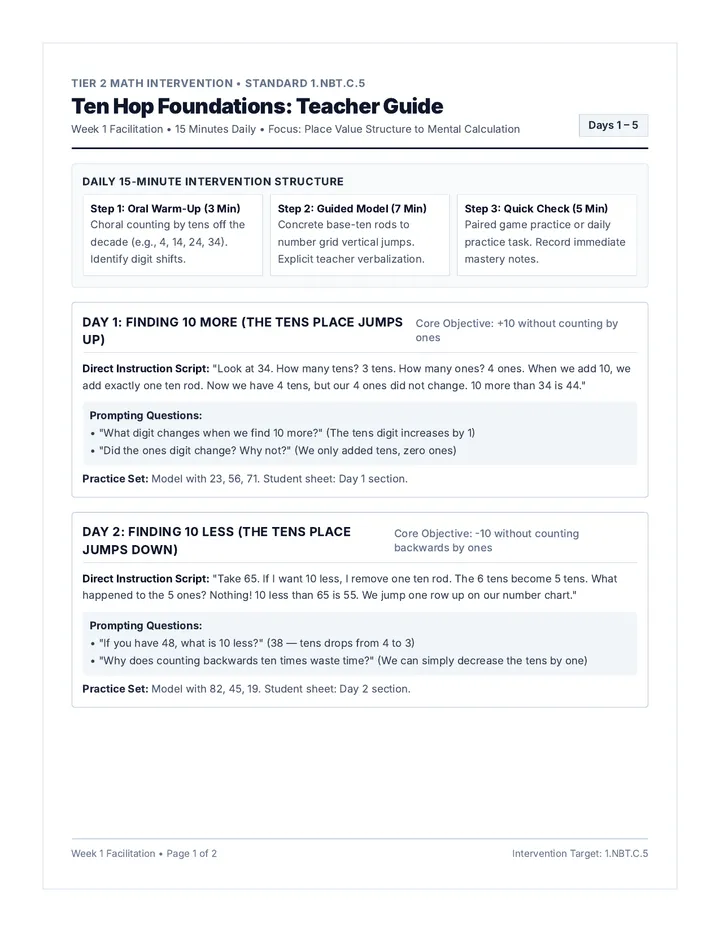
Ten Hop Week One Teacher Guide

Ten Leap Intervention

A targeted two-week Tier 2 mathematics intervention focusing on standard 1.NBT.C.5. Students develop conceptual understanding and mental fluency finding ten more and ten less than any two-digit number.

K

kkipperman

7
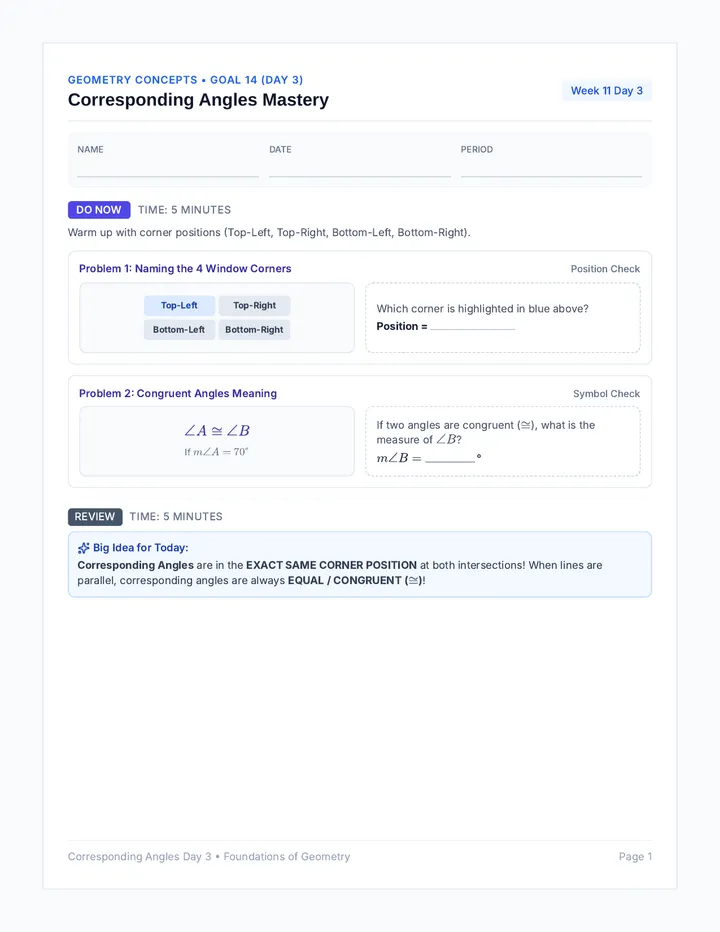
Corresponding Angles Day 3 Student Packet

Corresponding Angles Day Three

Day 3 of Goal 14 on identifying and naming corresponding angles formed when parallel lines are cut by a transversal, designed for SPED students. Focuses on the 'same position' matching corner model, the letter F visual anchor, and congruence rules.

D

deeohnny.jackson

2
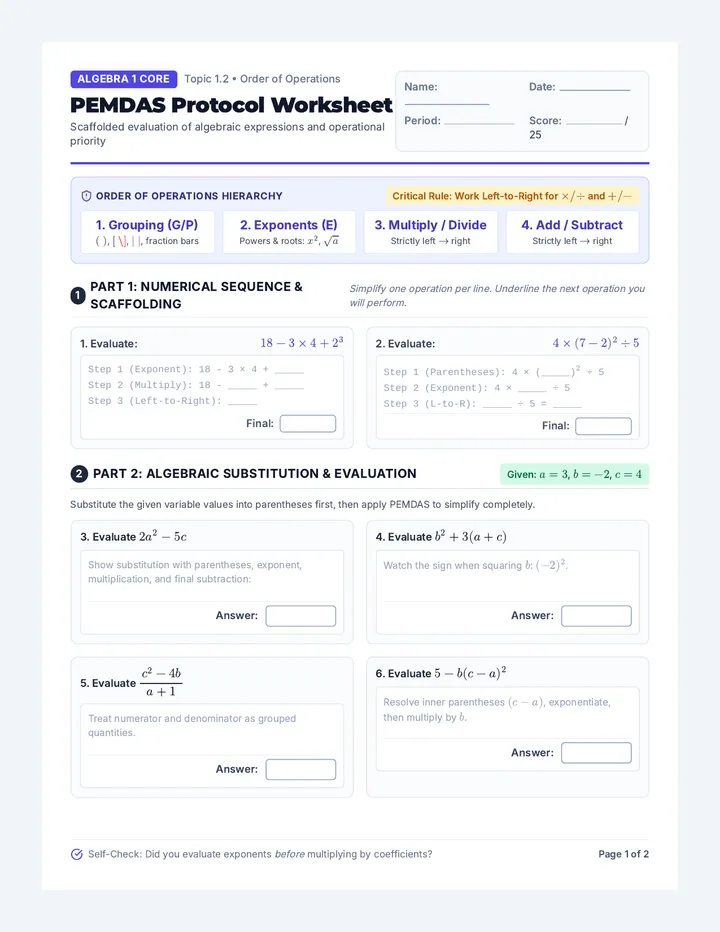
PEMDAS Protocol Worksheet

PEMDAS Protocol Worksheet

A comprehensive 2-page scaffolded algebra worksheet practicing the order of operations (PEMDAS/GEMDAS). Includes numerical warmups, variable substitution, nested grouping symbols, combining like terms with operations, error analysis, and formula evaluation.

TL

Tricia Lucie

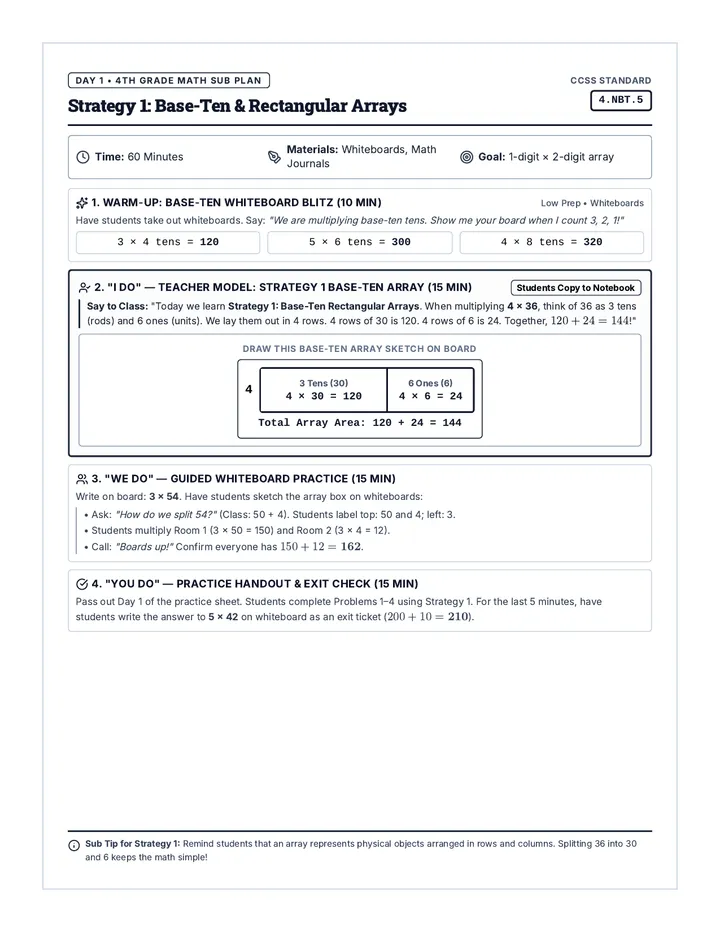
Single Digit Sub Guide

Multiplication Mastery Week

A comprehensive 5-day math curriculum sequence for 4th Grade standard 4.NBT.5, featuring scripted sub plans with gradual release, low-prep whiteboard and manipulative routines, student notebook guides, and a spiraled weekly homework packet.

RM

Rodnesha Minor

7
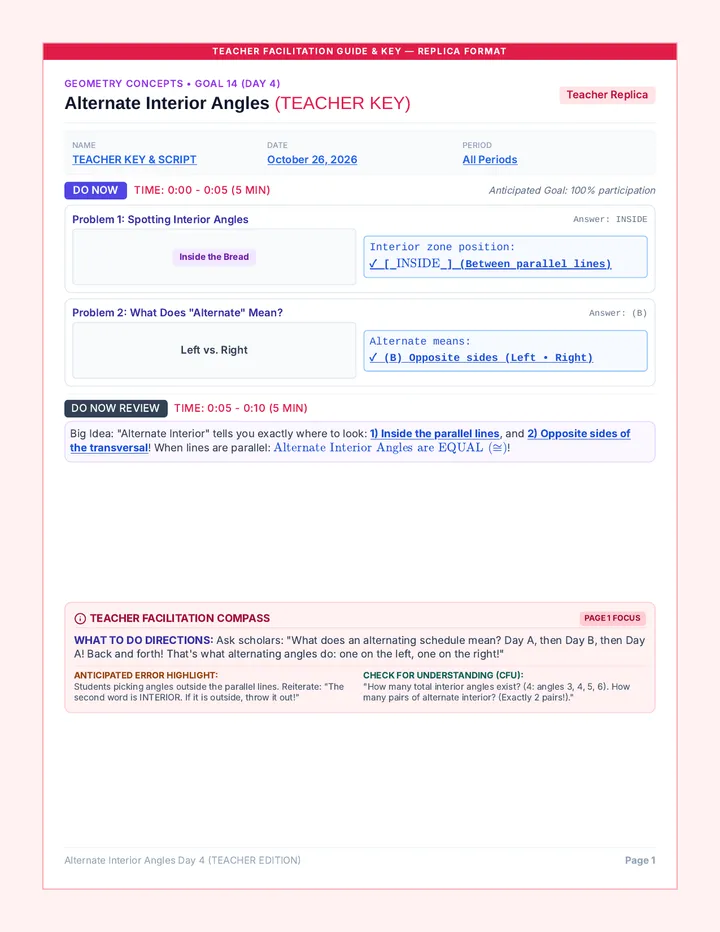
Alternate Interior Day 4 Teacher Packet

Alternate Interior Day 4 Teacher Packet

A highly annotated, 7-page teacher guide and replica of the Week 11 Day 4 student packet for alternate interior angles. It includes completed solutions in bold blue, word-for-word scripts, explicit timestamps, Lap-by-Lap monitoring guides, CFUs, and a prominent Notebook Stamp of Understanding.

D

deeohnny.jackson

Clue Words Presentation

Code Breakers Squad

A scaffolded pre-algebra sequence designed for sixth graders building confidence from second-grade arithmetic foundations. Students use code-breaking visual models, mystery boxes, number swaps, and equal-group arrays to master algebraic concepts without cognitive overload. Each lesson bridges concrete representations to symbolic expressions with age-respectful styling and supportive pacing.

MJ

Meg Jones

9
Alternate Interior Day 4 Student Packet

Alternate Interior Day 4 Student Packet

A highly-scaffolded, 7-page student work packet for Week 11 Day 4 on identifying and naming alternate interior angles formed by parallel lines cut by a transversal. Features the zigzag 'Z-shape' visual anchor, interior opposite-side maps, guided practice, an Exit Ticket, and Homework.

D

deeohnny.jackson

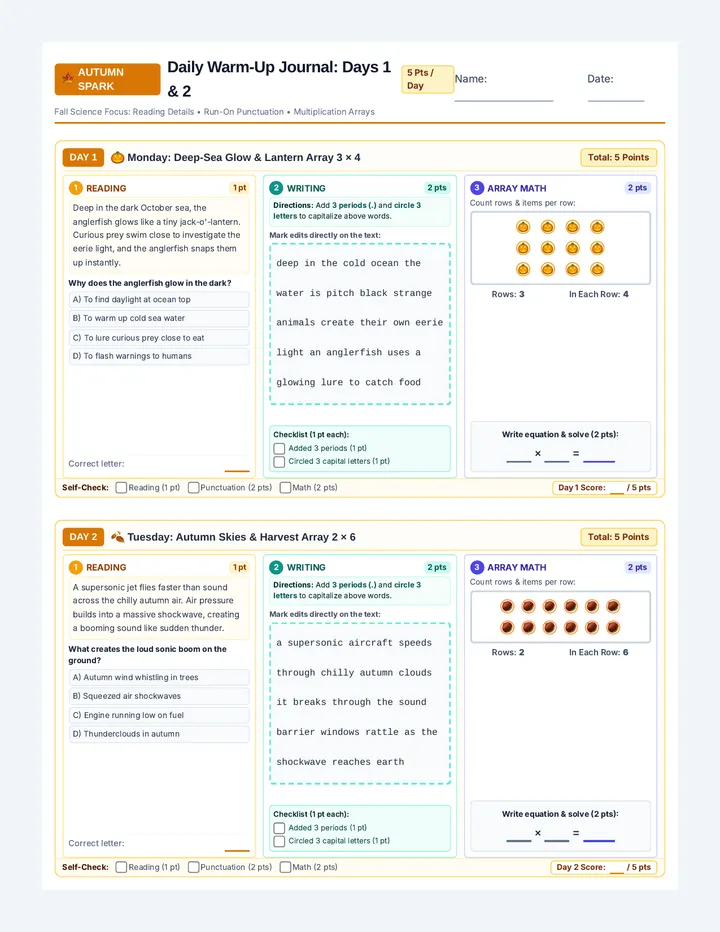
Autumn Warmup Packet

Daily Spark Warmups

A five-day daily warm-up sequence for 8th grade intervention classrooms featuring reading comprehension, sentence mechanics, and multiplication array modeling across three compact print pages.

KS

Kathleen Suther

3
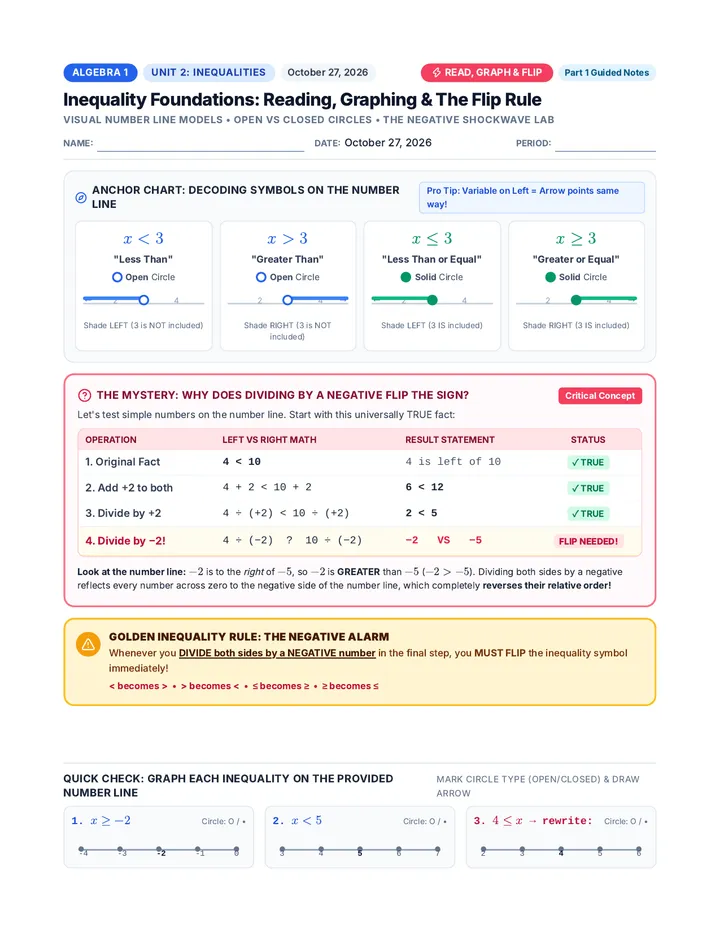
Sign Flip Foundations Handout

Sign Flip Showdown

A comprehensive Regents-aligned Algebra 1 sequence guiding students from reading and graphing inequalities on number lines to mastering multi-step linear inequalities using the visual Boxes and Circles cross-cross method.

H

Harlston

5