Lenny.com
Explore
Create
ActivitiesNewMathEnglish Language ArtsScience & EngineeringSocial StudiesGlobal LanguagesHealth & Physical EducationSpecial EducationCounseling & Life SkillsArts & CreativityESL
Lenny.com
Lenny.com
Explore
Create
ActivitiesNewMathEnglish Language ArtsScience & EngineeringSocial StudiesGlobal LanguagesHealth & Physical EducationSpecial EducationCounseling & Life SkillsArts & CreativityESL
Lenny.com
Lenny.com

Solutions

Lenny for EducatorsLenny for SchoolsLenny for Districts

Product

ExploreSign inCreateSupportAbout

Resources

Getting startedMTSS Acceleration Program

© 2026 Lenny Learning Inc.

TermsPrivacyAccessibility
LinkedInInstagramX
Lenny
MathNumbers & CountingCounting ObjectsNumber NamesComparing NumbersNumber OperationsCounting SequenceNumbers 0-10Place Value Understanding and SystemAdd and Subtract Within 20Addition and Subtraction ConceptsAddition and Subtraction EquationsAddition and Subtraction ProblemsFoundations for MultiplicationMultiplication and Division PropertiesMultiply and Divide Within 100Multiplication and Division ProblemsFactors and MultiplesProperties of OperationsPatterns and RelationshipsGenerate and Analyze PatternsMulti-Digit ArithmeticPlace Value OperationsMulti-Digit and Decimal OperationsNumerical ExpressionsFour Operations and PatternsFour Operations Problem SolvingMeasurement & DataMeasurable AttributesMeasuring LengthsMeasure and Estimate Lengths in Standard UnitsRelate Addition and Subtraction to LengthClassifying and Counting ObjectsTime and MoneyArea Concepts and MeasurementPerimeter and Area MeasuresAngle Concepts and MeasurementTime, Volume, and MassMeasurement Unit ConversionsGeometryIdentifying ShapesShapes and AttributesShape Attributes and ReasoningShapes and CompositionClassifying 2D FiguresGeometric Figures and RelationshipsLines, Angles, and ShapesAngle, Area, and VolumeGeometric MeasurementVolume of 3D ShapesCoordinate Plane ApplicationsTransformations in the PlaneCongruence and SimilarityUnderstand congruence in terms of rigid motionsSimilarity and TransformationsProve Theorems Involving SimilarityPythagorean TheoremTrigonometry for General TrianglesMake Geometric ConstructionsProve Geometric TheoremsTheorems About CirclesFind Arc Lengths And Areas of Sectors of CirclesVolume FormulasRelationships Between Two-Dimensional and Three-Dimensional ObjectsProve Simple Geometric Theorems AlgebraicallyTranslate Between Geometric Description and Equation for Conic SectionApply Geometric Concepts in Modeling SituationsFractions & DecimalsFractions as NumbersBuilding FractionsFraction Equivalence and OrderingAdding and Subtracting FractionsMultiplying and Dividing FractionsDividing FractionsDecimal FractionsMulti-Digit Computation and FactorsAdd, Subtract, Multiply, and Divide Rational NumbersRational Number SystemIrrational Numbers and ApproximationsRatiosRatios and ProportionsProportional RelationshipsUnit RateAlgebraAlgebraic ExpressionsGenerate Equivalent ExpressionsQuantitative RelationshipsProportional Relationships and Linear EquationsEquations and InequalitiesEquation Solving and ReasoningLinear Equations and SystemsGraph Equations and InequalitiesSystems of EquationsReal-World Algebraic ProblemsQuantitative Reasoning with UnitsExpression StructureEquivalent Expression FormsRadicals and Integer ExponentsRational ExponentsRational and Irrational NumbersPolynomial OperationsPolynomial IdentitiesPolynomial Zeros and FactorsRational ExpressionsComplex Number OperationsComplex Numbers in PolynomialsComplex Numbers on PlaneStatistics & ProbabilityRepresent and Interpret DataData DistributionsStatistical VariabilityProbability ModelsCompound Event ProbabilitiesStatistical SamplingInterpret Categorical and Quantitative DataBivariate Data PatternsInterpret Linear ModelsComparing Two PopulationsRandom Processes in StatisticsIndependence and Conditional ProbabilityExpected ValuesProbability-Based Decision MakingStatistical Inference and ConclusionsFunctionsFunction Concepts and NotationDefine and Compare FunctionsInterpret Functions in ContextAnalyze Function RepresentationsModel Relationships with FunctionsIdentify Linear vs Exponential GrowthDistinguish Between Function TypesCompare Growth RatesInterpret Function ExpressionsBuild Functions from RelationshipsConstruct and Model FunctionsTransform and Combine FunctionsModel Comparison and SelectionSolve Exponential EquationsTrigonometryTrigonometric Ratios Involving Right TrianglesTrigonometric Functions and Unit CircleModel with Trigonometric FunctionsTrigonometric IdentitiesVectors & MatricesIntroduction to Vectors and MatricesVector QuantitiesVector OperationsMatrix OperationsCalculusLimits and ContinuityDerivative Concepts and NotationDerivative Rules and TechniquesApplications of DerivativesOptimization ProblemsRelated RatesCurve Sketching and AnalysisIntegration Concepts and NotationAntiderivatives and Indefinite IntegralsDefinite Integrals and AreaFundamental Theorem of CalculusIntegration TechniquesApplications of IntegrationDifferential EquationsSequences and SeriesParametric and Polar FunctionsVector-Valued Functions

Stepwise Solvers

A 7th-grade mathematics unit providing structured graphic organizers and instructional frameworks for deconstructing and solving multi-step real-world problems.

Jjbrower

Stepwise Solvers

A 7th-grade mathematics unit providing structured graphic organizers and instructional frameworks for deconstructing and solving multi-step real-world problems.

Jjbrower

• Step 1: 2 pts • Step 3: 4 pts • Step 2: 2 pts • Step 4: 2 pts

2 Problem 2: Drone Corridor Speeds (Unit Rates & Proportions)

Target: Drone Beta (48 mph) • 90 Minutes

Step 1 Exemplar: Decode & Identify Rates

[2 Points]

Given Quantities & Times: • Drone Alpha: \(3\frac{3}{4}\) (3.75) mi in 5 min
• Drone Beta: \(4\frac{4}{5}\) (4.80) mi in 6 min
• Delivery Corridor: 72 miles total route

Target Questions to Answer: 1. Which drone has the faster cruising speed in miles per hour (mph)?
2. How many total minutes will it take to fly 72 miles?

Step 2 Exemplar: Proportional Model & Formulas

[2 Points]

Unit Rate Setup: \(\text{Rate (mi/min)} = \frac{\text{Distance}}{\text{Time}}\); \(\text{mph} = \text{mi/min} \times 60\)

Route Time Formula: \(\text{Time (min)} = \frac{\text{Distance (72 mi)}}{\text{Unit Rate (mi/min)}}\)

Step 3 Exemplar: Step-by-Step Calculations

[4 Points]

Part A: Drone Alpha

\(\frac{3.75\text{ mi}}{5\text{ min}} = 0.75\text{ mi/min}\)
\(0.75 \times 60 = \mathbf{45\text{ mph}}\)

Part B: Drone Beta

\(\frac{4.80\text{ mi}}{6\text{ min}} = 0.80\text{ mi/min}\)
\(0.80 \times 60 = \mathbf{48\text{ mph}}\)
\(\rightarrow\) Beta is faster

Part C: Delivery Route

\(\text{Time} = \frac{72\text{ mi}}{0.80\text{ mi/min}}\)
\(\text{Time} = \mathbf{90\text{ minutes}}\)
\((= 1.5\text{ hours})\)

Step 4 Exemplar: Verify & Final Statement

[2 Points]

Inverse Check: \(48\text{ mph} \times 1.5\text{ h} = 72\text{ mi}\). Equivalently, \(90\text{ min} \times 0.8\text{ mi/min} = 72\text{ mi}\). Checks out.

Complete Sentence Statement: Drone Beta is faster with a speed of 48 mph (vs. Alpha's 45 mph), and it takes exactly 90 minutes (1.5 hours) to complete the 72-mile delivery.

Common Misconceptions to Watch For:

• Inverted rate division: Dividing time by distance (\(5 \div 3.75 = 1.33\) min/mi) and assuming higher is faster.
• Unconverted time units: Calculating \(72 \div 48 = 1.5\) hours and forgetting to convert to 90 minutes.

Grade 7 Mathematics • Answer Key & Scoring Guide Page 2 of 3

Teacher Key Scoring & Exemplars

Stepwise Word Problem Solver

Scoring Rubric 10 Pts Total

• Step 1: 2 pts • Step 3: 4 pts • Step 2: 2 pts • Step 4: 2 pts

3 Problem 3: Makerspace Supply Order (Multi-Step Percents & Shortage)

Target: Total = $532.58 • Short by $32.58

Step 1 Exemplar: Decode & Identify Order Stages

[2 Points]

Catalog Data & Percentage Rates: • 1 3D Printer = $380.00; 4 Robotics Kits @ $45.00 = $180.00
• Educational Discount = 15% off item total
• Sales Tax = 8% added to discounted subtotal; Freight = $18.50 (untaxed)

Budget Limit & Target Decision: • PTA Grant Available: $500.00
• Target: Does $500 cover the total invoice? Calculate exact leftover surplus or needed shortage.

Step 2 Exemplar: Flowchart & Equations

[2 Points]

Order Sequence Flowchart: \(\text{Gross Total} \xrightarrow{-15\%} \text{Subtotal} \xrightarrow{+8\%} \text{Taxed Total} \xrightarrow{+\$18.50} \text{Final Invoice}\)

Formulas / Multipliers: \(\text{Subtotal} = (380 + 180) \times 0.85 = \$476.00\);
\(\text{Invoice} = (476 \times 1.08) + 18.50 = \$532.58\)

Step 3 Exemplar: Step-by-Step Calculations

[4 Points]

Part A: Items & 15% Off

\(\$380 + \$180 = \$560.00\)
\(\text{Discount} = 0.15 \times 560 = \$84\)
\(\text{Subtotal} = \$560 - \$84 = \mathbf{\$476.00}\)

Part B: 8% Tax & Freight

\(\text{Tax} = 0.08 \times 476 = \$38.08\)
\(\text{Taxed} = \$476 + \$38.08 = \$514.08\)
\(+\$18.50 = \mathbf{\$532.58}\)

Part C: Grant Comparison

\(\text{Grant} - \text{Invoice}:\)
\(\$500.00 - \$532.58 = -\mathbf{\$32.58}\)
\(\rightarrow\) Deficit of $32.58

Step 4 Exemplar: Verify & Final Statement

[2 Points]

Benchmark Estimate: \(\$560 - \$84 = \$476\). \(8\% \text{ of } \$476 \approx \$38\). \(\$476 + \$38 + \$19 \approx \$533\). \(\$532.58\) is reasonable.

Complete Sentence Statement: No, the \(\$500.00\) PTA grant will not cover the final invoice of $532.58; Mr. Vance is short and needs an additional $32.58.

Common Misconceptions to Watch For:

• Taxing before discount: Applying \(8\%\) tax to the pre-discounted \(\$560.00\) (\(\$44.80\) tax) instead of \(\$476.00\) (\(\$38.08\) tax).
• Taxing freight shipping: Shipping is explicitly untaxed. Taxing shipping adds \(\$1.48\) incorrectly (\(\$534.06\)).

Grade 7 Mathematics • Answer Key & Scoring Guide Page 3 of 3

#16 4 × 12 (48) = 6 × 8 (48)

#17 0 × 12 (0) = 12 × 0 (0)

#18 11 × 11 (121) > 12 × 10 (120)

#19 9 × 7 (63) < 8 × 8 (64)

#20 12 × 4 (48) < 7 × 7 (49)

Basic Multiplication Facts 0 – 12 • Missing Factors & Comparisons Key Page 2 of 2

Scenario 1: Overloaded by Sudden Deadlines & Multiple Tests

Your teacher announces a surprise quiz while you haven't finished the review. Your pulse spikes and you want to yell, "This is unfair!"

Impulse: Outburst

Your Self-Advocate Script (What you say calmly to your teacher):

Scenario 2: Partner Dismissing Your Ideas in a Group Project

A teammate rolls their eyes, cuts you off, and says your idea won't work. Your face gets hot and you want to curse or slam your book.

Impulse: Insults

Your Firm Boundary Script (What you say directly to your teammate):

Scenario 3: Accused of Talking When You Were Borrowing a Pencil

The teacher calls out across the room: "Stop talking and disrupting!" You feel humiliated and feel the urge to snap back defensively.

Impulse: Defensiveness

Your Respectful Check-In Script (What you say quietly or after class):

Two Trusted Adults at School I Can Advocate To:

My Personal Power Commitment:

"When I feel angry, I will pause for 5 seconds and speak with my calm voice because..."

Self-Advocacy & Emotional Regulation • Grade 7 Page 2 of 2

• "I don't like being called that nickname. Stop."

• "Please step back, you're in my space."

How to Receive a Boundary with Maturity

When someone says "Stop" or asks for space, earn respect by responding in 2 seconds:

• Say: "My bad, got it" or "Sorry about that."

• Immediately stop the action and step back.

• Never argue: "You're so sensitive!" (That loses respect).

Scenario Lab: What Would You Say & Do? Write authentic middle school responses

Scenario 1: Personal Property & Belongings

During science lab, a classmate reaches across your desk, grabs your phone, and begins browsing your photos without asking.

Physical Boundary

Your Calm, Direct Boundary Statement:

Scenario 2: Hurtful Teasing Masked as a "Joke"

At the lunch table, a peer makes repeated sarcastic remarks about what you brought to eat. When you frown, they smirk and say, "Can't you take a joke?"

Verbal Boundary

Your Assertive Response (Without yelling or insulting them back):

Scenario 3: When YOU Accidentally Cross Someone Else's Line

You make a joke about a classmate's art project. They turn away, cross their arms, and look hurt. You realize you crossed a line.

Accountability

Your Mature Repair Statement (What you say to make it right):

One Personal Boundary I Expect Others to Respect:

"I expect my peers to respect my space by never..."

My Commitment to Respecting Other People's Lines:

"When a peer signals discomfort or says stop, I will immediately..."

Peer Interactions & Boundaries • Grade 7 Page 2 of 2

Mocking: "You can't take a joke / You're so sensitive."

Peer Boundaries & Respectful Language • Teacher Guide Page 1 of 2

Part 2 Coaching & Roleplay Protocol

Action Protocols & Intervention

Application Lab 30:00 – 50:00

• Format: Paired Script Modeling

• Outcome: Actionable Muscle Memory

Phase 4: Tone Coaching (Setting vs. Receiving Lines)

Setting a Line: The "Flat Steel" Voice

Warn students against two common failure modes:

  • • Whining / Apologizing: "Um, sorry, can you maybe stop?" (Invites more teasing).
  • • Screaming: "GET AWAY FROM ME!" (Escalates into a spectacle).
  • • Target Tone: Eye contact, chin level, unsmiling, low volume: "Don't touch my phone. Put it back."

Receiving a Line: The "2-Second Reset"

Teach students how to take a boundary with dignity:

  • • Step back 1 full step immediately.
  • • Deliver the 4-word code: "My bad, I hear you."
  • • Do not roll eyes, scoff, or explain yourself. Moving on earns immediate peer respect.

Phase 5: Paired Practice Protocol (3 Rounds × 2 Minutes) Active Practice

Round 1: Belongings

Partner A: Reaches for Partner B's pencil case.
Partner B: Holds palm up, says: "Ask first. Don't grab my materials."
Partner A: "My bad, got it." (Pulls hands back).

Round 2: Unwanted Roasting

Partner B: Makes a sarcastic comment on shoes.
Partner A: Steady gaze: "I'm not doing that today. Drop the shoe comments."
Partner B: "Heard. Moving on."

Round 3: Inadvertent Overstep

Partner A: Leans into Partner B's screen.
Partner B: Steps back, crosses arms.
Partner A: Notices cue: "Sorry, didn't realize I was crowding you."

Teacher Interventions for Live Classroom Oversteps

When a Student Says: "I was just joking!"

Teacher Response: "Intent doesn't erase impact. Look at your peer's face right now—are they laughing? Let's use our reset script and get back to work."

When a Student Blows Up / Yells:

Teacher Response: "I see that your boundary was crossed and you are angry. But screaming loses your voice. Take 30 seconds to breathe, then tell them your boundary with your calm advocate voice."

Peer Boundaries & Respectful Language • Teacher Guide Page 2 of 2
You might also like

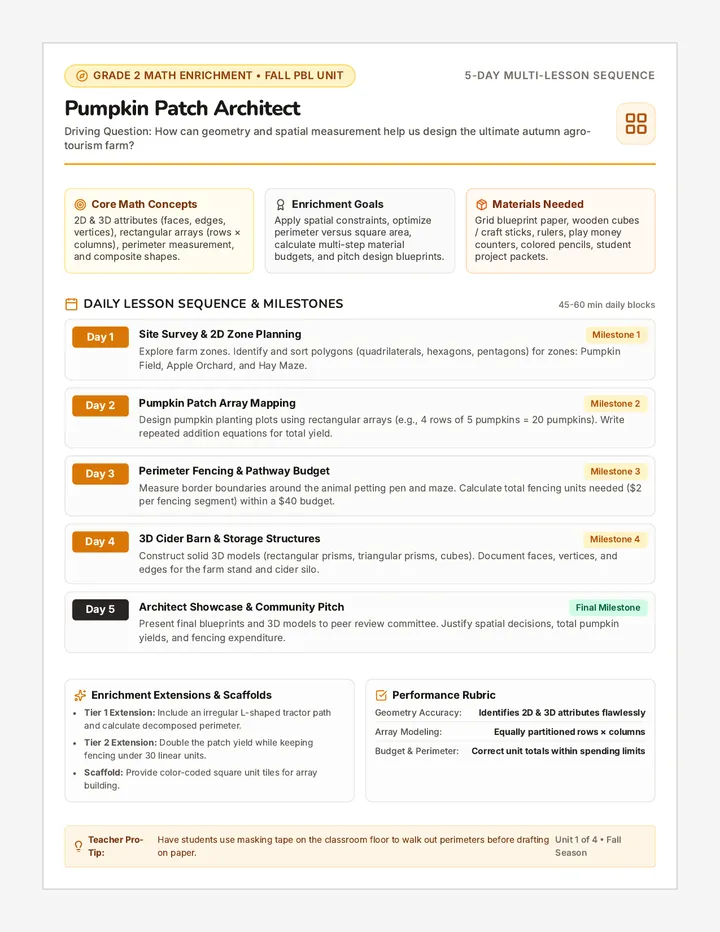
Pumpkin Patch Unit Plan

Seasonal Math Quests

A collection of four seasonal project-based learning units for Grade 2 math enrichment featuring autumn harvest and winter wonderland design missions. Students apply advanced geometry, multi-digit money math, precision measurement, and elapsed time to solve authentic real-world challenges.

K

kkipperman

8
Digit Duel Progress Probes

Digit Duel Multiplication

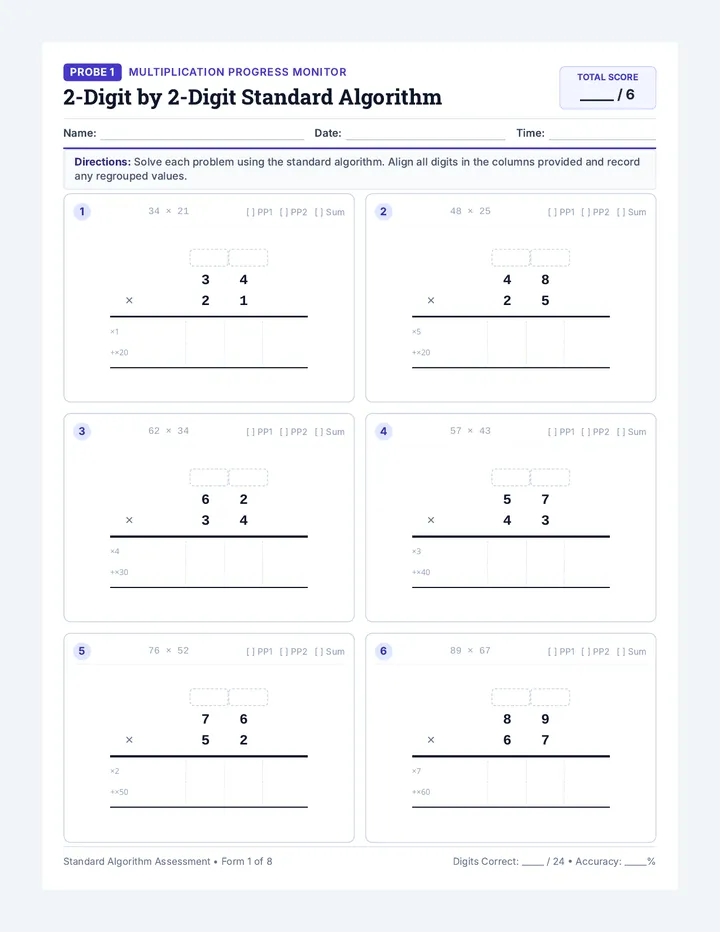
A standardized progress monitoring toolkit designed to track student mastery of 2-digit by 2-digit multiplication using the standard algorithm. Features eight equivalent diagnostic probes with column-aligned calculation grids, paired with comprehensive scoring rubrics, an 8-probe growth chart, and step-by-step partial product answer keys.

Lenny Avatar
Lenny
2
Digit Duel Teacher Guide

Digit Duel Teacher Guide

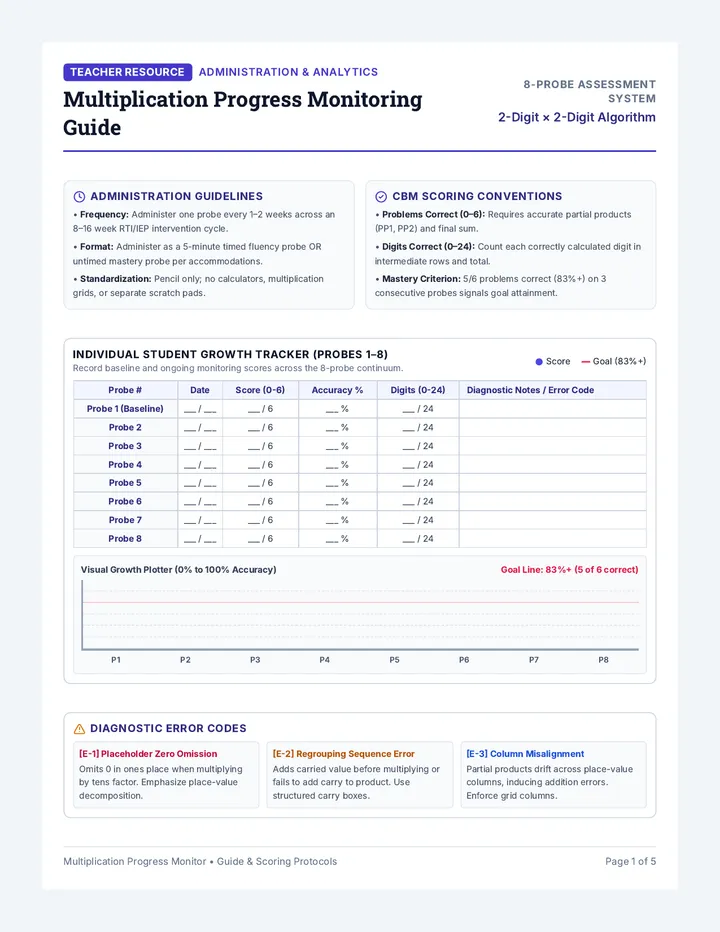
Teacher scoring guide, progress monitoring tracker, diagnostic error analysis rubric, and complete standard algorithm answer keys for all 8 probes. Features step-by-step partial product breakdowns and intervention pathways.

Lenny Avatar
Lenny
Fourth Grade Math Worksheet

Math Powerhouse

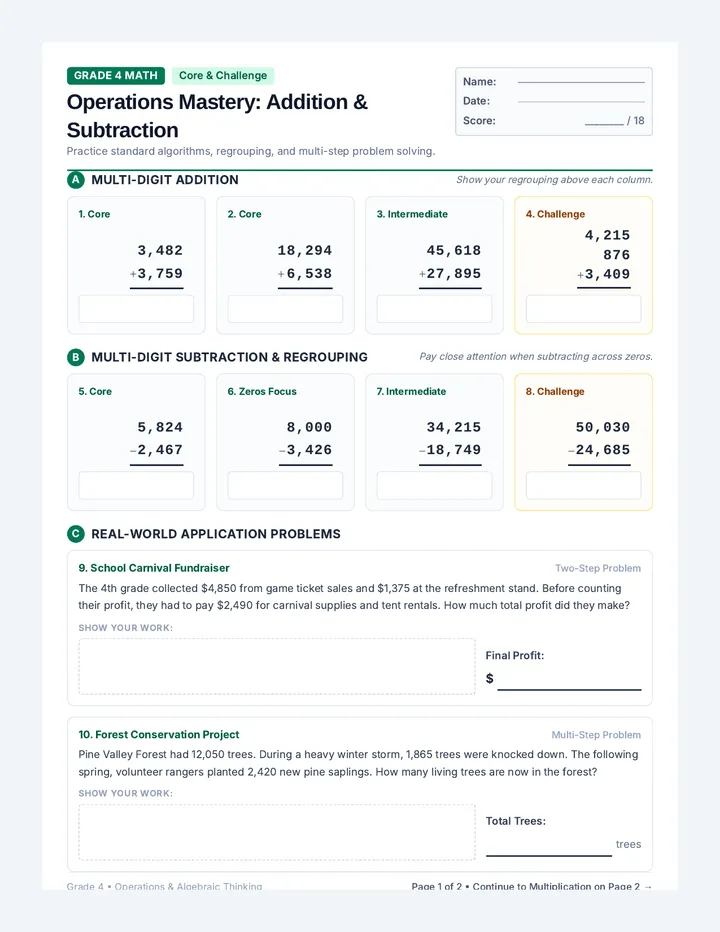
A targeted multi-grade mathematics sequence focusing on mastering whole-number operations including addition, subtraction, and multi-digit multiplication. It equips fourth and fifth-grade learners with procedural fluency, conceptual problem-solving, and rigorous challenge tasks.

T

temetropolis

4
Graph Detectives Practice Worksheet

Graph Detectives

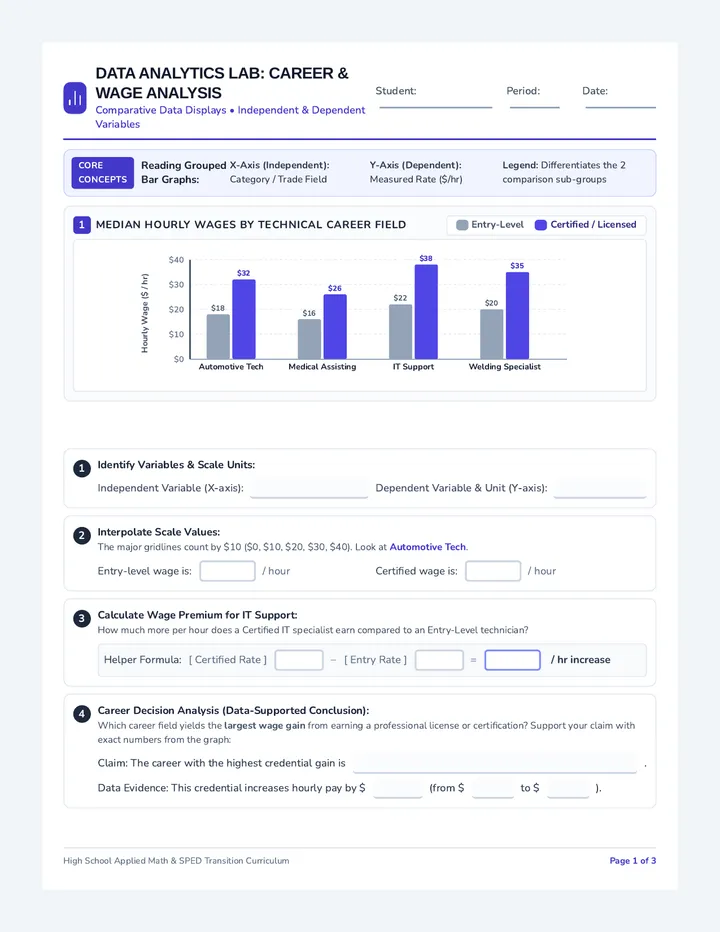
A high school special education math lesson focused on mastering real-world data literacy, including grouped career bar graphs, independent living circle graphs, and business break-even line graphs.

T

timothy.nixon

2
Digit Duel Progress Probes

Digit Duel Progress Probes

Eight standardized, equivalent progress monitoring probes for evaluating 2-digit by 2-digit multiplication using the standard algorithm. Each probe includes six calibrated test items set within column-aligned calculation matrices with designated regrouping boxes and partial product lines.

Lenny Avatar
Lenny
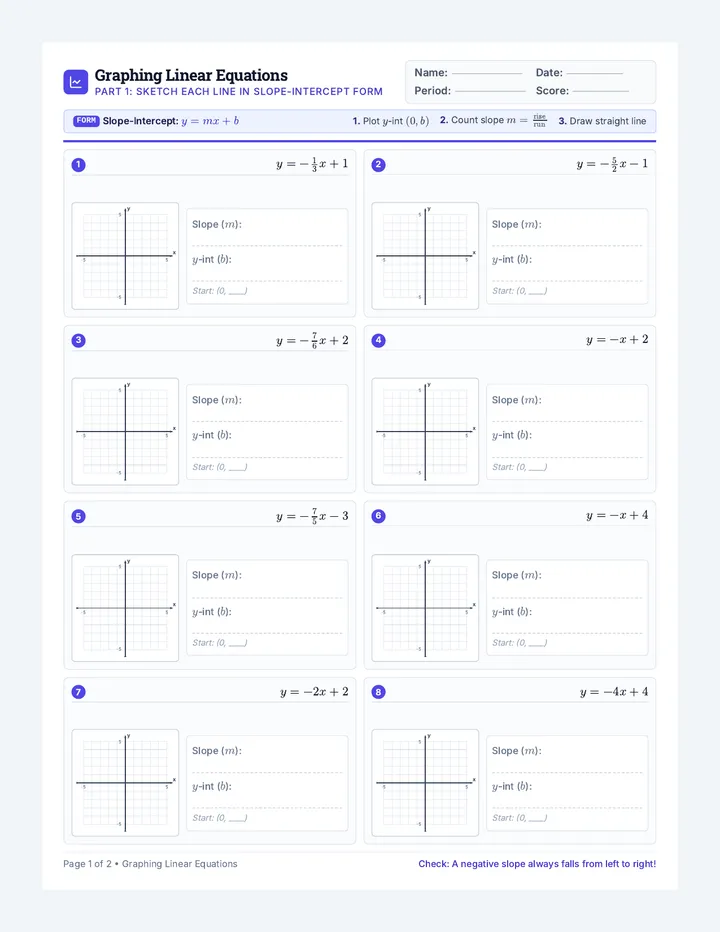
Linear Equations Practice Worksheet

Coordinate Geometry Mastery

A secondary mathematics curriculum sequence exploring linear functions and geometric transformations on the Cartesian coordinate plane, featuring print-ready guided practice and teacher keys.

FM

Fernando Mancini

4
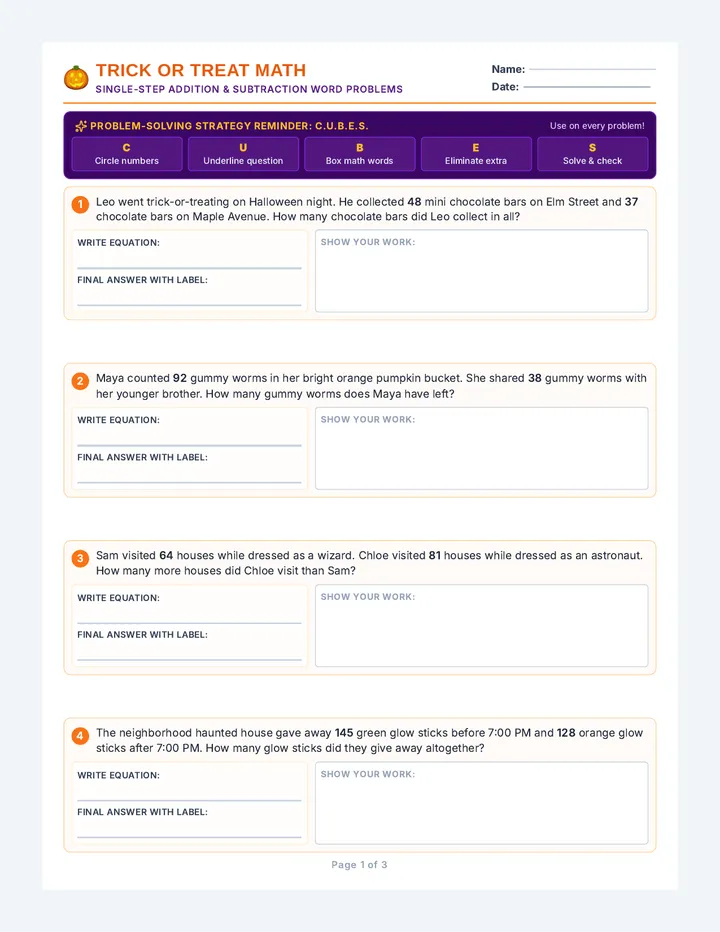
Spooky Treat Math Worksheet

Trick or Treat Math

A 3rd-grade math lesson featuring 12 Halloween trick-or-treat addition and subtraction single-step word problems. Students apply the CUBES strategy with dedicated workspace and equation lines, supported by an answer key and paraprofessional instructional coaching scripts.

SW

Stephanie Wooten

3
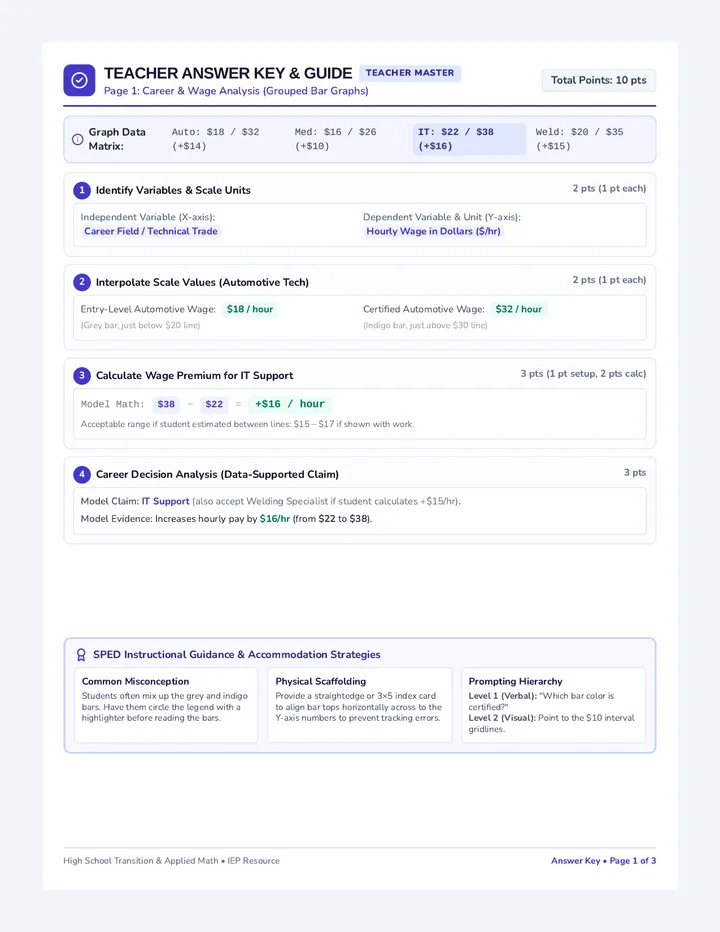
Graph Detectives Answer Key

Graph Detectives Answer Key

A comprehensive 3-page teacher answer key and instructional guide for high school special education, featuring complete model solutions, point breakdowns, SPED prompting hierarchies, and common error alerts.

T

timothy.nixon

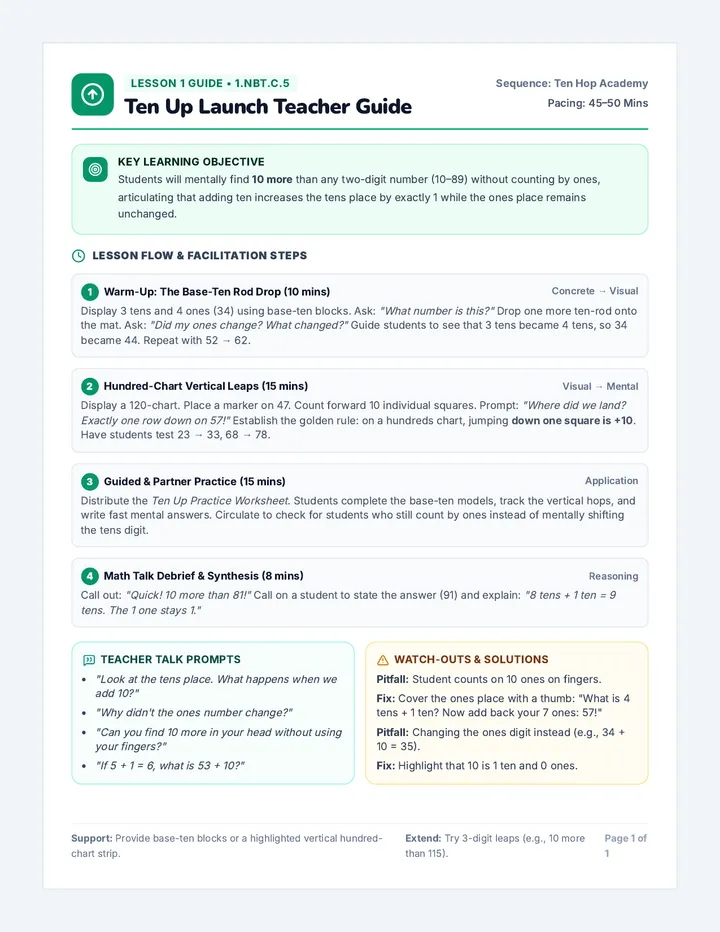
Ten Up Teacher Guide

Ten Hop Academy

A comprehensive 3-lesson primary math sequence designed to develop first graders' mental fluency with finding 10 more and 10 less than any two-digit number. Students transition from concrete base-ten models and hundreds-chart leap patterns to rapid mental calculations and clear verbal explanations.

K

kkipperman

9
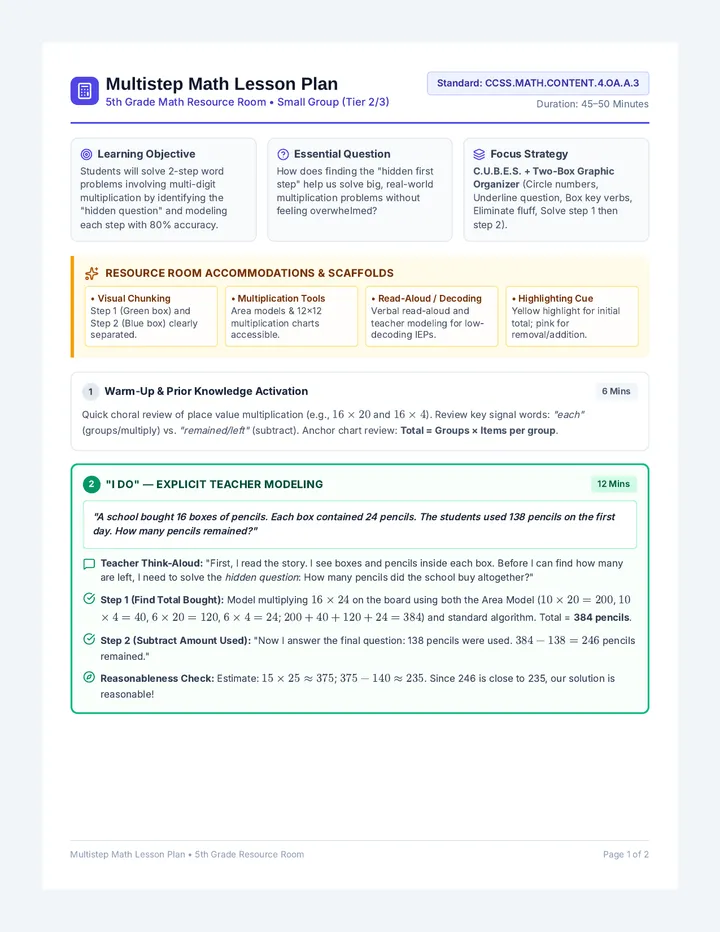
Multistep Math Lesson Plan

Multistep Multiplication Mission

A targeted 5th-grade math resource room lesson addressing standard 4.OA.3 through multi-digit multiplication and two-step word problems using the 'I Do, We Do, You Do' gradual release model with visual supports and accommodations.

AC

Aaron Conlin

4
Graph Detectives Practice Worksheet

Graph Detectives Practice Worksheet

A high school level, 3-page scaffolded data literacy and graph analysis worksheet for special education students covering career wage double-bar graphs, young adult monthly budget circle graphs with percentage-to-dollar conversions, and dual-line business break-even graphs with rate-of-change calculations.

T

timothy.nixon