Lenny.com
Explore
Create
ActivitiesNewMathEnglish Language ArtsScience & EngineeringSocial StudiesGlobal LanguagesHealth & Physical EducationSpecial EducationCounseling & Life SkillsArts & CreativityESL
Lenny.com
Lenny.com
Explore
Create
ActivitiesNewMathEnglish Language ArtsScience & EngineeringSocial StudiesGlobal LanguagesHealth & Physical EducationSpecial EducationCounseling & Life SkillsArts & CreativityESL
Lenny.com
Lenny.com

Solutions

Lenny for EducatorsLenny for SchoolsLenny for Districts

Product

ExploreSign inCreateSupportAbout

Resources

Getting startedMTSS Acceleration Program

© 2026 Lenny Learning Inc.

TermsPrivacyAccessibility
LinkedInInstagramX
Lenny
MathNumbers & CountingCounting ObjectsNumber NamesComparing NumbersNumber OperationsCounting SequenceNumbers 0-10Place Value Understanding and SystemAdd and Subtract Within 20Addition and Subtraction ConceptsAddition and Subtraction EquationsAddition and Subtraction ProblemsFoundations for MultiplicationMultiplication and Division PropertiesMultiply and Divide Within 100Multiplication and Division ProblemsFactors and MultiplesProperties of OperationsPatterns and RelationshipsGenerate and Analyze PatternsMulti-Digit ArithmeticPlace Value OperationsMulti-Digit and Decimal OperationsNumerical ExpressionsFour Operations and PatternsFour Operations Problem SolvingMeasurement & DataMeasurable AttributesMeasuring LengthsMeasure and Estimate Lengths in Standard UnitsRelate Addition and Subtraction to LengthClassifying and Counting ObjectsTime and MoneyArea Concepts and MeasurementPerimeter and Area MeasuresAngle Concepts and MeasurementTime, Volume, and MassMeasurement Unit ConversionsGeometryIdentifying ShapesShapes and AttributesShape Attributes and ReasoningShapes and CompositionClassifying 2D FiguresGeometric Figures and RelationshipsLines, Angles, and ShapesAngle, Area, and VolumeGeometric MeasurementVolume of 3D ShapesCoordinate Plane ApplicationsTransformations in the PlaneCongruence and SimilarityUnderstand congruence in terms of rigid motionsSimilarity and TransformationsProve Theorems Involving SimilarityPythagorean TheoremTrigonometry for General TrianglesMake Geometric ConstructionsProve Geometric TheoremsTheorems About CirclesFind Arc Lengths And Areas of Sectors of CirclesVolume FormulasRelationships Between Two-Dimensional and Three-Dimensional ObjectsProve Simple Geometric Theorems AlgebraicallyTranslate Between Geometric Description and Equation for Conic SectionApply Geometric Concepts in Modeling SituationsFractions & DecimalsFractions as NumbersBuilding FractionsFraction Equivalence and OrderingAdding and Subtracting FractionsMultiplying and Dividing FractionsDividing FractionsDecimal FractionsMulti-Digit Computation and FactorsAdd, Subtract, Multiply, and Divide Rational NumbersRational Number SystemIrrational Numbers and ApproximationsRatiosRatios and ProportionsProportional RelationshipsUnit RateAlgebraAlgebraic ExpressionsGenerate Equivalent ExpressionsQuantitative RelationshipsProportional Relationships and Linear EquationsEquations and InequalitiesEquation Solving and ReasoningLinear Equations and SystemsGraph Equations and InequalitiesSystems of EquationsReal-World Algebraic ProblemsQuantitative Reasoning with UnitsExpression StructureEquivalent Expression FormsRadicals and Integer ExponentsRational ExponentsRational and Irrational NumbersPolynomial OperationsPolynomial IdentitiesPolynomial Zeros and FactorsRational ExpressionsComplex Number OperationsComplex Numbers in PolynomialsComplex Numbers on PlaneStatistics & ProbabilityRepresent and Interpret DataData DistributionsStatistical VariabilityProbability ModelsCompound Event ProbabilitiesStatistical SamplingInterpret Categorical and Quantitative DataBivariate Data PatternsInterpret Linear ModelsComparing Two PopulationsRandom Processes in StatisticsIndependence and Conditional ProbabilityExpected ValuesProbability-Based Decision MakingStatistical Inference and ConclusionsFunctionsFunction Concepts and NotationDefine and Compare FunctionsInterpret Functions in ContextAnalyze Function RepresentationsModel Relationships with FunctionsIdentify Linear vs Exponential GrowthDistinguish Between Function TypesCompare Growth RatesInterpret Function ExpressionsBuild Functions from RelationshipsConstruct and Model FunctionsTransform and Combine FunctionsModel Comparison and SelectionSolve Exponential EquationsTrigonometryTrigonometric Ratios Involving Right TrianglesTrigonometric Functions and Unit CircleModel with Trigonometric FunctionsTrigonometric IdentitiesVectors & MatricesIntroduction to Vectors and MatricesVector QuantitiesVector OperationsMatrix OperationsCalculusLimits and ContinuityDerivative Concepts and NotationDerivative Rules and TechniquesApplications of DerivativesOptimization ProblemsRelated RatesCurve Sketching and AnalysisIntegration Concepts and NotationAntiderivatives and Indefinite IntegralsDefinite Integrals and AreaFundamental Theorem of CalculusIntegration TechniquesApplications of IntegrationDifferential EquationsSequences and SeriesParametric and Polar FunctionsVector-Valued Functions

Logarithm Lockdown

A comprehensive lesson on solving exponential equations with linear exponents using logarithms, guiding students from prerequisite foundational concepts to algebraic isolation and logarithmic evaluation.

BTBrianna Taracena

Logarithm Lockdown

A comprehensive lesson on solving exponential equations with linear exponents using logarithms, guiding students from prerequisite foundational concepts to algebraic isolation and logarithmic evaluation.

BTBrianna Taracena

Final: \(x \approx 0.0973\)

Step 1 & 2: Apply Log

Fill in the blank:

\(\log\left(5^{3x + 2}\right) = \log(40)\)

Check: Both sides receive identical \(\log\) operation.

Step 3: Power Rule

Bring exponent down:

\((3x + 2)\log(5) = \log(40)\)

\(3x + 2 = \frac{\log(40)}{\log(5)} \approx 2.2920\)

Divide by the constant \(\log(5)\).

Step 4: Solve for \(x\)

\(3x = \frac{\log(40)}{\log(5)} - 2\)

\(x = \frac{\log(40) - 2\log(5)}{3\log(5)}\)

Calculated Decimal: \(x \approx 0.0973\)

B Guided Practice 2 Full Solutions: \(6 \cdot 2^{x - 4} - 10 = 38\)

Final: \(x = 7\) (Exact Integer)

Stage 1: Isolate the Exponential Term

Add 10 to both sides:

\(6 \cdot 2^{x - 4} = 48\)

Divide both sides by 6:

\(2^{x - 4} = 8\)

Student work must show \(2^{x-4} = 8\).

Stage 2: Solve with Logarithms (or Inspection)

\(\log\left(2^{x - 4}\right) = \log(8)\)

\((x - 4)\log(2) = \log(8)\)

\(x - 4 = \frac{\log(8)}{\log(2)} = 3\)

\(x = 3 + 4 = 7\)

Point out: \(8 = 2^3\), so \(x - 4 = 3 \implies x = 7\)!

Frequent Misconception Alert: In Problem B, up to 30% of students attempt \(6 \cdot 2 = 12\) giving \(12^{x-4} = 48\). Stop the class immediately if this appears during the guided phase!

Teacher Resource • Answer Key

Independent Practice Set 1 Solutions

Page 3 Solutions

Problems 1–6 (General Bases)

1. \(3^{2x - 1} = 17\) Level 1

\((2x - 1)\log(3) = \log(17)\)

\(2x - 1 = \frac{\log(17)}{\log(3)} \approx 2.5789\)

\(2x = 3.5789\)

Exact: \(x = \frac{\log(17) + \log(3)}{2\log(3)} = \frac{\log(51)}{2\log(3)}\)

\(x \approx 1.7895\)

2. \(5^{x + 4} = 42\) Level 1

\((x + 4)\log(5) = \log(42)\)

\(x + 4 = \frac{\log(42)}{\log(5)} \approx 2.3223\)

\(x = 2.3223 - 4\)

Exact: \(x = \frac{\log(42)}{\log(5)} - 4\)

\(x \approx -1.6777\)

3. \(4 \cdot 2^{3x - 2} = 36\) Level 2

Divide by 4: \(2^{3x - 2} = 9\)

\((3x - 2)\log(2) = \log(9)\)

\(3x - 2 = \frac{\log(9)}{\log(2)} \approx 3.1699\)

\(3x \approx 5.1699\)

Exact: \(x = \frac{\log(9) + 2\log(2)}{3\log(2)} = \frac{\log(36)}{3\log(2)}\)

\(x \approx 1.7233\)

4. \(2 \cdot 5^{2x - 1} + 3 = 53\) Level 2

\(2 \cdot 5^{2x - 1} = 50 \implies 5^{2x - 1} = 25\)

Since \(25 = 5^2 \implies 2x - 1 = 2\)

\(2x = 3 \implies x = 1.5\)

Log Check: \(\frac{\log(25)}{\log(5)} = 2\)

\(x = 1.5\) (or \(\frac{3}{2}\))

5. Real-World Modeling Solution: Bacterial Growth Exact: t = 12 hrs

Equation: \(150 \cdot 2^{0.5t - 1} = 4800\)

Divide 150: \(2^{0.5t - 1} = 32\)

Recognize \(32 = 2^5\) (or take logs: \(0.5t - 1 = 5\))

\(0.5t = 6 \implies t = 12\)

Final Result:

\(t = 12\) hours

Doubles every 2 hrs.

6. Error Analysis Solution: Correcting the Blunder \(2 \cdot 3^{2x - 1} = 54\)

What Went Wrong:

The student incorrectly multiplied the coefficient \(2\) by the base \(3\) to get \(6\). By order of operations (PEMDAS), exponents take precedence. The coefficient must be divided out first!

Correct Algebraic Steps:

1. Divide by 2: \(3^{2x - 1} = 27\)

2. Since \(27 = 3^3 \implies 2x - 1 = 3\)

3. \(2x = 4 \implies x = 2\)

Logarithm Lockdown Teacher Key General Bases Set Verified

Teacher Resource • Answer Key

Practice Set 2 Solutions: Base \(e\) and \(\ln\)

Page 4 Solutions

Problems 7–10 (Natural Logs)

7. \(e^{2x + 3} = 15\) Use \(\ln\)

\(\ln\left(e^{2x + 3}\right) = \ln(15)\)

\(2x + 3 = \ln(15) \approx 2.7081\)

\(2x = 2.7081 - 3 = -0.2919\)

Exact: \(x = \frac{\ln(15) - 3}{2}\)

\(x \approx -0.1460\)

8. \(e^{4x - 5} = 28\) Use \(\ln\)

\(\ln\left(e^{4x - 5}\right) = \ln(28)\)

\(4x - 5 = \ln(28) \approx 3.3322\)

\(4x = 8.3322\)

Exact: \(x = \frac{\ln(28) + 5}{4}\)

\(x \approx 2.0831\)

9. \(3 \cdot e^{2x + 1} = 45\) Isolate First

Divide by 3: \(e^{2x + 1} = 15\)

\(2x + 1 = \ln(15) \approx 2.7081\)

\(2x = 1.7081\)

Exact: \(x = \frac{\ln(15) - 1}{2}\)

\(x \approx 0.8540\)

10. \(5 \cdot e^{3x - 2} - 8 = 32\) Two-Step Isolate

\(5 \cdot e^{3x - 2} = 40 \implies e^{3x - 2} = 8\)

\(3x - 2 = \ln(8) \approx 2.0794\)

\(3x = 4.0794\)

Exact: \(x = \frac{\ln(8) + 2}{3}\)

\(x \approx 1.3598\)

Pedagogical Key: Emphasize Inverse Cancellation

Remind students that \(\ln(e^u) = u\) directly because \(\ln\) has base \(e\). When students write \((2x+3)\ln(e)\), emphasize that \(\ln(e) = 1\), so writing \(\ln(e)\) is redundant and simplifies immediately.

Logarithm Lockdown Teacher Key Base e Solutions Verified

Teacher Resource • Answer Key

Exit Ticket Scoring Guide & Solutions

Page 5 Solutions

Formative Check (10 Pts)

Question 1: \(3^{2x - 1} = 20\) (Use Common \(\log\)) 5 Points

Step 1 (Take \(\log\) of both sides): \(\log\left(3^{2x - 1}\right) = \log(20)\) (1 pt)

Step 2 (Apply Power Property): \((2x - 1)\log(3) = \log(20)\) (1 pt)

Step 3 (Divide by \(\log(3)\)): \(2x - 1 = \frac{\log(20)}{\log(3)} \approx \frac{1.30103}{0.47712} \approx 2.72683\) (1 pt)

Step 4 (Add 1): \(2x \approx 3.72683\) (1 pt)

Step 5 (Divide by 2): \(x \approx 1.8634\) (1 pt)

Exact Form: \(x = \frac{\log(20) + \log(3)}{2\log(3)} = \frac{\log(60)}{2\log(3)}\) Approximate: \(x \approx 1.8634\)

Question 2: \(e^{2x + 3} = 15\) (Use Natural \(\ln\)) 5 Points

Step 1 (Take \(\ln\) of both sides): \(\ln\left(e^{2x + 3}\right) = \ln(15)\) (1 pt)

Step 2 (Apply \(\ln(e) = 1\)): \(2x + 3 = \ln(15) \approx 2.70805\) (2 pts)

Step 3 (Subtract 3): \(2x = \ln(15) - 3 \approx -0.29195\) (1 pt)

Step 4 (Divide by 2): \(x \approx -0.1460\) (1 pt)

Exact Form: \(x = \frac{\ln(15) - 3}{2}\) Approximate: \(x \approx -0.1460\)

Exit Ticket Master Solutions • 10 Points All Solutions Double-Checked
You might also like

Wave Hunters Worksheet

Math and Economics

A secondary curriculum sequence covering advanced mathematical modeling alongside foundational economic systems and financial literacy concepts.

JT

Jasia Tahir

4
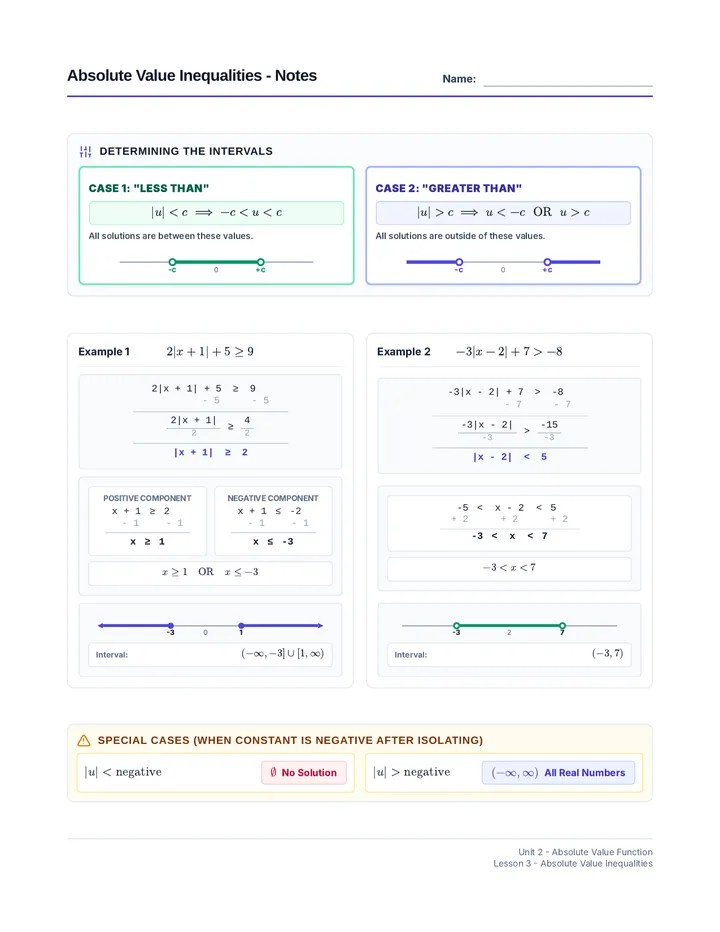
Absolute Value Inequalities Notes

Absolute Value Inequalities

A focused lesson on solving and graphing absolute value inequalities. Students explore distance-based conceptual representations, algebraic isolation techniques, compound inequality splits, and interval notation.

MA

Mary Ann Valiente

4
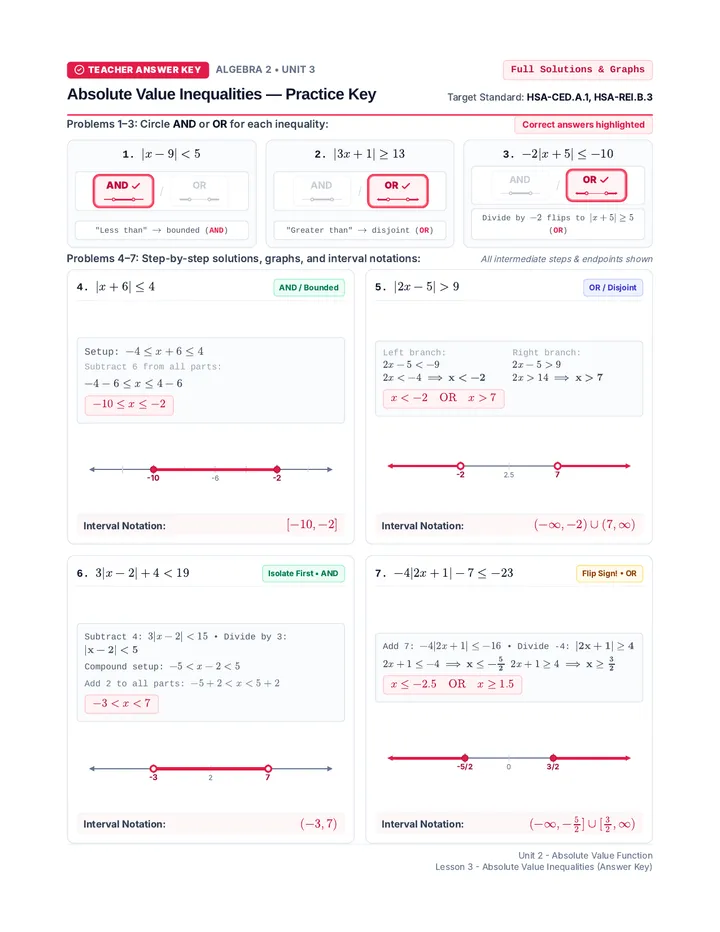
Absolute Value Practice Key

Absolute Value Practice Key

A comprehensive teacher answer key for the Absolute Value Inequalities Practice worksheet. Features circled answers with rationale annotations for problems 1-3, complete step-by-step algebraic isolation and splitting work, fully drawn and labeled number line graphs, and exact interval notation answers highlighted in red for problems 4-7.

MA

Mary Ann Valiente

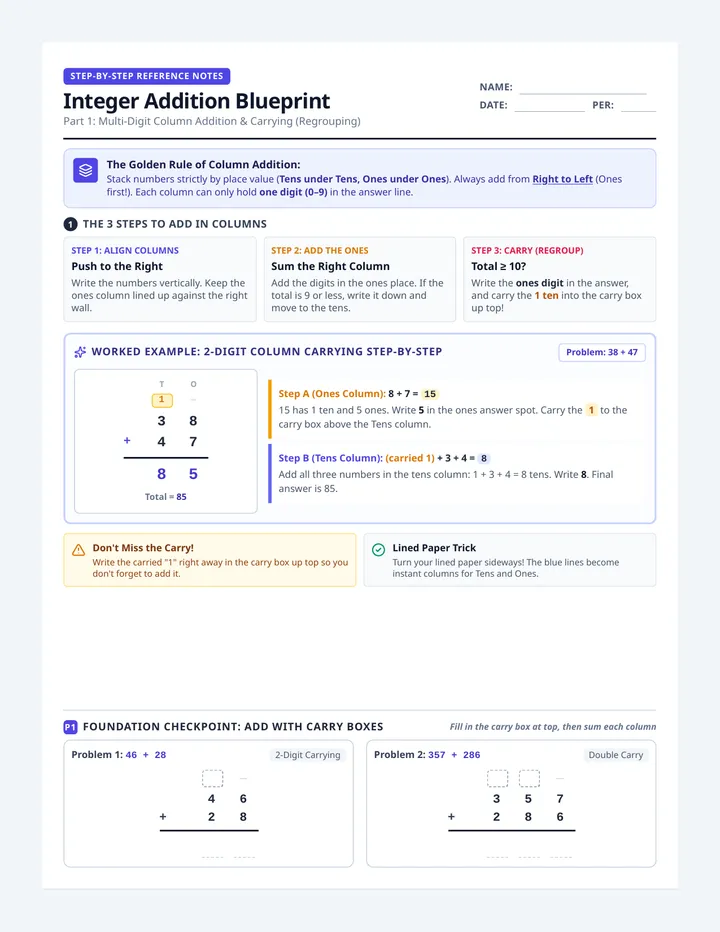
Integer Addition Blueprint Notes Sheet

Integer Operations Mastery

A comprehensive 9th-grade algebra readiness sequence covering addition with regrouping and conceptual integer multiplication through skip counting and repeated addition.

S

Shannon

3
Graph Detectives Practice Worksheet

Graph Detectives

A high school special education math lesson focused on mastering real-world data literacy, including grouped career bar graphs, independent living circle graphs, and business break-even line graphs.

T

timothy.nixon

2
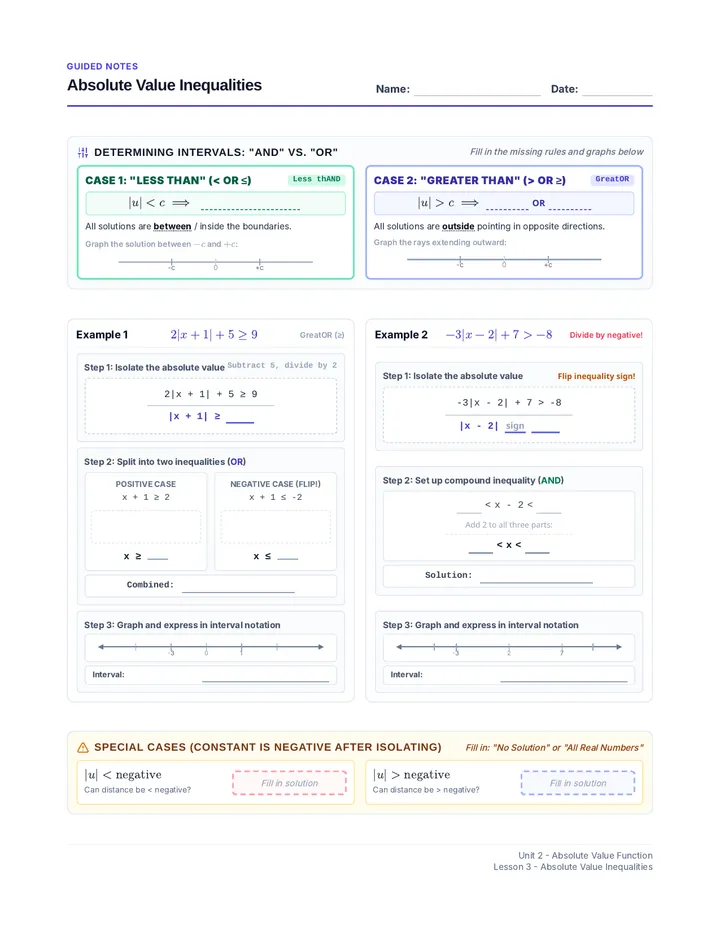
Absolute Value Guided Notes

Absolute Value Guided Notes

A single-page student fill-in guided notes sheet on absolute value inequalities. Features fill-in blanks for interval determination rules and memory tricks, scaffolded step-by-step isolation and splitting boxes for two core examples with blank graphing lines, and a fill-in special cases reference box.

MA

Mary Ann Valiente

Graph Steepness Slides

Rise and Run

A hands-on, two-part unit exploring slope as a rate of change, visual steepness on coordinate planes, and algebraic calculations using coordinate pairs. Students transition smoothly from counting rise and run on graphs to mastering the slope formula in real-world contexts.

K

kstanfield

6
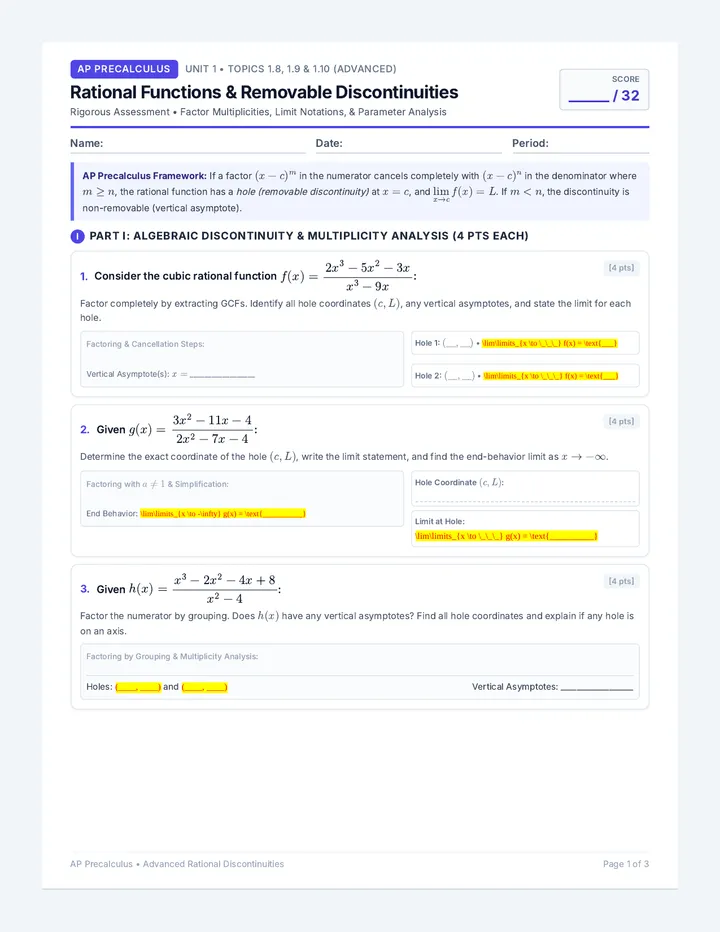
Hole Hunter Mini Assessment

Holes and Limits Assessment

A focused AP Precalculus mini-assessment and worked solutions key targeting rational functions, removable discontinuities (holes), graphical limit notations, and numerical table investigations.

R

Robinson

2
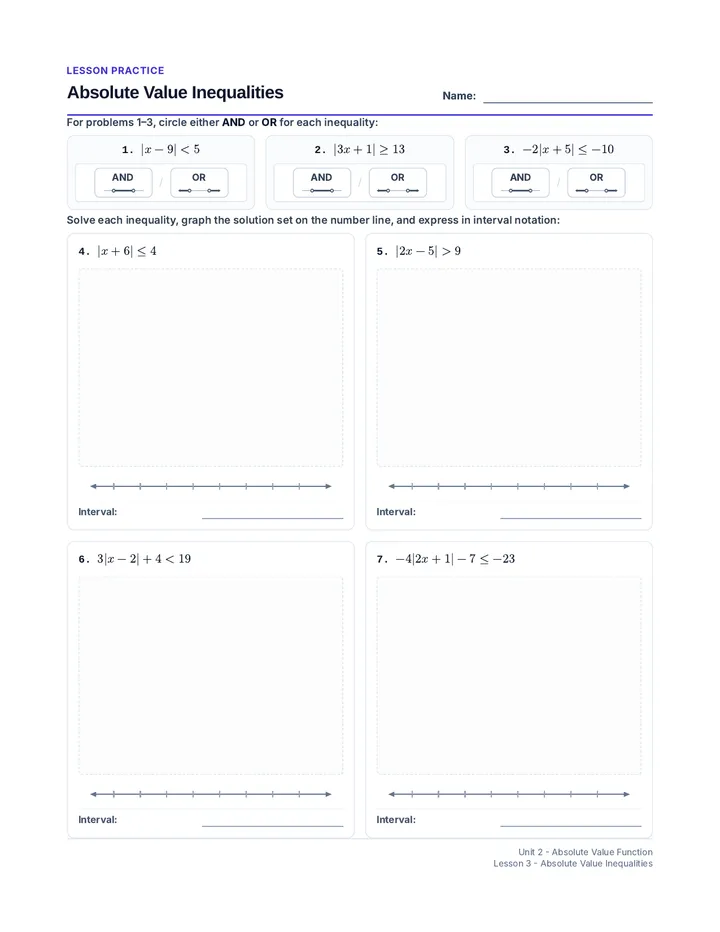
Absolute Value Inequalities Practice

Absolute Value Inequalities Practice

A single-page scaffolded practice set on absolute value inequalities. Features problems 1-3 with compounded and disjoint mini number lines under AND and OR selections, four multi-step solving and graphing problems, and a right-aligned footer.

MA

Mary Ann Valiente

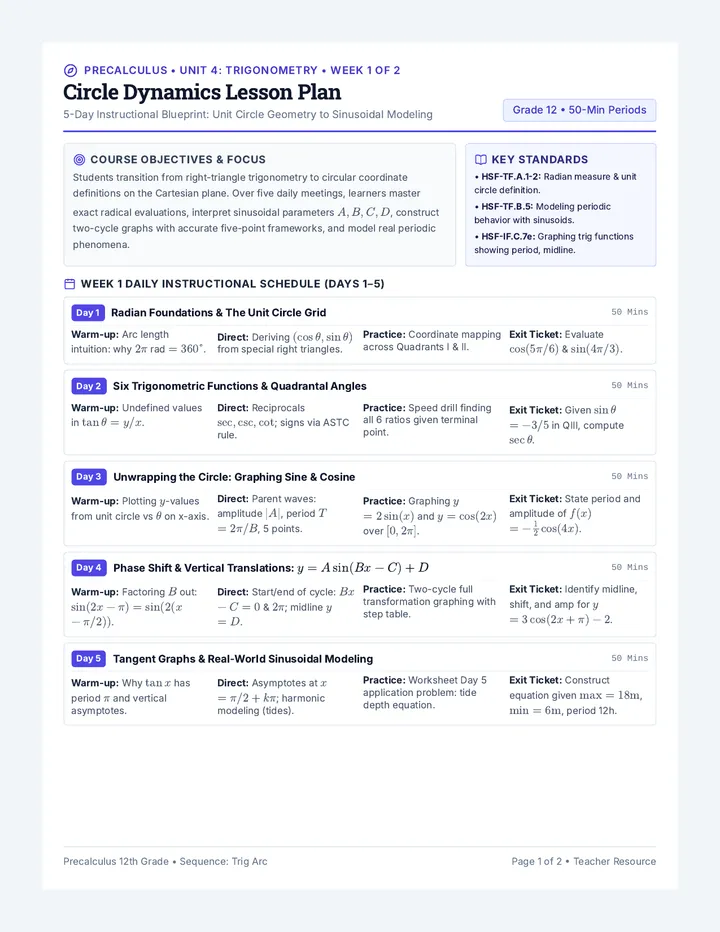
Circle Dynamics Lesson Plan

Trig Arc

A complete 10-day Precalculus trigonometry unit for 12th grade spanning two weeks of daily classes, covering radian foundations, unit circle values, sinusoidal graphs and transformations, periodic modeling, analytical identities, and equation solving.

JT

Jasia Tahir

24
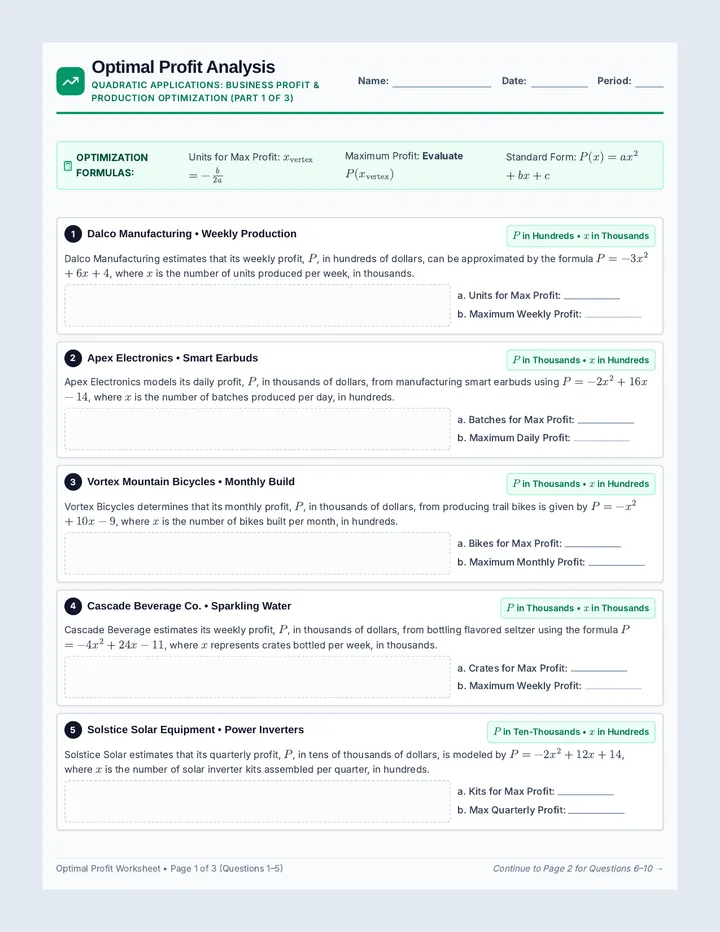
Optimal Profit Worksheet

Profit Optimization

An instructional lesson on quadratic business applications where students model revenue, cost, and profit to find vertex optima, maximum earnings, and strategic production levels.

CK

Cheydon Krysl

2
Absolute Value Inequalities Notes

Absolute Value Inequalities Notes

A single-page guided notes sheet on absolute value inequalities. Features an interval determination concept box, Example 1 solving 2|x+1|+5 >= 9 with vertical fraction division, positive/negative components, and number line graph, Example 2, a special cases box, and a right-aligned footer with no outer page border.

MA

Mary Ann Valiente