Volume Blueprint Handout VOLUME BLUEPRINT
Geometry Survival Guide
Master 3D Solids: Cylinders, Cones, Pyramids & Spheres
Name:
Period:
The Big Secret: Volume is Just 3 Core Patterns \( B = \text{Area of Base} \) • \( h = \text{Perpendicular Height} \)
1. Straight-Wall Solids Prisms & Cylinders
\( V = B \cdot h \)
Uniform cross-section from bottom to top
2. Pointed Solids (1 Apex) Pyramids & Cones
\( V = \frac{1}{3} B \cdot h \)
Takes exactly 3 cones to fill 1 cylinder!
3. Curved All Around Spheres
\( V = \frac{4}{3} \pi r^3 \)
No base! Radius \( r \) is cubed (\( r^3 \))
Prerequisite Toolkit: What is Capital "\( B \)"?
(Capital \( B \) is the 2D area of the bottom face)
Circle (Cylinder/Cone) \( B = \pi r^2 \)
\( r = \text{radius} \)
Rectangle (Pyramid) \( B = l \cdot w \)
\( l \times w \)
Triangle (Pyramid) \( B = \frac{1}{2} b \cdot h_{b} \)
\( h_b = \text{base ht} \)
Square (Pyramid/Cube) \( B = s^2 \)
\( s = \text{side} \)
Master 3D Volume Formulas & Visual Models
Always use vertical height \( h \), never slant height!
r h
Right Cylinder
Circular Base
\( V = \pi r^2 h \)
Base Area: \( B = \pi r^2 \)
r h ℓ
Right Cone
\( \frac{1}{3} \) of Cylinder
\( V = \frac{1}{3}\pi r^2 h \)
Shortcut: Do \( (\pi r^2 h) \div 3 \)
h l w
Rectangular Pyramid
\( B = l \cdot w \)
\( V = \frac{1}{3} (l \cdot w) h \)
Square Pyramid: \( V = \frac{1}{3} s^2 h \)
r
Sphere & Hemisphere
Radius Cubed (\( r^3 \))
\( V_{\text{Sphere}} = \frac{4}{3} \pi r^3 \)
Hemisphere (Half): \( V = \frac{2}{3} \pi r^3 \)
Triangular Pyramid: \( V = \frac{1}{3} B h = \frac{1}{3} \left(\frac{1}{2} b \cdot h_{\text{base}}\right) h_{\text{pyramid}} \)
Don't mix up base height (\( h_b \)) and 3D pyramid height (\( h \))!
Don't Fall Into These 3 Classic Geometry Traps!
Trap 1: Diameter vs Radius
Formulas ALWAYS require radius (\( r \)). If given diameter (\( d \)), divide by 2 first!
\( r = \frac{d}{2} \) • If \( d = 12 \), \( r = 6 \)
Trap 2: Slant Height (\( \ell \))
Volume needs vertical altitude (\( h \)). If given slant height \( \ell \), use Pythagorean Theorem:
\( r^2 + h^2 = \ell^2 \implies h = \sqrt{\ell^2 - r^2} \)
Trap 3: Exponent Confusion
Circle bases use \( r^2 \). Spheres use \( r^3 \). Never multiply by 3 instead of cubing!
\( 4^3 = 4 \times 4 \times 4 = 64 \) (NOT 12!)
HOW TO SOLVE ANY VOLUME PROBLEM
Step-by-Step Attack Plan • Worked Model Problems • 2-Step Real World Applications
Always write final units cubed: \( \text{cm}^3, \text{in}^3, \text{ft}^3, \text{m}^3 \)
The 4-Step Volume Attack Framework
1 Name Solid
Identify shape & write formula. Pointed? Needs \( \frac{1}{3} \).
2 Prep Radius
Diameter given? Divide by 2! Slant height? Find vertical \( h \).
3 Substitute
Plug numbers in with parentheses: \( \pi (r)^2 (h) \). Square/cube powers first!
4 Format Answer
In terms of \( \pi \) (exact) OR multiply by 3.14 (round to hundredths).
Standard Model Problems
Example 1: Cylinder (\( d = 10\text{ cm}, h = 14\text{ cm} \))
Radius: \( r = 10/2 = 5\text{ cm} \)
Formula: \( V = \pi r^2 h = \pi (5)^2 (14) = \pi (25)(14) \)
Exact: \( 350\pi\text{ cm}^3 \) • Approx: \( 350 \times 3.14159 \approx \mathbf{1,099.56\text{ cm}^3} \)
Example 2: Cone (\( r = 6\text{ in}, \text{slant } \ell = 10\text{ in} \))
Find \( h \): \( 6^2 + h^2 = 10^2 \implies 36 + h^2 = 100 \implies h = 8 \)
Formula: \( V = \frac{1}{3}\pi (6)^2 (8) = \frac{1}{3}\pi (36)(8) = 96\pi \)
Exact: \( 96\pi\text{ in}^3 \) • Approx: \( 96 \times 3.14159 \approx \mathbf{301.59\text{ in}^3} \)
Example 3: Pyramid (\( l = 8, w = 5, h = 9\text{ m} \))
Base Area: \( B = 8 \times 5 = 40\text{ m}^2 \)
Volume: \( V = \frac{1}{3} (40)(9) = 40 \times 3 = \mathbf{120\text{ m}^3} \)
No \( \pi \) needed for polygonal pyramids!
Example 4: Sphere (\( r = 3\text{ cm} \))
Cube Radius: \( r^3 = 3^3 = 3 \times 3 \times 3 = 27 \)
Formula: \( V = \frac{4}{3}\pi (27) = 4 \times 9\pi = 36\pi \)
Exact: \( 36\pi\text{ cm}^3 \) • Approx: \( 36 \times 3.14159 \approx \mathbf{113.10\text{ cm}^3} \)
Next-Level Skill: 2-Step Real-World Calculations
Volume is Just Step 1!
Many test and real-world problems ask you to find volume first , and then perform a second calculation (such as total cost, total mass/weight, or number of units).
1. Total Cost
\( \text{Cost} = \text{Volume} \times \text{Price/unit}^3 \)
Example: Metal cylinder has volume \( 125.66\text{ cm}^3 \) and costs \( \$0.67/\text{cm}^3 \):
2. Mass / Weight
\( \text{Mass} = \text{Volume} \times \text{Density} \)
Example: Granite pyramid has volume \( 120\text{ cm}^3 \) and density \( 2.7\text{ g/cm}^3 \):
3. Time or Quantity
\( \text{Time} = \text{Volume} \div \text{Flow Rate} \)
Example: Tank holds \( 300\text{ gallons} \). A pump fills it at \( 15\text{ gal/min} \):
Calculator Hack for 2-Step Problems Never round early! Keep the full decimal volume on your screen, then multiply directly by the unit price (\( \times 0.67 \)), and round money to 2 decimal places (cents) at the very end!
Final Checklist:
▢ Radius (not diameter) ▢ Vertical \( h \) (not slant \( \ell \)) ▢ Cubed \( r^3 \) for spheres ▢ Multiplied by unit cost / density ▢ Money has 2 decimal places ($)
Volume Workout Worksheet VOLUME WORKOUT
Practice Worksheet
Tier 1: Guided Foundations • Cylinders, Cones, Pyramids & Spheres
Name:
Date:
Directions: Show all formula substitutions. Give answers in exact terms of \( \pi \) (when applicable) AND rounded to the nearest hundredth using \( \pi \approx 3.14159 \). Don't forget units!
1 Right Cylinder \( V = \pi r^2 h \)
A cylindrical soda can has a radius of \( r = 4\text{ cm} \) and a height of \( h = 9\text{ cm} \). Calculate its volume.
▢ Radius \( r = \) ____ ▢ Height \( h = \) ____ ▢ Square \( r \) first
Exact:
Approx:
2 Right Cone \( V = \frac{1}{3}\pi r^2 h \)
A traffic cone has a diameter of \( d = 12\text{ in} \) and a vertical height of \( h = 15\text{ in} \). Determine its volume.
⚠ Diameter Trap! \( r = d/2 = \) ____ ▢ Divide by 3
Exact:
Approx:
3 Rectangular Pyramid \( V = \frac{1}{3} B h \)
A glass paperweight pyramid has base length \( l = 7\text{ cm} \), width \( w = 4\text{ cm} \), and vertical height \( h = 9\text{ cm} \).
▢ Base Area \( B = l \cdot w = \) ____ ▢ \( V = \frac{1}{3} \cdot B \cdot h \)
Formula used:
Volume:
4 Sphere \( V = \frac{4}{3}\pi r^3 \)
A bowling ball is a sphere with a radius of \( r = 6\text{ in} \). Find the total volume inside the ball.
▢ Cube radius: \( 6^3 = 6 \cdot 6 \cdot 6 \) ▢ Multiply by 4, divide by 3
Exact:
Approx:
Turn page for Tier 2 Mixed Practice & Multi-Step Cost Applications → Remember: Units are ALWAYS cubed (\( \text{cm}^3, \text{in}^3, \text{m}^3 \))
VOLUME WORKOUT: MULTI-STEP CHALLENGE
Tier 2 & 3: Slant Height Traps • Total Material Cost • Mass / Density Calculations
2-Step Calculations
5 Cone: Slant Height Trap ⚠ Geometry Trap
A funnel shaped like a right cone has a radius of \( r = 5\text{ cm} \) and a slant height of \( \ell = 13\text{ cm} \).Part A: Find vertical height \( h \) using \( r^2 + h^2 = \ell^2 \).Part B: Determine the total volume inside the funnel.
Height \( h = \):
Volume (Exact):
6 Metal Cylinder: Total Cost $0.67 / cm³
A factory manufactures solid right cylindrical metal rods with radius \( r = 4\text{ cm} \) and length (height) \( h = 10\text{ cm} \).Part A: Calculate the volume of one rod (round to hundredths).Part B: If the metal sells for \( \$0.67\text{ per cm}^3 \) , find the total cost of the rod to the nearest cent.
Vol (\( \text{cm}^3 \)):
Total Cost:
7 Pyramid: Density & Mass Mass = Vol × Density
A solid granite souvenir pyramid has a square base with edge \( s = 6\text{ cm} \) and vertical height \( h = 10\text{ cm} \).Part A: Calculate the volume of the pyramid.Part B: Granite has a density of \( 2.7\text{ g/cm}^3 \) . Determine the total mass in grams.
Volume:
Total Mass:
8 Sphere: Silver Casting Cost $0.85 / cm³
A jeweler casts a solid spherical sterling silver pendant with a diameter of \( d = 6\text{ cm} \).Part A: Find the volume of the sphere (round to hundredths).Part B: If pure silver costs \( \$0.85\text{ per cm}^3 \) , find the total cost of the metal to the nearest cent.
Vol (\( \text{cm}^3 \)):
Total Cost:
2-Step Problem Strategy Check: Did you find volume first, then multiply by price or density?
😕 Needed Help 😐 Almost There 😊 Mastered Multi-Step!
Volume Workout Answer Key VOLUME WORKOUT: ANSWER KEY
Teacher Edition
Tier 1 Solutions • Detailed Step Work • Common Error Diagnoses
Full Model Solutions
Grading Guidance: Award credit for: (1) Correct radius identification, (2) Formula substitution, (3) Arithmetic, and (4) Proper cubic units (\( \text{units}^3 \)).
1 Right Cylinder Solution 4 pts
Given: \( r = 4\text{ cm} \), \( h = 9\text{ cm} \)
Formula: \( V = \pi r^2 h \)
Substitute: \( V = \pi (4)^2 (9) \)
Evaluate Power: \( 4^2 = 16 \implies V = \pi (16)(9) \)
Multiply: \( 16 \times 9 = 144 \)
Exact: \( \mathbf{144\pi\text{ cm}^3} \)
Watch Out: If student wrote \( 72\pi \), they did \( 4 \times 2 = 8 \) instead of squaring \( 4^2 = 16 \).
2 Right Cone Solution 4 pts
Given: Diameter \( d = 12\text{ in} \implies r = 6\text{ in} \), \( h = 15\text{ in} \)
Radius Check: \( r = 12 / 2 = 6\text{ in} \)
Formula: \( V = \frac{1}{3}\pi r^2 h = \frac{1}{3}\pi (6)^2 (15) \)
Evaluate Power: \( 6^2 = 36 \implies V = \frac{1}{3}\pi (36)(15) \)
Multiply & Divide: \( (36 \times 15) \div 3 = 540 \div 3 = 180 \)
Exact: \( \mathbf{180\pi\text{ in}^3} \)
Trap Alert: If student got \( 720\pi \), they used diameter \( 12 \) instead of dividing by 2 to get \( r = 6 \).
3 Rectangular Pyramid Solution 4 pts
Given: \( l = 7\text{ cm} \), \( w = 4\text{ cm} \), \( h = 9\text{ cm} \)
Base Area (\( B \)): \( B = l \times w = 7 \times 4 = 28\text{ cm}^2 \)
Formula: \( V = \frac{1}{3} B h = \frac{1}{3} (28)(9) \)
Smart Math Shortcut: \( 9 \div 3 = 3 \implies 28 \times 3 \)
Result: \( 28 \times 3 = 84 \)
Total Volume: \( \mathbf{84\text{ cm}^3} \)
Watch Out: If student wrote \( 252\text{ cm}^3 \), they forgot to multiply by \( \frac{1}{3} \) (treated it like a prism!).
4 Sphere Solution 4 pts
Given: Radius \( r = 6\text{ in} \)
Formula: \( V = \frac{4}{3}\pi r^3 = \frac{4}{3}\pi (6)^3 \)
Evaluate Cube: \( 6^3 = 6 \times 6 \times 6 = 216 \)
Multiply & Divide: \( (4 \times 216) \div 3 = 864 \div 3 = 288 \)
Exact: \( \mathbf{288\pi\text{ in}^3} \)
Trap Alert: Common failure mode is \( 6^3 = 18 \) (doing \( 6 \times 3 \)). Check for \( 24\pi \) as a symptom.
Page 1 of 2 • Tier 1 Foundations Tier 2 & Multi-Step Solutions on next page →
VOLUME WORKOUT: MULTI-STEP KEY
Tier 2 & 3 Solutions • Metal Pricing (\( \$0.67/\text{cm}^3 \)) • Density • Jewelry Casting
Multi-Step Solutions
5 Cone Slant Height Key 5 pts
Given: \( r = 5\text{ cm} \), Slant height \( \ell = 13\text{ cm} \)
Part A: Find vertical height \( h \)
\( r^2 + h^2 = \ell^2 \implies 5^2 + h^2 = 13^2 \)
\( 25 + h^2 = 169 \implies h^2 = 144 \implies \mathbf{h = 12\text{ cm}} \)
Part B: Volume Calculation
\( V = \frac{1}{3}\pi r^2 h = \frac{1}{3}\pi (5)^2 (12) = \frac{1}{3}\pi (25)(12) \)
Exact: \( \mathbf{100\pi\text{ cm}^3} \)
Trap Alert: If student used \( 13 \) directly in volume, they got \( 108.33\pi \) because they confused slant height with vertical altitude.
6 Metal Cylinder Cost Key 5 pts
Given: \( r = 4\text{ cm} \), \( h = 10\text{ cm} \), Price = \( \$0.67/\text{cm}^3 \)
Part A: Volume Calculation
\( V = \pi r^2 h = \pi (4)^2 (10) = 160\pi \)
\( V = 160 \times 3.14159265 \approx \mathbf{502.65\text{ cm}^3} \)
Part B: Multiply by Unit Price (\( \$0.67 \))
\( \text{Cost} = 502.6548\text{ cm}^3 \times \$0.67/\text{cm}^3 = \$336.778... \)
Volume: \( \mathbf{502.65\text{ cm}^3} \)
Key Check: Ensure student rounded money to exactly 2 decimal places (\( \$336.78 \)).
7 Pyramid Density & Mass Key 5 pts
Given: \( s = 6\text{ cm} \), \( h = 10\text{ cm} \), Density = \( 2.7\text{ g/cm}^3 \)
Part A: Volume Calculation
Base Area: \( B = s^2 = 6^2 = 36\text{ cm}^2 \)
\( V = \frac{1}{3} B h = \frac{1}{3} (36)(10) = 12 \times 10 = \mathbf{120\text{ cm}^3} \)
Part B: Mass = Volume × Density
\( \text{Mass} = 120\text{ cm}^3 \times 2.7\text{ g/cm}^3 = \mathbf{324\text{ grams}} \)
Volume: \( \mathbf{120\text{ cm}^3} \)
Check: If student wrote \( 972\text{ g} \), they forgot \( \frac{1}{3} \) on volume (\( 360 \times 2.7 = 972 \)).
8 Sphere Silver Cost Key 5 pts
Given: Diameter \( d = 6\text{ cm} \implies r = 3\text{ cm} \), Price = \( \$0.85/\text{cm}^3 \)
Part A: Volume Calculation
Radius check: \( r = 6 / 2 = \mathbf{3\text{ cm}} \)
\( V = \frac{4}{3}\pi (3)^3 = \frac{4}{3}\pi (27) = 36\pi \approx \mathbf{113.10\text{ cm}^3} \)
Part B: Multiply by Unit Price (\( \$0.85 \))
\( \text{Cost} = 113.0973\text{ cm}^3 \times \$0.85 = \$96.1327... \)
Volume: \( \mathbf{113.10\text{ cm}^3} \) (Exact \( 36\pi \))
Trap Alert: If volume was \( 904.78 \), student used diameter \( 6 \) instead of radius \( 3 \) (yielding \( \$769.06 \)).
Page 2 of 2 • Tier 2 & Multi-Step Applications Total Possible Points: 31 Points
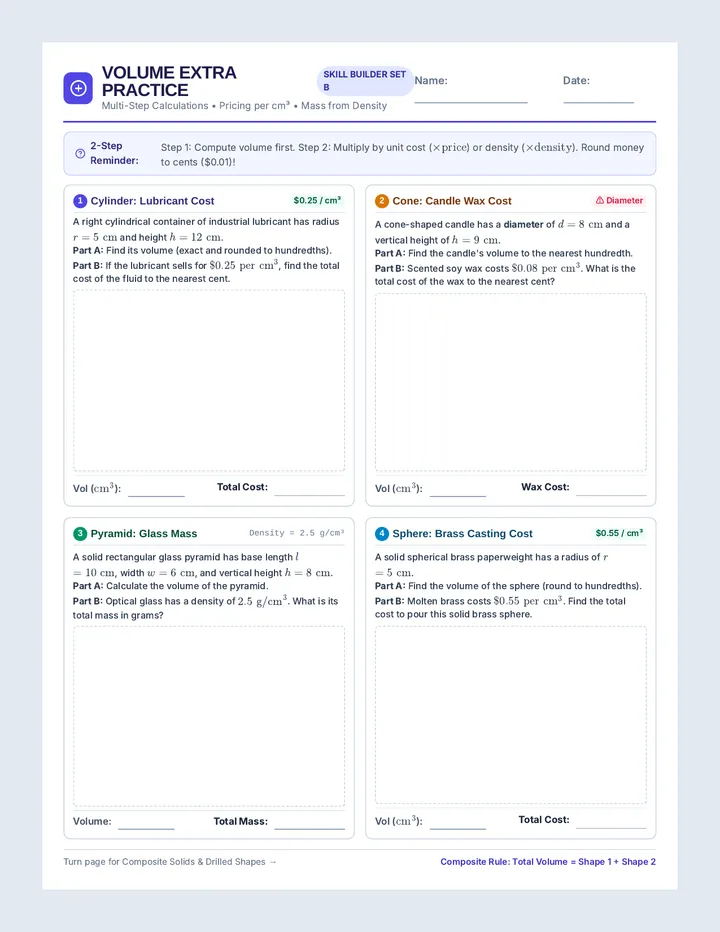
Volume Extra Practice Worksheet VOLUME EXTRA PRACTICE
Skill Builder Set B
Multi-Step Calculations • Pricing per cm³ • Mass from Density
Name:
Date:
2-Step Reminder: Step 1: Compute volume first. Step 2: Multiply by unit cost (\( \times \text{price} \)) or density (\( \times \text{density} \)). Round money to cents ($0.01)!
1 Cylinder: Lubricant Cost $0.25 / cm³
A right cylindrical container of industrial lubricant has radius \( r = 5\text{ cm} \) and height \( h = 12\text{ cm} \).Part A: Find its volume (exact and rounded to hundredths).Part B: If the lubricant sells for \( \$0.25\text{ per cm}^3 \) , find the total cost of the fluid to the nearest cent.
Vol (\( \text{cm}^3 \)):
Total Cost:
2 Cone: Candle Wax Cost ⚠ Diameter
A cone-shaped candle has a diameter of \( d = 8\text{ cm} \) and a vertical height of \( h = 9\text{ cm} \).Part A: Find the candle's volume to the nearest hundredth.Part B: Scented soy wax costs \( \$0.08\text{ per cm}^3 \) . What is the total cost of the wax to the nearest cent?
Vol (\( \text{cm}^3 \)):
Wax Cost:
3 Pyramid: Glass Mass Density = 2.5 g/cm³
A solid rectangular glass pyramid has base length \( l = 10\text{ cm} \), width \( w = 6\text{ cm} \), and vertical height \( h = 8\text{ cm} \).Part A: Calculate the volume of the pyramid.Part B: Optical glass has a density of \( 2.5\text{ g/cm}^3 \) . What is its total mass in grams?
Volume:
Total Mass:
4 Sphere: Brass Casting Cost $0.55 / cm³
A solid spherical brass paperweight has a radius of \( r = 5\text{ cm} \).Part A: Find the volume of the sphere (round to hundredths).Part B: Molten brass costs \( \$0.55\text{ per cm}^3 \) . Find the total cost to pour this solid brass sphere.
Vol (\( \text{cm}^3 \)):
Total Cost:
Turn page for Composite Solids & Drilled Shapes → Composite Rule: Total Volume = Shape 1 + Shape 2
COMPOSITE & FABRICATION CHALLENGES
Combining Solids • Drilling Cylinders • Slant Height Pricing
Multi-Solid Mastery
5 Grain Silo: Cylinder + Cone Composite
A silo has a cylinder body of radius \( r = 6\text{ m} \) and height \( h = 10\text{ m} \), topped with a cone roof of radius \( r = 6\text{ m} \) and height \( h = 4\text{ m} \).Part A: Find the cylinder volume: \( \pi (6)^2 (10) \).Part B: Find the cone roof volume: \( \frac{1}{3}\pi (6)^2 (4) \).Part C: Add them together to find the total storage capacity .
Exact (\( \pi \)):
Total (\( \text{m}^3 \)):
6 Ice Cream: Cone + Hemisphere Composite
A waffle cone has radius \( r = 3\text{ cm} \) and height \( h = 10\text{ cm} \). A half-sphere (hemisphere) scoop with radius \( r = 3\text{ cm} \) rests on top.Part A: Find cone volume: \( \frac{1}{3}\pi r^2 h \).Part B: Find hemisphere volume: \( \frac{2}{3}\pi r^3 \).Part C: Find total ice cream volume (\( \text{Cone} + \text{Hemisphere} \)).
Exact (\( \pi \)):
Total (\( \text{cm}^3 \)):
7 Drilled Cylinder: Metal Value $0.67 / cm³
A solid cylinder (\( R = 5\text{ cm}, h = 12\text{ cm} \)) has a cylindrical hole (\( r = 2\text{ cm}, h = 12\text{ cm} \)) drilled all the way through.Part A: Subtract the hole volume to find remaining metal volume: \( V_{\text{outer}} - V_{\text{hole}} \).Part B: If the metal sells for \( \$0.67\text{ per cm}^3 \) , what is the value of the finished part?
Remaining Vol:
Total Value:
8 Slant Height Cone Party Hat ⚠ Slant ℓ
A conical hat has a radius of \( r = 8\text{ cm} \) and a slant height of \( \ell = 17\text{ cm} \).Part A: Find vertical height \( h \) using \( r^2 + h^2 = \ell^2 \).Part B: Calculate volume of the hat.Part C: If filling it with glitter costs \( \$0.02\text{ per cm}^3 \) , find the total cost.
Height \( h \):
Glitter Cost:
Success Strategy: For holes, subtract volume. For stacked shapes, add volumes. For costs, multiply!
Great job completing Extra Practice!
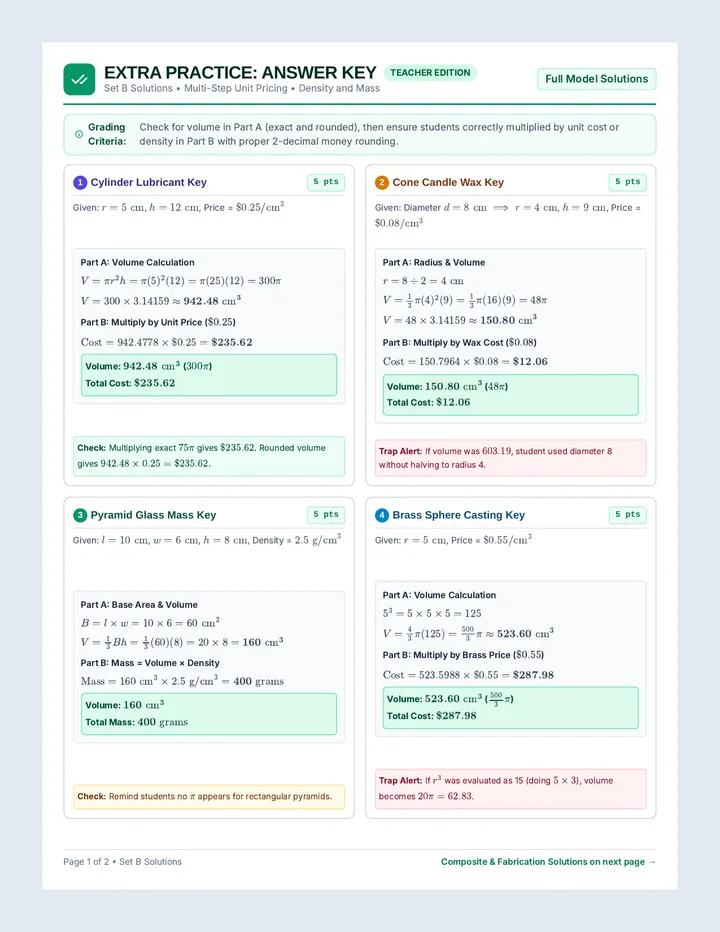
Volume Extra Practice Answer Key EXTRA PRACTICE: ANSWER KEY
Teacher Edition
Set B Solutions • Multi-Step Unit Pricing • Density and Mass
Full Model Solutions
Grading Criteria: Check for volume in Part A (exact and rounded), then ensure students correctly multiplied by unit cost or density in Part B with proper 2-decimal money rounding.
1 Cylinder Lubricant Key 5 pts
Given: \( r = 5\text{ cm} \), \( h = 12\text{ cm} \), Price = \( \$0.25/\text{cm}^3 \)
Part A: Volume Calculation
\( V = \pi r^2 h = \pi (5)^2 (12) = \pi (25)(12) = 300\pi \)
\( V = 300 \times 3.14159 \approx \mathbf{942.48\text{ cm}^3} \)
Part B: Multiply by Unit Price (\( \$0.25 \))
\( \text{Cost} = 942.4778 \times \$0.25 = \mathbf{\$235.62} \)
Volume: \( \mathbf{942.48\text{ cm}^3} \) (\( 300\pi \))
Check: Multiplying exact \( 75\pi \) gives \( \$235.62 \). Rounded volume gives \( 942.48 \times 0.25 = \$235.62 \).
2 Cone Candle Wax Key 5 pts
Given: Diameter \( d = 8\text{ cm} \implies r = 4\text{ cm} \), \( h = 9\text{ cm} \), Price = \( \$0.08/\text{cm}^3 \)
Part A: Radius & Volume
\( r = 8 \div 2 = 4\text{ cm} \)
\( V = \frac{1}{3}\pi (4)^2 (9) = \frac{1}{3}\pi (16)(9) = 48\pi \)
\( V = 48 \times 3.14159 \approx \mathbf{150.80\text{ cm}^3} \)
Part B: Multiply by Wax Cost (\( \$0.08 \))
\( \text{Cost} = 150.7964 \times \$0.08 = \mathbf{\$12.06} \)
Volume: \( \mathbf{150.80\text{ cm}^3} \) (\( 48\pi \))
Trap Alert: If volume was \( 603.19 \), student used diameter 8 without halving to radius 4.
3 Pyramid Glass Mass Key 5 pts
Given: \( l = 10\text{ cm} \), \( w = 6\text{ cm} \), \( h = 8\text{ cm} \), Density = \( 2.5\text{ g/cm}^3 \)
Part A: Base Area & Volume
\( B = l \times w = 10 \times 6 = 60\text{ cm}^2 \)
\( V = \frac{1}{3} B h = \frac{1}{3} (60)(8) = 20 \times 8 = \mathbf{160\text{ cm}^3} \)
Part B: Mass = Volume × Density
\( \text{Mass} = 160\text{ cm}^3 \times 2.5\text{ g/cm}^3 = \mathbf{400\text{ grams}} \)
Volume: \( \mathbf{160\text{ cm}^3} \)
Check: Remind students no \( \pi \) appears for rectangular pyramids.
4 Brass Sphere Casting Key 5 pts
Given: \( r = 5\text{ cm} \), Price = \( \$0.55/\text{cm}^3 \)
Part A: Volume Calculation
\( 5^3 = 5 \times 5 \times 5 = 125 \)
\( V = \frac{4}{3}\pi (125) = \frac{500}{3}\pi \approx \mathbf{523.60\text{ cm}^3} \)
Part B: Multiply by Brass Price (\( \$0.55 \))
\( \text{Cost} = 523.5988 \times \$0.55 = \mathbf{\$287.98} \)
Volume: \( \mathbf{523.60\text{ cm}^3} \) (\( \frac{500}{3}\pi \))
Trap Alert: If \( r^3 \) was evaluated as 15 (doing \( 5 \times 3 \)), volume becomes \( 20\pi = 62.83 \).
Page 1 of 2 • Set B Solutions Composite & Fabrication Solutions on next page →
EXTRA PRACTICE: COMPOSITE SOLUTIONS
Composite Shapes • Drilled Metal Machining • Slant Height Pricing
Composite Mastery
5 Grain Silo Composite Key 5 pts
Given: Cylinder (\( r = 6, h = 10 \)), Cone (\( r = 6, h = 4 \))
Part A: Cylinder Body
\( V_{\text{cyl}} = \pi (6)^2 (10) = 360\pi \approx 1,130.97\text{ m}^3 \)
Part B: Cone Roof
\( V_{\text{cone}} = \frac{1}{3}\pi (6)^2 (4) = \frac{1}{3}\pi (36)(4) = 48\pi \approx 150.80\text{ m}^3 \)
Part C: Total Combined Storage
\( V_{\text{total}} = 360\pi + 48\pi = \mathbf{408\pi} \approx \mathbf{1,281.77\text{ m}^3} \)
Total Capacity: \( \mathbf{408\pi\text{ m}^3} \approx \mathbf{1,281.77\text{ m}^3} \)
Key Insight: Emphasize that keeping terms in \( \pi \) makes adding the two solids quick and clean!
6 Ice Cream Composite Key 5 pts
Given: Cone (\( r = 3, h = 10 \)), Hemisphere (\( r = 3 \))
Part A: Waffle Cone Volume
\( V_{\text{cone}} = \frac{1}{3}\pi (3)^2 (10) = 30\pi \approx 94.25\text{ cm}^3 \)
Part B: Hemisphere Scoop Volume
\( V_{\text{hemi}} = \frac{2}{3}\pi (3)^3 = \frac{2}{3}\pi (27) = 18\pi \approx 56.55\text{ cm}^3 \)
Part C: Total Ice Cream Volume
\( V_{\text{total}} = 30\pi + 18\pi = \mathbf{48\pi} \approx \mathbf{150.80\text{ cm}^3} \)
Total Volume: \( \mathbf{48\pi\text{ cm}^3} \approx \mathbf{150.80\text{ cm}^3} \)
Check: Verify student used \( \frac{2}{3} \) (not \( \frac{4}{3} \)) for the hemisphere scoop.
7 Drilled Cylinder Key 5 pts
Given: Outer (\( R = 5, h = 12 \)), Hole (\( r = 2, h = 12 \)), Price = \( \$0.67/\text{cm}^3 \)
Part A: Remaining Metal Volume
\( V_{\text{outer}} = \pi (5)^2 (12) = 300\pi \)
\( V_{\text{hole}} = \pi (2)^2 (12) = 48\pi \)
\( V_{\text{rem}} = 300\pi - 48\pi = \mathbf{252\pi} \approx \mathbf{791.68\text{ cm}^3} \)
Part B: Multiply by Price (\( \$0.67 \))
\( \text{Cost} = 791.6813 \times \$0.67 = \mathbf{\$530.43} \)
Remaining Vol: \( \mathbf{791.68\text{ cm}^3} \) (\( 252\pi \))
Machining Rule: Hole removal always requires subtracting volume before multiplying by price.
8 Slant Height Party Hat Key 5 pts
Given: \( r = 8\text{ cm} \), Slant \( \ell = 17\text{ cm} \), Glitter = \( \$0.02/\text{cm}^3 \)
Part A: Vertical Altitude \( h \)
\( 8^2 + h^2 = 17^2 \implies 64 + h^2 = 289 \implies \mathbf{h = 15\text{ cm}} \)
Part B: Volume Calculation
\( V = \frac{1}{3}\pi (8)^2 (15) = 5 \times 64\pi = 320\pi \approx \mathbf{1,005.31\text{ cm}^3} \)
Part C: Glitter Filling Cost (\( \$0.02 \))
\( \text{Cost} = 1,005.3096 \times \$0.02 = \mathbf{\$20.11} \)
Altitude: \( \mathbf{15\text{ cm}} \) • Vol: \( \mathbf{1,005.31\text{ cm}^3} \)
Trap Alert: Confusing \( \ell = 17 \) with height gives \( V \approx 1,139.35 \) and cost \( \$22.79 \).
Page 2 of 2 • Composite & Fabrication Solutions Total Possible Points: 31 Points