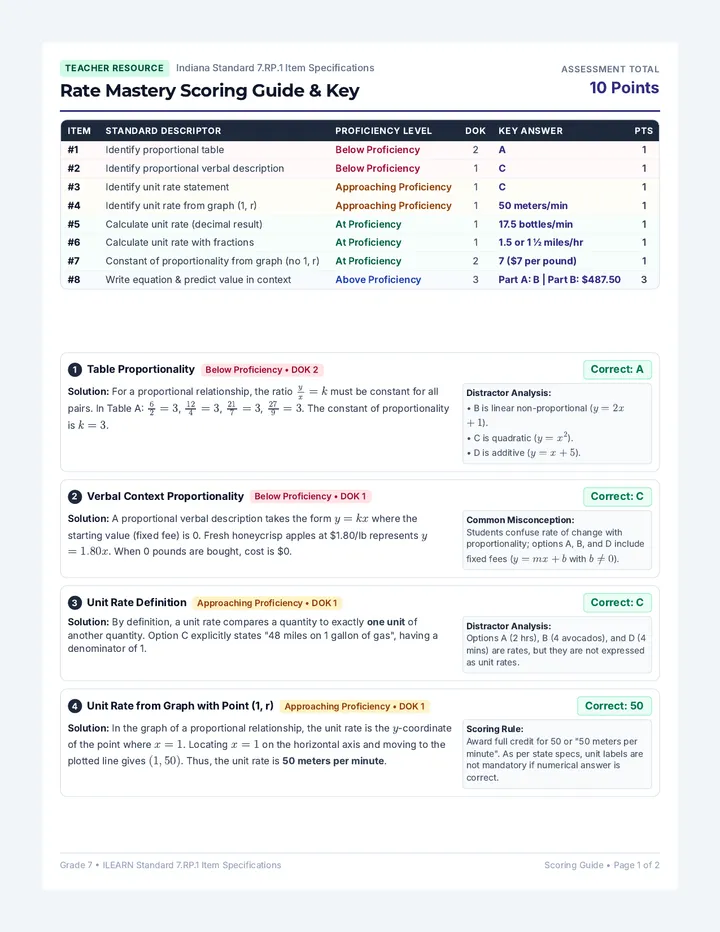
3 Unit Rate Definition Approaching Proficiency • DOK 1
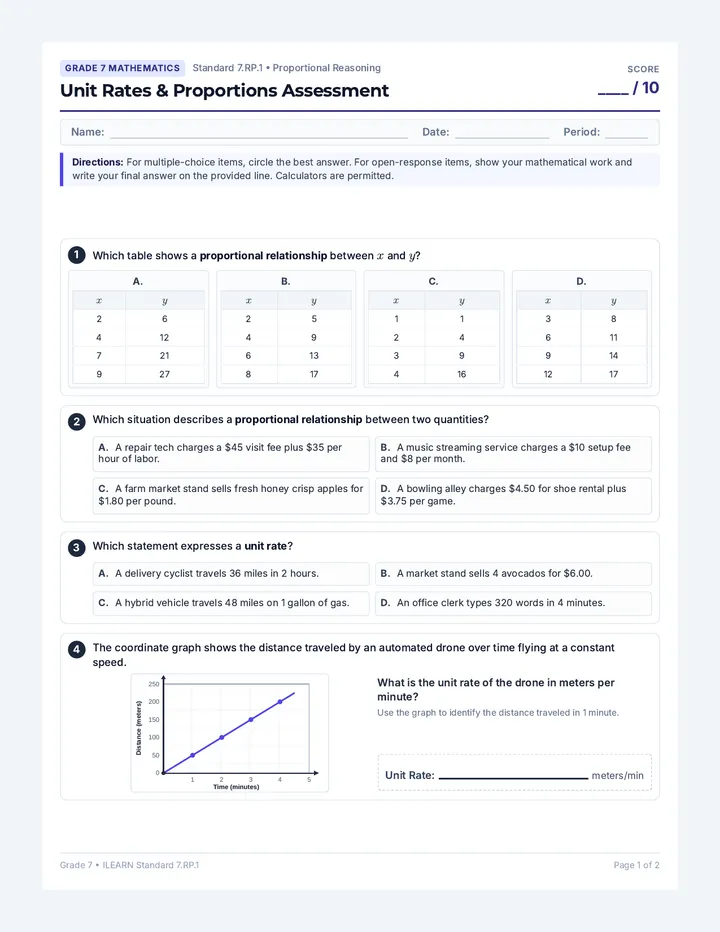
Correct: C
Solution: By definition, a unit rate compares a quantity to exactly one unit of another quantity. Option C explicitly states "48 miles on 1 gallon of gas", having a denominator of 1.
Distractor Analysis: Options A (2 hrs), B (4 avocados), and D (4 mins) are rates, but they are not expressed as unit rates.
4 Unit Rate from Graph with Point (1, r) Approaching Proficiency • DOK 1
Correct: 50
Solution: In the graph of a proportional relationship, the unit rate is the \(y\)-coordinate of the point where \(x = 1\). Locating \(x = 1\) on the horizontal axis and moving to the plotted line gives \((1, 50)\). Thus, the unit rate is 50 meters per minute.
Scoring Rule: Award full credit for 50 or "50 meters per minute". As per state specs, unit labels are not mandatory if numerical answer is correct.
Grade 7 • ILEARN Standard 7.RP.1 Item Specifications Scoring Guide • Page 1 of 2
Teacher Resource Rate Mastery Scoring Guide & Key • Items 5–8
Indiana Standard 7.RP.1
5 Unit Rate Calculation (Decimal Result) At Proficiency • DOK 1
Correct: 17.5 (or 17 ½)
Solution: Calculate the rate in bottles per minute by dividing total bottles by total minutes: \(\frac{140\text{ bottles}}{8\text{ minutes}} = 17.5\text{ bottles/min}\) (or \(17\frac{1}{2}\) or \(\frac{35}{2}\)).
Common Error: Inverted division (\(8 \div 140 \approx 0.057\) minutes per bottle). Emphasize matching the target unit order ("bottles per minute").
6 Fractional Unit Rate Calculation At Proficiency • DOK 1
Correct: 1.5 (or 1 ½ or 3/2)
Solution: Divide distance by time using reciprocal multiplication: \(\frac{3}{4} \div \frac{1}{2} = \frac{3}{4} \times \frac{2}{1} = \frac{6}{4} = \frac{3}{2} = 1\frac{1}{2} = 1.5\text{ mph}\).
Common Error: Multiplying fractions directly without inverting the divisor (\(\frac{3}{4} \times \frac{1}{2} = \frac{3}{8}\)).
7 Constant of Proportionality from Graph (No Point at x=1) At Proficiency • DOK 2
Correct: 7 (or $7/lb)
Solution: The graph shows marked points \((2, 14)\) and \((4, 28)\). Students calculate \(k = \frac{y}{x} = \frac{14}{2} = 7\) or \(\frac{28}{4} = 7\). The constant of proportionality is $7 per pound.
Common Error: Calculating \(\frac{x}{y} = \frac{2}{14} \approx 0.14\), or simply reporting the coordinates without dividing.
8 Equation Modeling & Contextual Prediction Above Proficiency • DOK 3
Part A: B | Part B: $487.50
Part A (1 pt): Find unit price: \(\frac{\$180.00}{24\text{ shirts}} = \$7.50\text{/shirt}\). In equation form \(c = kt\), this is \(c = 7.50t\) (Option B).
Part B (2 pts): Substitute \(t = 65\) into the model: \(c = 7.50 \times 65 = \$487.50\). (1 pt for setup/work, 1 pt for accurate final product).
Common Error: In Part A, choosing Option A (\(24 \div 180 \approx 0.13\)). In Part B, arithmetic errors when multiplying with decimals without a calculator.
Below Proficiency (0–3 pts)
Struggles to determine whether a constant multiplier exists across data pairs.
Next Step: Review ratio tables using visual bar models and test if \(y \div x\) is always identical.
Approaching (4–5 pts)
Identifies rates when \(x = 1\) is visible; struggles with general calculations or fractions.
Next Step: Practice dividing \(y \div x\) from points where \(x \neq 1\) and reinforce "per 1 unit" language.
At Proficiency (6–8 pts)
Accurately computes unit rates and \(k\) with decimals, fractions, and coordinate graphs.
Next Step: Extend into contextual modeling, comparing multiple unit rates and formulating \(y = kx\).
Above Proficiency (9–10 pts)
Fluently interprets, writes equations, and solves multi-step contextual predictions.
Next Step: Introduce non-proportional comparisons, percent change applications, and multi-unit conversions.
Grade 7 • ILEARN Standard 7.RP.1 Item Specifications Scoring Guide • Page 2 of 2