Lenny.com
Explore
Create
ActivitiesNewMathEnglish Language ArtsScience & EngineeringSocial StudiesGlobal LanguagesHealth & Physical EducationSpecial EducationCounseling & Life SkillsArts & CreativityESL
Lenny.com
Lenny.com
Explore
Create
ActivitiesNewMathEnglish Language ArtsScience & EngineeringSocial StudiesGlobal LanguagesHealth & Physical EducationSpecial EducationCounseling & Life SkillsArts & CreativityESL
Lenny.com
Lenny.com

Solutions

Lenny for EducatorsLenny for SchoolsLenny for Districts

Product

ExploreSign inCreateSupportAbout

Resources

Getting startedMTSS Acceleration Program

Newsletters

School Funding Newsletter

© 2026 Lenny Learning Inc.

TermsPrivacyAccessibility
LinkedInInstagramX
Lenny
MathNumbers & CountingCounting ObjectsNumber NamesComparing NumbersNumber OperationsCounting SequenceNumbers 0-10Place Value Understanding and SystemAdd and Subtract Within 20Addition and Subtraction ConceptsAddition and Subtraction EquationsAddition and Subtraction ProblemsFoundations for MultiplicationMultiplication and Division PropertiesMultiply and Divide Within 100Multiplication and Division ProblemsFactors and MultiplesProperties of OperationsPatterns and RelationshipsGenerate and Analyze PatternsMulti-Digit ArithmeticPlace Value OperationsMulti-Digit and Decimal OperationsNumerical ExpressionsFour Operations and PatternsFour Operations Problem SolvingMeasurement & DataMeasurable AttributesMeasuring LengthsMeasure and Estimate Lengths in Standard UnitsRelate Addition and Subtraction to LengthClassifying and Counting ObjectsTime and MoneyArea Concepts and MeasurementPerimeter and Area MeasuresAngle Concepts and MeasurementTime, Volume, and MassMeasurement Unit ConversionsGeometryIdentifying ShapesShapes and AttributesShape Attributes and ReasoningShapes and CompositionClassifying 2D FiguresGeometric Figures and RelationshipsLines, Angles, and ShapesAngle, Area, and VolumeGeometric MeasurementVolume of 3D ShapesCoordinate Plane ApplicationsTransformations in the PlaneCongruence and SimilarityUnderstand congruence in terms of rigid motionsSimilarity and TransformationsProve Theorems Involving SimilarityPythagorean TheoremTrigonometry for General TrianglesMake Geometric ConstructionsProve Geometric TheoremsTheorems About CirclesFind Arc Lengths And Areas of Sectors of CirclesVolume FormulasRelationships Between Two-Dimensional and Three-Dimensional ObjectsProve Simple Geometric Theorems AlgebraicallyTranslate Between Geometric Description and Equation for Conic SectionApply Geometric Concepts in Modeling SituationsFractions & DecimalsFractions as NumbersBuilding FractionsFraction Equivalence and OrderingAdding and Subtracting FractionsMultiplying and Dividing FractionsDividing FractionsDecimal FractionsMulti-Digit Computation and FactorsAdd, Subtract, Multiply, and Divide Rational NumbersRational Number SystemIrrational Numbers and ApproximationsRatiosRatios and ProportionsProportional RelationshipsUnit RateAlgebraAlgebraic ExpressionsGenerate Equivalent ExpressionsQuantitative RelationshipsProportional Relationships and Linear EquationsEquations and InequalitiesEquation Solving and ReasoningLinear Equations and SystemsGraph Equations and InequalitiesSystems of EquationsReal-World Algebraic ProblemsQuantitative Reasoning with UnitsExpression StructureEquivalent Expression FormsRadicals and Integer ExponentsRational ExponentsRational and Irrational NumbersPolynomial OperationsPolynomial IdentitiesPolynomial Zeros and FactorsRational ExpressionsComplex Number OperationsComplex Numbers in PolynomialsComplex Numbers on PlaneStatistics & ProbabilityRepresent and Interpret DataData DistributionsStatistical VariabilityProbability ModelsCompound Event ProbabilitiesStatistical SamplingInterpret Categorical and Quantitative DataBivariate Data PatternsInterpret Linear ModelsComparing Two PopulationsRandom Processes in StatisticsIndependence and Conditional ProbabilityExpected ValuesProbability-Based Decision MakingStatistical Inference and ConclusionsFunctionsFunction Concepts and NotationDefine and Compare FunctionsInterpret Functions in ContextAnalyze Function RepresentationsModel Relationships with FunctionsIdentify Linear vs Exponential GrowthDistinguish Between Function TypesCompare Growth RatesInterpret Function ExpressionsBuild Functions from RelationshipsConstruct and Model FunctionsTransform and Combine FunctionsModel Comparison and SelectionSolve Exponential EquationsTrigonometryTrigonometric Ratios Involving Right TrianglesTrigonometric Functions and Unit CircleModel with Trigonometric FunctionsTrigonometric IdentitiesVectors & MatricesIntroduction to Vectors and MatricesVector QuantitiesVector OperationsMatrix OperationsCalculusLimits and ContinuityDerivative Concepts and NotationDerivative Rules and TechniquesApplications of DerivativesOptimization ProblemsRelated RatesCurve Sketching and AnalysisIntegration Concepts and NotationAntiderivatives and Indefinite IntegralsDefinite Integrals and AreaFundamental Theorem of CalculusIntegration TechniquesApplications of IntegrationDifferential EquationsSequences and SeriesParametric and Polar FunctionsVector-Valued Functions

Equation Checkpoint Probes

A standards-aligned progress monitoring system for two-step equations involving order of operations, featuring standardized student probes, an error-analysis scoring rubric, and a progress tracking dashboard.

SBSabrina Bramlet

Equation Checkpoint Probes

A standards-aligned progress monitoring system for two-step equations involving order of operations, featuring standardized student probes, an error-analysis scoring rubric, and a progress tracking dashboard.

SBSabrina Bramlet

CP:

#2. \( \frac{x+5}{4} = 6 \) \( x = 19 \)

• OO: Numerator bracketed; multiply denominator first
• EQ: Multiply by 4 (\( x + 5 = 24 \)), subtract 5
• CP: \( 6 \times 4 = 24 \) and \( 24 - 5 = 19 \)

#3. \( 5(x - 4) = 30 \) \( x = 10 \)

• OO: Distribute \( 5x - 20 = 30 \) (or divide by 5)
• EQ: Add 20 to 30 (\( 5x = 50 \)), divide by 5
• CP: \( 30 + 20 = 50 \) and \( 50 \div 5 = 10 \)

#4. \( 6x - (3 \times 4) = 24 \) \( x = 6 \)

• OO: Multiply parentheses first: \( 3 \times 4 = 12 \)
• EQ: \( 6x - 12 = 24 \implies 6x = 36 \implies x = 6 \)
• CP: \( 24 + 12 = 36 \) and \( 36 \div 6 = 6 \)

#5. \( \frac{x}{3} + 4^2 = 21 \) \( x = 15 \)

• OO: Evaluate power first: \( 4^2 = 16 \)
• EQ: Subtract 16 (\( \frac{x}{3} = 5 \)), multiply by 3
• CP: \( 21 - 16 = 5 \) and \( 5 \times 3 = 15 \)

#6. \( 3(x + 2) - 4 = 17 \) \( x = 5 \)

• OO: Expand: \( 3x + 6 - 4 \implies 3x + 2 = 17 \)
• EQ: Subtract 2 (\( 3x = 15 \)), divide by 3
• CP: \( 6 - 4 = 2 \), \( 17 - 2 = 15 \), \( 15 \div 3 = 5 \)

*Each item allows diagnosis of isolated skill breakdown: check corresponding checkbox on probe sheet. Guide Page 1 of 2

Scoring Guide

Form C Key & Error Taxonomy

Mixed-Skill Error Analysis

Form C Step-by-Step Key (6 Items • 18 Pts) Parallel Item Equivalents

#1. \( 2x + 4^2 = 30 \)\( x = 7 \)

OO: \( 4^2=16 \)
EQ: \( 2x = 14 \implies x = 7 \)
CP: \( 30-16=14 \)

#2. \( \frac{x+8}{2} = 9 \)\( x = 10 \)

OO: Bar groups numerator
EQ: \( x+8 = 18 \implies x = 10 \)
CP: \( 9 \times 2 = 18 \)

#3. \( 3(x - 5) = 24 \)\( x = 13 \)

OO: Distribute: \( 3x - 15 \)
EQ: \( 3x = 39 \implies x = 13 \)
CP: \( 24+15=39 \)

#4. \( 4x - (2 \times 5) = 22 \)\( x = 8 \)

OO: Multiply: \( 2 \times 5 = 10 \)
EQ: \( 4x - 10 = 22 \implies 4x = 32 \)
CP: \( 32 \div 4 = 8 \)

#5. \( \frac{x}{4} + 3^2 = 16 \)\( x = 28 \)

OO: \( 3^2=9 \implies \frac{x}{4} + 9 = 16 \)
EQ: \( \frac{x}{4} = 7 \implies x = 28 \)
CP: \( 7 \times 4 = 28 \)

#6. \( 4(x + 1) - 6 = 18 \)\( x = 5 \)

OO: \( 4x+4-6 \implies 4x-2=18 \)
EQ: \( 4x = 20 \implies x = 5 \)
CP: \( 20 \div 4 = 5 \)

Mixed-Skill Error Diagnostic Matrix & Misconception Identifiers

Error Category 1: Order-of-Operations (OO) Failures Code: ERR-OO

• Exponent Multiplication Error: Multiplies base by exponent instead of evaluating power (e.g., calculates \( 2^3 = 6 \) instead of \( 8 \), or \( 3^2 = 6 \) instead of \( 9 \)).

• Grouping / Fraction Bar Trap: Operates on numerator terms before eliminating denominator (e.g., subtracting 7 from \( \frac{x+7}{3} \) prior to multiplying by 3).

• Distributive Incompletion: Multiplies coefficient by the variable only, omitting the second term (e.g., \( 4(x - 3) \implies 4x - 3 \)).

• Premature Term Combining: Combines across unlike terms or ignores operational grouping (e.g., in \( 5x - (4 \times 3) \), subtracting 4 first).

Error Category 2: Equation Solving / Inverse Operation (EQ) Failures Code: ERR-EQ

• Inverse Operation Reversal: Uses addition instead of subtraction or multiplication instead of division (e.g., adding 8 to 26 in \( 3x + 8 = 26 \)).

• Unbalanced Equality: Performs an operation on one side of the equation without applying the identical operation to the opposite side.

• Isolation Sequence Error: Attempts to divide by coefficient before clearing added or subtracted constant terms.

• Coefficient Inversion: When solving \( \frac{x}{2} = 4 \), divides 4 by 2 instead of multiplying by 2 (yielding \( x = 2 \) instead of \( 8 \)).

Error Category 3: Computation & Arithmetic (CP) Slips Code: ERR-CP

• Fact Retrieval Slip: Conceptual equation and GEMDAS path are entirely correct, but basic multiplication or division facts are miscalculated (e.g., \( 18 \div 3 = 5 \)).

• Sign / Integer Error: Loses or drops negative signs during subtraction or multi-digit arithmetic operations.

Instructional Decision Rules & Tiered Action Triggers IEP / MTSS Decision Thresholds

• If OO Score < 4/6: Pause two-step equation practice. Reteach GEMDAS hierarchy with color-coded grouping models and exponent flashcard drills.

• If EQ Score < 4/6: Use two-pan balance scale manipulatives and vertical "river line" equation templates to isolate variable terms before coefficients.

• If CP Score < 4/6: Provide a 100-chart or multiplication grid support to isolate whether algebra reasoning is intact while remediating fact fluency.
You might also like

Tens Takeover Slides

Math Mayhem Bootcamp

A 3-day high-energy, humor-packed math bootcamp bridging place value regrouping within 100, expansion to 1000 and repeated addition models, and multi-digit multiplication and division strategies. Every day features scaffolded models, spiral warm-ups, funny storylines, practice problems, and exit tickets.

LB

Lara Becker

10
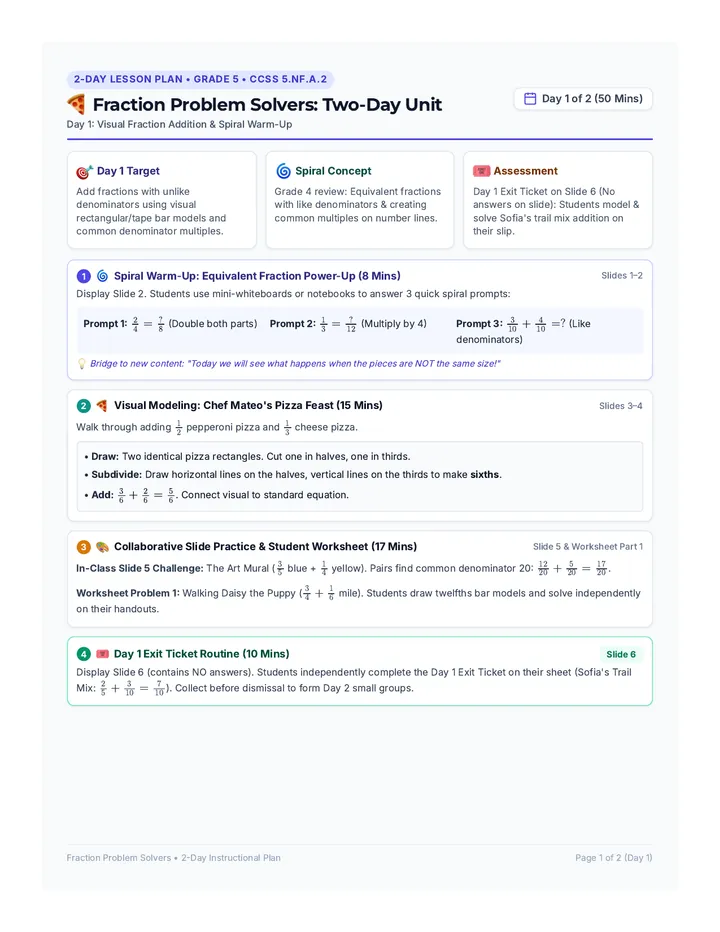
Fraction Problem Solvers Lesson Plan

Fraction Problem Solvers

A two-day fifth-grade math lesson featuring spiral warm-ups, visual fraction models, real-world emoji themes, practice problems, and exit tickets for addition (Day 1) and subtraction with benchmark estimation (Day 2).

LB

Lara Becker

5
Day 2 Fraction Slides

Day 2 Fraction Slides

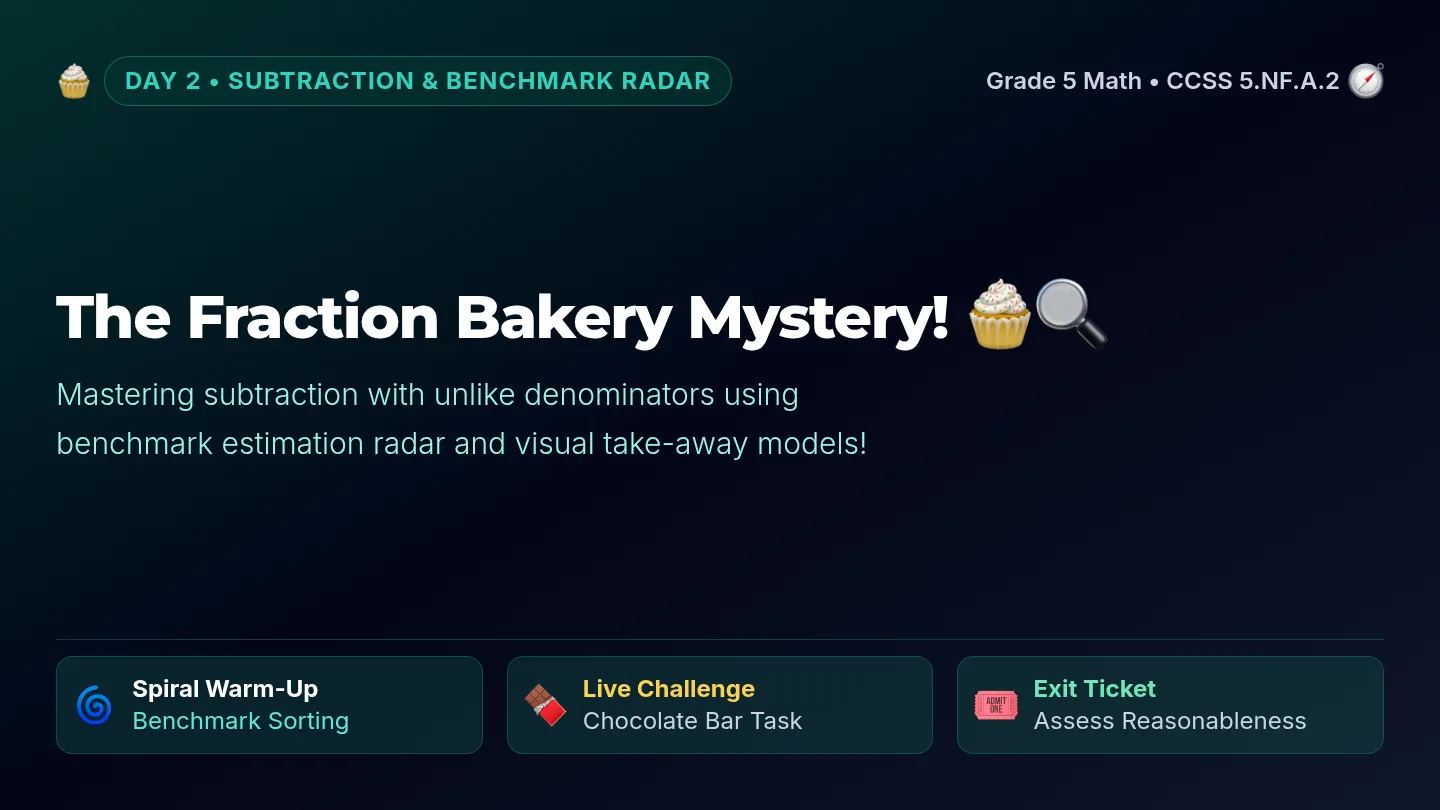
A vibrant 6-slide Day 2 presentation featuring a spiral warm-up on benchmark fraction sorting, visual subtraction with unlike denominators, video game battery practice, and an exit ticket without answers.

LB

Lara Becker

Critter Vision Lesson Plan

Animal Eyes Algebra

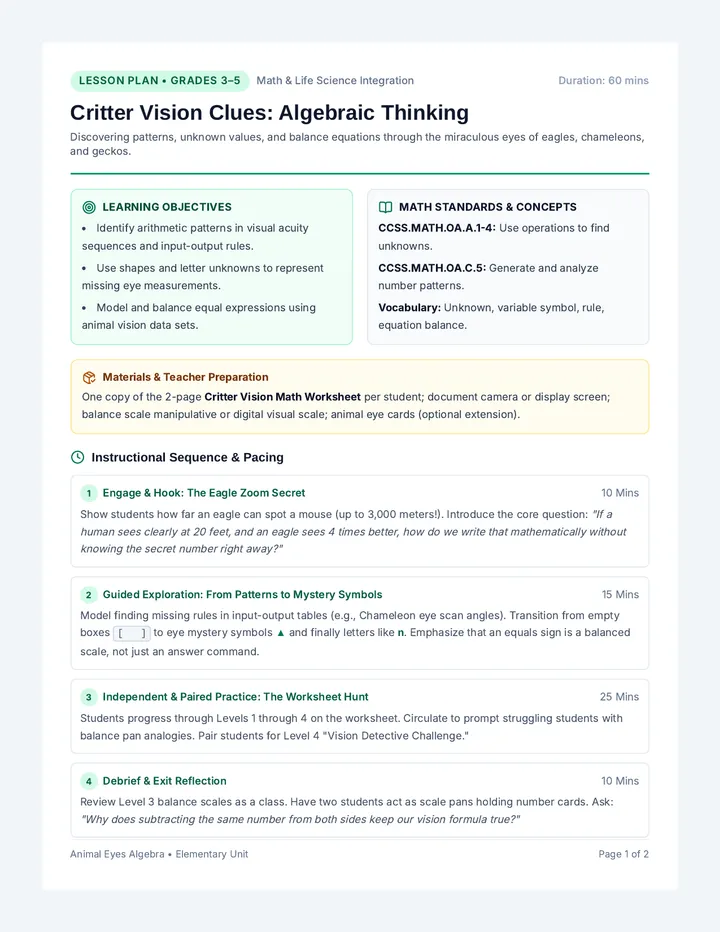
A two-part mathematics sequence exploring algebraic thinking through comparative animal vision. Students in elementary and middle school analyze fields of view, visual acuity, photoreceptor counts, and stereoscopic sight through graduated algebraic models.

Lenny Avatar
Lenny
6
Rate Mastery Assessment

Rate Mastery

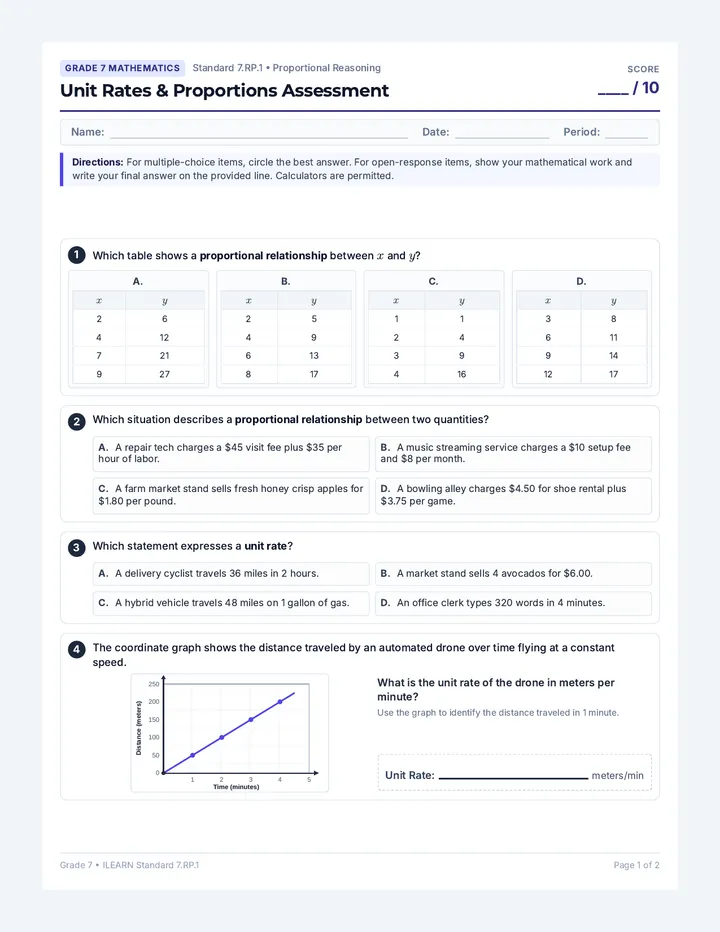
A targeted Grade 7 math lesson evaluating student mastery of standard 7.RP.1, identifying and calculating unit rates and constants of proportionality across tables, verbal descriptions, graphs, and equations.

CS

Chynna Smith

2
Fraction Word Problems Answer Key

Fraction Word Problems Answer Key

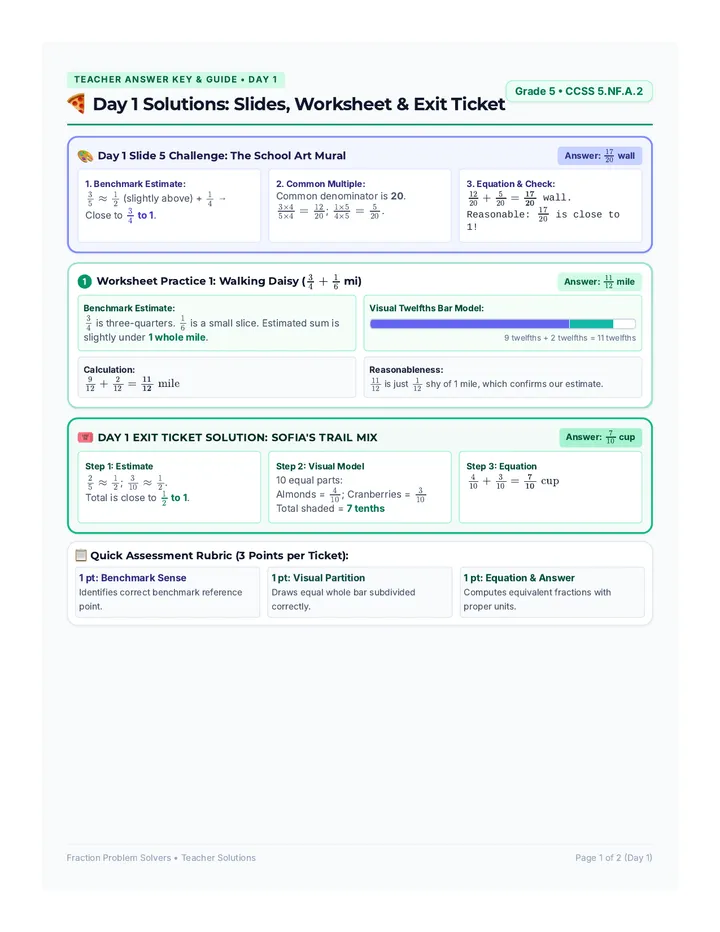
A complete two-page teacher answer key providing step-by-step solutions, visual bar models, benchmark estimation notes, and rubrics for both Day 1 and Day 2 practice and exit tickets.

LB

Lara Becker

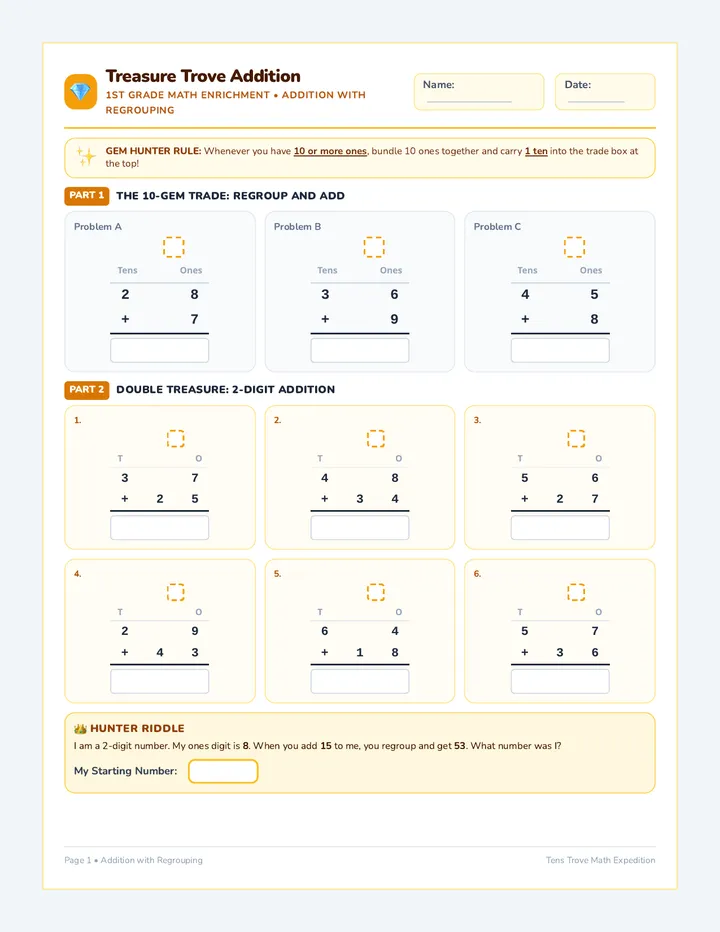
Treasure Trove Addition Worksheet

Regrouping Quest

A two-part 1st grade math enrichment sequence exploring addition and subtraction with regrouping through interactive partner card games and detective puzzle challenges.

KE

Kathy Ellis

6
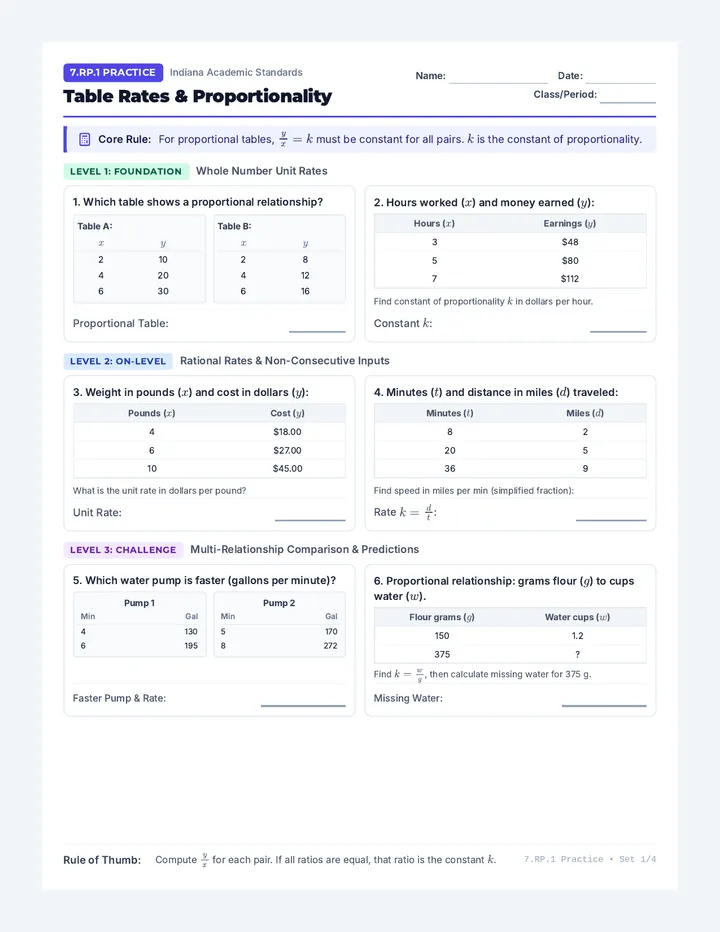
Table Rates Worksheet

Rate Radar

A focused Grade 7 mathematics practice unit targeting Indiana Academic Standard 7.RP.1. Students analyze, calculate, and interpret unit rates and constants of proportionality across tables, graphs, equations, and verbal descriptions with scaffolded difficulty levels.

CS

Chynna Smith

5
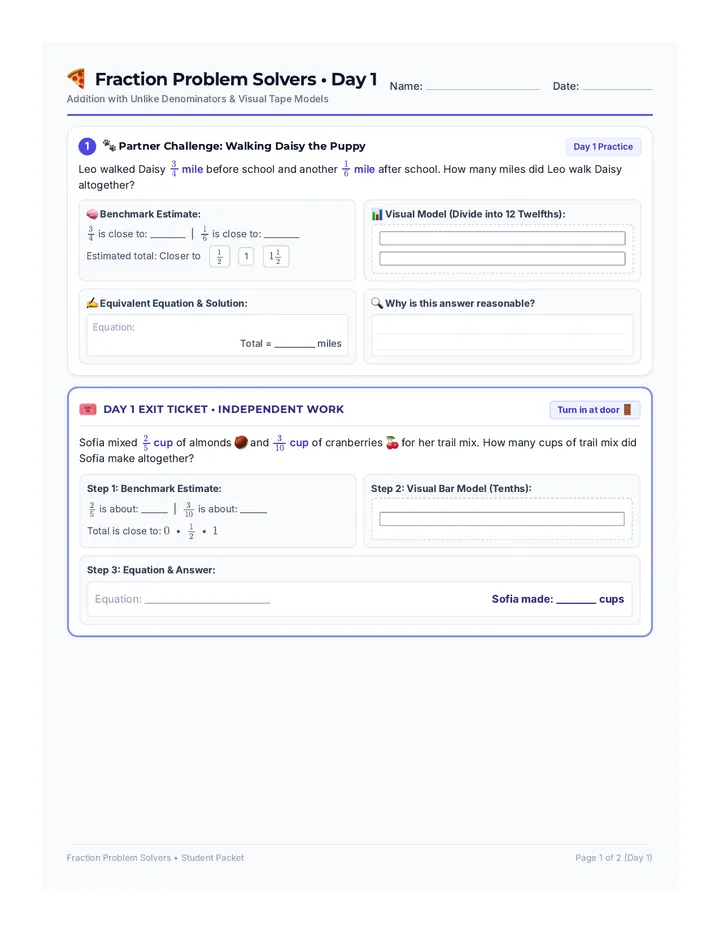
Fraction Word Problems Worksheet

Fraction Word Problems Worksheet

A fun and engaging two-page student practice and exit ticket packet for Day 1 (visual addition) and Day 2 (subtraction and benchmark estimation) packed with real-world emoji themes and blank work spaces.

LB

Lara Becker

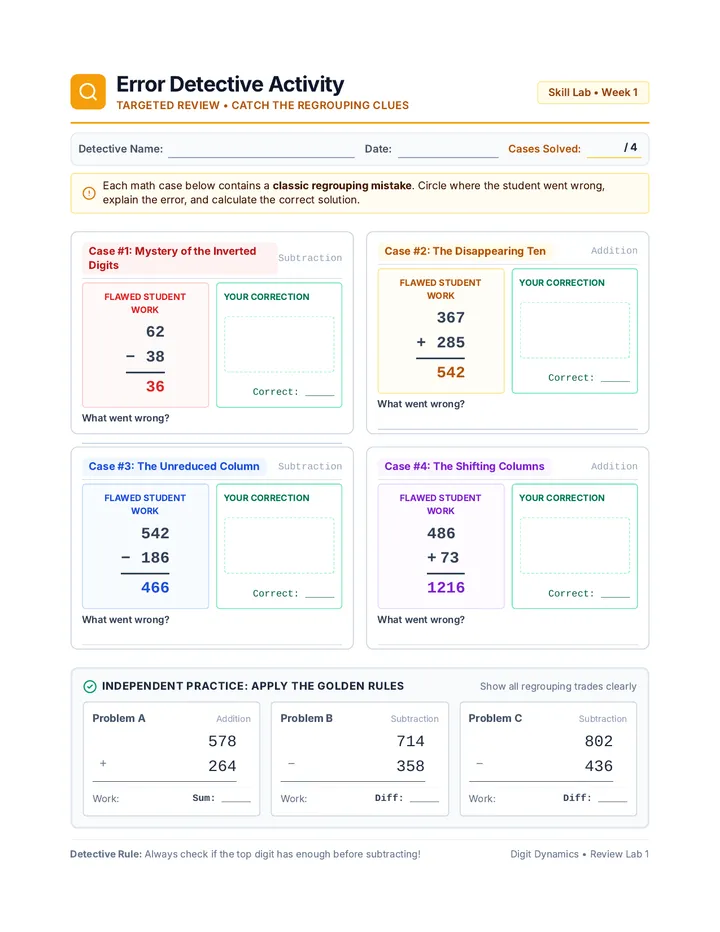
Error Detective Activity

Digit Dynamics

A multi-week progress monitoring sequence targeting multi-digit addition and subtraction with regrouping. Features recurring standardized probes, diagnostic error-analysis review sheets, and a longitudinal student progress tracker.

Lenny Avatar
Lenny
14
Code Breaker Slides

Operation Code Breakers

Students conquer multi-digit multiplication and division using visual area models, partial products, and partial quotients. Features a top-secret spy codebreaker adventure with scaffolds, spiral warm-up, practice, and exit ticket.

LB

Lara Becker

4
Day 1 Fraction Slides

Day 1 Fraction Slides

A vibrant 6-slide Day 1 presentation featuring a spiral warm-up on equivalent fractions, visual fraction bar addition models, partner practice, and an exit ticket without answers.

LB

Lara Becker