Puppy Pen Slides 🐶 1st & 2nd Grade Math Adventure
Puppy Pen Puzzles
Puppy Playpen Puzzles!
Can two puppy pens have the same space inside but different fences? Let's find out!
🟩
Area
Rug squares inside
🪵
Perimeter
Fence panels around edge
🐾 Meet the builder pups: Barnaby & Pip! Let's build! ➔
🐾 Step 1: Learn the Tools
What are Area and Perimeter?
AREA 🟩
The Cozy Floor Inside!
Count how many soft square tiles fit inside the pen for the puppy to nap on!
1
2
3
4
5
6
Area = 6 Square Tiles
PERIMETER 🪵
The Fence All Around!
Count the fence steps walking all the way around the outside edge!
Top: 3 2 2 Bottom: 3
Perimeter = 3 + 2 + 3 + 2 = 10 Steps
💡 Memory Clue: Area is tiles IN • Perimeter is the fence RIM!
🐾 Mystery #1
Same Area... Different Fences?
Both pups have exactly 8 soft rug squares . Look at their shapes!
🐶 Pip's Pen 2 rows of 4
1
2
3
4
5
6
7
8
Area (floor tiles): 8 tiles
Fence (4 + 2 + 4 + 2): 12 panels
🐶 Barnaby's Pen 1 long row of 8
1
2
3
4
5
6
7
8
Area (floor tiles): 8 tiles
Fence (8 + 1 + 8 + 1): 18 panels!
😲 WOW! Both have 8 tiles, but Barnaby needs 18 fences and Pip needs only 12!
🐾 Detective Clue
Why are the Fences Different?
Look closely at how the tiles touch each other!
🧱
Chunky Rectangle
The tiles crowd together in the middle! Their sides hide inside, so they don't need fence.
Fence needed: 12 units (Shorter!)
📏
Long Skinny Rectangle
Almost every tile touches the outside air! You need lots more fence panels to cover it.
Fence needed: 18 units (Longer!)
⭐ Rule 1: Same area doesn't mean same perimeter! Long skinny shapes have BIG perimeters!
🐾 Mystery #2
Same Fence... Different Area?
We have exactly 12 fence panels . Which pen gives the puppy MORE floor room?
Pen A: Skinny Pen
1 wide by 5 long
Fence: 1+5+1+5 = 12
Area = 5 Tiles
Smallest nap space!
Pen B: Medium Pen
2 wide by 4 long
Fence: 2+4+2+4 = 12
Area = 8 Tiles
Bigger nap space!
Pen C: Square Pen 🏆
3 wide by 3 high
Fence: 3+3+3+3 = 12
Area = 9 Tiles!
Most space for puppy!
🎉 All 3 pens use 12 fence panels, but square shapes give the MOST room!
🐾 Master Builder Secret
What Did We Discover Today?
1️⃣
Same Area Can Have Different Perimeters!
Two pens can both hold 8 tiles, but long skinny pens need lots more fence than chunky pens.
2️⃣
Same Perimeter Can Have Different Areas!
Using the exact same 12 fence panels, you can build pens with 5 tiles, 8 tiles, or 9 tiles.
3️⃣
Squares Give the Most Space!
If you want the biggest playpen with your fence, make it as square as you can!
🐾 Now it's your turn to be a Puppy Pen Architect!
Puppy Pen Worksheet 🐶
Puppy Playpen Architect
Part 1: Same Area, Different Fences!
Name:
Date:
🟩 AREA = Count the square rug tiles inside.
🪵 PERIMETER = Count the fence steps around the outside edge.
🐾 Mission 1: Count the rug tiles and fence panels for Pen A and Pen B!
Pen A: Barnaby's Pen 2 by 3
Top fence: 3 units
2
1
2
3
4
5
6
2
Bottom fence: 3 units
Tiles Inside (Area):
Fence All Around (Perimeter):
Pen B: Pip's Pen 1 by 6
Top fence: 6 units
1
1
2
3
4
5
6
1
Bottom fence: 6 units
Tiles Inside (Area):
Fence All Around (Perimeter):
🔍 Detective Check: Circle Your Answer!
1. Do Pen A and Pen B have the same area (same tiles)?
YES NO
2. Do Pen A and Pen B have the same perimeter (same fence)?
YES NO
3. Which pen needed MORE fence panels to build?
Pen A Pen B
💡 Puppy Architect Discovery:
Even when two shapes have the exact same area (6 tiles), a long skinny shape needs a longer fence than a chunky shape!
Page 1 of 2 • Turn page for Mission 2 ➔
🪵
Puppy Playpen Architect
Part 2: Same Fence, Different Space!
Fence Budget = 12 Panels
Farmer Sam gave you 12 fence panels . Look at the two pens built with all 12 panels. Let's see which puppy gets more floor space!
Pen 1: The Tunnel 1 by 5
Top fence: 5
1
1
Bottom fence: 5
Fence math: 5 + 1 + 5 + 1 = 12 panels
Count the tiles inside:
Pen 2: The Courtyard 3 by 3
Top fence: 3
3
3
Bottom fence: 3
Fence math: 3 + 3 + 3 + 3 = 12 panels
Count the tiles inside:
✏️ Draw Your Own Pen on the Grid!
Can you color in a rectangle that is 2 tiles wide and 4 tiles long ?
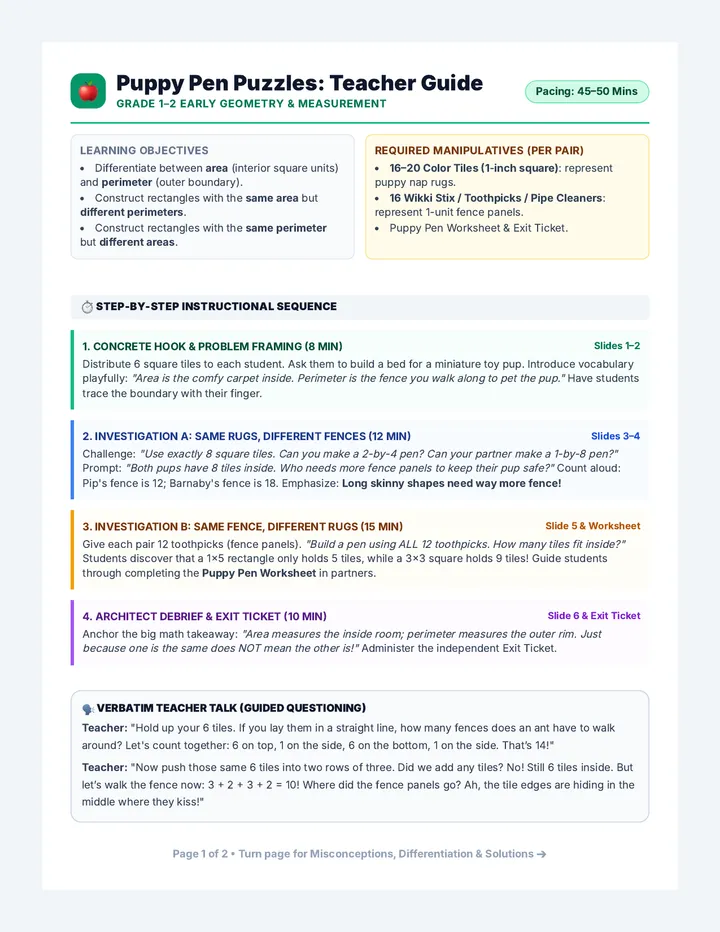
Puppy Pen Teacher Guide 🍎
Puppy Pen Puzzles: Teacher Guide
Grade 1–2 Early Geometry & Measurement
Pacing: 45–50 Mins
Learning Objectives
Differentiate between area (interior square units) and perimeter (outer boundary).
Construct rectangles with the same area but different perimeters .
Construct rectangles with the same perimeter but different areas .
Required Manipulatives (Per Pair)
16–20 Color Tiles (1-inch square) : represent puppy nap rugs.16 Wikki Stix / Toothpicks / Pipe Cleaners : represent 1-unit fence panels.Puppy Pen Worksheet & Exit Ticket.
⏱️ Step-by-Step Instructional Sequence
1. Concrete Hook & Problem Framing (8 min) Slides 1–2
Distribute 6 square tiles to each student. Ask them to build a bed for a miniature toy pup. Introduce vocabulary playfully: "Area is the comfy carpet inside. Perimeter is the fence you walk along to pet the pup." Have students trace the boundary with their finger.
2. Investigation A: Same Rugs, Different Fences (12 min) Slides 3–4
Challenge: "Use exactly 8 square tiles. Can you make a 2-by-4 pen? Can your partner make a 1-by-8 pen?" Prompt: "Both pups have 8 tiles inside. Who needs more fence panels to keep their pup safe?" Count aloud: Pip's fence is 12; Barnaby's fence is 18. Emphasize: Long skinny shapes need way more fence!
3. Investigation B: Same Fence, Different Rugs (15 min) Slide 5 & Worksheet
Give each pair 12 toothpicks (fence panels). "Build a pen using ALL 12 toothpicks. How many tiles fit inside?" Students discover that a 1×5 rectangle only holds 5 tiles, while a 3×3 square holds 9 tiles! Guide students through completing the Puppy Pen Worksheet in partners.
4. Architect Debrief & Exit Ticket (10 min) Slide 6 & Exit Ticket
Anchor the big math takeaway: "Area measures the inside room; perimeter measures the outer rim. Just because one is the same does NOT mean the other is!" Administer the independent Exit Ticket.
🗣️ Verbatim Teacher Talk (Guided Questioning)
Teacher: "Hold up your 6 tiles. If you lay them in a straight line, how many fences does an ant have to walk around? Let's count together: 6 on top, 1 on the side, 6 on the bottom, 1 on the side. That’s 14!"
Teacher: "Now push those same 6 tiles into two rows of three. Did we add any tiles? No! Still 6 tiles inside. But let’s walk the fence now: 3 + 2 + 3 + 2 = 10! Where did the fence panels go? Ah, the tile edges are hiding in the middle where they kiss!"
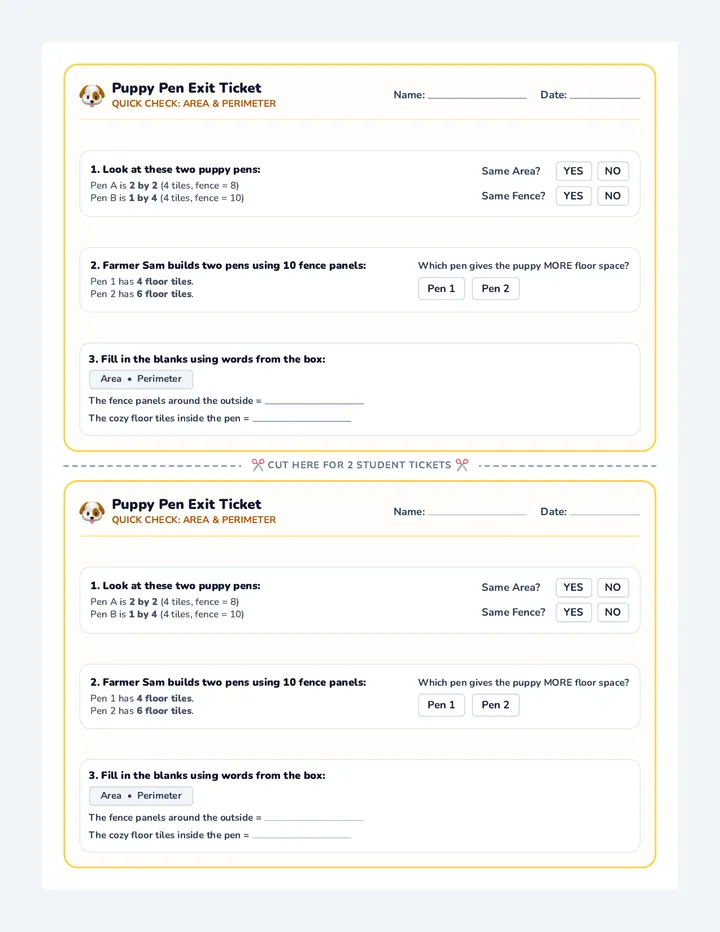
Puppy Pen Exit Ticket 🐶
Puppy Pen Exit Ticket
Quick Check: Area & Perimeter
Name:
Date:
1. Look at these two puppy pens:
Pen A is 2 by 2 (4 tiles, fence = 8)1 by 4 (4 tiles, fence = 10)
Same Area?
YES NO
Same Fence?
YES NO
2. Farmer Sam builds two pens using 10 fence panels:
Pen 1 has 4 floor tiles .6 floor tiles .
Which pen gives the puppy MORE floor space?
Pen 1 Pen 2
3. Fill in the blanks using words from the box:
Area • Perimeter
The fence panels around the outside =
The cozy floor tiles inside the pen =
✂️ Cut here for 2 student tickets ✂️
🐶
Puppy Pen Exit Ticket
Quick Check: Area & Perimeter
Name:
Date:
1. Look at these two puppy pens:
Pen A is 2 by 2 (4 tiles, fence = 8)1 by 4 (4 tiles, fence = 10)
Same Area?
YES NO
Same Fence?
YES NO
2. Farmer Sam builds two pens using 10 fence panels:
Pen 1 has 4 floor tiles .6 floor tiles .
Which pen gives the puppy MORE floor space?
Pen 1 Pen 2
3. Fill in the blanks using words from the box:
Area • Perimeter
The fence panels around the outside =
The cozy floor tiles inside the pen =
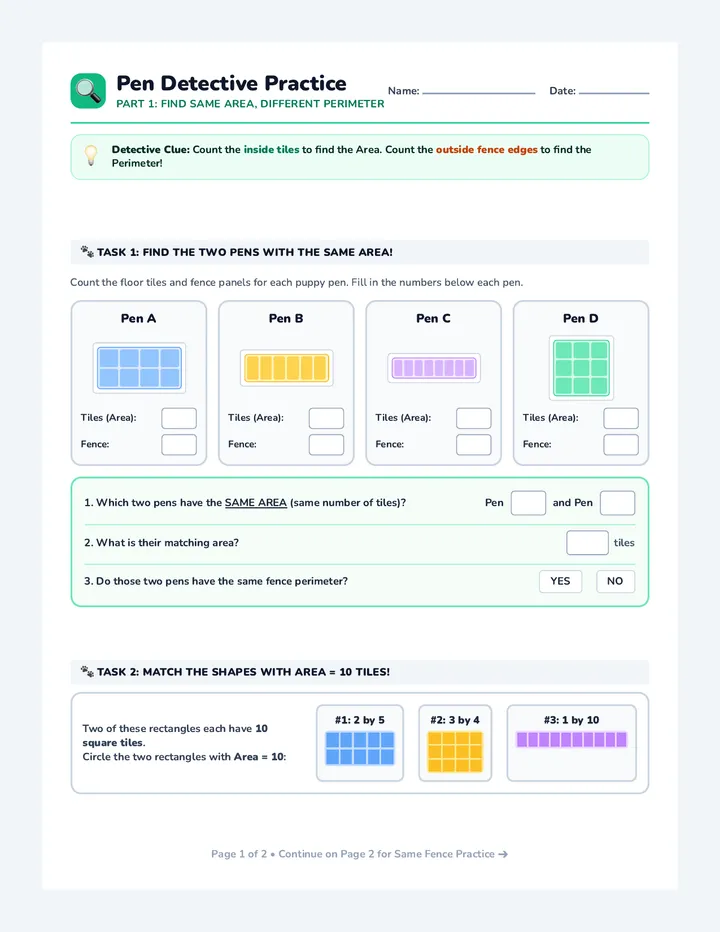
Pen Detective Practice Worksheet 🔍
Pen Detective Practice
Part 1: Find Same Area, Different Perimeter
Name:
Date:
💡
Detective Clue: Count the inside tiles to find the Area. Count the outside fence edges to find the Perimeter!
🐾 Task 1: Find the Two Pens with the SAME AREA!
Count the floor tiles and fence panels for each puppy pen. Fill in the numbers below each pen.
Pen A
Tiles (Area):
Fence:
Pen B
Tiles (Area):
Fence:
Pen C
Tiles (Area):
Fence:
Pen D
Tiles (Area):
Fence:
1. Which two pens have the SAME AREA (same number of tiles)?
Pen
and Pen
2. What is their matching area?
tiles
3. Do those two pens have the same fence perimeter?
YES NO
🐾 Task 2: Match the Shapes with Area = 10 Tiles!
Two of these rectangles each have 10 square tiles .Area = 10 :
#1: 2 by 5
#2: 3 by 4
#3: 1 by 10
Page 1 of 2 • Continue on Page 2 for Same Fence Practice ➔
🪵
Pen Detective Practice
Part 2: Find Same Fence, Different Area
Target Fence = 14 Panels
Perimeter Reminder: Add the lengths of all 4 sides to get the fence panels! (Top + Side + Bottom + Side).
🐾 Task 3: Which Pens Share the EXACT SAME Fence (Perimeter = 14)?
Pen X 3 by 4
Top: 4
3
3
Bottom: 4
4 + 3 + 4 + 3 = 14
Area (tiles):
Pen Y 2 by 5
Top: 5
2
2
Bottom: 5
5 + 2 + 5 + 2 = 14
Area (tiles):
Pen Z 1 by 6
Top: 6
1
1
Bottom: 6
6 + 1 + 6 + 1 = 14
Area (tiles):
1. Did all three pens use the EXACT SAME fence length (Perimeter = 14)?
YES NO
2. Do they have the same area inside?
YES NO
3. Which pen gives the puppy the MOST FLOOR SPACE to play?
Pen Detective Answer Key ✓
Pen Detective Answer Key
Teacher Reference & Solutions Guide
Grade 1–2 Practice Solutions
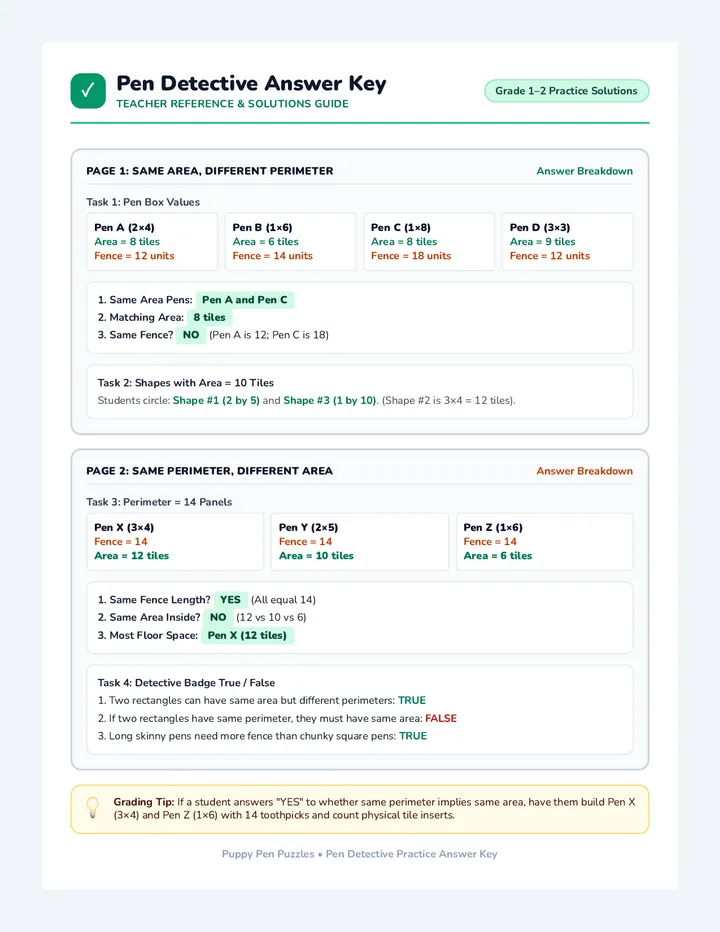
Page 1: Same Area, Different Perimeter Answer Breakdown
Task 1: Pen Box Values
Pen A (2×4)
Area = 8 tiles
Fence = 12 units
Pen B (1×6)
Area = 6 tiles
Fence = 14 units
Pen C (1×8)
Area = 8 tiles
Fence = 18 units
Pen D (3×3)
Area = 9 tiles
Fence = 12 units
1. Same Area Pens: Pen A and Pen C
2. Matching Area: 8 tiles
3. Same Fence? NO (Pen A is 12; Pen C is 18)
Task 2: Shapes with Area = 10 Tiles
Students circle: Shape #1 (2 by 5) and Shape #3 (1 by 10) . (Shape #2 is 3×4 = 12 tiles).
Page 2: Same Perimeter, Different Area Answer Breakdown
Task 3: Perimeter = 14 Panels
Pen X (3×4)
Fence = 14
Area = 12 tiles
Pen Y (2×5)
Fence = 14
Area = 10 tiles
Pen Z (1×6)
Fence = 14
Area = 6 tiles
1. Same Fence Length? YES (All equal 14)
2. Same Area Inside? NO (12 vs 10 vs 6)
3. Most Floor Space: Pen X (12 tiles)
Task 4: Detective Badge True / False
1. Two rectangles can have same area but different perimeters: TRUE
2. If two rectangles have same perimeter, they must have same area: FALSE
3. Long skinny pens need more fence than chunky square pens: TRUE
💡
Grading Tip: If a student answers "YES" to whether same perimeter implies same area, have them build Pen X (3×4) and Pen Z (1×6) with 14 toothpicks and count physical tile inserts.
Puppy Pen Puzzles • Pen Detective Practice Answer Key