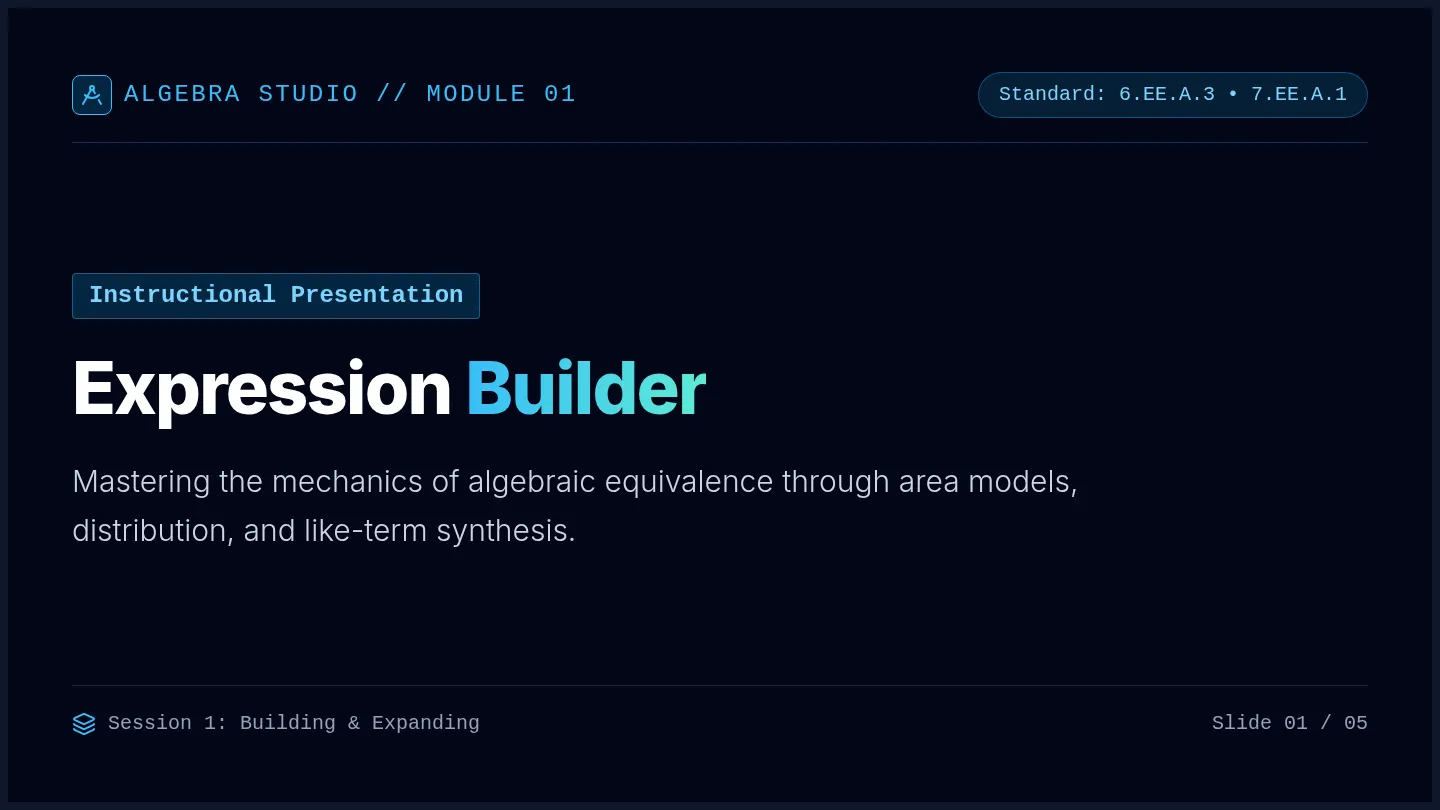
Case Brief Teacher Guide Case Brief: Pattern Sleuths
Grade 6 Mathematics: Arithmetic vs. Geometric Sequences
Objective
Distinguish between arithmetic (additive) and geometric (multiplicative) patterns by identifying common differences and ratios.
Duration
45-50 Minutes
Materials
Slides, Sorting Cards, Lab Notes (Worksheet), Exit Ticket.
Operational Timeline
0-5 min
Warm-up: Two Truths and a Lie
"Sleuths, look at these three sequences on the board. One of them isn't like the others. Can you find the lie?"
5-15 min
Surveillance (Video Analysis)
Watch the video provided in the slides. Pause Point 1 (3:20): Discuss the "Common Difference." Ask: "What math operation is happening between numbers?" Pause Point 2 (6:00): Discuss the "Common Ratio." Ask: "How is multiplication different from addition in a sequence?"
15-35 min
Evidence Sort (Activity)
Students work in pairs to sort "Sequence Cards." They must categorize them as "Adders" (Arithmetic) or "Multipliers" (Geometric) and solve for the missing term.
35-45 min
Closure: The Challenge
Students create their own "Secret Sequence" and trade with a partner to solve.
Code Words (Vocabulary)
Arithmetic Sequence: A pattern made by adding/subtracting the same value.Common Difference: The specific amount added or subtracted.Geometric Sequence: A pattern made by multiplying/dividing by the same value.Common Ratio: The specific amount multiplied or divided.
Case Solutions (Answer Key)
Sorting Cards Key
Sequence Type Next Term 1, 5, 9, 13 Arithmetic (+4) 17 2, 6, 18, 54 Geometric (×3) 162 100, 90, 80, 70 Arithmetic (-10) 60 64, 32, 16, 8 Geometric (×0.5) 4 5, 15, 25, 35 Arithmetic (+10) 45 1, 2, 4, 8 Geometric (×2) 16 30, 27, 24, 21 Arithmetic (-3) 18 4, 12, 36, 108 Geometric (×3) 324 0.5, 1, 1.5, 2 Arithmetic (+0.5) 2.5 11, 22, 33, 44 Arithmetic (+11) 55 1, 10, 100, 1000 Geometric (×10) 10,000 5, 10, 20, 40 Geometric (×2) 80
Exit Ticket Key
1. Identify: 3, 12, 48, 192...
Answer: Geometric. Common Ratio is ×4.
2. Identify: 15, 11, 7, 3...
Answer: Arithmetic. Common Difference is -4.
3. Create Arithmetic
Example: 2, 5, 8, 11 (+3)
4. Create Geometric
Example: 2, 4, 8, 16 (×2)
Teacher Tips for "Sequence Sort"
Struggling Students: Encourage them to find the difference between the first two numbers, then test it on the next pair. If it doesn't match, they should try dividing to check for a ratio.Fast Finishers: Ask them to write the next 5 terms for their cards, or challenge them to find a sequence that is NEITHER (like Fibonacci: 1, 1, 2, 3, 5, 8).Visual Learners: Have them draw "jumps" with arrows on their worksheet, similar to the narrator in the video. Pattern Sleuths Presentation Pattern Sleuths
Case #6-2026: The Sequence Mystery
Analyze
Sort
Solve
Warm-up
Two Truths and a Lie
5 Minutes
Which one of these sequences is the LIE?
A 2, 5, 8, 11, 14...
B 5, 9, 13, 17, 21...
C 3, 6, 12, 15, 21...
Surveillance Part 1
Case Analysis: Arithmetic Patterns
0:00 - 3:20
Embedded media
"Whenever you have a sequence that differs by a common number, this is an arithmetic sequence."
Analysis: Arithmetic
The Operation
Numbers change by adding or subtracting the same value.
27, 21, 15, 9...
The Evidence
The constant change is called the Common Difference.
21 - 27 = -6
15 - 21 = -6
Rule: Subtract 6
Surveillance Part 2
Case Analysis: Geometric Patterns
3:21 - 6:00
Embedded media
"This is known as a geometric sequence because the numbers differ by multiplication or division."
Analysis: Geometric
The Operation
Numbers change by multiplying or dividing the same value.
3, 6, 12, 24...
The Evidence
The constant factor is called the Common Ratio.
6 ÷ 3 = 2
12 ÷ 6 = 2
Rule: Multiply by 2
Sleuth's Field Guide
Feature Arithmetic Geometric Action Add / Subtract Multiply / Divide Key Term Common Difference Common Ratio To Find Rule Subtract terms Divide terms
Mission: Sequence Sort
1
Pick a Sequence Card from your evidence folder.
2
Sort it: Adder or Multiplier?
3
Record your Evidence on your Lab Notes.
4
Solve for the Next Term and repeat!
Evidence Sorting Cards Case Evidence: Sequence Sorting Cards
Instruction: Cut along the dashed lines to separate the dossiers.
CASE #01
Sequence Analysis
1, 5, 9, 13, ...
Confidential Evidence
CASE #02
Sequence Analysis
2, 6, 18, 54, ...
Confidential Evidence
CASE #03
Sequence Analysis
100, 90, 80, 70, ...
Confidential Evidence
CASE #04
Sequence Analysis
64, 32, 16, 8, ...
Confidential Evidence
CASE #05
Sequence Analysis
5, 15, 25, 35, ...
Confidential Evidence
CASE #06
Sequence Analysis
1, 2, 4, 8, ...
Confidential Evidence
CASE #07
Sequence Analysis
30, 27, 24, 21, ...
Confidential Evidence
CASE #08
Sequence Analysis
4, 12, 36, 108, ...
Confidential Evidence
CASE #09
Sequence Analysis
0.5, 1, 1.5, 2, ...
Confidential Evidence
CASE #10
Sequence Analysis
1, 10, 100, 1000, ...
Confidential Evidence
CASE #11
Sequence Analysis
11, 22, 33, 44, ...
Confidential Evidence
CASE #12
Sequence Analysis
5, 10, 20, 40, ...
Confidential Evidence
Pattern Detective Lab Notes Pattern Detective: Lab Notes
Classification: Confidential Grade 6 Math
Sleuth Name:
Date:
Warm-up: Identifying the Lie
Analyze the sequences on the board. Which sequence (A, B, or C) was the LIE ? Why didn't it fit?
The Lie is:
Reasoning:
Field definitions
Arithmetic Sequence
A pattern made by adding or subtracting a constant value.
Secret Term: Common Difference
Geometric Sequence
A pattern made by multiplying or dividing a constant value.
Secret Term: Common Ratio
Evidence Log: Sequence Sort
Case # The Rule (+, -, ×, ÷) Type (A or G) Next Term 01 02 03 04 05 06 07 08 09 10 11 12
Note: A = Arithmetic, G = Geometric. Show your jumps (e.g. +4 or ×3) in the Rule column.
Partner Challenge: The Hidden Pattern
Your Secret Sequence (4 Numbers):
Create a pattern that is either Arithmetic or Geometric.
Partner's Analysis:
Type (A/G)
The Rule
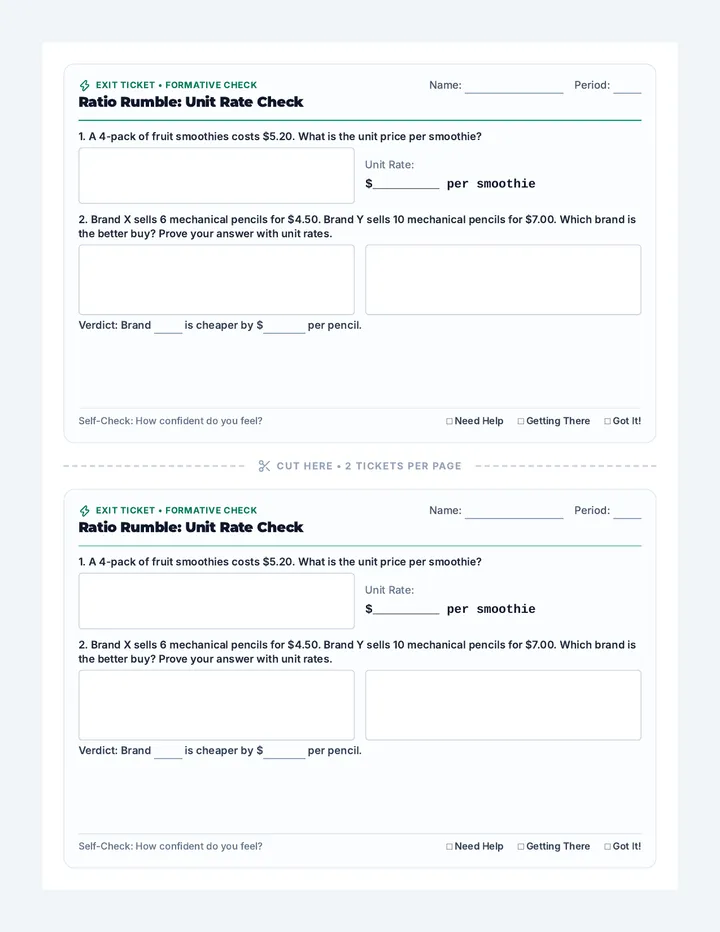
Case Closed Exit Ticket Case Closed
Final Exit Ticket Analysis
Badge Name:
Date:
1. Identify this sequence: 3, 12, 48, 192...
Arithmetic
Geometric
Evidence (The Rule):
2. Identify this sequence: 15, 11, 7, 3...
Arithmetic
Geometric
Evidence (The Rule):
3. Create an Arithmetic sequence using subtraction:
__, __, __, __
4. Create a Geometric sequence using multiplication:
__, __, __, __
Evidence Verified