Operation Detective Teacher Guide Operation Detective
Teacher Facilitation Guide
Top Secret
Subject: Mathematics
Topic: Multi-Step Operations
Learning Objectives
Represent multi-step word problems using equations with a letter standing for the unknown quantity.
Assess the reasonableness of answers using mental computation and estimation strategies including rounding.
Apply all four operations (addition, subtraction, multiplication, and division) to solve complex, real-world problems.
Materials Needed
Operation Detective Slides
Case Files Worksheet (Differentiated)
Magnifying glasses (optional, for engagement)
Individual whiteboards and markers
Quick Prep
Total Duration
60 Minutes
Vocabulary
Variable, Equation, Reasonable, Inverse, Multi-step
Differentiation
The worksheet is divided into three "Case Difficulty" levels: Rookie, Sleuth, and Mastermind.
Instructional Flow
0-10 MIN
The Hook: The Missing Cookies
Enter the room with a "Top Secret" folder. Explain that a local bakery has had a shipment go missing, and we need to use our math skills to trace the missing items. Present the first example from the slides as a "live case" to solve together.
10-25 MIN
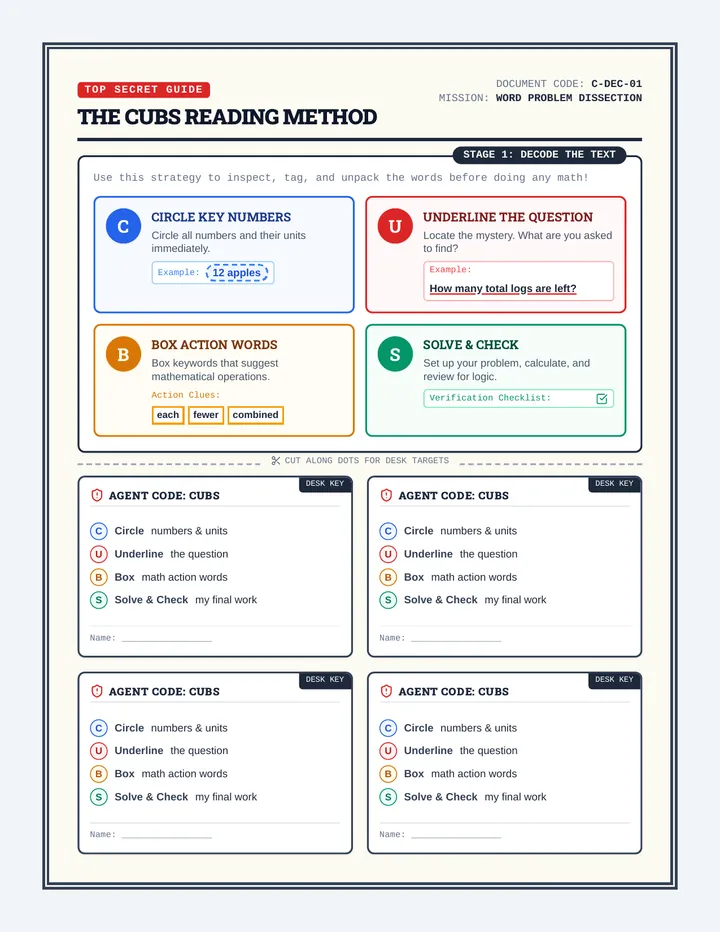
Direct Instruction: The CLUES Strategy
Introduce the CLUES acronym for solving word problems:
Circle the numbers.
Line through extra info.
Underline the question.
Estimate the answer.
Solve and check.
Use the slides to model this strategy with a 2-step problem involving multiplication and subtraction.
25-40 MIN
Guided Practice: Collaborative Investigation
Students work in pairs to solve 2 "Practice Cases" on whiteboards. Teacher circulates, looking for students who are forgetting the final step or misinterpreting the "total" vs. "groups."
Teacher Tip: Watch for students who stop after the first operation. Remind them: "A detective never leaves a case half-solved!"
40-55 MIN
Independent Work: Case Files Worksheet
Distribute the differentiated worksheet. Allow students to choose their entry point, but guide "Rookies" to start with Case 1. Challenge advanced students to go straight to "Mastermind" cases.
55-60 MIN
Closing: Debrief
Review the most challenging problem from the worksheet. Ask: "Which operation was the 'hidden' clue?"
Scaffolding (Support)
Provide a graphic organizer that separates "Step 1" and "Step 2."
Use smaller, friendly numbers (multiples of 10) for the same context.
Provide a visual "Operation Key" showing common keywords for +, -, ×, ÷.
Extension (Challenge)
Have students write their own "Detective Case" that requires exactly three different operations.
Introduce problems with multi-digit division and remainders that must be interpreted.
Ask students to solve a problem in two different ways.
Discussion Prompts
"How did you know you weren't finished after the first calculation?"
"If the answer was much larger than your estimate, what might have gone wrong in your detective work?"
"Can you explain why division was necessary in this specific step?"
"What information in this problem was a 'red herring' designed to distract you?"
Operation Detective Slides Operation Detective
Solving Multi-Step Word Problems
The Mission
A good detective doesn't just look at the first clue they find. They gather all the evidence and follow every lead.
Today, we will solve multi-step problems using addition, subtraction, multiplication, and division.
The C.L.U.E.S. Strategy
C
Circle
the numbers and units.
L
Line
through extra information.
U
Underline
the final question.
E
Estimate
a reasonable answer.
S
Solve
and check your work.
Beware of Red Herrings!
In some cases, the villains will plant extra information to distract you.
Identify the data you DON'T need and cross it out!
Case Study #1
Modeling
"Detective Reed is buying gear. He needs 4 magnifying glasses that cost $8 each. He also needs a $15 flashlight. He has a $50 bill. How much change will he receive?"
Step 1: Total Cost
(4 × $8) + $15 = ?
Step 2: The Change
$50 - $47 = $3
Case Study #2
Modeling
"There are 120 files in the evidence room. The chief detective archives 48 files. The remaining files are split into 9 equal storage bins. How many files go in each bin?"
Step 1: Find Remaining
120 - 48 = 72
Step 2: Share equally
72 ÷ 9 = 8 files
Your Turn, Detectives!
"The station received 5 boxes of pens. Each box has 12 pens. If 8 pens are given to the rookie squad, how many pens are left for the veterans?"
Step 1: ?
Step 2: ?
Solve on your whiteboards!
Case Files Assigned
Return to your desks and open your Case Files. Choose your difficulty and begin your investigation.
Rookie
Sleuth
Mastermind
Case Files Worksheet Case Files: Operations
Department of Mathematical Investigations
Detective:
Date:
Level 1
Rookie Cases
Case #101: A local bakery had 128 cookies. They baked 45 more cookies in the morning. By noon, they had sold 92 cookies. How many cookies are left in the bakery?
Show Your Work
Equation with Variable:
Final Answer:
Case #102: Detective badges come in packs of 8. The station bought 6 packs. If 15 badges are given to the new recruits, how many badges remain?
Show Your Work
Equation with Variable:
Final Answer:
Level 2
Sleuth Cases
Case #201: The evidence lab has 4 rows of storage lockers, with 12 lockers in each row. If the lab technicians need to divide all the evidence equally into 6 large bins, how many lockers' worth of evidence go into each bin?
Show Your Work
Equation with Variable:
Final Answer:
Case #202: For a 3-day surveillance mission, a team of 4 detectives needs 2 bottles of water per person, per day. If they already have 14 bottles, how many more bottles do they need to purchase?
Show Your Work
Equation with Variable:
Final Answer:
Level 3
Mastermind Cases
"The suspects are calculating their payroll. Suspect A earns $15 per hour and worked 40 hours. Suspect B earns $18 per hour and worked 30 hours. They decided to pool their money and split it equally among 4 different bank accounts. How much money goes into each account?"
Investigation Log (Show Your Work)
Equation with Variable:
Final Answer:
"A detective squad has 158 clues to organize into folders. Each folder can hold 6 clues. How many folders will be completely full, and how many clues will be left in the final, partially filled folder?"
Investigation Log (Show Your Work)
Full Folders:
Clues Left Over:
End of Dossier
Case Files Answer Key Answer Key: Classified
Confidential: For Teacher Use Only
Restricted Access
Level 1
Rookie Cases
Case #101: Bakery Mystery
Equation:
(128 + 45) - 92 = c
Final Answer:
81 cookies
Case #102: Badge Inventory
Equation:
(8 × 6) - 15 = b
Final Answer:
33 badges
Level 2
Sleuth Cases
Case #201: Lab Storage
Equation:
(4 × 12) ÷ 6 = l
Final Answer:
8 lockers per bin
Case #202: Water Supply
Equation:
(3 × 4 × 2) - 14 = w
Final Answer:
10 bottles
Level 3
Mastermind Cases
Case #301: Suspect Payroll
Equation:
[(15 × 40) + (18 × 30)] ÷ 4 = m
Final Answer:
$285 per account
Case #302: Clue Filing
Calculation:
158 ÷ 6 = 26 r 2
Final Answer:
26 full folders, 2 clues leftover
Grading Guidance
Partial Credit: Award points if the student correctly identified the first step, even if the final calculation is incorrect.Variable Usage: Encourage students to use any letter (x, n, c) as long as it represents the unknown correctly in their equation.Reasonableness: If a student's answer is wildly different but their equation is correct, focus feedback on their calculation/estimation skills.