Linear Forms Study Guide
Name: ______________________________
Class: ________________
Date: ______________
Unit 1 Comprehensive Review (Sections 5-3 to 5-5)
Linear Equations Study Guide
Skills Covered
Slope-Intercept • Point-Slope • Standard
Formula Quick-Reference Card
Slope Formula
\( m = \frac{y_2 - y_1}{x_2 - x_1} \) • \( \frac{\text{rise}}{\text{run}} \)
Slope-Intercept Form (5-3)
\( y = mx + b \) (\(m\) = slope, \(b\) = \(y\)-int.)
Point-Slope Form (5-4)
\( y - y_1 = m(x - x_1) \) (point \((x_1, y_1)\))
Standard Form (5-5)
\( Ax + By = C \) (\(A, B, C\) are integers)
Skill 1: Slope-Intercept Form (Section 5-3)
Use \( y = mx + b \) to write equations from slopes, points, graphs, and real-world rates.
Key Concepts
- Slope (\(m\)): Rate of change. Positive slopes rise left-to-right; negative slopes fall left-to-right.
- \(y\)-intercept (\(b\)): Where the line crosses the \(y\)-axis, at point \((0, b)\).
- From Two Points: First find \(m\) using the slope formula, then plug \(m\) and one point \((x, y)\) into \(y = mx + b\) to solve for \(b\).
Study Tip
Always check the sign of \(b\)! If \(b = -3\), write \(y = mx - 3\), not \(+ 3\). In word problems, \(m\) is the "per item/visit" rate and \(b\) is the starting amount.
Step-by-Step Worked Solutions
Example 1A: Write the slope-intercept equation of the line passing through \((2, 5)\) and \((9, 2)\).
Step 1: Find slope \(m\)
\( m = \frac{2 - 5}{9 - 2} = \frac{-3}{7} = -\frac{3}{7} \)
Step 2: Solve for \(b\)
Plug in \((2, 5)\) and \(m = -\frac{3}{7}\):
\( 5 = -\frac{3}{7}(2) + b \Rightarrow 5 = -\frac{6}{7} + b \)
\( b = 5 + \frac{6}{7} = \frac{35}{7} + \frac{6}{7} = \frac{41}{7} \)
Step 3: Write equation
Substitute \(m\) and \(b\):
\( y = -\frac{3}{7}x + \frac{41}{7} \)
Example 1B (Real-World): Giselle pays $240 in advance at an athletic club. Each visit deducts $15. Write a linear function for her balance \(b\) after \(x\) visits.
Step 1: Starting value
At \(0\) visits, her balance is \(\$240\). So the \(y\)-intercept is \(240\).
Step 2: Rate of change
"Deducts $15 each visit" means the balance decreases by \(15\) per visit: \(m = -15\).
Step 3: Write function
Combine rate and start:
\( b = 240 - 15x \)
(or \(b = -15x + 240\))
Skill 1 Practice: Slope-Intercept Form
Show all work
Part A: Write an equation in slope-intercept form with the given slope and \(y\)-intercept.
1. \( m = -4, \quad b = 7 \)
2. \( m = \frac{2}{3}, \quad b = -\frac{5}{2} \)
Part B: Write an equation in slope-intercept form for the line passing through the two points.
3. \( (1, 4) \text{ and } (5, 12) \)
4. \( (-3, 7) \text{ and } (3, -1) \)
Part C: Real-World Linear Modeling
5. Marcus loads $120 onto a transit card. Each bus ride costs $2.50. Write a linear equation for the remaining balance \(B\) after \(r\) rides, and find his balance after 14 rides.
Part D: Graph each equation on the coordinate grid.
6. \( y = -2x + 3 \)
x y -5 5 5 -5
7. \( y = \frac{1}{2}x - 2 \)
x y -5 5 5 -5
Skill 2: Point-Slope Form (Section 5-4)
Use \( y - y_1 = m(x - x_1) \) when you know a point \((x_1, y_1)\) and the slope \(m\).
Key Concepts
- Formula: \( y - y_1 = m(x - x_1) \), where \(m\) is the slope and \((x_1, y_1)\) is any point on the line.
- Graphing: Plot the point \((x_1, y_1)\) first, then count \(\frac{\text{rise}}{\text{run}}\) from that point using \(m\).
Study Tip
Subtracting a negative turns into addition! For point \((-10, -6)\), \(y - (-6)\) becomes \(y + 6\), and \(x - (-10)\) becomes \(x + 10\).
Step-by-Step Worked Example
Write the point-slope equation for the line through \((-10, -6)\) with slope \(m = -\frac{5}{8}\).
Step 1: Label values
\( x_1 = -10, \; y_1 = -6 \)
\( m = -\frac{5}{8} \)
Step 2: Substitute
\( y - (-6) = -\frac{5}{8}(x - (-10)) \)
Step 3: Simplify signs
\( y + 6 = -\frac{5}{8}(x + 10) \)
Skill 2 Practice: Point-Slope Form
Show all work
Part A: Write an equation in point-slope form for the line through the given point with the given slope.
8. \( (4, 9); \quad m = -3 \)
9. \( (-2, 5); \quad m = \frac{3}{4} \)
10. \( (-7, -1); \quad m = -\frac{1}{2} \)
Part B: From Two Points
11. Write a point-slope equation for the line through \( (-3, -2) \) and \( (1, 6) \).
Part C: Graph Point-Slope
12. \( y - 2 = \frac{2}{3}(x + 3) \)
x y -5 5 5 -5
Skill 3: Standard Form, Intercepts & Special Lines (Section 5-5)
Master \( Ax + By = C \), finding intercepts, converting forms, and graphing \(y = c\) or \(x = c\).
Key Concepts
- Finding Intercepts (Cover-Up Method): Set \(y = 0\) and solve for \(x\) to find the \(x\)-intercept. Set \(x = 0\) and solve for \(y\) to find the \(y\)-intercept.
- Converting to Standard Form: Clear any fractions by multiplying the entire equation by the denominator, then move the \(x\)-term to the left side so it reads \(Ax + By = C\).
- Real-World Modeling: Use \(Ax + By = C\) when combining two items with different rates/prices to equal a total budget \(C\).
HOY • VUX Trick
HOY: Horizontal line, 0 slope, y = # (e.g., \(y = -2\)).
VUX: Vertical line, Undefined slope, x = # (e.g., \(x = 1\)).
Step-by-Step Worked Solutions
Example 3A (Intercepts): Find the \(x\)- and \(y\)-intercepts of \( -\frac{7}{5}x - 4y = 7 \).
Find \(x\)-intercept (set \(y = 0\))
\( -\frac{7}{5}x - 4(0) = 7 \Rightarrow -\frac{7}{5}x = 7 \)
Multiply both sides by \(-\frac{5}{7}\):
\( x = 7 \cdot \left(-\frac{5}{7}\right) = \) \(-5\)
Find \(y\)-intercept (set \(x = 0\))
\( -\frac{7}{5}(0) - 4y = 7 \Rightarrow -4y = 7 \)
Divide both sides by \(-4\):
\( y = \) \(-\frac{7}{4}\)
Example 3B (Converting): Write \( y = \frac{2}{5}x + 6 \) in standard form using integers.
Step 1: Clear fraction
Multiply every term by \(5\):
\( 5(y) = 5\left(\frac{2}{5}x\right) + 5(6) \)
\( 5y = 2x + 30 \)
Step 2: Move \(x\)-term
Subtract \(2x\) from both sides:
\( -2x + 5y = 30 \)
Step 3: Check integers
\(A = -2, B = 5, C = 30\) are all integers.
\( -2x + 5y = 30 \)
Example 3C (Word Problem): Paint costs $35.75/gal (\(p\)) and rollers cost $6.00 each (\(r\)). Write a standard form equation for a $190 budget.
Cost of paint (\(35.75p\)) + Cost of rollers (\(6r\)) = Total budget (\(190\)) → \( 35.75p + 6r = 190 \)
Skill 3 Practice: Standard Form & Special Lines
Show all work
Part A: Find the \(x\)- and \(y\)-intercept of each line.
13. \( 3x - 6y = 18 \)
14. \( -\frac{3}{4}x + 2y = 6 \)
Part B: Write each equation in standard form using integers.
15. \( y = \frac{1}{4}x - 3 \)
16. \( y = -\frac{3}{5}x + 4 \)
Part C: Graph each equation.
17. \( y = 3 \) and \( x = -2 \) (label both)
x y -5 5 5 -5
18. \( 2x + 3y = 6 \)
x y -5 5 5 -5
Part D: Real-World Standard Form
19. A bakery sells loaves of bread for $4.50 each (\(b\)) and muffins for $2.25 each (\(m\)). Write a standard form equation for a customer who spends $36.00.
Test-Day Self-Check
☐ I can find \(m\) and \(b\) from a graph or two points.
☐ I flip the signs when plugging into \(y - y_1 = m(x - x_1)\).
☐ I can clear fractions to write \(Ax + By = C\).
Linear Forms Answer Key
Teacher & Self-Check Resource
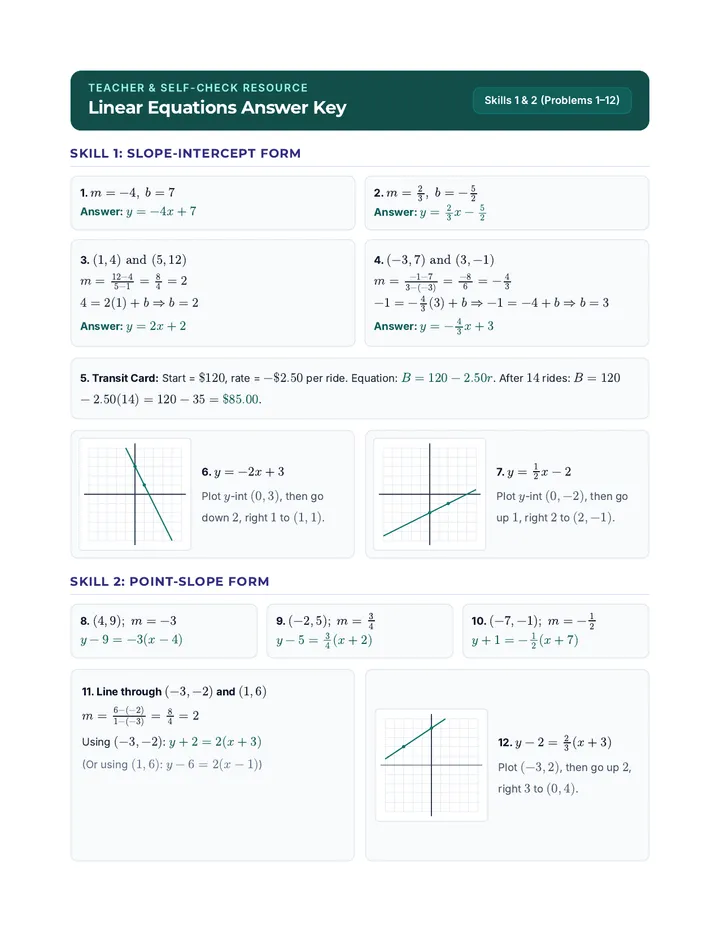
Linear Equations Answer Key
Skills 1 & 2 (Problems 1–12)
Skill 1: Slope-Intercept Form
1. \( m = -4, \; b = 7 \)
Answer: \( y = -4x + 7 \)
2. \( m = \frac{2}{3}, \; b = -\frac{5}{2} \)
Answer: \( y = \frac{2}{3}x - \frac{5}{2} \)
3. \( (1, 4) \text{ and } (5, 12) \)
\( m = \frac{12 - 4}{5 - 1} = \frac{8}{4} = 2 \)
\( 4 = 2(1) + b \Rightarrow b = 2 \)
Answer: \( y = 2x + 2 \)
4. \( (-3, 7) \text{ and } (3, -1) \)
\( m = \frac{-1 - 7}{3 - (-3)} = \frac{-8}{6} = -\frac{4}{3} \)
\( -1 = -\frac{4}{3}(3) + b \Rightarrow -1 = -4 + b \Rightarrow b = 3 \)
Answer: \( y = -\frac{4}{3}x + 3 \)
5. Transit Card: Start = \(\$120\), rate = \(-\$2.50\) per ride. Equation: \( B = 120 - 2.50r \). After \(14\) rides: \( B = 120 - 2.50(14) = 120 - 35 = \) \(\$85.00\).
6. \( y = -2x + 3 \)
Plot \(y\)-int \((0, 3)\), then go down \(2\), right \(1\) to \((1, 1)\).
7. \( y = \frac{1}{2}x - 2 \)
Plot \(y\)-int \((0, -2)\), then go up \(1\), right \(2\) to \((2, -1)\).
Skill 2: Point-Slope Form
8. \( (4, 9); \; m = -3 \)
\( y - 9 = -3(x - 4) \)
9. \( (-2, 5); \; m = \frac{3}{4} \)
\( y - 5 = \frac{3}{4}(x + 2) \)
10. \( (-7, -1); \; m = -\frac{1}{2} \)
\( y + 1 = -\frac{1}{2}(x + 7) \)
11. Line through \( (-3, -2) \) and \( (1, 6) \)
\( m = \frac{6 - (-2)}{1 - (-3)} = \frac{8}{4} = 2 \)
Using \((-3, -2)\): \( y + 2 = 2(x + 3) \)
(Or using \((1, 6)\): \( y - 6 = 2(x - 1) \))
12. \( y - 2 = \frac{2}{3}(x + 3) \)
Plot \((-3, 2)\), then go up \(2\), right \(3\) to \((0, 4)\).
Teacher & Self-Check Resource
Linear Equations Answer Key
Skill 3 (Problems 13–19)
Skill 3: Standard Form, Intercepts & Special Lines
13. \( 3x - 6y = 18 \)
\(x\)-int (\(y=0\)): \( 3x = 18 \Rightarrow x = 6 \)
\(y\)-int (\(x=0\)): \( -6y = 18 \Rightarrow y = -3 \)
Answer: \(x\)-int: \(6\); \(y\)-int: \(-3\)
14. \( -\frac{3}{4}x + 2y = 6 \)
\(x\)-int (\(y=0\)): \( -\frac{3}{4}x = 6 \Rightarrow x = 6 \cdot \left(-\frac{4}{3}\right) = -8 \)
\(y\)-int (\(x=0\)): \( 2y = 6 \Rightarrow y = 3 \)
Answer: \(x\)-int: \(-8\); \(y\)-int: \(3\)
15. \( y = \frac{1}{4}x - 3 \)
Multiply by \(4\): \( 4y = x - 12 \)
Subtract \(x\): \( -x + 4y = -12 \)
Answer: \( -x + 4y = -12 \) (or \(x - 4y = 12\))
16. \( y = -\frac{3}{5}x + 4 \)
Multiply by \(5\): \( 5y = -3x + 20 \)
Add \(3x\): \( 3x + 5y = 20 \)
Answer: \( 3x + 5y = 20 \)
17. \( y = 3 \) and \( x = -2 \)
y = 3 x = -2
\(y = 3\) is horizontal; \(x = -2\) is vertical.
18. \( 2x + 3y = 6 \)
Plot \(x\)-int \((3, 0)\) and \(y\)-int \((0, 2)\).
19. Bakery Word Problem
Cost of bread (\(4.50b\)) + Cost of muffins (\(2.25m\)) = Total spent (\(36.00\))
Answer: \( 4.50b + 2.25m = 36 \)