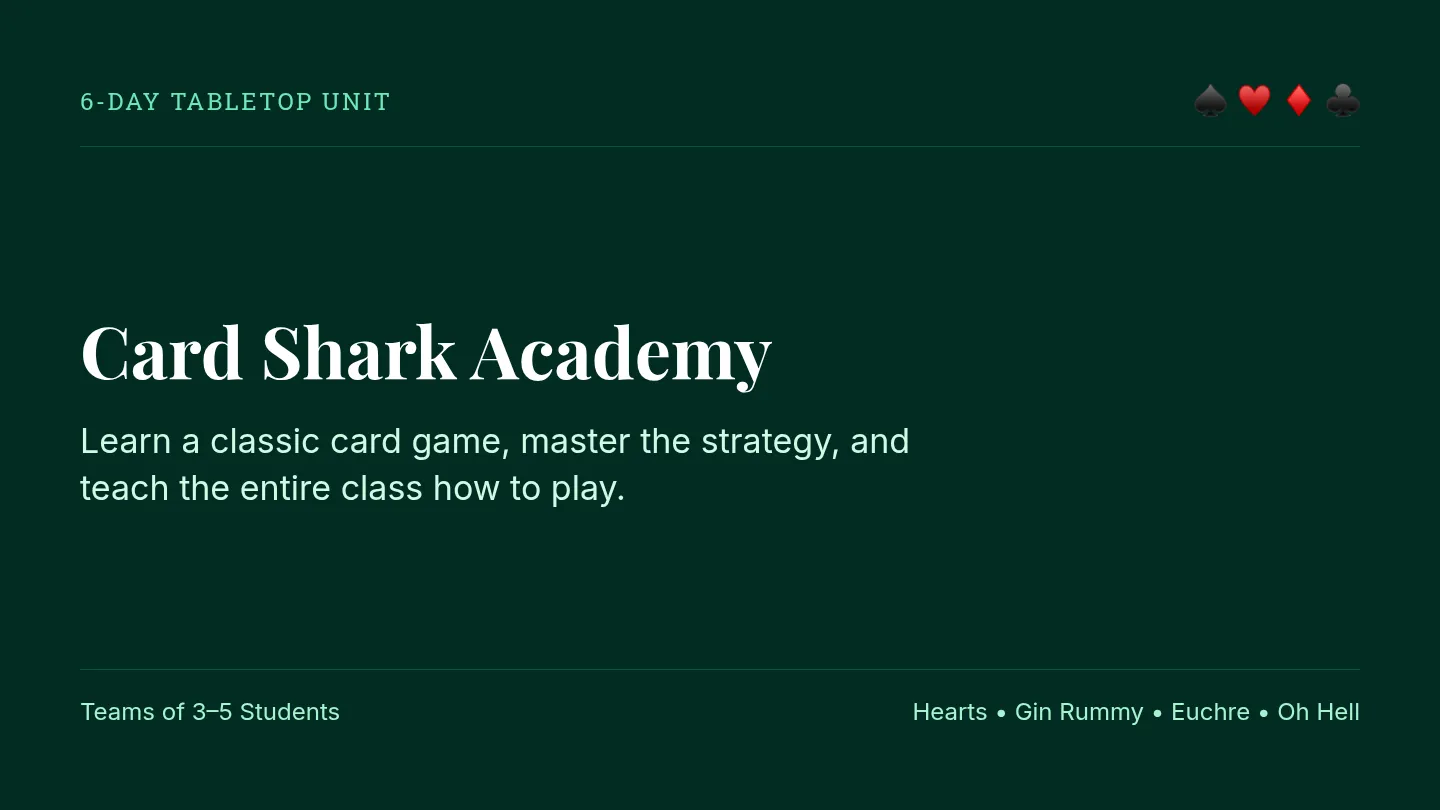
Unit Rate Slides Grade 6 Math • Visual Guide
Unit Rate Detectives
How to find the amount for 1 item, 1 hour, or 1 unit!
Compare Prices
•
Find Speed
•
Divide to Solve
WARM-UP Turn & Talk
Which Juice Pack Is the Better Deal?
Pack A
🧃🧃🧃🧃
4 Juice Boxes
$8
Pack B
🧃🧃🧃
3 Juice Boxes
$9
Hint: How much does just 1 juice box cost in each pack?
KEY WORDS
Rate vs. Unit Rate
Rate
Compares two different quantities (amounts).
Example
$8 for 4 juice boxes
120 miles in 2 hours
Unit Rate
FOR 1
A rate that tells how much for 1 unit!
Example
$2 per 1 juice box
60 miles per 1 hour
OUR STRATEGY
2 Easy Steps to Find Any Unit Rate
1
Set Up the Division
Put the total amount (like $) on top, and the number of items on bottom.
\[\frac{\text{Total Amount}}{\text{Number of Units}}\]
2
Divide Top ÷ Bottom
Divide to make the bottom number 1. Label your answer with "per 1 ..."
Top ÷ Bottom = Amount for 1
I DO • WATCH ME
4 Notebooks Cost $12. What Is the Unit Price?
Visual Model: Double Number Line
Cost ($)
$0
$3
$6
$9
$12
Notebooks
0
1
2
3
4
\[\frac{\$12}{4 \text{ notebooks}} = 12 \div 4 = 3\]
Answer: $3 per 1 notebook
WE DO • TOGETHER
A Train Travels 150 Miles in 3 Hours.
How many miles does it travel in 1 hour?
Step 1: Set Up
\[\frac{150 \text{ miles}}{3 \text{ hours}}\]
Miles on top, hours on bottom.
Step 2: Divide
150 ÷ 3 = ?
Think: What is 15 ÷ 3?
Step 3: Label
_____ miles per 1 hour
Check: 50 × 3 = 150!
WE DO • COMPARE
Which Store Has the Lower Price Per Apple?
Store A
🍎
5 apples for $10
$10 ÷ 5 = $____ per apple
Store B
🍏
2 apples for $6
$6 ÷ 2 = $____ per apple
Lower unit price = Better deal! Which store wins?
YOU DO • QUICK CHECK
Try This One on Your Own!
Maya puts 18 stickers equally onto 3 pages.
How many stickers are on 1 page?
1. Write the division: ___ ÷ ___ 2. Solve 3. Label: ___ stickers per 1 page
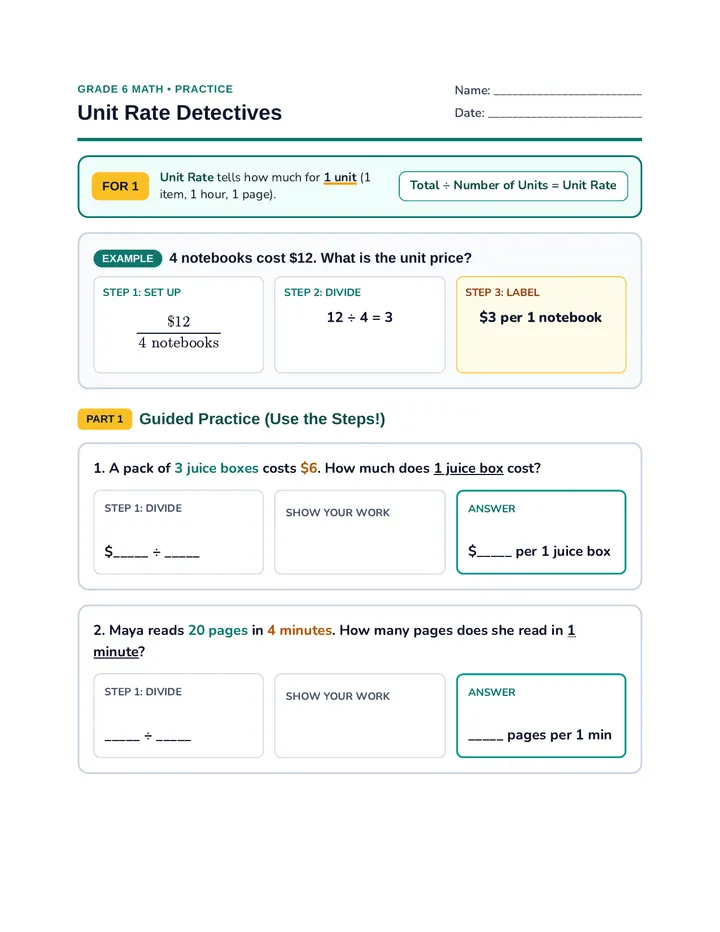
Unit Rate Practice Worksheet Grade 6 Math • Practice
Unit Rate Detectives
Name: ________________________
Date: _________________________
FOR 1
Unit Rate tells how much for 1 unit (1 item, 1 hour, 1 page).
Total ÷ Number of Units = Unit Rate
Example
4 notebooks cost $12. What is the unit price?
Step 1: Set Up
\[\frac{\$12}{4\text{ notebooks}}\]
Step 2: Divide
12 ÷ 4 = 3
Step 3: Label
$3 per 1 notebook
PART 1 Guided Practice (Use the Steps!)
1. A pack of 3 juice boxes costs $6. How much does 1 juice box cost?
Step 1: Divide
$_____ ÷ _____
Show Your Work
Answer
$_____ per 1 juice box
2. Maya reads 20 pages in 4 minutes. How many pages does she read in 1 minute?
Step 1: Divide
_____ ÷ _____
Show Your Work
Answer
_____ pages per 1 min
PART 2 Independent Practice
Name: ____________________
3. A school bus travels 120 miles in 2 hours. What is the bus's speed in miles per 1 hour?
Answer: _________ miles per 1 hour
4. Leo earns $45 for walking dogs for 5 hours. How much does Leo earn for 1 hour?
Answer: $_________ per 1 hour
PART 3 Better Buy Challenge!
5. Which box of granola bars is the better deal (lower price for 1 bar)?
Box A: 6 bars for $12
Unit Price: $_____ per bar
Box B: 4 bars for $12
Unit Price: $_____ per bar
Explain: _______________ is the better deal because $______ per bar is less than $______ per bar.
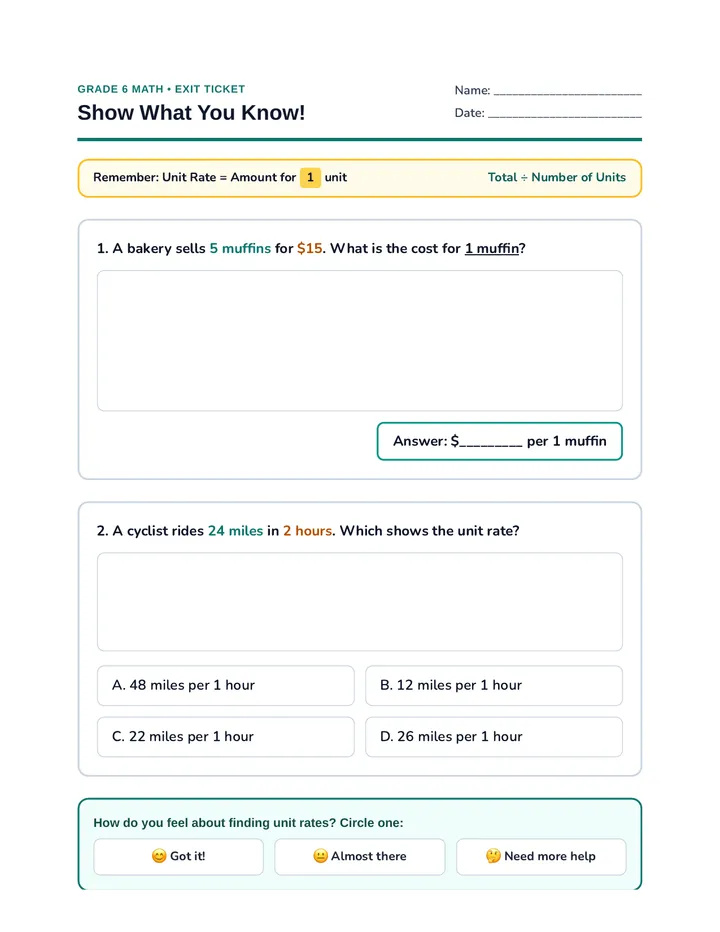
Unit Rate Exit Ticket Grade 6 Math • Exit Ticket
Show What You Know!
Name: ________________________
Date: _________________________
Remember: Unit Rate = Amount for 1 unit Total ÷ Number of Units
1. A bakery sells 5 muffins for $15. What is the cost for 1 muffin?
Answer: $_________ per 1 muffin
2. A cyclist rides 24 miles in 2 hours. Which shows the unit rate?
A. 48 miles per 1 hour
B. 12 miles per 1 hour
C. 22 miles per 1 hour
D. 26 miles per 1 hour
How do you feel about finding unit rates? Circle one:
😊 Got it!
😐 Almost there
🤔 Need more help
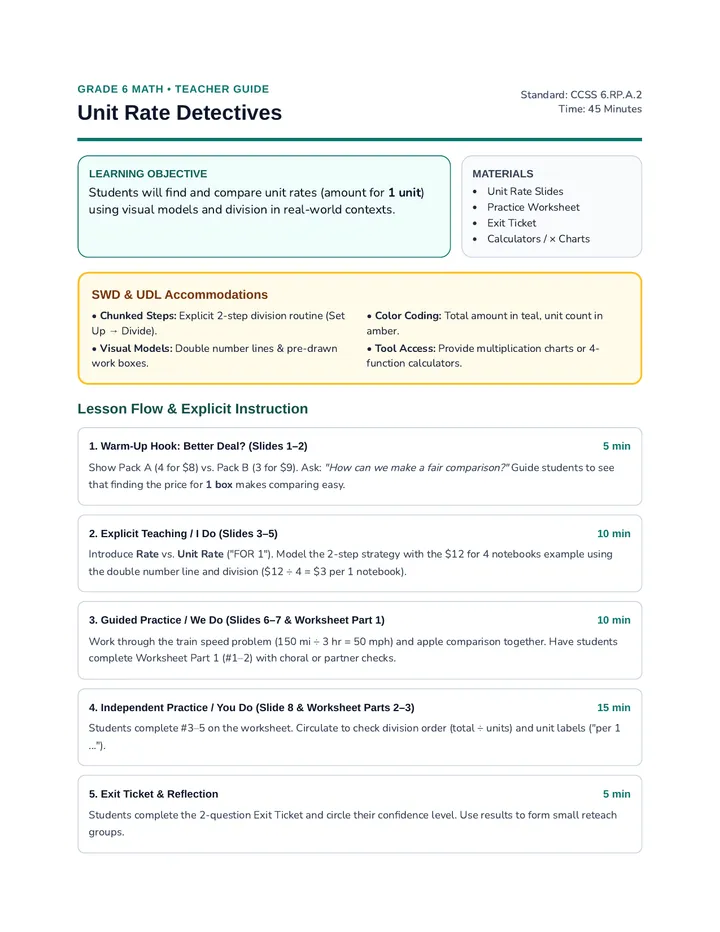
Unit Rate Teacher Guide Grade 6 Math • Teacher Guide
Unit Rate Detectives
Standard: CCSS 6.RP.A.2
Time: 45 Minutes
Learning Objective
Students will find and compare unit rates (amount for 1 unit ) using visual models and division in real-world contexts.
Materials
Unit Rate Slides
Practice Worksheet
Exit Ticket
Calculators / × Charts
SWD & UDL Accommodations
• Chunked Steps: Explicit 2-step division routine (Set Up → Divide).
• Color Coding: Total amount in teal, unit count in amber.
• Visual Models: Double number lines & pre-drawn work boxes.
• Tool Access: Provide multiplication charts or 4-function calculators.
Lesson Flow & Explicit Instruction
1. Warm-Up Hook: Better Deal? (Slides 1–2) 5 min
Show Pack A (4 for $8) vs. Pack B (3 for $9). Ask: "How can we make a fair comparison?" Guide students to see that finding the price for 1 box makes comparing easy.
2. Explicit Teaching / I Do (Slides 3–5) 10 min
Introduce Rate vs. Unit Rate ("FOR 1"). Model the 2-step strategy with the $12 for 4 notebooks example using the double number line and division ($12 ÷ 4 = $3 per 1 notebook).
3. Guided Practice / We Do (Slides 6–7 & Worksheet Part 1) 10 min
Work through the train speed problem (150 mi ÷ 3 hr = 50 mph) and apple comparison together. Have students complete Worksheet Part 1 (#1–2) with choral or partner checks.
4. Independent Practice / You Do (Slide 8 & Worksheet Parts 2–3) 15 min
Students complete #3–5 on the worksheet. Circulate to check division order (total ÷ units) and unit labels ("per 1 ...").
5. Exit Ticket & Reflection 5 min
Students complete the 2-question Exit Ticket and circle their confidence level. Use results to form small reteach groups.
Misconceptions, Differentiation & Answer Key
Unit Rate Detectives
Common Misconceptions
Dividing backwards (e.g., 4 ÷ 12 instead of 12 ÷ 4): Remind students to put the money or total distance first/on top.Forgetting the label: Prompt with "3 what? Per 1 what?" Picking the bigger number as "better": Reinforce that for prices, a lower unit rate is the better deal.
Differentiation
Extra Support: Pre-highlight the two numbers in each word problem; allow calculator use so cognitive load stays on setup and meaning.Extension: Ask early finishers to find the cost of 10 items using the unit rate they just found.
Complete Answer Key
Slides (Guided & Quick Check)
• Slide 2 (Warm-Up): Pack A is $2 per box ($8 ÷ 4); Pack B is $3 per box ($9 ÷ 3). Pack A is the better deal.
• Slide 6 (Train): 150 ÷ 3 = 50 miles per 1 hour .
• Slide 7 (Apples): Store A: $10 ÷ 5 = $2 per apple ; Store B: $6 ÷ 2 = $3 per apple . Store A wins.
• Slide 8 (Quick Check): 18 ÷ 3 = 6 stickers per 1 page .
Practice Worksheet
• #1 (Juice boxes): $6 ÷ 3 = $2 per 1 juice box
• #2 (Reading): 20 ÷ 4 = 5 pages per 1 minute
• #3 (School bus): 120 ÷ 2 = 60 miles per 1 hour
• #4 (Dog walking): $45 ÷ 5 = $9 per 1 hour
• #5 (Better Buy): Box A: $12 ÷ 6 = $2 per bar ; Box B: $12 ÷ 4 = $3 per bar .
Exit Ticket
• #1 (Muffins): $15 ÷ 5 = $3 per 1 muffin
• #2 (Cyclist): 24 ÷ 2 = 12 → B. 12 miles per 1 hour