Calculus Readiness Half Worksheet
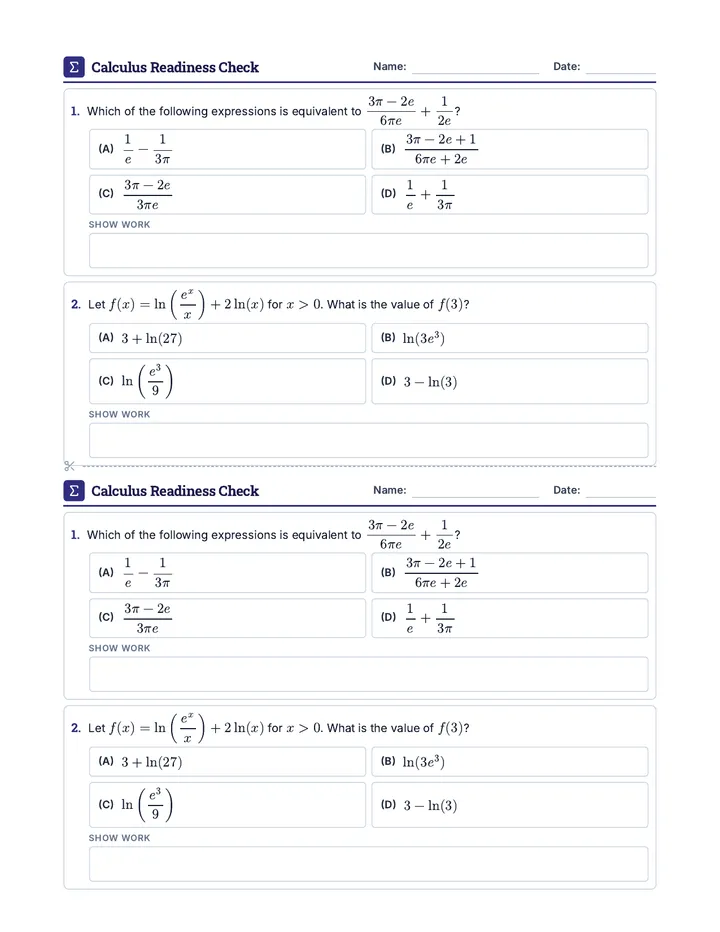
Calculus Readiness Check
Name:
Date:
Which of the following expressions is equivalent to \(\displaystyle \frac{3\pi - 2e}{6\pi e} + \frac{1}{2e}\)?
(A) \(\displaystyle \frac{1}{e} - \frac{1}{3\pi}\)
(B) \(\displaystyle \frac{3\pi - 2e + 1}{6\pi e + 2e}\)
(C) \(\displaystyle \frac{3\pi - 2e}{3\pi e}\)
(D) \(\displaystyle \frac{1}{e} + \frac{1}{3\pi}\)
Show Work
Let \(\displaystyle f(x) = \ln\left(\frac{e^x}{x}\right) + 2\ln(x)\) for \(x > 0\). What is the value of \(f(3)\)?
(A) \(\displaystyle 3 + \ln(27)\)
(B) \(\displaystyle \ln(3e^3)\)
(C) \(\displaystyle \ln\left(\frac{e^3}{9}\right)\)
(D) \(\displaystyle 3 - \ln(3)\)
Show Work
Polynomial Function Analysis
Back Side
Consider \(f(x) = (x - 1)^2(x - 4)\). Find \(f'(x)\) and \(f''(x)\), then identify open intervals of increasing/decreasing, \(x\)-values of relative extrema, open intervals of concavity, and \(x\)-values of inflection points.
First Derivative \(f'(x)\) & Sign Chart
Second Derivative \(f''(x)\) & Sign Chart
Open Interval(s) Increasing
Open Interval(s) Decreasing
Relative Extrema (\(x\)-values)
Point(s) of Inflection (\(x\)-values)
Open Interval(s) Concave Up
Open Interval(s) Concave Down
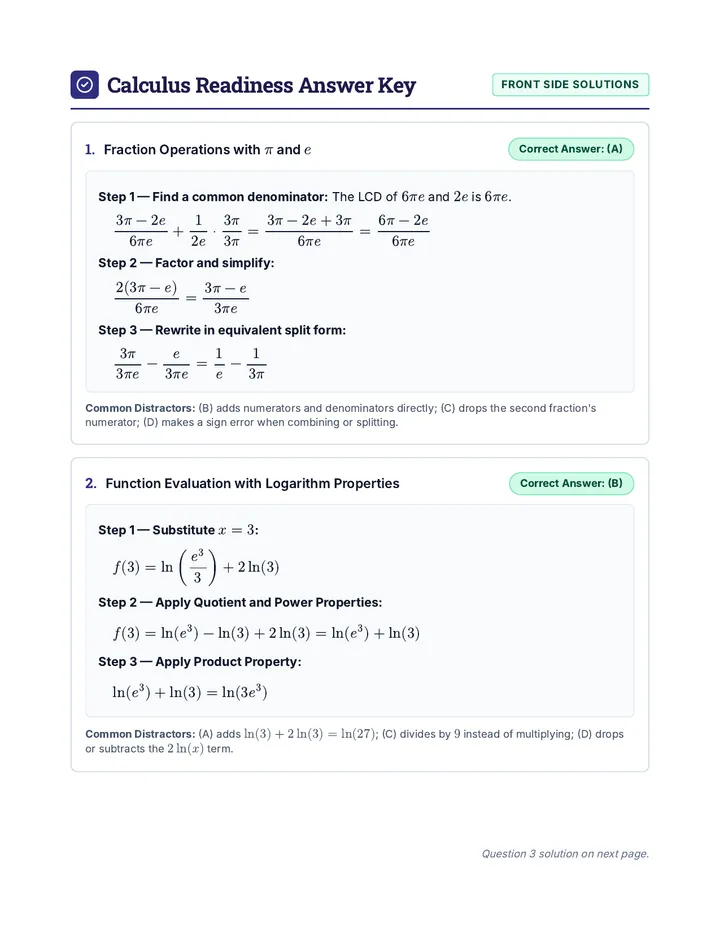
Calculus Readiness Answer Key
Calculus Readiness Answer Key
Front Side Solutions
- Fraction Operations with \(\pi\) and \(e\)
Correct Answer: (A)
Step 1 — Find a common denominator: The LCD of \(6\pi e\) and \(2e\) is \(6\pi e\).
\(\displaystyle \frac{3\pi - 2e}{6\pi e} + \frac{1}{2e} \cdot \frac{3\pi}{3\pi} = \frac{3\pi - 2e + 3\pi}{6\pi e} = \frac{6\pi - 2e}{6\pi e}\)
Step 2 — Factor and simplify:
\(\displaystyle \frac{2(3\pi - e)}{6\pi e} = \frac{3\pi - e}{3\pi e}\)
Step 3 — Rewrite in equivalent split form:
\(\displaystyle \frac{3\pi}{3\pi e} - \frac{e}{3\pi e} = \frac{1}{e} - \frac{1}{3\pi}\)
Common Distractors: (B) adds numerators and denominators directly; (C) drops the second fraction's numerator; (D) makes a sign error when combining or splitting.
- Function Evaluation with Logarithm Properties
Correct Answer: (B)
Step 1 — Substitute \(x = 3\):
\(\displaystyle f(3) = \ln\left(\frac{e^3}{3}\right) + 2\ln(3)\)
Step 2 — Apply Quotient and Power Properties:
\(\displaystyle f(3) = \ln(e^3) - \ln(3) + 2\ln(3) = \ln(e^3) + \ln(3)\)
Step 3 — Apply Product Property:
\(\displaystyle \ln(e^3) + \ln(3) = \ln(3e^3)\)
Common Distractors: (A) adds \(\ln(3) + 2\ln(3) = \ln(27)\); (C) divides by \(9\) instead of multiplying; (D) drops or subtracts the \(2\ln(x)\) term.
Question 3 solution on next page.
Question 3 Solution: \(f(x) = (x - 1)^2(x - 4)\)
Back Side Solution
First Derivative & Sign Analysis
Using the Product Rule:
\(f'(x) = 2(x - 1)(x - 4) + (x - 1)^2(1)\)
\(f'(x) = (x - 1)[2x - 8 + x - 1] = 3(x - 1)(x - 3)\)
Critical Numbers: \(x = 1, \; x = 3\)
\((-\infty, 1): \; f'(x) = 3(-)(-) > 0\) → Increasing
\((1, 3): \; f'(x) = 3(+)(-) < 0\) → Decreasing
\((3, \infty): \; f'(x) = 3(+)(+) > 0\) → Increasing
Extrema: \(f'\) changes \(+ \to -\) at \(x = 1\) (max) and \(- \to +\) at \(x = 3\) (min).
Second Derivative & Sign Analysis
Expand \(f'(x) = 3(x^2 - 4x + 3) = 3x^2 - 12x + 9\):
\(f''(x) = 6x - 12 = 6(x - 2)\)
Possible Inflection Point: \(x = 2\)
\((-\infty, 2): \; f''(x) = 6(-) < 0\) → Concave Down
\((2, \infty): \; f''(x) = 6(+) > 0\) → Concave Up
Since \(f''(x)\) changes sign at \(x = 2\), there is a point of inflection at \(x = 2\).
Final Analysis Answers
Open Interval(s) Increasing \((-\infty, 1) \cup (3, \infty)\)
Open Interval(s) Decreasing \((1, 3)\)
Relative Extrema (\(x\)-values) Relative Max at \(x = 1\)
Relative Min at \(x = 3\)
Point(s) of Inflection (\(x\)-values) \(x = 2\)
Open Interval(s) Concave Up \((2, \infty)\)
Open Interval(s) Concave Down \((-\infty, 2)\)