Function Foundations Review Packet
CP Algebra 1 • Module 4
Functions & Sequences Study Guide
Review & Reference
Keep for class study & exam review
1. Core Function Families & Representations
Parent Function Baseline
The simplest, most basic function in a family that preserves the shape and characteristics of the family.
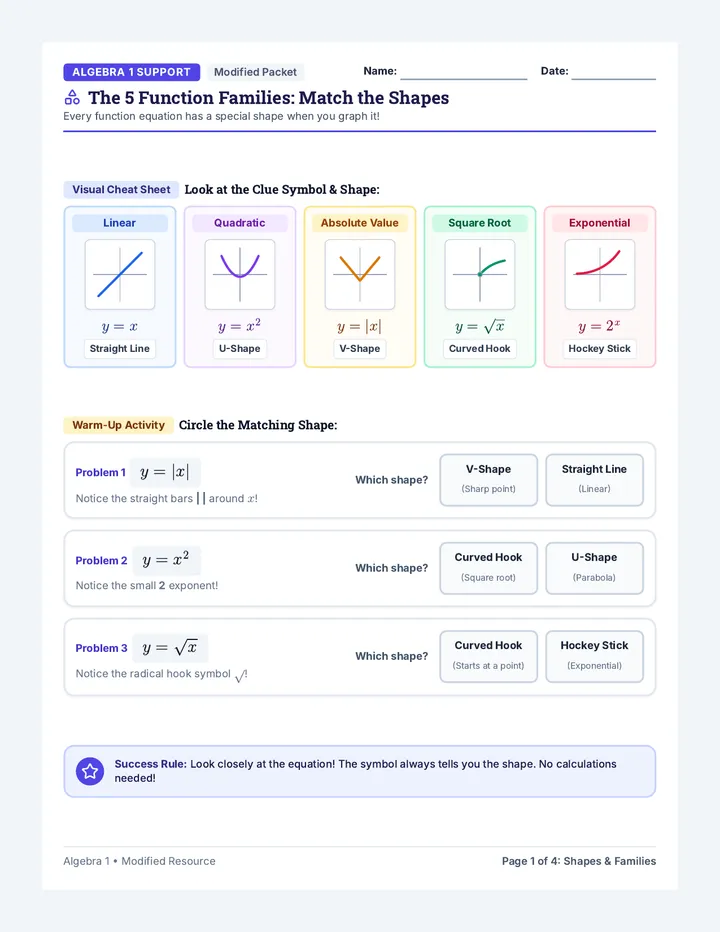
Examples: \(y = x\) & \(f(x) = |x|\)
Absolute Value Function V-Shape
A function written \(f(x) = |x|\), where \(f(x) \ge 0\) for all values of \(x\). The graph always forms a distinct “V” shape.
Key property: \(|x| \ge 0\)
Piecewise-Linear Function Multi-Part
A function made up of at least two linear subfunctions, each defined differently depending on domain intervals. Often appears as rays.
Rule changes across intervals
Step Function Horizontal Segments
A specific type of piecewise-linear function whose graph consists of a series of horizontal line segments looking like a staircase.
Horizontal rays / line segments
2. Rates of Change, Slope & Extrema
Rate of Change
How a quantity is changing with respect to another quantity (real-world ratio or context).
\(\frac{\text{change in quantity A}}{\text{change in quantity B}}\)
Slope (\(m\))
A numerical value describing both the steepness and direction of a line.
\(\text{Slope} = \frac{\text{change in } y\text{ (rise)}}{\text{change in } x\text{ (run)}}\)
Vertex
Either the lowest point (minimum) or highest point (maximum) of a function graph.
Turning point of “V” or curve
3. Arithmetic Sequences & The Explicit Formula
Definition
An arithmetic sequence is a pattern in which each term after the first is found by adding a constant (called the common difference, \(d\)) to the previous term.
Example Sequence: 3, 7, 11, 15, 19, …
Here, \(a_1 = 3\) and \(d = +4\) (constant addition).
General Term Formula
\(a_n = a_1 + (n - 1)d\)
- \(a_n\) General term (evaluated value, like \(f(x)\))
- \(a_1\) First term in the sequence
- \(n\) Term number (position: 1st, 2nd, 20th...)
- \(d\) Common difference between consecutive terms
Key Distinction to Remember: Slope is specifically the constant rate of change along any straight line. Piecewise-linear functions can change slopes across different domain rays, while step functions have a slope of zero along every horizontal step!
Module 4 Review Guide Turn page to begin the Student Assessment Quiz → Page 1 of 3
Module 4 Assessment
Functions & Sequences Vocabulary Quiz
Total Score ______ / 30 pts
Name:
Date:
Period:
Part A: Vocabulary Matching (6 Questions • 1 pt each)
Write the matching capital letter on each blank line.
Word Bank:
[A] Absolute Value Function
[B] Step Function
[C] Arithmetic Sequence
[D] Parent Function
[E] Rate of Change
[F] Vertex
The simplest of functions in a family; preserves fundamental shape (e.g., \(y = x\) or \(f(x) = |x|\)).
Either the lowest point (minimum) or the highest point (maximum) of a function graph.
A function written \(f(x) = |x|\), where \(f(x) \ge 0\) for all \(x\), whose graph produces a distinct “V” shape.
A mathematical measure of how one quantity is changing with respect to another quantity.
A pattern in which each term after the first is found by adding a constant to the previous term.
A type of piecewise-linear function with a graph that is a series of horizontal line segments.
Part B: Multiple Choice Concepts (4 Questions • 2 pts each)
Select the best answer for each question.
7. Which statement provides the most accurate definition of slope?
(A) The highest turning point on any function graph
(B) A number describing steepness and direction: \(\frac{\text{rise}}{\text{run}}\)
(C) The constant value multiplied to each prior term
(D) The domain interval over which subfunctions exist
8. In the arithmetic sequence explicit formula \(a_n = a_1 + (n - 1)d\), what does \(d\) represent?
(A) The first initial term in the sequence
(B) The specific position number of the evaluated term
(C) The common difference between consecutive terms
(D) The total sum of all terms in the sequence
9. A piecewise-linear function differs from a standard linear function because:
(A) It consists of at least two linear subfunctions on different intervals
(B) It can never have rays or line segments on its graph
(C) It must always have horizontal segments with zero slope
(D) Its outputs can never be zero or negative
10. Which statement is true regarding the absolute value parent function \(f(x) = |x|\)?
(A) The graph appears as a straight horizontal line
(B) The vertex is at the origin \((0,0)\) and \(f(x) \ge 0\) for all \(x\)
(C) The graph has no vertex or turning point
(D) Output values are always negative when input \(x\) is negative
Module 4 Assessment • Part 1 Turn over for Part 2: Applications → Page 2 of 3
Module 4 Assessment
Part 2: Applications & Problem Solving
Section Score: _____ / 16 pts
Read each problem carefully. Show complete work for calculation problems in the designated spaces.
Part C: Identify & Classify (Questions 11–13 • 6 pts)
11. Classify by Term: Identify the exact vocabulary term that best describes each scenario:
(2 pts)
a. A pricing model charging \$30 (0–2 GB), \$45 (2–4 GB), graphing as flat horizontal bars: Term:
b. A function defined by two linear subfunctions on different intervals, graphing as rays: Term:
12. Vertex & Absolute Value: An absolute value function graph opens upward with its turning point at \((4, -3)\).
(2 pts)
a. Vocabulary name for this turning point:
b. Is it a lowest (minimum) or highest (maximum)?
13. Rate of Change & Slope: A drone ascends from \(40\text{ m}\) at \(t = 2\text{ s}\) to \(160\text{ m}\) at \(t = 6\text{ s}\).
(2 pts)
Calculate the rate of change using \(\frac{\text{change in } y}{\text{change in } x}\) with units, and state the slope of the line:
Part D: Arithmetic Sequence Application (Questions 14–15 • 10 pts)
14. Given the arithmetic sequence: 7, 13, 19, 25, 31, …
(6 pts)
a. First term: \(a_1 =\)
b. Common difference: \(d =\)
c. Explicit formula using \(a_n = a_1 + (n - 1)d\): \(a_n =\)
d. Find the 30th term (\(a_{30}\)). Show your substitution and calculation steps below:
15. Real-World Application: An amphitheater has \(24\) seats in Row 1. Each subsequent row adds \(4\) seats.
(4 pts)
a. Value of \(a_1\):
b. Value of \(d\):
c. How many seats are in Row 18? Set up \(a_n = a_1 + (n - 1)d\) and calculate:
Module 4 Assessment • Part 2 Double-check all work before submitting Page 3 of 3
Function Foundations Answer Key
Teacher Resource • Scoring Guide
Functions & Sequences Quiz Answer Key
Full Assessment: 30 Points
CP Algebra 1 • Module 4
Part A: Vocabulary Matching Solutions (6 Points • 1 pt each)
1 pt per match
- [D]
Parent Function
The simplest of functions in a family (e.g., \(y = x\) or \(f(x) = |x|\)); acts as the base template.
- [F]
Vertex
Either the lowest point (minimum) or highest point (maximum) of a function (specifically absolute value).
- [A]
Absolute Value Function
\(f(x) = |x|\) where \(f(x) \ge 0\) for all \(x\); characterized by a distinct symmetric “V” graph.
- [E]
Rate of Change
How a quantity changes with respect to another quantity; foundation for understanding linear slope in context.
- [C]
Arithmetic Sequence
A pattern where each term after the first is found by adding a constant (\(d\)) to the preceding term.
- [B]
Step Function
A type of piecewise-linear function whose graph appears as a series of disjointed horizontal segments.
Part B: Multiple Choice Explanations (8 Points • 2 pts each)
2 pts per question
7. Correct: [B] A number describing steepness and direction: \(\frac{\text{change in } y}{\text{change in } x}\) (\(\frac{\text{rise}}{\text{run}}\))
Teacher Rationale: Slope is the exact numerical measure of steepness and direction of a line. Distracter (A) describes vertex; (C) describes geometric sequences; (D) defines piecewise domain intervals.
8. Correct: [C] The common difference between consecutive terms
Teacher Rationale: In \(a_n = a_1 + (n - 1)d\), \(d\) is added repeatedly \((n - 1)\) times. Distracter (A) is \(a_1\); (B) is \(n\); (D) is the sequence sum \(S_n\).
9. Correct: [A] It consists of at least two linear subfunctions on different domain intervals
Teacher Rationale: By definition, piecewise-linear functions split the domain into intervals where each subfunction is linear (often appearing as rays). Distracter (C) describes step functions specifically.
10. Correct: [B] The vertex is at the origin \((0,0)\) and \(f(x) \ge 0\) for all values of \(x\)
Teacher Rationale: The absolute value parent function graph is symmetric across the \(y\)-axis with its minimum vertex at \((0,0)\). Because distance is non-negative, \(f(x) \ge 0\).