Page 2 of 5
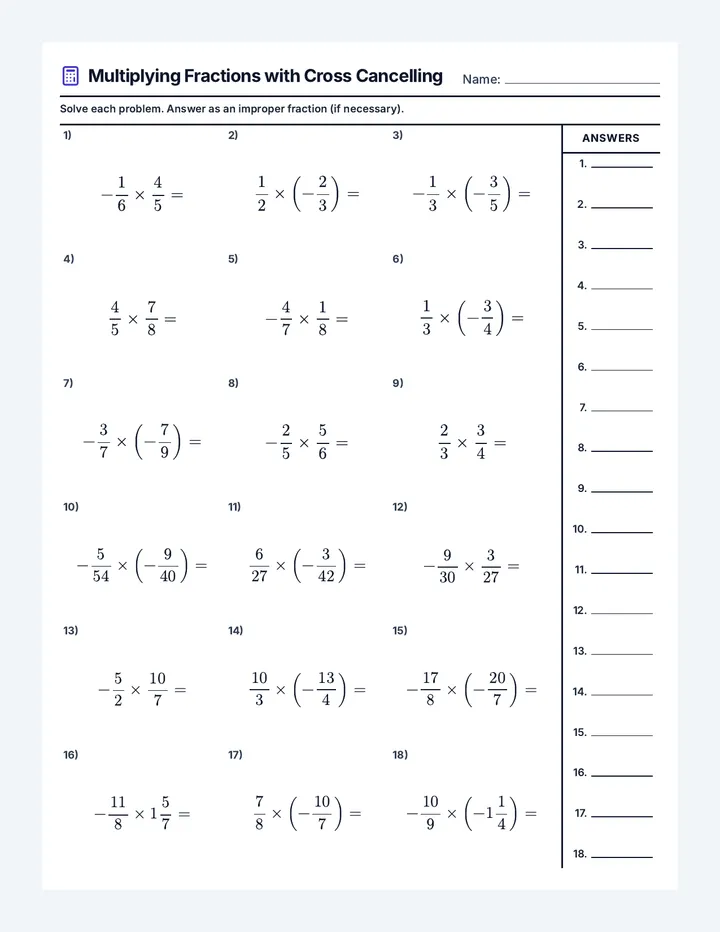
Core fraction multiplication concepts to explicitly reinforce on the whiteboard.
1
Unlike addition and subtraction, you do not need a common denominator! Multiply numerators together and denominators together: \(\frac{a}{b} \times \frac{c}{d} = \frac{a \times c}{b \times d}\).
2
Every whole number \(n\) can be rewritten as \(\frac{n}{1}\). Example: \(6 \times \frac{2}{5} = \frac{6}{1} \times \frac{2}{5} = \frac{12}{5} = 2\frac{2}{5}\).
3
Never multiply whole numbers and fractions separately! Always convert first: \(A\frac{b}{c} = \frac{(A \times c) + b}{c}\). This ensures all partial products are accounted for.
4
Divide any numerator and any denominator by their greatest common factor before multiplying. It keeps numbers manageable and reduces final simplification.
5
Round mixed numbers to the nearest whole number to predict the approximate size of the product before calculating.
Model on Board Script Teacher Talk
“Evaluate: \(2\frac{2}{3} \times \frac{3}{4}\). Watch the step-by-step conversion.”
Step 1: Convert Mixed \(2\frac{2}{3} = \frac{8}{3}\)
Step 2: Cross-Simplify \(\frac{8}{3} \times \frac{3}{4} = \frac{2}{1} \times \frac{1}{1}\)
Step 3: Multiply \(2\) (whole number)
Reasonableness: \(2\frac{2}{3}\) scaled by \(\frac{3}{4}\) (less than 1) should be slightly less than 2.67. 2 is reasonable! ✓
CHECK FOR UNDERSTANDING: “Why do we NOT need a common denominator when multiplying fractions, even though we need one for addition?” (Target response: Multiplication represents finding a part of a part or area, which automatically creates new smaller unit divisions).
Grade 6 Math • Fraction Multiplication Page 2 • Launch & Direct Instruction
Grade 6 Mathematics Guided Practice Solutions
Page 3 of 5
Scaffolding, common misconceptions, and live monitoring indicators.
1. Multiply: \(2\frac{1}{4} \times \frac{2}{3}\) — Correct Method Analysis: Correct: Choice b (\(1\frac{1}{2}\))
Exemplar Student Work:
• Convert mixed number to improper fraction: \(2\frac{1}{4} = \frac{(2 \times 4) + 1}{4} = \frac{9}{4}\).
• Multiply: \(\frac{9}{4} \times \frac{2}{3} = \frac{18}{12}\).
• Simplify by dividing numerator and denominator by 6: \(\frac{18 \div 6}{12 \div 6} = \frac{3}{2} = \mathbf{1\frac{1}{2}}\).
Misconception Note: Choice a (\(1\frac{1}{3}\)) is the classic error where students only multiply the whole number (\(2 \times \frac{2}{3}\)) and omit the fractional part entirely.
2. Multiply Improper Fractions: \(\frac{7}{2} \times \frac{6}{5}\): Answer: \(\frac{21}{5} = 4\frac{1}{5}\)
Exemplar Student Work:
• Cross-simplify 6 and 2 by dividing both by 2: \(\frac{7}{1} \times \frac{3}{5}\).
• Multiply straight across: \(\frac{7 \times 3}{1 \times 5} = \frac{21}{5}\).
• Convert to mixed number: \(21 \div 5 = \mathbf{4\frac{1}{5}}\).
3. Method Showdown: \(1\frac{3}{5} \times 2\frac{1}{2}\): Product = 4
Method A (Algorithm):
• \(1\frac{3}{5} = \frac{8}{5}\) and \(2\frac{1}{2} = \frac{5}{2}\). \(\frac{8}{5} \times \frac{5}{2} = \frac{8 \times 5}{5 \times 2} = \frac{40}{10} = \mathbf{4}\).
Method B (Area / Partial Products):
• \((1 \times 2) + (1 \times \frac{1}{2}) + (\frac{3}{5} \times 2) + (\frac{3}{5} \times \frac{1}{2}) = 2 + \frac{1}{2} + \frac{6}{5} + \frac{3}{10} = 2 + \frac{5}{10} + \frac{12}{10} + \frac{3}{10} = 2 + \frac{20}{10} = 2 + 2 = \mathbf{4}\).
MONITOR & CIRCULATE: Highlight that while both methods work, Method A (converting to improper fractions) requires significantly fewer steps and avoids finding common denominators for 4 partial products!
Grade 6 Math • Fraction Multiplication Page 3 • Guided Practice Exemplar
Grade 6 Mathematics Independent Practice Solutions
Page 4 of 5
Step-by-step algorithms, cross-simplification, and word problems.
1. Water Bottles: \(6 \times \frac{3}{4}\) liters: Work: \(\frac{6}{1} \times \frac{3}{4} = \frac{18}{4} = \frac{9}{2} = 4\frac{1}{2}\) liters.
Answer: \(4\frac{1}{2}\) L
2. Multiply Proper Fractions: \(\frac{5}{6} \times \frac{9}{10}\): Work: Divide 5 and 10 by 5 (\(1, 2\)); divide 9 and 6 by 3 (\(3, 2\)). \(\frac{1 \times 3}{2 \times 2} = \frac{3}{4}\).
Answer: \(\frac{3}{4}\)
3. Garden Plot Area: \(\frac{4}{5} \text{ m} \times \frac{2}{3} \text{ m}\): Work: \(\text{Area} = \frac{4 \times 2}{5 \times 3} = \frac{8}{15}\) square meters. (Already in simplest terms).
Answer: \(\frac{8}{15} \text{ m}^2\)
4. Baker Amy's Flour: \(2\frac{1}{4} \times 3\frac{1}{3}\) batches: Answer: \(7\frac{1}{2}\) cups
• Step 1 (Convert): \(2\frac{1}{4} = \frac{9}{4}\) and \(3\frac{1}{3} = \frac{10}{3}\).
• Step 2 (Multiply & Simplify): \(\frac{9}{4} \times \frac{10}{3} = \frac{9 \times 10}{4 \times 3} = \frac{90}{12}\). Divide by 6 \(\to \frac{15}{2} = \mathbf{7\frac{1}{2}}\) cups.
5. Carpenter Board (8 ft board, \(\frac{3}{4}\) cut for shelf): Shelf: 6 ft | Leftover: 2 ft
• Bookshelf Length: \(\frac{8}{1} \times \frac{3}{4} = \frac{24}{4} = \mathbf{6}\) feet.
• Leftover Wood: \(8 - 6 = \mathbf{2}\) feet (or \(\frac{8}{1} \times \frac{1}{4} = 2\) ft).
COMMON ERRORS TO WATCH FOR:
Grade 6 Math • Fraction Multiplication Page 4 • Independent Practice Exemplar
Grade 6 Mathematics Exit Ticket Solutions
Page 5 of 5
Evaluation rubric, common student traps, and targeted reteach prompts.
1. Evaluate: \(3\frac{1}{3} \times \frac{3}{5}\): Correct: 2
Exemplar Work:
• Convert mixed number: \(3\frac{1}{3} = \frac{(3 \times 3) + 1}{3} = \frac{10}{3}\).
• Multiply: \(\frac{10}{3} \times \frac{3}{5}\).
• Cross-simplify 3 with 3 (\(1, 1\)) and 10 with 5 (\(2, 1\)): \(\frac{2 \times 1}{1 \times 1} = \mathbf{2}\). ✓
2. Error Analysis: \(2\frac{1}{2} \times 1\frac{1}{4} = 2\frac{1}{8}\) is Incorrect: Correct: \(3\frac{1}{8}\) or \(\frac{25}{8}\)
Explanation of Error:
• The student treated mixed numbers as separate terms and only multiplied wholes (\(2 \times 1\)) and fractions (\(\frac{1}{2} \times \frac{1}{4}\)).
• This neglects the cross-terms: \(2 \times \frac{1}{4} = \frac{1}{2}\) and \(1 \times \frac{1}{2} = \frac{1}{2}\), which together add 1 whole to the product!
• Correct conversion & calculation: \(2\frac{1}{2} = \frac{5}{2}\) and \(1\frac{1}{4} = \frac{5}{4}\). Product is \(\frac{5 \times 5}{2 \times 4} = \frac{25}{8} = \mathbf{3\frac{1}{8}}\).
ASSESSMENT LOOK-FORS:
RETEACH PROMPT: “If a student struggles with mixed number multiplication, draw a 2-by-2 area grid with dimensions \((2 + \frac{1}{2})\) and \((1 + \frac{1}{4})\). Show them that there are FOUR distinct boxes to add together, proving why \(2\frac{1}{8}\) misses two whole sections!”
Grade 6 Math • Fraction Multiplication Page 5 • Exit Ticket Exemplar