Fraction Fluency Reference Sheet IEP Strategy Anchor 6.NS.1 • 5.NBT.B.5 • 5.NBT.B.6
Math Fluency & Fraction Strategy Guide
Desk Reference Sheet
Keep flat on desk during work
Part 1: Dividing Whole Numbers by Unit Fractions
Core Meaning: "How many parts fit?"
Visual Tape Model: \(3 \div \frac{1}{4}\)
"How many \(\frac{1}{4}\)-size pieces are inside 3 wholes?"
Whole 1 (4 fourths) Whole 2 (4 fourths) Whole 3 (4 fourths)
¼ ¼ ¼ ¼
¼ ¼ ¼ ¼
¼ ¼ ¼ ¼
Total Pieces = \(3 \times 4 = 12\) pieces
Key Rule & Multiplication Connection
General Formula:
\[ \text{Whole} \div \frac{1}{\text{Denominator}} = \text{Whole} \times \text{Denominator} \]
When dividing by a unit fraction, the quotient is larger than the starting number because pieces are smaller than 1.
Check with Multiplication:
\(\text{Quotient} \times \text{Divisor} = \text{Dividend}\) | \(12 \times \frac{1}{4} = \frac{12}{4} = 3\) ✓
Part 2: Multi-Digit Multiplication
Standard Algorithm
1 Multiply by the ONES digit: Multiply the top number by the bottom ones digit. Regroup above if \(\ge 10\).
! PLACE THE ZERO PLACEHOLDER: Before multiplying by tens, write 0 in the ones column!
2 Multiply by the TENS digit: Multiply the top number by the bottom tens digit. Add any new regroupings.
3 Add Partial Products: Add the two rows together carefully, column by column.
4 6 8
× 8 3
1 4 0 4 (468 × 3)
+ 3 7 4 4 0 (468 × 80)
3 8, 8 4 4
Part 3: Multi-Digit Division (D-M-S-B-R)
5-Step Checklist
Does • McDonald's • Serve • Burgers • Raw?
D
DIVIDE: How many times does divisor fit into the digit(s)? Write quotient digit above.
M
MULTIPLY: Multiply that quotient digit by the divisor. Write product below.
S
SUBTRACT: Subtract to find the remainder. Check: must be < divisor!
B
BRING DOWN: Bring down the next single digit only .
R
REPEAT or REMAINDER: Start back at Divide, or label remainder.
★ Keep digits lined up neatly in their place-value columns!
Student Self-Monitoring Checklist (Before Turning In Work):
Did I write equations for all word problems?
Did I remember the 0 placeholder in step 2?
Did I check fraction division with multiplication?
Fraction Division 75% Packet 6th Grade Math • Lesson 5 Modified (75% Workload) Tiered IEP Version A
Dividing Whole Numbers by Unit Fractions
Explore the relationship between division, fractions, and multiplication.
Name:
Date: Period:
1 Do Now: Spiral Review & Activation
Show your complete mathematical thinking
Item 1 (5.OA.1) Order of Operations
Evaluate the expression:
\(9 \times (12 - 7) + 15\)
A. 116
B. 180
C. 60
D. 90
Item 2 (5.NF.6) Mixed Number Multiplication
Solve the expression:
\(2\frac{1}{3} \times \frac{4}{5}\)
A. \(\frac{12}{35}\)
B. \(\frac{13}{15}\)
C. \(1\frac{13}{15}\)
D. \(2\frac{4}{15}\)
Item 3: Activating Prior Knowledge (Visual Model) Interpret the Model
Solve the division expression by creating a tape diagram model: \(4 \div \frac{1}{5} =\) _____
Draw 4 wholes. Divide each whole into fifths (\(\frac{1}{5}\)). Count the total pieces:
How many \(\frac{1}{5}\)-sized pieces are inside 4 wholes? Quotient = _______
Key Conceptual Takeaway
• When we divide a whole number by a unit fraction (\(\frac{1}{b}\)), we are asking: "How many \(\frac{1}{b}\) parts fit into the whole?"
• Because each 1 whole contains \(b\) pieces, the total number of pieces is: Whole \(\times b\) .
• Strategy Check: To check division, multiply: \(\text{Quotient} \times \text{Divisor} = \text{Dividend}\).
Part 1: Explore Patterns & Priority Practice
Page 2 of 4
1. If 1 whole is divided into pieces that are each \(\frac{1}{9}\) of a whole, how many pieces are there?
\(1 \div \frac{1}{9} =\) _____
Sketch or label your model below:
Explanation: There are ________ pieces because 1 whole contains ________ ninths.
2. If 3 wholes are divided into pieces that are each \(\frac{1}{5}\) of a whole, how many pieces are there?
\(3 \div \frac{1}{5} =\) _____
Show your work or model below:
Total pieces = \(3 \times\) ________ = ________ pieces.
3. Generalize the Pattern (In Your Own Words):
How can you divide any whole number by a unit fraction \(\frac{1}{b}\) without drawing a model?
Part 2: Priority Guided Practice
Cognitive Focus: Operation & Proof
4. Find the value of: \(6 \div \frac{1}{3}\)
Choose the correct quotient and draw a visual model below to prove your answer.
A. \(\frac{1}{18}\) B. \(\frac{1}{2}\) C. \(18\) D. \(2\)
Model Proof:
Multiplication Check:
Quotient \(\times\) Divisor = Dividend
______ \(\times \frac{1}{3} =\) ______
5. Conceptual Reasoning: Which expression has the largest quotient?
A. \(5 \div \frac{1}{2}\)
B. \(5 \div \frac{1}{3}\)
C. \(5 \div \frac{1}{4}\)
D. \(5 \div \frac{1}{5}\)
Explain why smaller fraction pieces lead to a larger quotient:
Part 3: Application & Daily Exit Ticket
Page 3 of 4
6. Compute and verify the expression:
\(8 \div \frac{1}{5}\)
Solve with equation or steps:
Check using multiplication:
7. Ice Cream Sundae Challenge
Word Problem Analysis
Samantha has 16 pints of ice cream. She serves her friends by scooping exactly \(\frac{1}{5}\) of a pint into each dish.
A) Write a division equation and calculate how many sundaes Samantha can make:
Samantha can make _______ sundaes.
B) Error Analysis: Terry claims,
"Samantha only starts with 16 pints, so she must make less than 16 sundaes!"
Do you agree or disagree with Terry? Explain using what you know about dividing by fractions:
EXIT TICKET
Dividing Whole Numbers by Unit Fractions
Standard: 6.NS.1
Prompt: What is the value of \(42 \div \frac{1}{2}\)?
1. Calculate and Explain Steps:
2. Check with Multiplication:
Self-Check: [ ] Determined operation [ ] Evaluated correctly [ ] Verified with multiplication check
Lesson 5 Homework • Modified 75% Workload
Independent Practice & Fluency Maintenance
Name:
Part A: Unit Fraction Division Practice (Solve & Show Work)
4 Essential Problems
\(25 \div \frac{1}{2} =\) Show steps
Quotient = ________
\(40 \div \frac{1}{3} =\) Show steps
Quotient = ________
\(7 \div \frac{1}{10} =\) Show steps
Quotient = ________
\(9 \div \frac{1}{2} =\) Check with mult.
Check: _____ \(\times \frac{1}{2} =\) _____
Part B: 5th Grade Multi-Digit Fluency Maintenance (IEP Goals)
Execute standard algorithms fluently without placeholder drops.
Standards: 5.NBT.5 & 5.NBT.6
Problem 5 3-digit × 2-digit
\(468 \times 83\)
[ ] Multiply by 3 ones
[ ] Zero placeholder (0)
[ ] Multiply by 8 tens
[ ] Add partial products
Problem 6 Internal Zero Factor
\(809 \times 57\)
[ ] Multiply by 7 ones
[ ] Zero placeholder (0)
[ ] Multiply by 5 tens
[ ] Add partial products
Problem 7 Long Division
\(384 \div 12\)
[ ] D ivide (\(38 \div 12\))
[ ] M ultiply & S ubtract
[ ] B ring down 4
[ ] R epeat / Remainder
Reminder: Use your desktop Strategy Reference Sheet to verify your steps and zero placeholders!
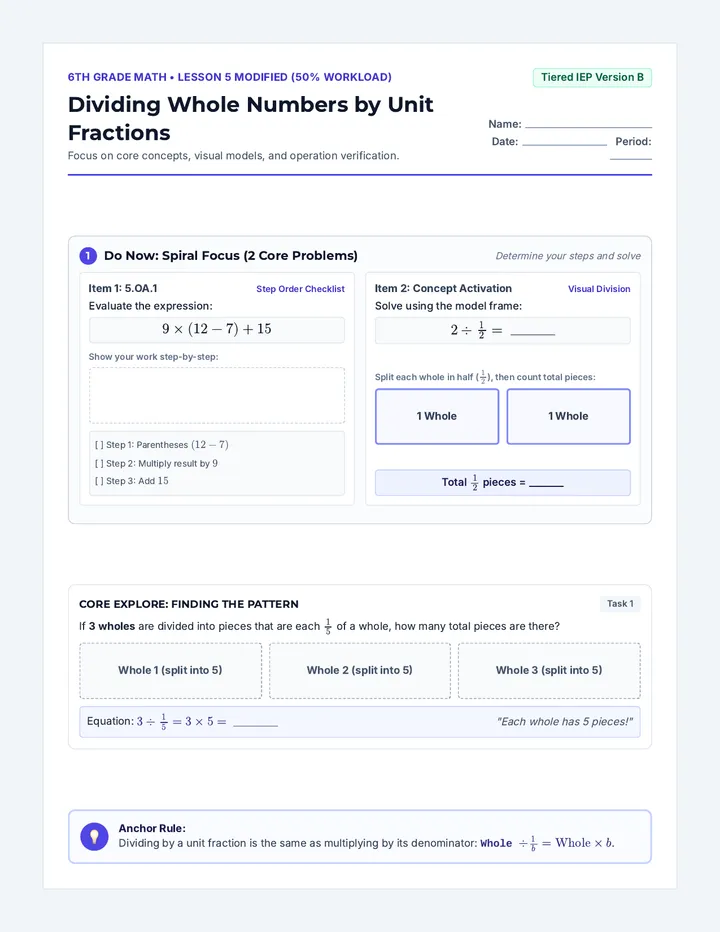
Fraction Division 50% Packet 6th Grade Math • Lesson 5 Modified (50% Workload) Tiered IEP Version B
Dividing Whole Numbers by Unit Fractions
Focus on core concepts, visual models, and operation verification.
Name:
Date: Period:
1 Do Now: Spiral Focus (2 Core Problems)
Determine your steps and solve
Item 1: 5.OA.1 Step Order Checklist
Evaluate the expression:
\(9 \times (12 - 7) + 15\)
Show your work step-by-step:
[ ] Step 1: Parentheses \((12 - 7)\)
[ ] Step 2: Multiply result by \(9\)
[ ] Step 3: Add \(15\)
Item 2: Concept Activation Visual Division
Solve using the model frame:
\(2 \div \frac{1}{2} =\) ______
Split each whole in half (\(\frac{1}{2}\)), then count total pieces:
1 Whole
1 Whole
Total \(\frac{1}{2}\) pieces = _______
Core Explore: Finding the Pattern
Task 1
If 3 wholes are divided into pieces that are each \(\frac{1}{5}\) of a whole, how many total pieces are there?
Whole 1 (split into 5)
Whole 2 (split into 5)
Whole 3 (split into 5)
Equation: \(3 \div \frac{1}{5} = 3 \times 5 =\) _______ "Each whole has 5 pieces!"
💡
Anchor Rule:
Dividing by a unit fraction is the same as multiplying by its denominator: Whole \(\div \frac{1}{b} = \text{Whole} \times b\) .
Part 2: Priority Practice & Exit Ticket
Page 2 of 3
1. Find the value of: \(6 \div \frac{1}{3}\)
Draw or Calculate
Student Workspace (Show your thinking):
Multiplication Check:
Check Rule: Quotient \(\times\) Divisor
______ \(\times \frac{1}{3} =\) ______
Does your product equal 6? [ ] Yes [ ] No
Answer Choices: A. \(\frac{1}{18}\) B. \(\frac{1}{2}\) C. \(18\) D. \(2\)
2. Ice Cream Sundae Problem
Word Problem
Samantha has 16 pints of ice cream. She scoops \(\frac{1}{5}\) of a pint into each sundae dish for her friends.
A) Write your division expression and calculate the total number of sundaes:
B) Reasoning Prompt:
Why is the number of sundaes larger than 16? (Hint: How many \(\frac{1}{5}\) scoops are in each 1 pint?)
EXIT TICKET
Lesson 5 Mastery Check
Standard: 6.NS.1
Solve and check: \(42 \div \frac{1}{2} =\) _______
Calculate:
Check with Multiplication:
Lesson 5 Homework • Modified 50% Workload
Targeted Practice & Fluency Maintenance
Name:
Part A: Unit Fraction Division (Solve & Show Work)
3 Essential Problems
\(25 \div \frac{1}{2} =\)
Think: \(25 \times 2\)
Answer = _______
\(40 \div \frac{1}{3} =\)
Think: \(40 \times 3\)
Answer = _______
\(7 \div \frac{1}{10} =\)
Think: \(7 \times 10\)
Answer = _______
Part B: 5th Grade Fluency Maintenance (IEP Goals)
Solve using standard algorithm with step checklists.
5.NBT.5 & 5.NBT.6
Problem 4: Multi-Digit Multiplication 3-digit × 2-digit
\(468 \times 83\)
Multiplication Checklist:
[ ] Step 1: Multiply \(468 \times 3\) ones
[ ] Step 2: WRITE 0 PLACEHOLDER IN ONES PLACE!
[ ] Step 3: Multiply \(468 \times 8\) tens
[ ] Step 4: Add partial products neatly
Problem 5: Long Division (D-M-S-B-R) 3-digit ÷ 2-digit
\(384 \div 12\)
D-M-S-B-R Division Checklist:
[ ] D ivide: How many 12s in 38?
[ ] M ultiply: Quotient digit \(\times 12\)
[ ] S ubtract: Find remainder
[ ] B ring down: Bring down the 4
[ ] R epeat: Divide 24 by 12
Great job! Check all checkboxes before turning in your homework packet.
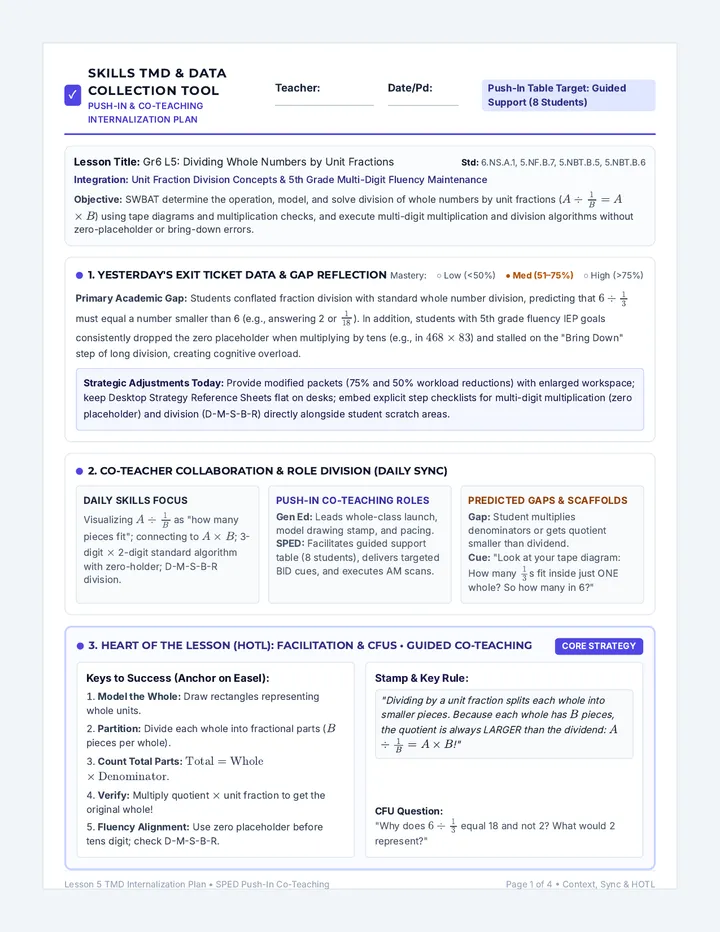
Push-In TMD Data Tracker ✓
Skills TMD & Data Collection Tool
Push-In & Co-Teaching Internalization Plan
Teacher:
Date/Pd:
Push-In Table Target: Guided Support (8 Students)
Lesson Title: Gr6 L5: Dividing Whole Numbers by Unit Fractions
Std: 6.NS.A.1, 5.NF.B.7, 5.NBT.B.5, 5.NBT.B.6
Integration: Unit Fraction Division Concepts & 5th Grade Multi-Digit Fluency Maintenance
Objective: SWBAT determine the operation, model, and solve division of whole numbers by unit fractions (\(A \div \frac{1}{B} = A \times B\)) using tape diagrams and multiplication checks, and execute multi-digit multiplication and division algorithms without zero-placeholder or bring-down errors.
1. Yesterday's Exit Ticket Data & Gap Reflection
Mastery: ○ Low (<50%) ● Med (51–75%) ○ High (>75%)
Primary Academic Gap: Students conflated fraction division with standard whole number division, predicting that \(6 \div \frac{1}{3}\) must equal a number smaller than 6 (e.g., answering 2 or \(\frac{1}{18}\)). In addition, students with 5th grade fluency IEP goals consistently dropped the zero placeholder when multiplying by tens (e.g., in \(468 \times 83\)) and stalled on the "Bring Down" step of long division, creating cognitive overload.
Strategic Adjustments Today: Provide modified packets (75% and 50% workload reductions) with enlarged workspace; keep Desktop Strategy Reference Sheets flat on desks; embed explicit step checklists for multi-digit multiplication (zero placeholder) and division (D-M-S-B-R) directly alongside student scratch areas.
2. Co-Teacher Collaboration & Role Division (Daily Sync)
Daily Skills Focus
Visualizing \(A \div \frac{1}{B}\) as "how many pieces fit"; connecting to \(A \times B\); 3-digit \(\times\) 2-digit standard algorithm with zero-holder; D-M-S-B-R division.
Push-In Co-Teaching Roles
Gen Ed: Leads whole-class launch, model drawing stamp, and pacing.SPED: Facilitates guided support table (8 students), delivers targeted BID cues, and executes AM scans.
Predicted Gaps & Scaffolds
Gap: Student multiplies denominators or gets quotient smaller than dividend.Cue: "Look at your tape diagram: How many \(\frac{1}{3}\)s fit inside just ONE whole? So how many in 6?"
3. Heart of the Lesson (HOTL): Facilitation & CFUs • Guided Co-Teaching
CORE STRATEGY
Keys to Success (Anchor on Easel):
Model the Whole: Draw rectangles representing whole units.Partition: Divide each whole into fractional parts (\(B\) pieces per whole).Count Total Parts: \(\text{Total} = \text{Whole} \times \text{Denominator}\).Verify: Multiply quotient \(\times\) unit fraction to get the original whole!Fluency Alignment: Use zero placeholder before tens digit; check D-M-S-B-R.
Stamp & Key Rule:
"Dividing by a unit fraction splits each whole into smaller pieces. Because each whole has \(B\) pieces, the quotient is always LARGER than the dividend: \(A \div \frac{1}{B} = A \times B\)!"
CFU Question:
"Why does \(6 \div \frac{1}{3}\) equal 18 and not 2? What would 2 represent?"
Lesson 5 TMD Internalization Plan • SPED Push-In Co-Teaching Page 1 of 4 • Context, Sync & HOTL
★
4. Moment of Productive Struggle #1 (MPS 1)
Item: Priority Practice #4 (\(6 \div \frac{1}{3}\)) & Multi-Digit Warm-Up (\(468 \times 83\))
Push-In Guided Focus
Anticipated Error / Misconception
BID / Teacher Prompt (Scaffold Question)
1. Confuses Division by \(\frac{1}{3}\) with Division by 3: Selects answer 2 (\(6 \div 3 = 2\)), assuming division always shrinks numbers."Are we sharing 6 with 3 whole groups, or cutting each whole into thirds? Draw 1 whole. How many thirds are inside it? So how many in 6 wholes?"
2. Drops Zero Placeholder in Multiplication: In \(468 \times 83\), multiplies by 8 without writing a 0 in the ones column of the second partial product."Check step 2 on your Strategy Reference Sheet! What place value is the 8 sitting in? (Tens). What must you write in the ones place before multiplying?"
3. Inverts Operation to Multiplication Incorrectly: Multiplies \(6 \times \frac{1}{3} = 2\) instead of \(6 \times 3 = 18\)."Look at your reference sheet rule. Each whole contains 3 parts. Does our total count of pieces get bigger or smaller?"
Plan Mini-RTD for Most Likely Error (Easel Script):
"Pencils down in 3-2-1! Look at \(6 \div \frac{1}{3}\). If I have 6 whole pizzas and cut each into thirds, do I have 2 slices or 18 slices? Slices are smaller than 1 whole, so you get MORE pieces! \(6 \times 3 = 18\)!"
Script a Stamp (MPS 1 Key Takeaway):
"Dividing by a unit fraction always increases the count because pieces are smaller than one whole. Always check with multiplication: \(18 \times \frac{1}{3} = 6\)!"
Name Your AM Laps 1–6 (Specific Look-Fors) • Live Push-In Scans
Lap 1
Lap 2
Lap 3
Lap 4
Lap 5
Lap 6
Real-Time Push-In Student Data Tracker (6 Laps • 8 Students) Mark: ✓ Mastered | ✗ Error | • BID Prompted
Student Name / IEP Target
L1
L2
L3
L4
L5
L6
Error Code / Observation
BID Delivered
1. [IEP: _____]
□
□
□
□
□
□
2. [IEP: _____]
□
□
□
□
□
□
3. [IEP: _____]
□
□
□
□
□
□
4. [IEP: _____]
□
□
□
□
□
□
5. [IEP: _____]
□
□
□
□
□
□
6. [IEP: _____]
□
□
□
□
□
□
7. [IEP: _____]
□
□
□
□
□
□
8. [IEP: _____]
□
□
□
□
□
□
Push-In Move: If 2+ students select quotient 2 on Lap 3, execute 45-sec Mini-RTD at table. Page 2 of 4 • MPS 1 Error Analysis & 8-Student Tracker
★
5. Moment of Productive Struggle #2 (MPS 2)
Item: Application #7 (Samantha's Sundaes: \(16 \div \frac{1}{5}\)) & Long Division Fluency (\(384 \div 12\))
Division & Reasoning Focus
Anticipated Error / Misconception
BID / Teacher Prompt (Scaffold Question)
1. Agrees with Terry's Flawed Reasoning: Believes that starting with 16 pints means you can't make more than 16 sundaes."If each friend gets 1 whole pint, how many friends? (16). But friends only get 1/5 of a pint! Does that mean more friends or fewer friends get to eat?"
2. Long Division Bring-Down Error: In \(384 \div 12\), brings down both '8' and '4' together, or forgets to subtract before bringing down."Follow your D-M-S-B-R checklist on your desk! You just subtracted \(38 - 36 = 2\). What is the next letter? B = Bring Down. How many digits do you bring down? Just the 4!"
3. Misidentifies the Dividend / Divisor Order: Sets up word problem as \(\frac{1}{5} \div 16\) instead of \(16 \div \frac{1}{5}\)."What is the total amount of ice cream being shared? (16 pints). The total amount being split ALWAYS goes first as the dividend!"
Plan Mini-RTD for Most Likely Error (Easel Script):
"Freeze table! Look at Samantha's ice cream. 1 pint = 5 scoops. 2 pints = 10 scoops. So 16 pints = \(16 \times 5 = 80\) sundaes! When scoops are smaller than 1 pint, you make WAY MORE sundaes!"
Script a Stamp (MPS 2 Key Takeaway):
"Dividing by a unit fraction answers: 'How many fractional portions can I make?' In long division, strictly follow D-M-S-B-R one digit at a time."
Name Your AM Laps 1–6 (Specific Look-Fors) • Live Push-In Scans
Lap 1
Lap 2
Lap 3
Lap 4
Lap 5
Lap 6
Real-Time Push-In Student Data Tracker (6 Laps • 8 Students) Mark: ✓ Mastered | ✗ Error | • BID Prompted
Student Name / IEP Target
L1
L2
L3
L4
L5
L6
Error Code / Observation
BID Delivered
1. [IEP: _____]
□
□
□
□
□
□
2. [IEP: _____]
□
□
□
□
□
□
3. [IEP: _____]
□
□
□
□
□
□
4. [IEP: _____]
□
□
□
□
□
□
5. [IEP: _____]
□
□
□
□
□
□
6. [IEP: _____]
□
□
□
□
□
□
7. [IEP: _____]
□
□
□
□
□
□
8. [IEP: _____]
□
□
□
□
□
□
Push-In Priority: Ensure students record partial subtraction remainders before bringing down digits. Page 3 of 4 • MPS 2 Error Analysis & 8-Student Tracker
✓
6. Exit Ticket & Assessment Tracker
Lesson 5 Mastery Check: \(42 \div \frac{1}{2} = 84\) & Verification
Mandatory Non-Negotiable
ET Lap 1 (Operation & Value)
Scans equation and quotient: Did student determine \(42 \times 2 = 84\) rather than \(42 \div 2 = 21\)?
ET Lap 2 (Verification Check)
Scans check: Did student write \(84 \times \frac{1}{2} = 42\) to prove their quotient is correct?
Conceptual Stamp / Rule
"Halves are 2 pieces per whole. 42 wholes have 84 halves. Division reverses through multiplication."
Push-In Student Assessment Data Collection Tool (8 Students) Fill during grading • Mastery: Low (<50%) / Med (51–75%) / High (>75%)
Student Name / IEP Target
Score / %
Level
Primary Misconception / Gap
Tomorrow's Push-In Action
1.
[IEP: ________________]
___ / 4
L / M / H
2.
[IEP: ________________]
___ / 4
L / M / H
3.
[IEP: ________________]
___ / 4
L / M / H
4.
[IEP: ________________]
___ / 4
L / M / H
5.
[IEP: ________________]
___ / 4
L / M / H
6.
[IEP: ________________]
___ / 4
L / M / H
7.
[IEP: ________________]
___ / 4
L / M / H
8.
[IEP: ________________]
___ / 4
L / M / H
Next-Day Push-In Priority & Strategy
Priority Standard / Gap to Target:
Distinguishing \(A \div \frac{1}{B}\) (multiplying by denominator) from \(A \div B\); reinforcing multi-digit multiplication zero-placeholder and D-M-S-B-R bring-down alignment.
Planned Grouping / Push-In Delivery:
Tier II (Kidney Table): 4 students for 5-minute Do Now reteach on tape diagram partitioning.Tier III (Co-Taught Station): Guided practice with scratch grids and multiplication zero-placeholder checklists.
Data Cycle Complete: Use Exit Ticket data to drive tomorrow's push-in intervention grouping. Page 4 of 4 • Exit Ticket & Assessment Tracker