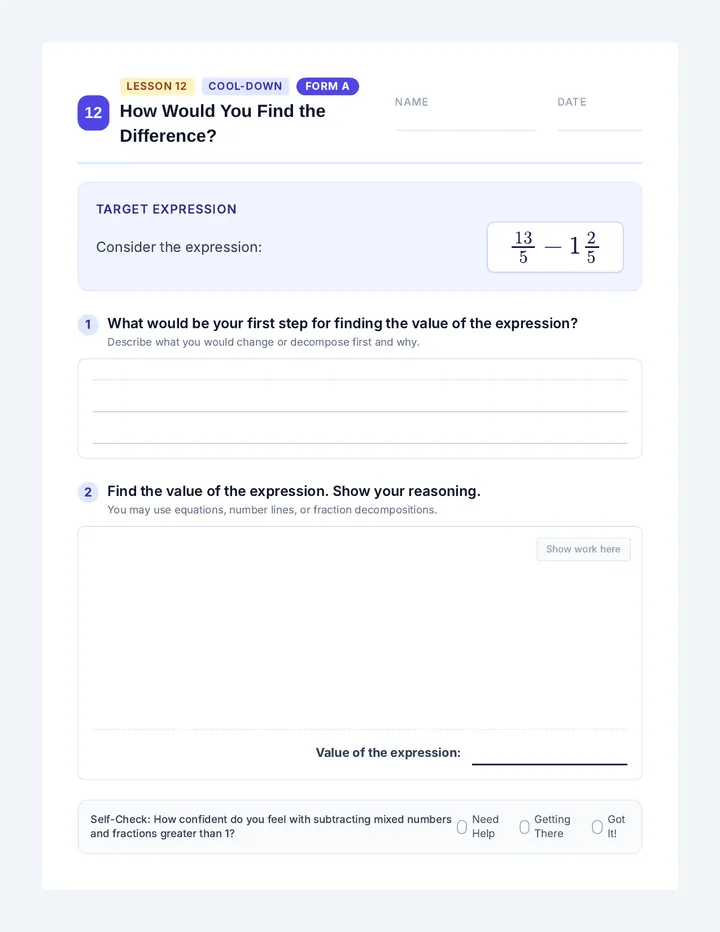
Fraction Difference Ticket A
12
Lesson 12 Cool-Down Form A
How Would You Find the Difference?
Name
Date
Target Expression
Consider the expression:
\(\frac{13}{5} - 1\frac{2}{5}\)
1
What would be your first step for finding the value of the expression?
Describe what you would change or decompose first and why.
2
Find the value of the expression. Show your reasoning.
You may use equations, number lines, or fraction decompositions.
Show work here
Value of the expression:
Self-Check: How confident do you feel with subtracting mixed numbers and fractions greater than 1?
Need Help Getting There Got It!
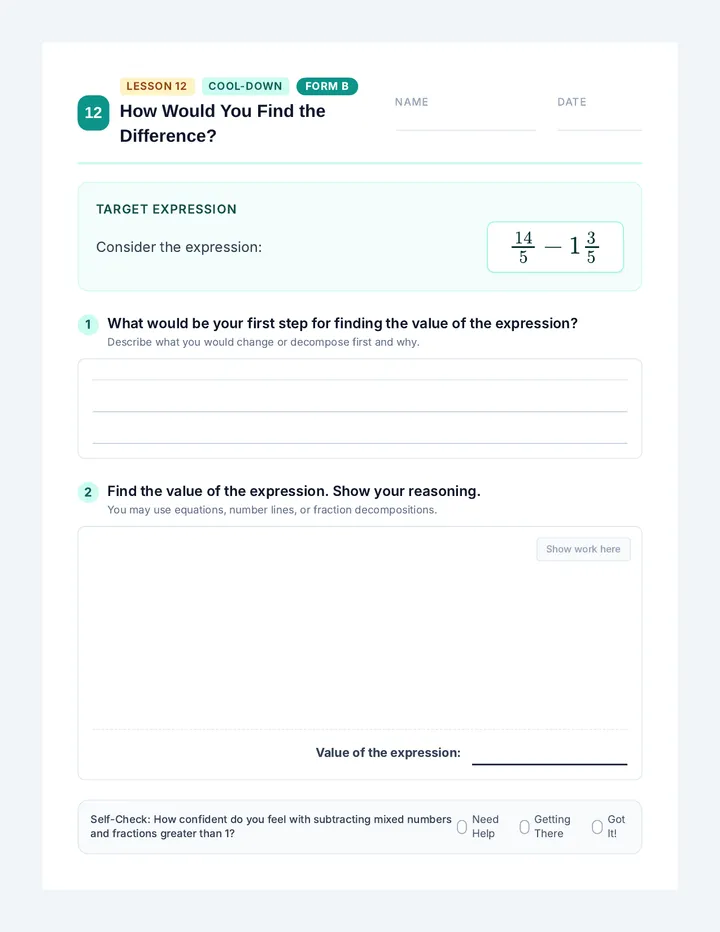
Fraction Difference Ticket B
12
Lesson 12 Cool-Down Form B
How Would You Find the Difference?
Name
Date
Target Expression
Consider the expression:
\(\frac{14}{5} - 1\frac{3}{5}\)
1
What would be your first step for finding the value of the expression?
Describe what you would change or decompose first and why.
2
Find the value of the expression. Show your reasoning.
You may use equations, number lines, or fraction decompositions.
Show work here
Value of the expression:
Self-Check: How confident do you feel with subtracting mixed numbers and fractions greater than 1?
Need Help Getting There Got It!
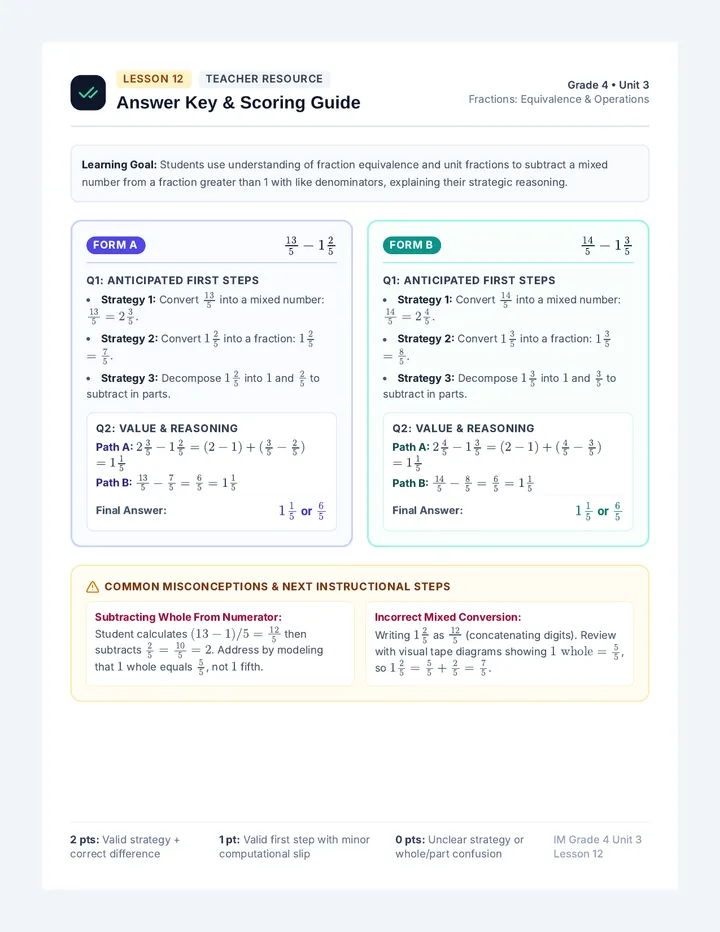
Fraction Difference Answer Key
Lesson 12 Teacher Resource
Answer Key & Scoring Guide
Grade 4 • Unit 3 Fractions: Equivalence & Operations
Learning Goal: Students use understanding of fraction equivalence and unit fractions to subtract a mixed number from a fraction greater than 1 with like denominators, explaining their strategic reasoning.
Form A \(\frac{13}{5} - 1\frac{2}{5}\)
Q1: Anticipated First Steps
- Strategy 1: Convert \(\frac{13}{5}\) into a mixed number: \(\frac{13}{5} = 2\frac{3}{5}\).
- Strategy 2: Convert \(1\frac{2}{5}\) into a fraction: \(1\frac{2}{5} = \frac{7}{5}\).
- Strategy 3: Decompose \(1\frac{2}{5}\) into \(1\) and \(\frac{2}{5}\) to subtract in parts.
Q2: Value & Reasoning
Path A: \(2\frac{3}{5} - 1\frac{2}{5} = (2-1) + (\frac{3}{5}-\frac{2}{5}) = 1\frac{1}{5}\)
Path B: \(\frac{13}{5} - \frac{7}{5} = \frac{6}{5} = 1\frac{1}{5}\)
Final Answer: \(1\frac{1}{5}\) or \(\frac{6}{5}\)
Form B \(\frac{14}{5} - 1\frac{3}{5}\)
Q1: Anticipated First Steps
- Strategy 1: Convert \(\frac{14}{5}\) into a mixed number: \(\frac{14}{5} = 2\frac{4}{5}\).
- Strategy 2: Convert \(1\frac{3}{5}\) into a fraction: \(1\frac{3}{5} = \frac{8}{5}\).
- Strategy 3: Decompose \(1\frac{3}{5}\) into \(1\) and \(\frac{3}{5}\) to subtract in parts.
Q2: Value & Reasoning
Path A: \(2\frac{4}{5} - 1\frac{3}{5} = (2-1) + (\frac{4}{5}-\frac{3}{5}) = 1\frac{1}{5}\)
Path B: \(\frac{14}{5} - \frac{8}{5} = \frac{6}{5} = 1\frac{1}{5}\)
Final Answer: \(1\frac{1}{5}\) or \(\frac{6}{5}\)
Common Misconceptions & Next Instructional Steps
Subtracting Whole From Numerator:
Student calculates \((13-1)/5 = \frac{12}{5}\) then subtracts \(\frac{2}{5} = \frac{10}{5} = 2\). Address by modeling that \(1\) whole equals \(\frac{5}{5}\), not \(1\) fifth.
Incorrect Mixed Conversion:
Writing \(1\frac{2}{5}\) as \(\frac{12}{5}\) (concatenating digits). Review with visual tape diagrams showing \(1\text{ whole} = \frac{5}{5}\), so \(1\frac{2}{5} = \frac{5}{5} + \frac{2}{5} = \frac{7}{5}\).
2 pts: Valid strategy + correct difference 1 pt: Valid first step with minor computational slip 0 pts: Unclear strategy or whole/part confusion
IM Grade 4 Unit 3 Lesson 12