Factor Forge Slides
Grade 5 Mathematics
Unit: Multiplication Masterclass
Precision Math Lab
FACTOR FORGE
Multiplying 2-Digit by 1-Digit Numbers: Decomposing, Area Models & Standard Algorithm Mastery
Core Strategy: Place Value Power
SESSION 01
01 WARM-UP
Deconstruct the Number
Place Value Foundation
Before we multiply, we break apart double-digit numbers into tens and ones.
Example Breakdown
47 = 40 + 7
4 tens (40) and 7 ones (7)
Quick Mental Check: Deconstruct These!
63 = 60 + 3
85 = 80 + 5
29 = 20 + 9
Why? Multiplying friendly tens is fast and prevents place value errors!
STRATEGY 1
The Area Model (Partial Products)
43 × 6
Split into rectangles!
Break the factor \(43\) into 40 and 3. Multiply each part by 6, then sum the partial products.
Step 1: \(6 \times 40 = 240\)
Step 2: \(6 \times 3 = 18\)
Total: \(240 + 18 = 258\)
Length = 40 + 3 | Width = 6
6
40
6 × 40
= 240
3
6 × 3
= 18
\(240 + 18 =\) 258
Key insight: Every digit gets multiplied by the single digit factor! Area Model = Visual Clarity
STRATEGY 2
The Standard Algorithm (Regrouping)
43 × 6
1
Multiply the Ones
\(6 \times 3 = 18\). Write down the 8 in ones place, regroup 1 ten to tens column.
2
Multiply the Tens
\(6 \times 4\text{ tens} = 24\text{ tens}\).
3
Add the Regrouped Tens
\(24\text{ tens} + 1\text{ regrouped ten} = 25\text{ tens}\). Write 25!
¹
43
× 6
258
Same exact product: 258!
Rule: Always MULTIPLY first, then ADD the regrouped tens! Standard Algorithm = Fast Fluency
GUIDED FORGE
Let's Solve Together: 58 × 4
Dual Strategy Check
Path A: Area Model Split
Deconstruct 58:
50 + 8
Multiply Part 1:
4 × 50 = 200
Multiply Part 2:
4 × 8 = 32
Sum Partial Products: 232
Path B: Vertical Algorithm
³
58
× 4
232
-
\(4 \times 8 = 32\)
Drop 2, regroup 3 tens.
-
\(4 \times 5 = 20\)
Add regrouped 3: \(20 + 3 = 23\).
Target Product: 232
Both methods confirm the identical answer: 232!
Now ready for independent forge practice!
TRAP ALERT
Watch Out for the "Add First" Trap!
Common Pitfall
The Glitch (INCORRECT)
²
37 × 4
A student added the regrouped 2 tens to 3 before multiplying:
Student did: \(3 + 2 = 5\)
Then did: \(5 \times 4 = 20\)
Result: 208 ❌ (WRONG!)
Never add the regrouped value before multiplying!
The Fix (CORRECT)
²
37 × 4
Follow the order of operations: Multiply first, then add the regrouped tens:
Step 1: \(4 \times 7 = 28\) (Drop 8, regroup 2)
Step 2: \(4 \times 3 = 12\) (Multiply tens)
Step 3: \(12 + 2 = 14\) → Result: 148 ✅
Always multiply the factors, then add the regrouped tens!
MIND MANTRA: "Multiply first, add the bonus after!"
CHALLENGE BOSS
Exit Ticket Preview: Double × Double
Level Up to 2-Digit × 2-Digit
What happens when BOTH numbers have two digits?
The Same Logic Expands!
Instead of 2 rectangles, our Area Model expands into a 2 × 2 grid (4 rectangles)!
Sample: \(24 \times 13\)
Break down \(24 = 20 + 4\) and \(13 = 10 + 3\)
10 × 20
200
10 × 4
40
3 × 20
60
3 × 4
12
\(200 + 40 + 60 + 12 =\) 312
Ready to conquer your worksheet and tackle the Challenge Exit Ticket? Let's Forge! 🔨
Factor Forge Worksheet
Factor Forge | Math Lab
Multiplying 2-Digit by 1-Digit Numbers (5.NBT.B.5)
Name:
Date:
Strategy A Area Model: \(36 \times 4 = (30 \times 4) + (6 \times 4) = 120 + 24 = 144\)
Strategy B Standard: Multiply ones, regroup tens, multiply tens, add regrouped!
1
Guided Forge: Complete with Both Methods
Problem 1: \(43 \times 5\) Target = _____
Area Model Breakdown:
\(5 \times 40 =\) ______
\(5 \times 3 =\) ______
Sum = ______
Standard Algorithm:
43
× 5
Problem 2: \(68 \times 3\) Target = _____
Area Model Breakdown:
\(3 \times 60 =\) ______
\(3 \times 8 =\) ______
Sum = ______
Standard Algorithm:
68
× 3
2
Independent Practice: Compute Each Product
Show all calculations and regrouped digits clearly.
- \(52 \times 7\) Method of choice
Product: ______
- \(86 \times 4\) Method of choice
Product: ______
- \(39 \times 8\) Method of choice
Product: ______
- \(95 \times 3\) Method of choice
Product: ______
- \(67 \times 9\) Method of choice
Product: ______
- \(48 \times 6\) Method of choice
Product: ______
Factor Forge • Lesson Module 5.1 Page 1 of 2 Turn over for Applied Engineering & Glitch Detector ➔
Factor Forge | Applied Engineering & Error Analysis
Name:
3
Applied Engineering Scenarios
9) The Solar Tech Lab: An electrical engineer connects 7 high-efficiency solar arrays. Each array contains 84 photovoltaic power cells. How many power cells are operating in total across all 7 arrays?
Show calculation / model:
Final Statement:
There are
total power cells.
10) The Drone Delivery Depot: A logistics depot deploys 6 transport drones per hour. Each drone flies a delivery route of 76 kilometers. What is the total combined distance flown by all 6 drones?
Show calculation / model:
Factor Forge Exit Ticket
Factor Forge | Exit Ticket & Challenge
Daily Mastery Check + Boss Level
Name:
Date:
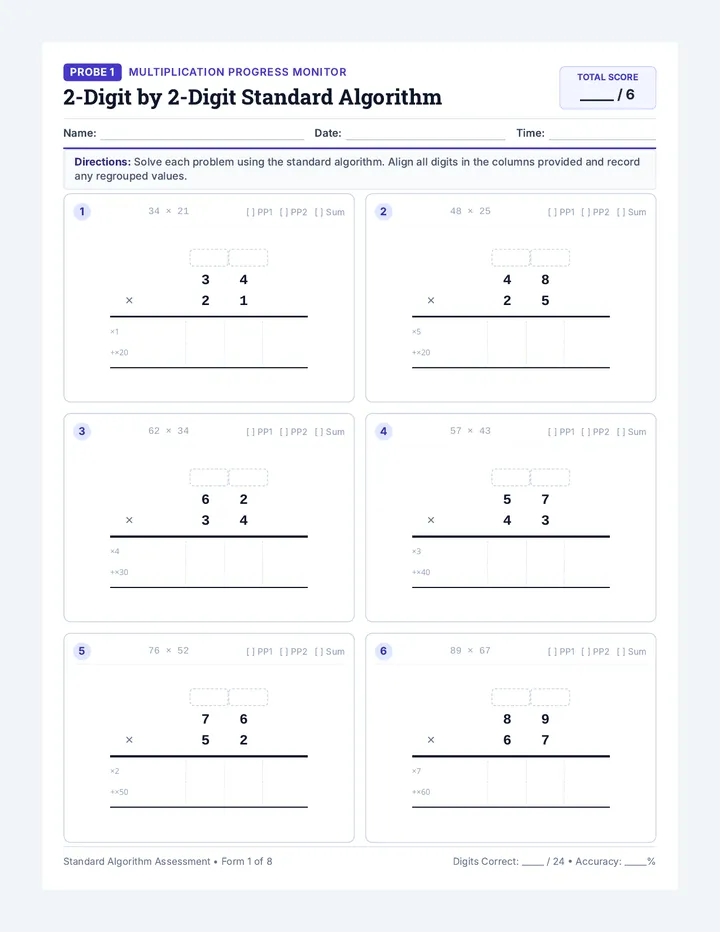
1 Mastery Check: Calculate \(76 \times 8\)
Use any strategy
Product
______
★ FORGE CHALLENGE Multiply Two Double-Digit Numbers!
\(34 \times 23\)
Prompt: Decompose both numbers \((30 + 4) \times (20 + 3)\) or use a 2×2 Area Model grid to calculate the total product:
Show area model rectangles or partial products:
Challenge Product
Score: / 5
Strategy Note: Did breaking both numbers into tens and ones make this easier? Explain:
Cut along dashed line for student half-sheets
Factor Forge | Exit Ticket & Challenge
Daily Mastery Check + Boss Level
Name:
Date:
1 Mastery Check: Calculate \(76 \times 8\)
Use any strategy
Product
______
★ FORGE CHALLENGE Multiply Two Double-Digit Numbers!
\(34 \times 23\)
Prompt: Decompose both numbers \((30 + 4) \times (20 + 3)\) or use a 2×2 Area Model grid to calculate the total product:
Show area model rectangles or partial products:
Challenge Product
Score: / 5
Strategy Note: Did breaking both numbers into tens and ones make this easier? Explain:
Factor Forge Teacher Guide
Factor Forge | Teacher Facilitation Guide
Instructional Blueprint • 5th Grade Multi-Digit Multiplication
Duration: 60 Minutes
Instructional Objectives (SWBAT)
- Decompose 2-digit factors into tens and ones using base-ten place value understanding.
- Represent 2-digit × 1-digit multiplication using rectangular Area Models (partial products).
- Execute the standard multiplication algorithm with regrouping with at least 85% accuracy.
- Extend conceptual decomposition to preview 2-digit × 2-digit multiplication in the challenge exit slip.
Standards Alignment
CCSS 5.NBT.B.5: Fluently multiply multi-digit whole numbers using the standard algorithm.
CCSS 4.NBT.B.5: Multiply a whole number of up to four digits by a one-digit whole number using strategies based on place value.
Suggested Lesson Pacing (60 Minutes)
| Time | Phase | Key Teacher & Student Actions |
|---|
| 10 min | Warm-Up & Intro | Display Slides 1–2. Practice rapid verbal decomposition (\(73 = 70 + 3\)). Frame the mission: every digit gets multiplied! |
| 15 min | Direct Modeling | Slides 3–5. Present Area Model side-by-side with Standard Algorithm for \(43 \times 6\). Emphasize where the regrouped tens come from. |
| 10 min | Guided Practice | Worksheet Part 1 (Problems 1 & 2). Choral response on regrouping values. Highlight Slide 6 "Trap Alert" (multiplying before adding). |
| 15 min | Independent Lab | Worksheet Part 2 & Part 3. Circulate with sticky notes. Guide students to check reasonableness by rounding to nearest ten. |
| 10 min | Exit Challenge | Distribute Exit Ticket. Slide 7 preview. Students tackle the double-by-double challenge (\(34 \times 23\)) using a 2×2 grid! |
Common Student Misconceptions
1. Adding before multiplying: Students often add the regrouped ten to the tens digit first (\((3 + 2) \times 4\)).
Fix: Teach the rhyme: "Multiply first, add the carried prize!"
2. Dropping place value zeroes: Forgetting that multiplying \(4 \times 5\text{ tens} = 20\text{ tens} = 200\).
Fix: Always link vertical steps back to the visual area model box.
Tiered Differentiation Strategies
Support / Tier 1: Provide pre-drawn grid paper or base-ten blocks. Allow students to write full partial products vertically before consolidating into regrouping.