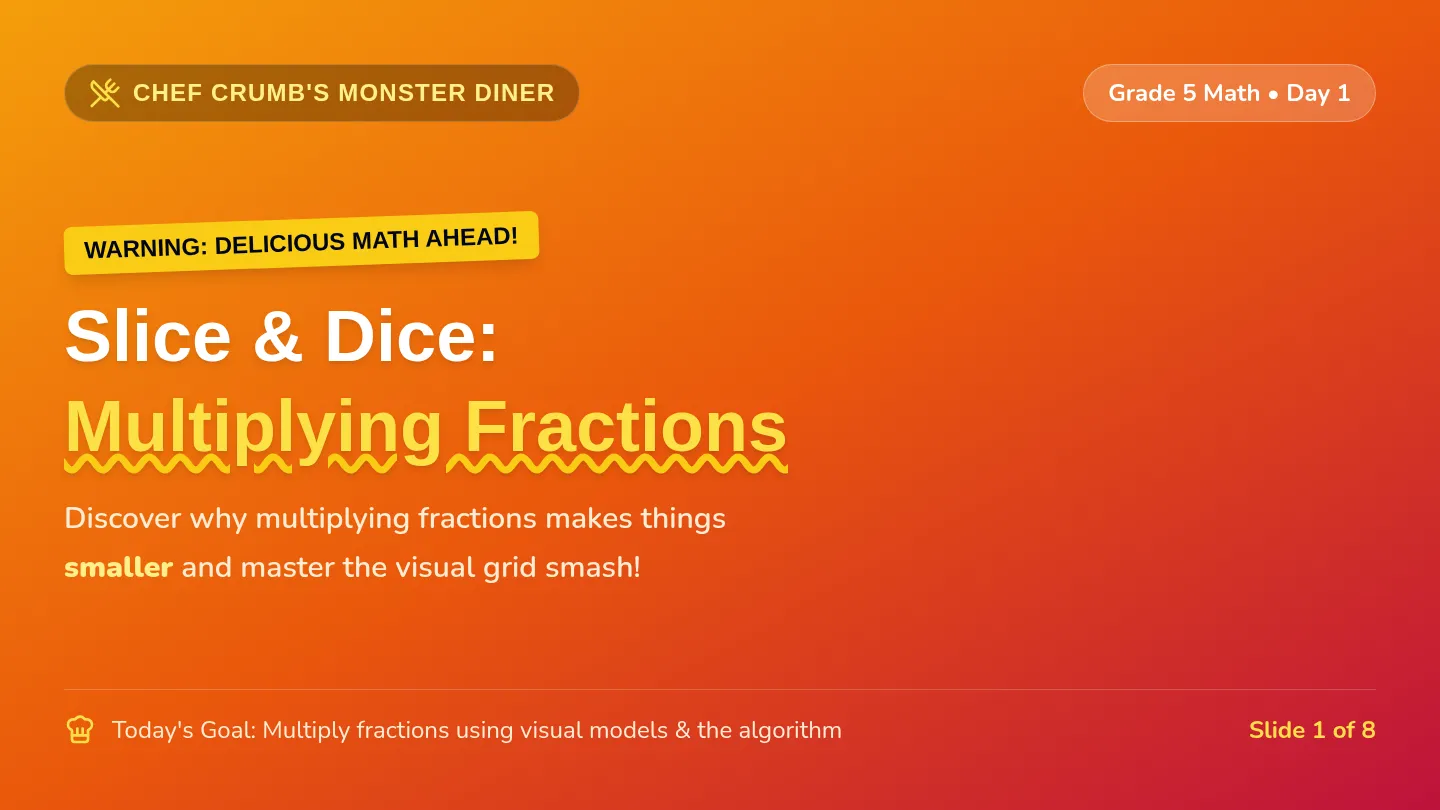
Factor Force Review Slides Grade 3 Math • Unit 3 Review Operations & Algebraic Thinking
Factor Force: Unit 3 Mastery
Power up your multiplication properties, master multiples of 10, crack number patterns, and conquer division models!
Distributive
Associative
Multiples of 10
Patterns & Rules
Break It Apart: The Distributive Property
Standard 3.OA.5
Tile Floor Model: \(5 \times 6\)
Total width: 6 units (Split into 4 + 2)
\(5 \times 4 = 20\)
\(5 \times 2 = 10\)
Total: \(20 + 10 = 30\) square units
How to Write the Expression:
\((5 \times 4) + (5 \times 2)\)
Multiply rows by each section, then ADD the partial products together!
Watch Out for Trap Answers!
\((5 \times 4) \times (5 \times 2)\) is WRONG because you do not multiply the two areas—you add them!
Key Rule: Keep one factor the same, break the other factor into two friendly parts!
Switch the Grouping: Associative Property
Standard 3.OA.5
Grouping A
\((2 \times 3) \times 4\)
Step 1: Inside Parentheses \(2 \times 3 = 6\)
Step 2: Multiply Remaining \(6 \times 4 = 24\)
2 groups of 3, repeated 4 times = 24
Grouping B
\(2 \times (3 \times 4)\)
Step 1: Inside Parentheses \(3 \times 4 = 12\)
Step 2: Multiply Remaining \(2 \times 12 = 24\)
3 times 4 is 12, then doubled = 24
Missing Factor Clue: If all numbers are multiplied, both sides must have the exact same three factors!
Multiplying Multiples of 10
Standard 3.NBT.3
Think in Tens
\(2 \times 70\)
Think of 70 as 7 tens.
\(2 \text{ groups of } 7 \text{ tens} = 14 \text{ tens} = \mathbf{140}\)
Decompose by 10
\(2 \times 7 \times 10\)
Break 70 into \(7 \times 10\).
\((2 \times 7) \times 10 = 14 \times 10 = \mathbf{140}\)
Beware Place Value Errors
\(5 \times 40 = 2000\)
\(5 \times 40 = 200\) (20 tens)
\(7 \times 50 = 35\)
\(7 \times 50 = 350\) (35 tens)
Secret Formula: \(8 \times 30 = (24 \times 10) = 240\) Basic fact first, then multiply by 10!
Cracking Number Machines & Patterns
Standard 3.OA.9
Mobi's Number Machine Rule Finder
IN
Rule
OUT
12
\(\times 10\)
120
14
\(\times 10\)
140
16
\(\times 10\)
160
Skip-Counting Check:
8, 16, 24, 32, 40, 48
Each step increases by +8. Count by 8s to find the next number!
Subtraction Pattern Check:
Rule: "Subtract 3"
17 → 14 → 11 → 8 → 5 → 2
Test every jump in the sequence to ensure the difference is constant!
Rule Detective Strategy: Ask yourself — Does the number get larger (+ or ×) or smaller (- or ÷)?
Even & Odd Addition Rules
Standard 3.OA.9
Case 1 EVEN
Even + Even
4 + 6 = 10
8 + 2 = 10
All pairs are complete! No leftovers remain. The sum is always EVEN.
Case 2 EVEN
Odd + Odd
3 + 5 = 8
7 + 1 = 8
Each odd has 1 leftover. The two leftovers pair up, making the sum EVEN!
Case 3 ODD
Even + Odd
4 + 3 = 7
6 + 5 = 11
The single leftover from the odd number has no partner. The sum is always ODD!
Pro Tip on the Test: Plug in small test numbers like 2 for even and 3 for odd to double check!
Division: Equal Groups & Fair Shares
Standard 3.OA.2
Target Expression
\(12 \div 3\)
Starting with 12 total items and splitting them into equal groups of 3 (or 3 equal groups).
Total
12 items
Group Size
3 each
Quotient
4 groups
True Division Situation:
"Andre has 12 toy cars. He sorts them into equal groups of 3 cars each."
Traps: Different Operations!
• "Milan makes 12 bagels and gives away 3" → Subtraction \((12 - 3)\)
• "Zion puts 12 cards in 3 bags" → Multiplication \((12 \times 3)\)
Key Word Clue: Look for "sorts into equal groups" or "shares equally"!
Factor Force: Mission Checklist
Assessment Ready
Test-Day Strategies
Break apart big arrays into friendly 5s and 2s!
Multiples of 10: Solve basic fact first, then append zero!
Associative property: Check that both sides have identical factors!
Next Up: Practice Packet
Open your practice packet. Read each problem carefully, show your array drawings and decomposing steps, and check each True/False row!
12 Target Review Questions • Full Points Challenge!
You have the tools. You have the strategies. Let's show what you know!
Factor Force Practice Packet GRADE 3 MATHEMATICS • UNIT 3 REVIEW PACKET STANDARDS: 3.OA.5, 3.OA.9, 3.NBT.3, 3.OA.2
Factor Force: Unit 3 Practice
Complete each question carefully. Show your thinking and check your calculations.
Name:
Date:
1 Standard 3.OA.5 • DOK 1 • 1 pt
The model below shows a rectangular floor covered with shaded tiles and white tiles.
← 4 shaded → ← 2 white →
Height: 6 rows
Which expression can be used to find the total square units?
A. \((6 \times 4) + (6 \times 2)\)
B. \((6 \times 4) \times (6 \times 2)\)
C. \((6 + 4) + (6 + 2)\)
D. \((6 + 4) \times (6 + 2)\)
2 Standard 3.OA.9 • DOK 1 • 1 pt
Kendra uses skip-counting to create the pattern shown below:
7, 14, 21, 28, ...
What is the next number in the pattern?
A. 32
B. 35
C. 36
D. 42
3 Standard 3.NBT.3 • DOK 1 • 1 pt
Which equations are true? Select a box in each row to identify if each equation is True or False.
Equation
True
False
\(70 \times 3 = 210\)
\(4 \times 50 = 2000\)
\(9 \times 40 = 36\)
\(8 \times 60 = 480\)
4 Standard 3.OA.5 • DOK 1 • 1 pt
Find the missing number in the equation below:
\((3 \times 2) \times 5 = 3 \times (2 \times \_\_\_\_) \)
A. 2
B. 3
C. 5
D. 10
Grade 3 Unit 3 Assessment Review Page 1 of 3
Grade 3: Unit 3 Assessment Practice
Name: Date:
5 Standard 3.OA.9 / 3.NBT.3 • DOK 3 • 2 pts
Design the Machine!
Look at what happens when Sparky the robot puts numbers into his machine:
Sparky's Machine
IN
Rule
OUT
15
?
150
18
?
180
21
?
210
Part A: What is the rule for Sparky's machine?
Rule:
Your Number Machine
Part B: Complete the table with 3 rows and state your rule.
Rule:
6 Standard 3.OA.5 • DOK 2 • 1 pt
An equation with two blanks is shown below:
\(8 \times 6 = (5 \times \_\_\_\_) + (3 \times \_\_\_\_)\)
What number can go into both blanks to make the equation true?
A. 3
B. 5
C. 6
D. 8
7 Standard 3.NBT.3 • DOK 2 • 1 pt
Which two ways show how to find the value of \(3 \times 80\)? Select the two correct answers.
A. \(3 \times 8\)
B. \(8 \times 10\)
C. \(3 \times 8 \times 10\)
D. 3 groups of 8 ones
E. 3 groups of 8 tens
8 Standard 3.OA.9 • DOK 1 • 1 pt
Select the box in each row to make the statement true.
Statement
Odd
Even
When you add an even and odd number together the answer is ____.
When you add two odd numbers together the answer is ____.
When you add two even numbers together the answer is ____.
Grade 3 Unit 3 Assessment Review Page 2 of 3
Grade 3: Unit 3 Assessment Practice
Name: Date:
9 Standard 3.NBT.3 • DOK 2 • 1 pt
An incomplete equation is shown below:
\(7 \times 40 = (\_\_\_\_ \times 10)\)
What number makes the equation true?
Answer:
10 Standard 3.OA.9 • DOK 1 • 1 pt
Which pattern follows the rule “subtract 4”?
A. 24, 20, 16, 12, 8, 4
B. 24, 22, 20, 18, 16, 14
C. 24, 28, 32, 36, 40, 44
D. 64, 16, 4, 1, 0
11 Standard 3.OA.5 • DOK 3 • 2 pts
Maya and Leo looked at the array below and each created an equation to represent the array.
Maya wrote: \((4 \times 5) + (4 \times 2)\) Leo wrote: \(2 \times (4 \times 2)\)
Directions: Show how each equation represents the array. Draw lines or circles on each student’s array to show how the array is decomposed to match their equation.
Maya: \((4 \times 5) + (4 \times 2)\)
Decompose into 4×5 and 4×2
Leo: \(2 \times (4 \times 2)\)
Group into 2 sections of (4×2)
12 Standard 3.OA.2 • DOK 1 • 1 pt
Which statement can be represented by the expression \(15 \div 3\)?
A. Tariq bakes 15 muffins. He gives away 3 muffins to his neighbor.
B. Brianna puts 15 stickers on each sheet. She fills 3 complete sheets.
C. Marcus has 15 colored pencils. He places them equally into 3 pencil boxes.
D. Camilla has 15 flowers. She buys 3 more flowers at the market.
Grade 3 Unit 3 Assessment Review Page 3 of 3
Factor Force Answer Key TEACHER SCORING GUIDE • GRADE 3 MATHEMATICS ANSWER KEY
Factor Force: Teacher Answer Key
Unit 3 Assessment Review • Standards 3.OA.5, 3.OA.9, 3.NBT.3, 3.OA.2
Total Points: 14 pts
1 Correct Answer: A • (6 × 4) + (6 × 2)
3.OA.5 • 1 pt
Explanation: The grid has 6 rows. The shaded section has 4 columns (\(6 \times 4 = 24\)) and the unshaded section has 2 columns (\(6 \times 2 = 12\)). To find the total area, add the two partial areas: \((6 \times 4) + (6 \times 2) = 36\).
Misconception Alert: Option B is a common trap where students multiply the partial products instead of adding them.
2 Correct Answer: B • 35
3.OA.9 • 1 pt
Explanation: Identify the pattern rule by finding the constant difference between consecutive terms: \(14 - 7 = 7\), \(21 - 14 = 7\), \(28 - 21 = 7\). The rule is “add 7” (multiples of 7). Next term: \(28 + 7 = \mathbf{35}\).
3 Correct Answers: Row 1: True | Row 2: False | Row 3: False | Row 4: True
3.NBT.3 • 1 pt
• \(70 \times 3 = 210\): True (\(7 \text{ tens} \times 3 = 21 \text{ tens} = 210\))
• \(4 \times 50 = 2000\): False (\(4 \times 5 \text{ tens} = 20 \text{ tens} = 200\))
• \(9 \times 40 = 36\): False (\(9 \times 4 \text{ tens} = 36 \text{ tens} = 360\))
• \(8 \times 60 = 480\): True (\(8 \times 6 \text{ tens} = 48 \text{ tens} = 480\))
4 Correct Answer: C • 5
3.OA.5 • 1 pt
Explanation: The Associative Property of Multiplication states that changing the grouping of factors does not change the product: \((a \times b) \times c = a \times (b \times c)\). The factors on the left are 3, 2, and 5. Therefore, the missing factor on the right is 5.
5 Design the Machine! Scoring Rubric • 2 pts
3.OA.9 / 3.NBT.3 • DOK 3
Part A (1 pt): Rule is × 10 (or “multiply by 10” / “10 times the input”). Accept equivalent wording.
Part B (1 pt): Student creates a 3-row table where the OUT numbers consistently match their stated rule. Sample valid answers: Rule “× 10” (IN: 4, 7, 9 → OUT: 40, 70, 90) or Rule “+ 25” (IN: 10, 20, 30 → OUT: 35, 45, 55).
6 Correct Answer: C • 6
3.OA.5 • 1 pt
Explanation: In \(8 \times 6\), the factor 8 is decomposed into \(5 + 3\). By the Distributive Property, both 5 and 3 must be multiplied by the other factor, 6: \(8 \times 6 = (5 \times \mathbf{6}) + (3 \times \mathbf{6}) = 30 + 18 = 48\).
Factor Force Teacher Scoring Guide • Unit 3 Assessment Review Page 1 of 2
Factor Force: Teacher Answer Key (Continued) Questions 7 – 12
7 Correct Answers: C and E
3.NBT.3 • 1 pt
Explanation: To find \(3 \times 80\), rewrite 80 as \(8 \times 10\), giving \(3 \times 8 \times 10\) (Option C). In place-value terms, 80 is 8 tens, so \(3 \times 80\) is 3 groups of 8 tens (Option E). Both equal 240.
8 Correct Classification: Even / Odd Rules
3.OA.9 • 1 pt
• Even + Odd = Odd (e.g., \(4 + 3 = 7\))
• Odd + Odd = Even (e.g., \(3 + 5 = 8\)) — two leftover ones pair up!
• Even + Even = Even (e.g., \(4 + 6 = 10\)) — all numbers are in complete pairs.
9 Correct Answer: 28
3.NBT.3 • 1 pt
Explanation: \(7 \times 40 = 7 \times (4 \times 10) = (7 \times 4) \times 10 = \mathbf{28} \times 10 = 280\). The missing value inside parentheses is \(7 \times 4 = \mathbf{28}\).
10 Correct Answer: A • 24, 20, 16, 12, 8, 4
3.OA.9 • 1 pt
Explanation: Test the jumps between numbers: \(24 - 4 = 20\), \(20 - 4 = 16\), \(16 - 4 = 12\), \(12 - 4 = 8\), \(8 - 4 = 4\). Each number decreases by exactly 4. (Option B subtracts 2; Option C adds 4; Option D divides by 4).
11 Array Decomposition Rubric • 2 pts
3.OA.5 • DOK 3
Maya's Array (1 pt): Student draws a vertical dividing line after column 5 (or circles 5 columns and 2 columns). This visually shows the array split into a \(4 \times 5\) block (\(20\) dots) and a \(4 \times 2\) block (\(8\) dots). Sum = \(28\) dots.
Leo's Array (1 pt): Student draws a vertical dividing line down the middle of the \(4 \times 4\) array to create two equal \(4 \times 2\) groups (or circles each \(4 \times 2\) group). This shows \(2 \times (4 \times 2) = 2 \times 8 = 16\) dots.
12 Correct Answer: C • Marcus places 15 colored pencils equally into 3 boxes
3.OA.2 • 1 pt
Explanation: Division represents partitioning a total quantity into equal groups or finding how many in each group. Marcus has 15 total pencils shared equally among 3 boxes (\(15 \div 3 = 5\)).
Non-division options: A is subtraction (\(15 - 3\)), B is multiplication (\(15 \times 3\)), D is addition (\(15 + 3\)).
Factor Force Teacher Scoring Guide • Unit 3 Assessment Review Page 2 of 2