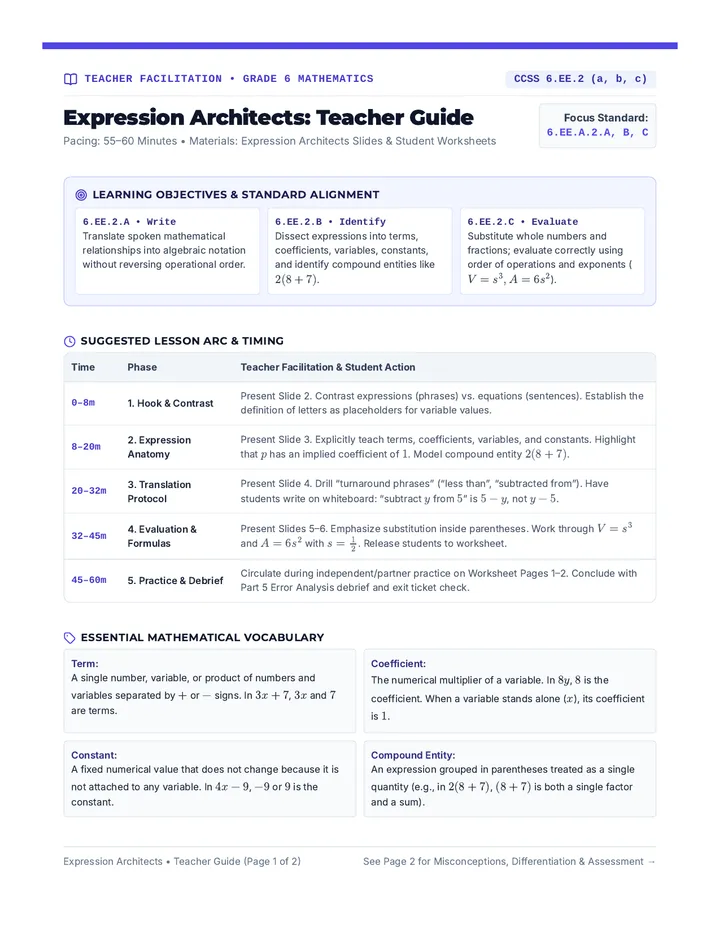
A comprehensive 6th-grade mathematics lesson aligned to CCSS 6.EE.2 covering expression anatomy, translating verbal phrases to algebraic expressions, and evaluating expressions with exponents and geometric formulas.
Architect Blueprint • Page 2 of 2 Expression Architects • Standard 6.EE.2 Mastery
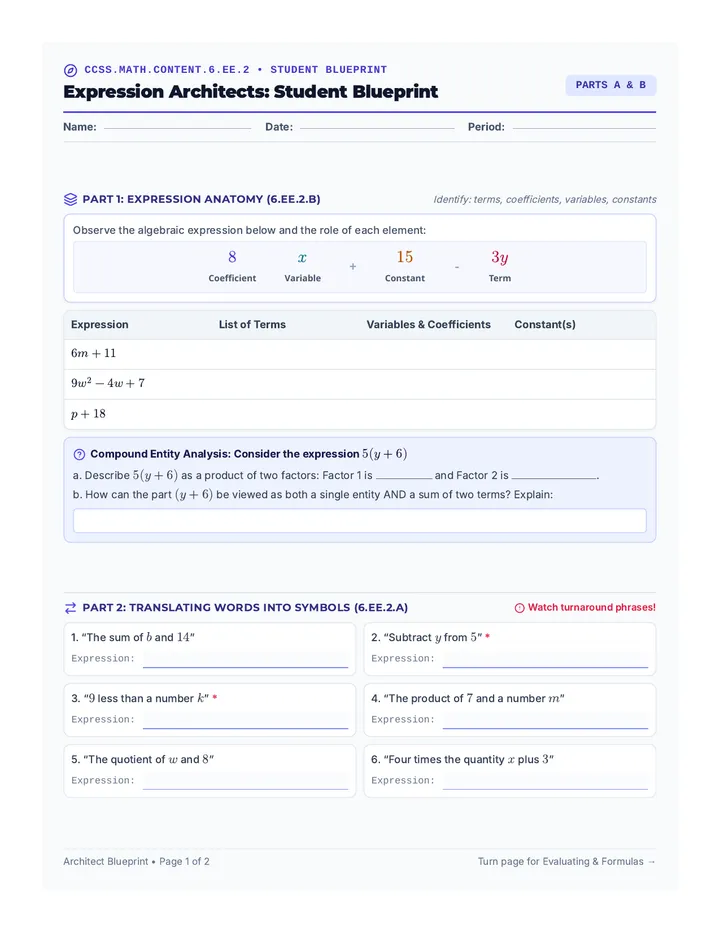
Compound Entity: An expression grouped in parentheses treated as a single quantity (e.g., in \(2(8+7)\), \((8+7)\) is both a single factor and a sum).
Expression Architects • Teacher Guide (Page 1 of 2) See Page 2 for Misconceptions, Differentiation & Assessment →
Pedagogical Support & Troubleshooting
CCSS.MATH.CONTENT.6.EE.2
Top Misconceptions & How to Address Them
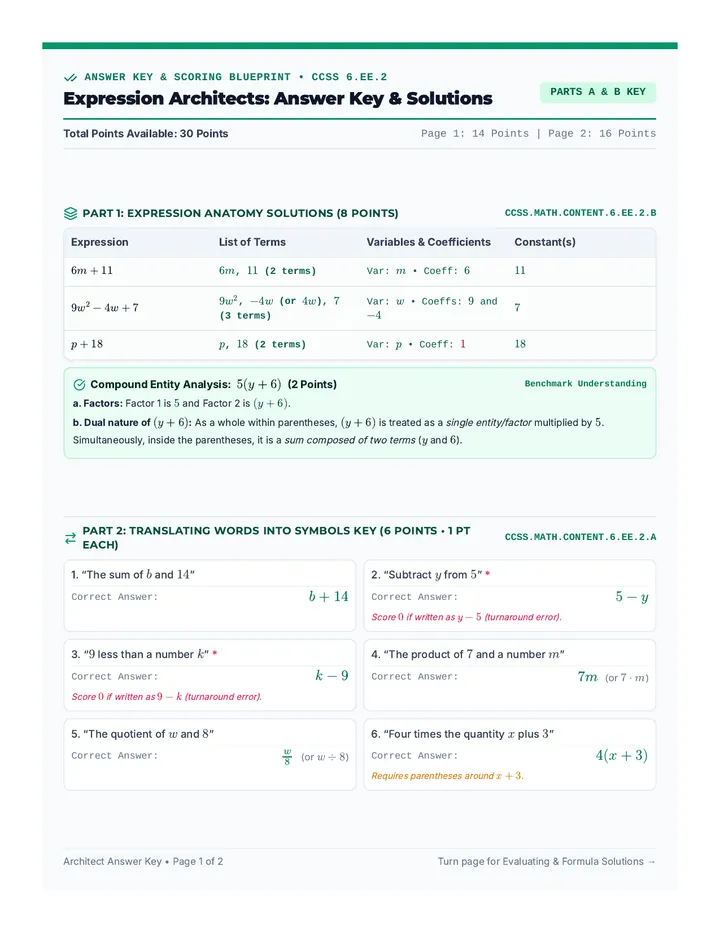
1. Turnaround Inversion: “Subtract \(y\) from \(5\)” written as \(y - 5\) Standard 6.EE.2.A
Root Cause: Students read English left-to-right and transliterate words directly into symbols. Remedy Question: “If I say, ‘Take \(\$2\) from \(\$10\),’ which amount did you have first?” Students immediately see \(10 - 2\). Then substitute the letter: “Take \(y\) from \(5\) means start with \(5\) and take away \(y\) \((5 - y)\).”
2. Exponent vs. Multiplier: Calculating \(3x^2\) when \(x = 5\) as \((3 \times 5)^2 = 225\) Standard 6.EE.2.C
Root Cause: Students do not realize the exponent attaches only to its immediate base unless grouped by parentheses. Remedy Question: “Whose exponent is it? Only \(x\) is wearing the exponent hat! Evaluate the power first: \(5^2 = 25\), then multiply by the coefficient \(3 \times 25 = 75\). Contrast with \((3x)^2\).”
3. Invisible Coefficient of \(1\) (e.g., in \(p + 18\), stating coefficient is \(0\)) Standard 6.EE.2.B
Root Cause: If students don't see a number in front of the letter, they assume there is none (or zero). Remedy Question: “How many \(p\)’s are standing there? There is \(1\) of them! If the coefficient were \(0\), \(0 \times p\) would vanish completely.”
Tiered Differentiation Framework
Support / Striving
Provide highlighters to color-code variables in yellow, coefficients in blue, and constants in pink. Provide a physical PEMDAS step card for evaluating expressions.
English Learners (EL)
Display a four-operation bilingual anchor chart with trigger words (“sum”, “difference”, “product”, “quotient”, “less than”). Pair with graphic arrows.
Extension / Advanced
Ask students to write their own real-world scenario formula (e.g., cellphone plan, taxi fare \(C = 2.50m + 4\)) and challenge them to evaluate with decimal variable values.
On an index card, students answer: 1. Write an expression for “\(6\) less than the product of \(4\) and \(x\)” (Target: \(4x - 6\)). 2. Evaluate \(2w^3\) when \(w = 3\) (Target: \(2 \times 27 = 54\); check if students computed \(6^3 = 216\)).
Part 5: Blueprint Inspector Solution (3 Points) Exemplar Response
Diagnosis of Devon's Error (1.5 pts): Devon multiplied \(3 \times 5 = 15\) before applying the exponent of \(2\). According to the order of operations, exponents must be evaluated before multiplication. The exponent of \(2\) applies only to the base \(x\), not to the coefficient \(3\).