Equation Engineering Facilitator Guide Facilitator Guide
Equation Engineering: Master the Balance
Grade 6
MATH
TEKS Alignment
6.7A-D: Expressions & Properties
6.9A-B: Writing & Solving Equations/Inequalities
6.6A-C: Dependent/Independent Variables & Relationships
6.10A: Modeling and Solving Equations
Instructional Progression
1
Concrete Foundation: Algebra Tiles
Based on Van de Walle's progression, students must first understand the "balance" of an equation using physical or visual models.
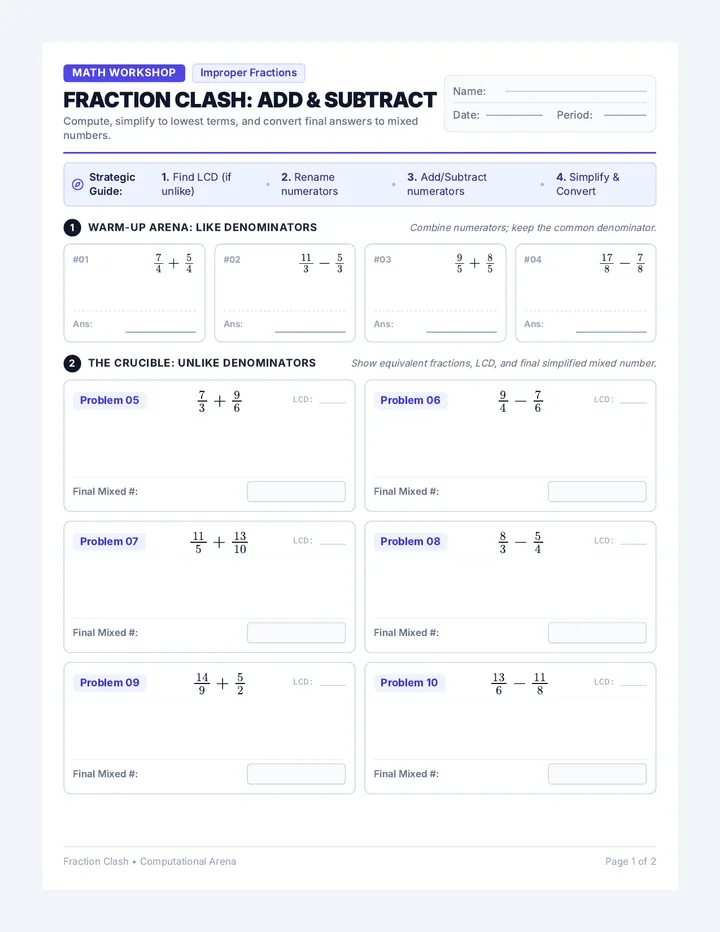
Use the Tile Tools Worksheet to model \(x + 3 = 7\) and \(2x = 8\).
Focus on the "Zero Pair" concept when dealing with subtraction/negative numbers.
2
Representational: Verbal to Algebraic
Bridge the gap between language and symbols.
Use Expression Blueprints for guided practice.
Incorporate the Visual Vocabulary Cards specifically for EL support.
3
Abstract: Solving & Graphing
Connect equations to coordinate planes and inequalities to number lines.
Use Relationship Maps to identify independent and dependent variables.
Think-Pair-Share
Prompt:
"If we add 5 to one side of a balanced scale, what must we do to keep it level? How does this relate to the equation \(x - 5 = 10\)? Why wouldn't we subtract 5?"
Think: 1 minute of silent writing/sketching.Pair: Compare "inverse operations" with a partner.Share: Select 3 pairs to explain their "why" to the class.
Error Analysis
The "Forgot-to-Flip" Flaw:
Problem: \(15 < 3x\)
Student Step 1: \(15 / 3 < 3x / 3\)
Student Step 2: \(5 < x\)
Graph: [Student shades to the left of 5]
Discussion: Ask students to test a number in the shaded region (e.g., 2). Does \(15 < 3(2)\)? No. Help them see that \(5 < x\) means \(x\) must be GREATER than 5.
Scaffolded EL Support
Cognates
Expression → Expresión
Equation → Ecuación
Variable → Variable
Sentence Stems
"I chose the operation ______ because the verbal phrase said ______."
Visuals
Use the Visual Vocabulary Cards to match symbols (+, -, ×, ÷) to situational drawings.
Equation Visual Vocabulary Cards Visual Vocabulary
Equation Engineering Support Tools
Lesson Resource
Math Mechanic
Expression
3x + 5
"No equals sign! A mathematical phrase."
Look for: "more than", "total of", "split by"
Equation
3x + 5 = 20
Balance
Look for: "is", "is equivalent to", "results in"
Variable
x
"The mystery number. It can change!"
Think of it as a container waiting for a value.
Inverse Operation
+ ↔ -
× ↔ ÷
"The Undo Button"
Use these to isolate the variable.
TEKS 6.7A, 6.9A Support Cards
Expression Blueprints Activity Engineer Name
Date
Expression Blueprints
Drafting Algebraic Phrases
The Mechanic's Guide
Algebraic expressions are shorthand for real-world situations. To build a blueprint, identify the variable (the unknown value) and the operation (+, -, ×, ÷).
Addition
Sum, Plus, More Than, Increased By
Subtraction
Difference, Minus, Less Than, Take Away
Multiplication
Product, Times, Of, Per, Each
Division
Quotient, Split, Ratio, Per, Half
Drafting Phase: Translate the Phrase
1. A technician has \(b\) lightbulbs and buys 12 more.
Write an expression for the total number of bulbs.
2. The height of a tower, \(h\), decreased by 45 feet.
3. A factory produces \(g\) gears every hour for 8 hours.
4. 15 less than a number \(n\).
Caution!
Think about which number comes first.
5. A plumber charges a flat fee of $50 plus $35 per hour (\(h\)).
Engineering Checklist:
Did I use a variable?
Did I use the correct operation?
Is there an equals sign? (Wait! Should there be?)
Tile Tools Solving Worksheet Engineer Name
Date
Tile Tools
Concrete to Abstract Solving
Toolbox Legend
x
Variable (x)
+1
Unit (+1)
-1
Negative (-1)
Zero Pairs Rule
When you combine one (+1) and one (-1), they cancel each other out to make zero! Use this to "undo" addition and subtraction.
1. Solve: x + 3 = 8
Inverse: Subtraction
Draw Tiles Here
x
=
Mathematical Blueprint
x + 3 = 8
Subtract 3 from both sides:
x =
2. Solve: 2x = 6
Inverse: Division
Draw Groups Here
=
Mathematical Blueprint
2x = 6
Divide into 2 equal groups:
x =
Engineer's Challenge: x - 4 = 2
You have 4 negative tiles (-). What do you need to add to both sides to "cancel" them out? Hint: Use Zero Pairs !
Relationship Maps Worksheet Engineer Name
Date
Relationship Maps
Input, Output, and Graphs
Independent Variable (\(x\))
The Input . It's the "Cause." It changes freely.
Example: Number of hours worked.
Dependent Variable (\(y\))
The Output . It's the "Effect." It depends on the input.
Example: Amount of money earned.
The Project Scenario
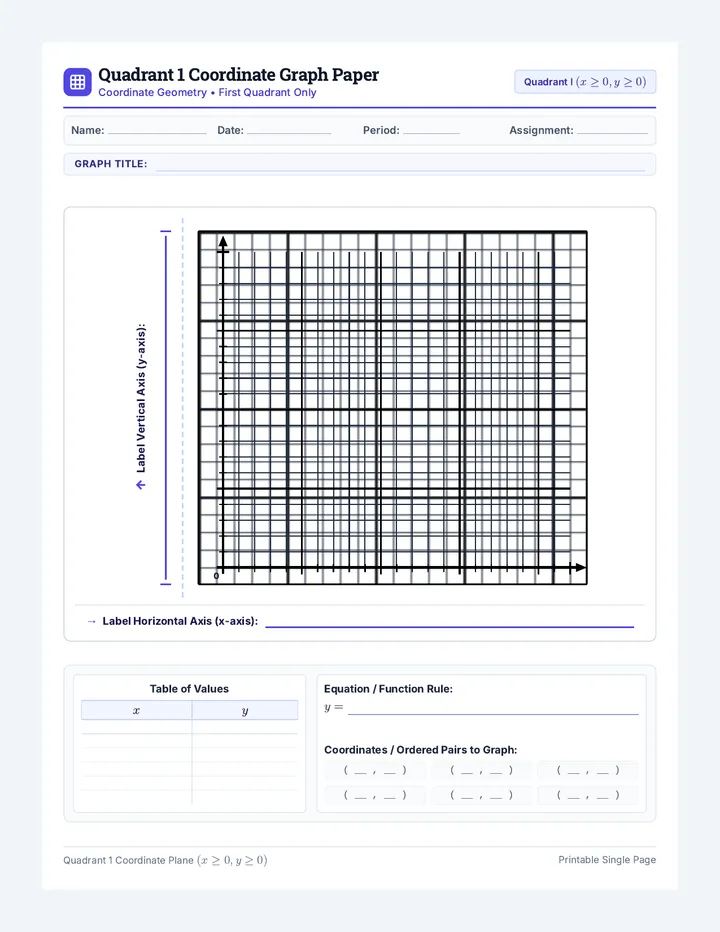
A car repair shop charges a flat diagnostic fee of $20 plus $10 for every hour (\(x\)) they work on the car. The total cost (\(y\)) is calculated by the equation: y = 10x + 20
Part A: Data Table
Hours worked (\(x\)) Total Cost (\(y\)) 1 2 3 4
Part B: Relationship Graph
Independent Variable (x)
Dependent Variable (y)
0
Engineering Analysis
1. Looking at your graph, does the line start at zero? Why or why not?
2. If the technician works 0 hours, how much is the bill? How does this connect to the equation?
STAAR Challenge Assessment The STAAR Challenge
Reporting Category 2: Computations & Algebraic Relationships
Assessment 6.2
10 Problems
Name
Date
1 Which expression represents the phrase "8 less than the product of 5 and a number \(n\)"?
A. \(8 - 5n\)
B. \(5n - 8\)
C. \(5(n - 8)\)
D. \(5 + n - 8\)
2 A plumber charges a $40 service fee plus $25 per hour of work. Which equation can be used to find \(c\), the total cost of a repair that takes \(h\) hours?
F. \(c = 40h + 25\)
G. \(c = 65h\)
H. \(c = 25h + 40\)
J. \(c = 25(h + 40)\)
3 What value of \(x\) makes the following equation true? \[x + 14.5 = 28.2\]
A. 42.7
B. 13.7
C. 14.3
D. 13.3
4 Which number line represents the solution to the inequality \(x - 4 > 2\)?
F.
6
G.
6
5 Which property of operations is shown below? \[3(x + 5) = 3x + 15\]
A. Commutative Property
B. Associative Property
C. Distributive Property
D. Identity Property
The STAAR Challenge
Part 2
6 Which table represents the relationship \(y = 3x\)?
F
G
7 In the equation \(y = 0.5x\), which statement is true?
A. \(x\) is the dependent variable because it depends on \(y\).
B. \(y\) is the independent variable because it is being multiplied.
C. \(y\) is the dependent variable because its value depends on the value of \(x\).
D. Both \(x\) and \(y\) are independent variables.
8 What is the prime factorization of 120?
F. \(2^3 \cdot 3 \cdot 5\)
G. \(2^2 \cdot 3 \cdot 10\)
H. \(4 \cdot 6 \cdot 5\)
J. \(2^4 \cdot 3 \cdot 5\)
9 An equation is modeled below. What is the value of \(x\)? \[4x = 24\]
A. 20
B. 28
C. 6
D. 96
STAAR Challenge Answer Key Teacher Key
The STAAR Challenge: Answer Explanations
Confidential
Item Key TEKS Conceptual Rationale 1 B 6.7C "Less than" is a turnaround phrase. 8 is subtracted FROM the product. 2 H 6.9A $25 is the rate (coefficient), $40 is the initial fee (constant). 3 B 6.10A Inverse of addition: \(28.2 - 14.5 = 13.7\). 4 F 6.9B Solve: \(x > 6\). Open circle (greater than, not equal) at 6, shade right. 5 C 6.7D The number 3 is distributed to both terms inside the parentheses. 6 F 6.6C Multiplicative relationship: \(1 \times 3 = 3\) and \(2 \times 3 = 6\). 7 C 6.6A \(y\) is the output; it is determined by what \(x\) happens to be. 8 F 6.7A \(2 \times 2 \times 2 \times 3 \times 5 = 8 \times 15 = 120\). 9 C 6.10A Inverse of multiplication: \(24 \div 4 = 6\). 10 F 6.7A GEMDAS: \((10) \div 2 = 5\). Then \(2^3 = 8\). Sum: \(8 + 5 = 13\).
Common Misconceptions
Item 1: Students often choose A (\(8 - 5n\)) because they translate directly left-to-right. Emphasize that "8 less than" means starting with something and subtracting 8.Item 4: Watch for students choosing G (closed circle). Remind them that ">" means "more than" but does NOT include the number itself.Item 10: Students may multiply \(2 \times 3\) instead of doing \(2 \times 2 \times 2\). Check for exponent understanding. Equation Engineering Slides MATH MECHANICS
Equation
Engineering
Mastering Expressions, Equations, and Relationships
TEKS 6.6-6.9 Grade 6 Math
The Balance Rule
"If we add 5 bricks to one side of a balanced scale, what MUST we do to keep it level?"
1
Think silently for 30s.
2
Pair with a neighbor.
The Blueprint Language
Expression
A mathematical phrase.
3x + 12
"No equal sign!"
Equation
A statement that two expressions are equal.
3x + 12 = 30
"The scale is balanced."
Visualizing x + 3 = 7
x
1
1
1
=
To isolate x, we must subtract 3 from BOTH sides!
Who's the Boss?
Independent (x)
The CAUSE . You choose this value.
Example: How many pizzas you buy.
Dependent (y)
The EFFECT . It depends on \(x\).
Example: The total price you pay.