Denominator Detectives Worksheet
DENOMINATOR DETECTIVES
Mission File: Finding the Least Common Denominator (LCD)
Part 1 of 2
Agent Name:
Date:
Score: / 10
Detective Protocol: The Least Common Denominator (LCD) is the smallest positive number that is a common multiple of the given denominators. List multiples or use prime factors to crack each case!
Tier 1
Multiple Matches (One divides into the other)
Problems 1–3
Case #01
\(\frac{1}{2}\) and \(\frac{3}{4}\)
Show Multiples / Scratch Work:
LCD
Case #02
\(\frac{2}{3}\) and \(\frac{5}{6}\)
Show Multiples / Scratch Work:
LCD
Case #03
\(\frac{3}{5}\) and \(\frac{7}{10}\)
Show Multiples / Scratch Work:
LCD
Tier 2
Co-Prime Denominators (No shared common factors)
Problems 4–5
Case #04
\(\frac{1}{4}\) and \(\frac{2}{5}\)
Show Multiples / Scratch Work:
LCD
Case #05
\(\frac{2}{7}\) and \(\frac{1}{3}\)
Show Multiples / Scratch Work:
LCD
Investigate carefully: Write out the first 4–5 multiples if you get stuck. Turn page for Tier 3 & Master Challenge →
DENOMINATOR DETECTIVES
Part 2: Shared Factors & Multi-Fraction Cases
Agent:
Part 2 of 2
Advanced Clue: When numbers share a common factor (like 6 and 8 sharing 2), multiplying them directly (\(6 \times 8 = 48\)) gives a common denominator, but not the smallest one! Test their multiples to find the true LCD.
Tier 3
Composite Pairs (Shared factors present)
Problems 6–8
Case #06
\(\frac{1}{6}\) and \(\frac{3}{8}\)
Show Multiples / Scratch Work:
LCD
Case #07
\(\frac{5}{12}\) and \(\frac{7}{15}\)
Show Multiples / Scratch Work:
LCD
Case #08
\(\frac{7}{10}\) and \(\frac{4}{25}\)
Show Multiples / Scratch Work:
LCD
Tier 4
Master Detective Challenge
Problems 9–10
Case #09
\(\frac{5}{12}\) and \(\frac{7}{18}\)
Show Multiples / Scratch Work:
LCD
Case #10 (Triple)
\(\frac{1}{4}\), \(\frac{5}{6}\), and \(\frac{3}{8}\)
Show Multiples / Scratch Work:
LCD
Case Debrief: Strategy Deduction
When two denominators share no common factors (like \(4\) and \(5\)), how can you quickly discover their LCD without listing every multiple?
Self-Check: Can each original denominator divide evenly into your LCD with zero remainder? Completed Case File
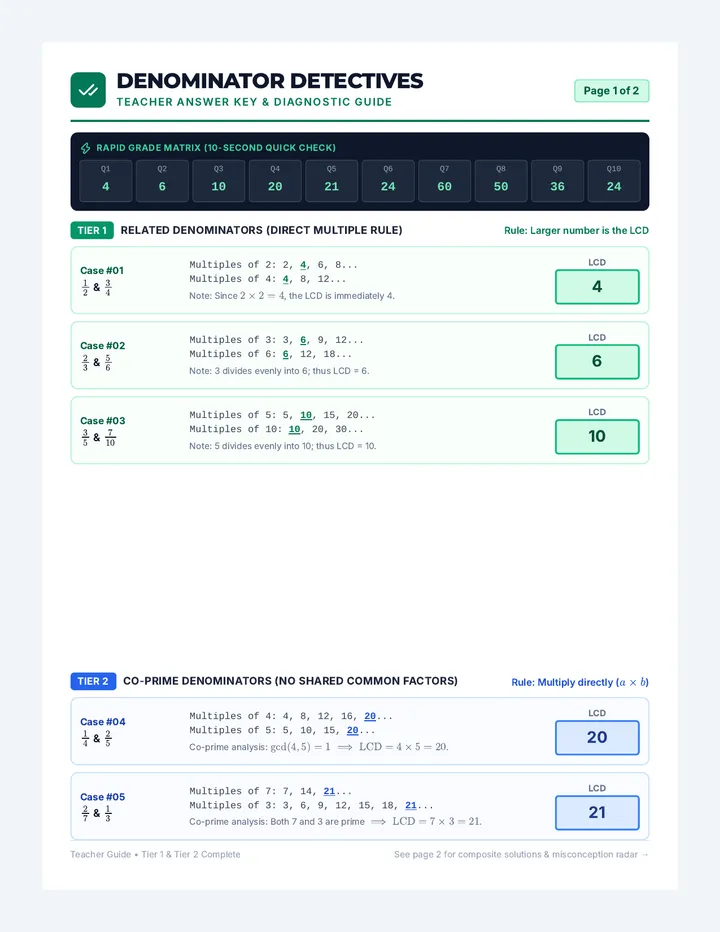
Denominator Detectives Answer Key
DENOMINATOR DETECTIVES
Teacher Answer Key & Diagnostic Guide
Page 1 of 2
Rapid Grade Matrix (10-Second Quick Check)
Q14
Q26
Q310
Q420
Q521
Q624
Q760
Q850
Q936
Q1024
Tier 1
Related Denominators (Direct Multiple Rule)
Rule: Larger number is the LCD
Case #01
\(\frac{1}{2}\) & \(\frac{3}{4}\)
Multiples of 2: 2, 4, 6, 8...
Multiples of 4: 4, 8, 12...
Note: Since \(2 \times 2 = 4\), the LCD is immediately 4.
LCD
4
Case #02
\(\frac{2}{3}\) & \(\frac{5}{6}\)
Multiples of 3: 3, 6, 9, 12...
Multiples of 6: 6, 12, 18...
Note: 3 divides evenly into 6; thus LCD = 6.
LCD
6
Case #03
\(\frac{3}{5}\) & \(\frac{7}{10}\)
Multiples of 5: 5, 10, 15, 20...
Multiples of 10: 10, 20, 30...
Note: 5 divides evenly into 10; thus LCD = 10.
LCD
10
Tier 2
Co-Prime Denominators (No shared common factors)
Rule: Multiply directly (\(a \times b\))
Case #04
\(\frac{1}{4}\) & \(\frac{2}{5}\)
Multiples of 4: 4, 8, 12, 16, 20...
Multiples of 5: 5, 10, 15, 20...
Co-prime analysis: \(\gcd(4, 5) = 1 \implies \text{LCD} = 4 \times 5 = 20\).
LCD
20
Case #05
\(\frac{2}{7}\) & \(\frac{1}{3}\)
Multiples of 7: 7, 14, 21...
Multiples of 3: 3, 6, 9, 12, 15, 18, 21...
Co-prime analysis: Both 7 and 3 are prime \(\implies \text{LCD} = 7 \times 3 = 21\).
LCD
21
Teacher Guide • Tier 1 & Tier 2 Complete See page 2 for composite solutions & misconception radar →
DENOMINATOR DETECTIVES
Solutions & Strategy: Composite Pairs & Triplets
Page 2 of 2
Tier 3
Composite Pairs (Shared factors present)
Trap Alert: Product is too large