Division Scaffolding Teacher GuideGrade 3 Math • Lesson 10 Scaffolding Understand the Meaning of Division Teacher Facilitation, Concrete Modeling Steps & Gradual Release Architecture Tier 1 & Tier 2 Ready Sessions 1 • 2 • 3 Core Conceptual Shift: The Two Meanings of Division 1. Equal Sharing (Partitive): Total ÷ Known Groups = Size of each group. (e.g., 8 slices shared equally onto 2 plates → 4 per plate). 2. Equal Grouping (Quotative / Measurement): Total ÷ Known Size = Number of groups. (e.g., 10 slices packed 2 per plate → 5 plates). SESSION 1 Explore: Modeling Equal Sharing vs. Equal Grouping Textbook pp. 227–230 1 I DO: Concrete Sharing Place 8 physical counters (or yellow tiles) under a document camera. Draw 2 large circles ("plates"). Say: "Watch me deal them one-by-one like playing cards until all 8 are gone. Both plates have exactly 4. That is 8 ÷ 2 = 4." 2 WE DO: Equal Grouping Give pairs 10 counters. Say: "Serwa puts 2 on each plate. Take 2 and make a plate. Take another 2. Keep going! How many plates did we make? 5 plates! Equation: 10 ÷ 2 = 5." Have students trace the difference. 3 YOU DO: Grape Leaves Students solve 12 grape leaves in groups of 4 independently. Prompt them to circle groups of 4 before counting how many plates were formed. Write: 12 ÷ 4 = 3 with labeled sentence frames. Teacher Talk Moves & Scaffolded Prompts • Clarifying the Total: "What number represents everything we start with? Why must 8 (or 10) come first in our division equation?" • Discourse Prompt (p. 227): "How do you know both plates got an equal share? What would happen if one plate had 5 and one had 3?" • Sentence Frame for ELLs: "I divided [total] into [groups] equal groups. There are [quotient] in each group." Session 1 Common Misconception: Reversing the Equation Students may write \(2 \div 8 = 4\) or \(4 \div 8 = 2\) because they recall that in subtraction larger numbers sometimes move, or they confuse factor order. Scaffold: Enforce the visual anchor: "Total Objects First ÷ How We Split = What We Get." Frayer Model Scaffold (p. 229: Prepare for Division) Vocabulary Anchor Kid Definition To separate a whole amount into fair, equal-sized piles or groups. Illustration 3 circled bags with 4 dots in each bag (12 dots total). Real Example \(12 \div 3 = 4\) (12 cookies shared by 3 kids = 4 each). Non-Example 12 cookies split into 5, 4, and 3 (NOT equal groups!). Lesson 10 Scaffolded Teacher Guide • Sessions 1–3 Page 1 of 2 Grade 3 Math • Lesson 10 Scaffolding Sessions 2 & 3: Models & Refinement Array Representations, Guided Error Analysis, and Word Problem Architecture Multi-Model Fluency Arrays • Equations • Stories SESSION 2 Develop: Connecting Equal Groups to Arrays Textbook pp. 231–234 Leon's Oranges Comparison (p. 231) — Highlight Dual Meanings Problem 1: 24 Oranges ÷ 6 in each bag Equation: \(24 \div 6 = 4\) bags. The 6 tells the group size; the 4 is the number of bags. Problem 2: 24 Oranges ÷ 6 bags Equation: \(24 \div 6 = 4\) oranges in each bag. The 6 tells the number of bags; the 4 is the group size. → Teacher Ask: "Look at both answers: 4 bags vs. 4 oranges. How can 24 ÷ 6 equal 4 in both situations?" Array Protocol: \(20 \div 5 = 4\) Model Way A: 5 rows with 4 in each row. Model Way B: 4 rows with 5 in each row. Scaffold tip: Use grid paper or array stamps so rows and columns stay aligned. Mato's Mistake Analysis (p. 234, #6) Array shows 18 rectangles arranged as 3 rows of 6. Mato claims it shows \(6 \div 3\). Prompt: "What is the total number of tiles? Where must the total be written in a division equation?" Correct: \(18 \div 3 = 6\) or \(18 \div 6 = 3\). SESSION 3 Refine: Error Analysis, Story Problems & Generalization Textbook pp. 235–236 Yuko's Star Array (p. 235, #1) Yuko drew 8 rows with 4 stars in each row (32 total stars!) instead of an array of 8 stars total divided by 4 (which is 2 rows of 4 or 4 rows of 2). Scaffold Prompt: "Did Yuko start with 8 stars, or did she make 8 groups of 4?" Story Problem Builder: \(16 \div 2 = 8\) Provide a structured 3-part sentence starter: 1. Total: "There are 16 [items]." 2. Action: "They are shared equally by 2 [people/bags]." 3. Question: "How many [items] does each get?" Math Journal Synthesis (p. 236, #5): \(45 \div 9 = 5\) Interpretation 1: 45 counters split into 9 equal groups → 5 in each group (9 = number of groups). Interpretation 2: 45 counters placed into groups of 9 → 5 equal groups (9 = size of each group). Formative Checkpoints & Tier 2 Quick Interventions If student counts all... And forgets group boundaries, provide tactile sorting mats or physical cupcake tins to physically separate objects. If student confuses × and ÷... Highlight that division unpacks the total into equal parts, whereas multiplication combines equal parts into a total. If language barriers occur... Pair gestures: two hands sweeping inward for "Total", hands karate-chopping or dealing into circles for "Divide into equal groups". Lesson 10 Scaffolded Teacher Guide • Sessions 1–3 Page 2 of 2
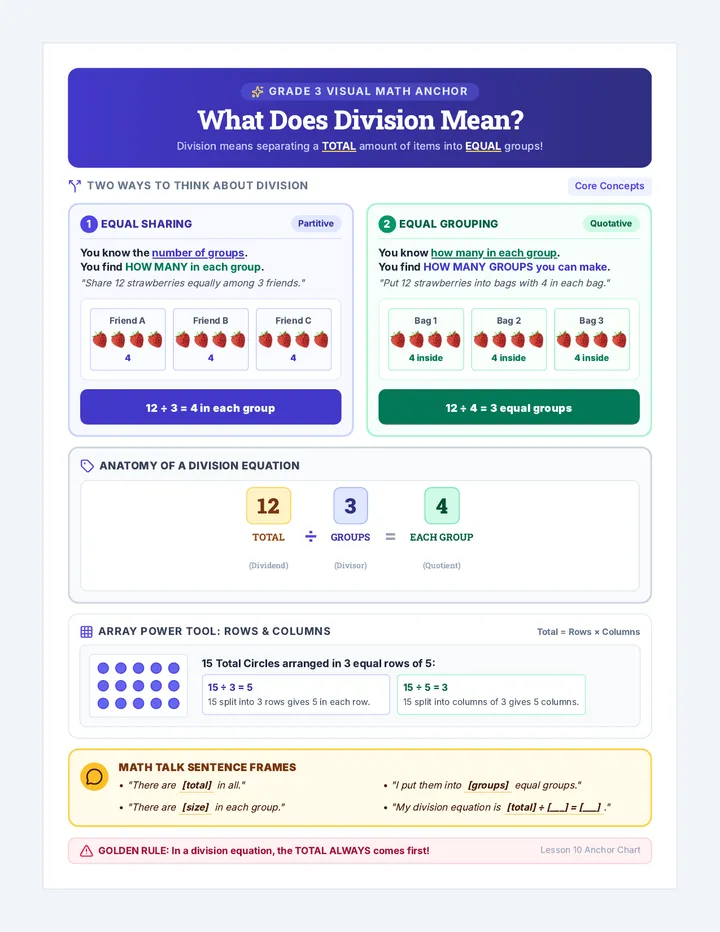
Division Meaning Anchor ChartGrade 3 Visual Math Anchor What Does Division Mean? Division means separating a TOTAL amount of items into EQUAL groups! Two Ways to Think About Division Core Concepts 1 Equal Sharing Partitive You know the number of groups. You find HOW MANY in each group. "Share 12 strawberries equally among 3 friends." Friend A 🍓🍓🍓🍓 4 Friend B 🍓🍓🍓🍓 4 Friend C 🍓🍓🍓🍓 4 12 ÷ 3 = 4 in each group 2 Equal Grouping Quotative You know how many in each group. You find HOW MANY GROUPS you can make. "Put 12 strawberries into bags with 4 in each bag." Bag 1 🍓🍓🍓🍓 4 inside Bag 2 🍓🍓🍓🍓 4 inside Bag 3 🍓🍓🍓🍓 4 inside 12 ÷ 4 = 3 equal groups Anatomy of a Division Equation 12 TOTAL (Dividend) ÷ 3 GROUPS (Divisor) = 4 EACH GROUP (Quotient) Array Power Tool: Rows & Columns Total = Rows × Columns 15 Total Circles arranged in 3 equal rows of 5: 15 ÷ 3 = 5 15 split into 3 rows gives 5 in each row. 15 ÷ 5 = 3 15 split into columns of 3 gives 5 columns. Math Talk Sentence Frames • "There are [total] in all." • "I put them into [groups] equal groups." • "There are [size] in each group." • "My division equation is [total] ÷ [___] = [___]." GOLDEN RULE: In a division equation, the TOTAL ALWAYS comes first! Lesson 10 Anchor Chart
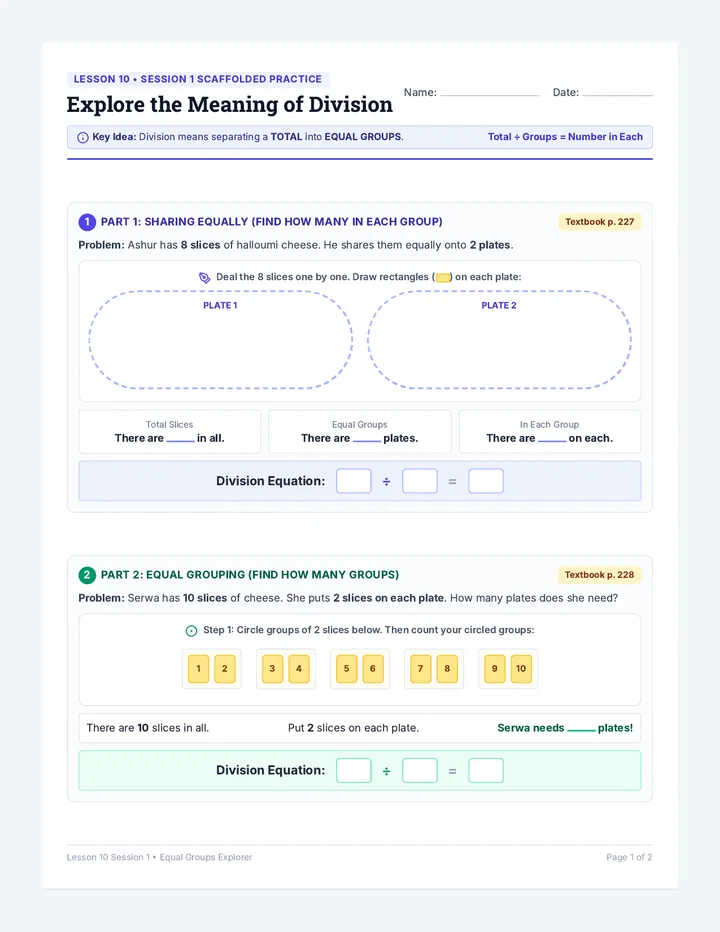
Equal Groups Explorer WorksheetLesson 10 • Session 1 Scaffolded Practice Explore the Meaning of Division Name: Date: Key Idea: Division means separating a TOTAL into EQUAL GROUPS. Total ÷ Groups = Number in Each 1 Part 1: Sharing Equally (Find How Many in Each Group) Textbook p. 227 Problem: Ashur has 8 slices of halloumi cheese. He shares them equally onto 2 plates. Deal the 8 slices one by one. Draw rectangles () on each plate: Plate 1 Plate 2 Total Slices There are in all. Equal Groups There are plates. In Each Group There are on each. Division Equation: ÷ = 2 Part 2: Equal Grouping (Find How Many Groups) Textbook p. 228 Problem: Serwa has 10 slices of cheese. She puts 2 slices on each plate. How many plates does she need? Step 1: Circle groups of 2 slices below. Then count your circled groups: 1 2 3 4 5 6 7 8 9 10 There are 10 slices in all. Put 2 slices on each plate. Serwa needs plates! Division Equation: ÷ = Lesson 10 Session 1 • Equal Groups Explorer Page 1 of 2 Lesson 10 • Session 1 Scaffolded Practice Vocabulary & Independent Application Textbook pp. 229–230 Concept Map: What is "DIVIDE"? Fill in the 4 boxes below 1. My Definition (in your own words): To divide means to separate a total into... 2. My Illustration (Draw equal groups): Draw 12 dots divided into 3 equal circles: 3. Real Example (Equal groups): 6 cookies shared equally between 2 kids: 6 ÷ 2 = cookies each 4. Non-Example (NOT equal groups): Why is this NOT division? "Group A has 4, but Group B has 2." → Groups must be EQUAL! 3 Savanna's Stuffed Grape Leaves (Textbook p. 230) Solve & Explain Savanna makes 12 stuffed grape leaves. She puts 4 grape leaves on each plate. How many plates will she need? Step 1: Draw plates with 4 grape leaves on each plate until you reach 12: Step 2: Sentence frames There are leaves in all. There are leaves on each plate. Savanna needs plates. Division Equation: ÷ = Session 1 Reflection (p. 228, #7): Finding the number of groups and finding the number in each group are both division because in both problems, the total is split into groups! Lesson 10 Session 1 • Equal Groups Explorer Page 2 of 2
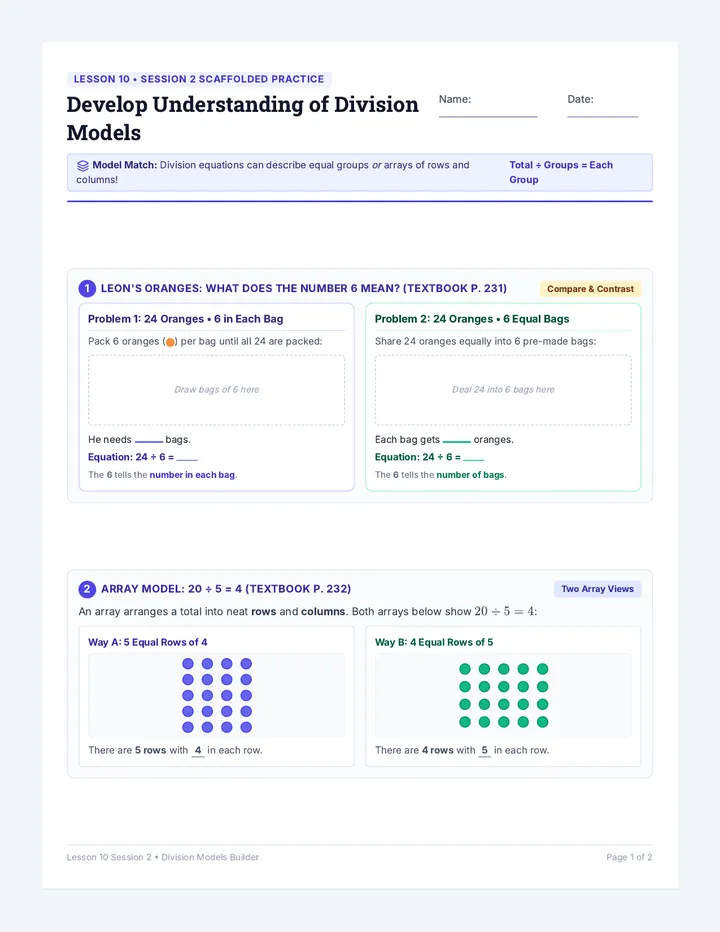
Division Models Builder WorksheetLesson 10 • Session 2 Scaffolded Practice Develop Understanding of Division Models Name: Date: Model Match: Division equations can describe equal groups or arrays of rows and columns! Total ÷ Groups = Each Group 1 Leon's Oranges: What Does the Number 6 Mean? (Textbook p. 231) Compare & Contrast Problem 1: 24 Oranges • 6 in Each Bag Pack 6 oranges () per bag until all 24 are packed: Draw bags of 6 here He needs bags. Equation: 24 ÷ 6 = The 6 tells the number in each bag. Problem 2: 24 Oranges • 6 Equal Bags Share 24 oranges equally into 6 pre-made bags: Deal 24 into 6 bags here Each bag gets oranges. Equation: 24 ÷ 6 = The 6 tells the number of bags. 2 Array Model: 20 ÷ 5 = 4 (Textbook p. 232) Two Array Views An array arranges a total into neat rows and columns. Both arrays below show \(20 \div 5 = 4\): Way A: 5 Equal Rows of 4 There are 5 rows with 4 in each row. Way B: 4 Equal Rows of 5 There are 4 rows with 5 in each row. Lesson 10 Session 2 • Division Models Builder Page 1 of 2 Lesson 10 • Session 2 Scaffolded Practice Model Practice & Error Analysis Textbook pp. 233–234 3 Frogs on Logs (Textbook p. 233, #1–4) Read the visual model 🐸 🐸 Log 1 🐸 🐸 Log 2 🐸 🐸 Log 3 🐸 🐸 Log 4 Frogs in all: frogs Number of logs: logs Frogs on each: frogs Equation: 8 ÷ 4 = Error Detective: What is Mato's Mistake? (Textbook p. 234, #6) Critical Thinking 3 rows of 6 Mato says: "This array shows the division problem 6 ÷ 3." What Mato Did Wrong: He used the row and column numbers (6 and 3) instead of starting with the TOTAL of 18 rectangles! Correct Equation: 18 ÷ 3 = 6 (or 18 ÷ 6 = 3) Explain Mato's mistake in your own words: Mato's mistake is that he forgot division always starts with the . The total number of tiles is , not 6. 4 Story Builder: Write a Word Problem for 30 ÷ 5 = 6 (p. 234, #7) Sentence Frame Fill in the blanks to complete your division story problem: 1. Total: A teacher has 30 (stickers, markers, or apples). 2. Action: She divides them equally among 5 (students or baskets). 3. Question: How many does each get? Answer: Each gets 6 because \(30 \div 5 = 6\). Lesson 10 Session 2 • Division Models Builder Page 2 of 2
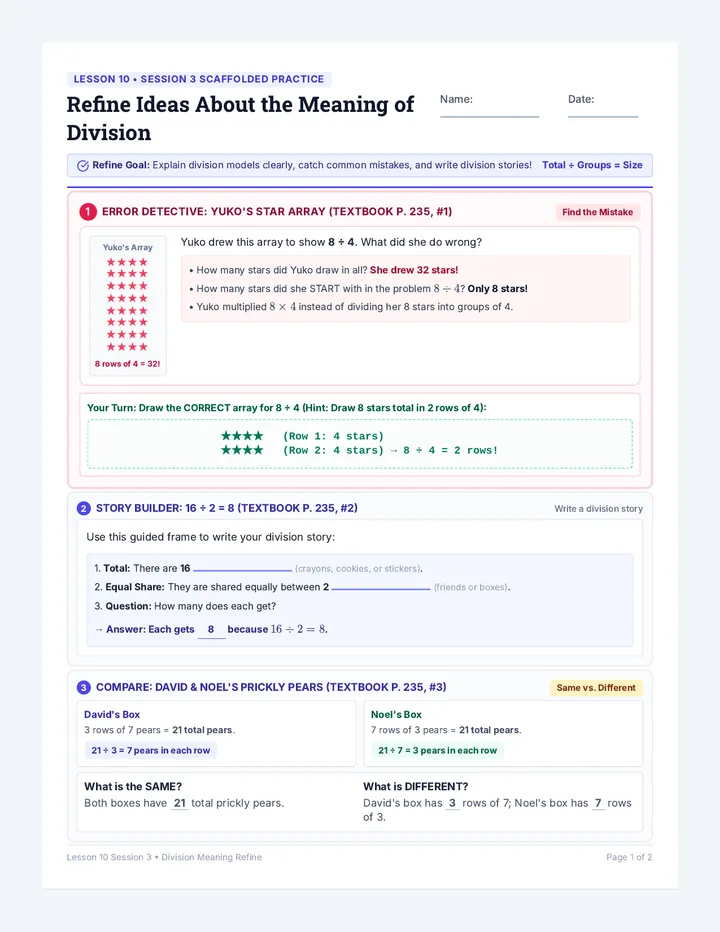
Division Meaning Refine WorksheetLesson 10 • Session 3 Scaffolded Practice Refine Ideas About the Meaning of Division Name: Date: Refine Goal: Explain division models clearly, catch common mistakes, and write division stories! Total ÷ Groups = Size 1 Error Detective: Yuko's Star Array (Textbook p. 235, #1) Find the Mistake Yuko's Array ★★★★ ★★★★ ★★★★ ★★★★ ★★★★ ★★★★ ★★★★ ★★★★ 8 rows of 4 = 32! Yuko drew this array to show 8 ÷ 4. What did she do wrong? • How many stars did Yuko draw in all? She drew 32 stars! • How many stars did she START with in the problem \(8 \div 4\)? Only 8 stars! • Yuko multiplied \(8 \times 4\) instead of dividing her 8 stars into groups of 4. Your Turn: Draw the CORRECT array for 8 ÷ 4 (Hint: Draw 8 stars total in 2 rows of 4): ★★★★ (Row 1: 4 stars) ★★★★ (Row 2: 4 stars) → 8 ÷ 4 = 2 rows! 2 Story Builder: 16 ÷ 2 = 8 (Textbook p. 235, #2) Write a division story Use this guided frame to write your division story: 1. Total: There are 16 (crayons, cookies, or stickers). 2. Equal Share: They are shared equally between 2 (friends or boxes). 3. Question: How many does each get? → Answer: Each gets 8 because \(16 \div 2 = 8\). 3 Compare: David & Noel's Prickly Pears (Textbook p. 235, #3) Same vs. Different David's Box 3 rows of 7 pears = 21 total pears. 21 ÷ 3 = 7 pears in each row Noel's Box 7 rows of 3 pears = 21 total pears. 21 ÷ 7 = 3 pears in each row What is the SAME? Both boxes have 21 total prickly pears. What is DIFFERENT? David's box has 3 rows of 7; Noel's box has 7 rows of 3. Lesson 10 Session 3 • Division Meaning Refine Page 1 of 2 Lesson 10 • Session 3 Scaffolded Practice Application & Formative Check Textbook p. 236 4 Imani's Almonds (Textbook p. 236, #4) Two-Part Task Imani picks 20 almonds. She wants to give the same number of almonds to each of her 4 friends. Part A: Draw 4 groups or an array for 20 almonds: Draw 4 plates or 4 rows of almonds Each friend receives: almonds. Part B: Write the Division Equation: ÷ = • 20 is the total almonds. • 4 is the number of friends. • The answer tells how many each friend gets. Math Journal: Two Meanings of \(45 \div 9 = 5\) (Textbook p. 236, #5) Deep Concept Describe two different ways to model \(45 \div 9 = 5\). How does 9 mean something different in each? Way 1: 9 is the Number of Groups 45 counters are shared equally into 9 groups. Each group has 5 counters. Way 2: 9 is the Number in Each Group 45 counters are put into groups with 9 in each group. You can make 5 groups. Lesson 10 Formative Quick Check Check for Understanding 1 Which number ALWAYS comes first in a division equation? A. The smallest number B. The total amount of objects C. The number of groups 2 Coach Diaz divides 18 soccer balls equally into 3 mesh bags. Which equation matches? A. \(18 \times 3 = 54\) B. \(18 - 3 = 15\) C. \(18 \div 3 = 6\) 3 How confident do you feel explaining division to a partner? 🙂 Super Confident! 😐 Need A Little Help 🤔 Still Confused Lesson 10 Session 3 • Division Meaning Refine Page 2 of 2