Thanksgiving Feast Project Pack 🦃 Thanksgiving Math Market
Name:
Date:
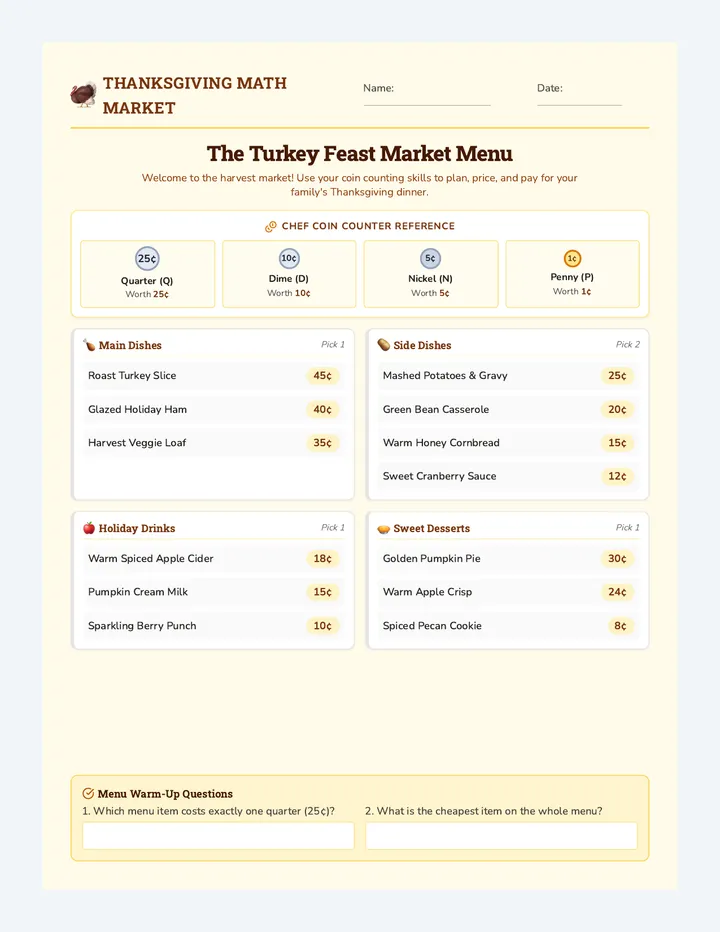
The Turkey Feast Market Menu
Welcome to the harvest market! Use your coin counting skills to plan, price, and pay for your family's Thanksgiving dinner.
Chef Coin Counter Reference
25¢
Quarter (Q)
Worth 25¢
10¢
Dime (D)
Worth 10¢
5¢
Nickel (N)
Worth 5¢
1¢
Penny (P)
Worth 1¢
🍗 Main Dishes Pick 1
Roast Turkey Slice 45¢
Glazed Holiday Ham 40¢
Harvest Veggie Loaf 35¢
🥔 Side Dishes Pick 2
Mashed Potatoes & Gravy 25¢
Green Bean Casserole 20¢
Warm Honey Cornbread 15¢
Sweet Cranberry Sauce 12¢
🍎 Holiday Drinks Pick 1
Warm Spiced Apple Cider 18¢
Pumpkin Cream Milk 15¢
Sparkling Berry Punch 10¢
🥧 Sweet Desserts Pick 1
Golden Pumpkin Pie 30¢
Warm Apple Crisp 24¢
Spiced Pecan Cookie 8¢
Menu Warm-Up Questions
1. Which menu item costs exactly one quarter (25¢)?
2. What is the cheapest item on the whole menu?
Step 1: Meal Plan & Payment
Build Your Thanksgiving Feast Plate
Name:
Instructions: Choose your items from the Menu on Page 1. Write the dish name and price. In the box, draw the coins you would hand the cashier to pay with exact change! Use circles with coin values: (25) (10) (5) (1)
1. Main Dish Item:
Cost:
¢
Draw exact coins to pay for this main dish:
2. Side Dish #1 Item:
Cost:
¢
Draw exact coins to pay for this side dish:
3. Side Dish #2 Item:
Cost:
¢
Draw exact coins to pay for this side dish:
4. Holiday Drink Item:
Cost:
¢
Draw exact coins to pay for your drink:
5. Sweet Dessert Item:
Cost:
¢
Draw exact coins to pay for your dessert:
Feast Coin Tally Count all the coins you drew above:
Quarters:
Dimes:
Nickels:
Pennies:
Step 2: Market Math
Cash Register Coin Challenges
Name:
1
Two Different Ways to Pay for Pumpkin Pie!
Golden Pumpkin Pie costs 30¢. Show two completely different groups of coins that both equal 30¢!
Way A (Using a Quarter):
Coins used:
Way B (Using Dimes or Nickels):
Coins used:
2
Customer Register Check
Count each shopper's coins. Write their total value. Then check the menu on Page 1 to name an item they can buy!
Shopper Maya has:
25¢ 10¢ 10¢ 5¢
Total: ¢
Can buy:
Shopper Leo has:
10¢ 5¢ 5¢ 1¢ 1¢
Total: ¢
Can buy:
3
Coin Comparison Showdown
Sam bought Warm Cornbread (15¢). Emma bought Sweet Cranberry Sauce (12¢).
Sam's Payment (15¢):
Draw coins Sam could use:
Emma's Payment (12¢):
Draw coins Emma could use:
How many more cents did Sam spend than Emma?
cents more
Tip: When counting mixed coins, start with the coin that has the greatest value first!
Step 3: Chef's Grand Budget
The $1.00 (100¢) Feast Challenge
Name:
25¢ 25¢ 25¢ 25¢
You Have Exactly 4 Quarters = 100¢ ($1.00)! Can you build a feast with at least 3 items that costs 100¢ or less without going over?
My $1.00 Feast Shopping List:
Item Name
Price
1.
¢
2.
¢
3.
¢
4. (Optional bonus item)
¢
Total Spent:
¢
Change Left Over from 100¢:
¢
Chef Coin Counter Reflection
1. Which coin is your favorite to count with, and why?
2. What is your best secret tip for counting a big group of mixed coins?
🏅
Feast Master Checklist Check off each task as you complete it:
Counted by 25s, 10s, 5s, 1s Used the ¢ symbol Double-checked my math
Feast Planner Teacher Guide 🦃
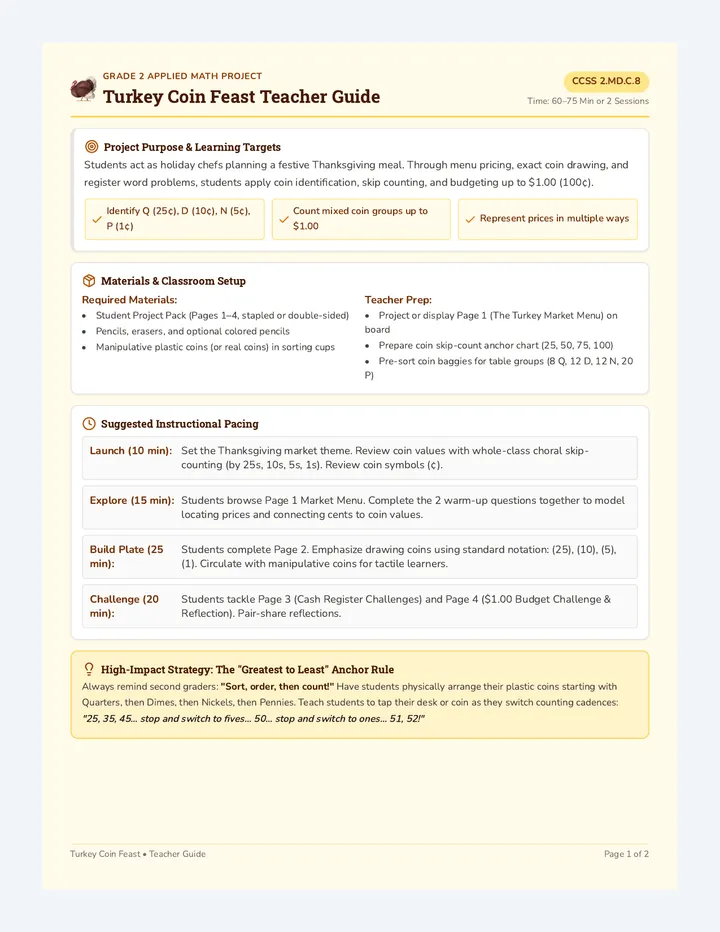
Grade 2 Applied Math Project
Turkey Coin Feast Teacher Guide
CCSS 2.MD.C.8 Time: 60–75 Min or 2 Sessions
Project Purpose & Learning Targets
Students act as holiday chefs planning a festive Thanksgiving meal. Through menu pricing, exact coin drawing, and register word problems, students apply coin identification, skip counting, and budgeting up to $1.00 (100¢).
Identify Q (25¢), D (10¢), N (5¢), P (1¢)
Count mixed coin groups up to $1.00
Represent prices in multiple ways
Materials & Classroom Setup
Required Materials:
Student Project Pack (Pages 1–4, stapled or double-sided)
Pencils, erasers, and optional colored pencils
Manipulative plastic coins (or real coins) in sorting cups
Teacher Prep:
Project or display Page 1 (The Turkey Market Menu) on board
Prepare coin skip-count anchor chart (25, 50, 75, 100)
Pre-sort coin baggies for table groups (8 Q, 12 D, 12 N, 20 P)
Suggested Instructional Pacing
Launch (10 min): Set the Thanksgiving market theme. Review coin values with whole-class choral skip-counting (by 25s, 10s, 5s, 1s). Review coin symbols (¢).
Explore (15 min): Students browse Page 1 Market Menu. Complete the 2 warm-up questions together to model locating prices and connecting cents to coin values.
Build Plate (25 min): Students complete Page 2. Emphasize drawing coins using standard notation: (25), (10), (5), (1). Circulate with manipulative coins for tactile learners.
Challenge (20 min): Students tackle Page 3 (Cash Register Challenges) and Page 4 ($1.00 Budget Challenge & Reflection). Pair-share reflections.
High-Impact Strategy: The "Greatest to Least" Anchor Rule
Always remind second graders: "Sort, order, then count!" Have students physically arrange their plastic coins starting with Quarters, then Dimes, then Nickels, then Pennies. Teach students to tap their desk or coin as they switch counting cadences: "25, 35, 45... stop and switch to fives... 50... stop and switch to ones... 51, 52!"
Turkey Coin Feast • Teacher Guide Page 1 of 2
Instructional Supports & Evaluation
Facilitation, Misconceptions & Rubric
Teacher Reference
Common Second Grade Coin Misconceptions
Misconception 1: "The nickel is bigger than the dime, so it must be worth more." Coaching Tip: Have students compare 1 dime (10¢) to 2 nickels (5¢ + 5¢ = 10¢). Reassure them that value is not about size: the dime has "super-packed" value in a tiny circle!
Misconception 2: Struggling to switch counting patterns mid-stream. Coaching Tip: When moving from dimes to nickels or nickels to pennies, use visual "stop signs" or have students write the running total above each coin: e.g., 25 → 35 → 45 → 50 → 51.
Intervention & Support
Provide a pre-printed 100s chart or coin ten-frames for skip counting.
Let students place plastic manipulatives directly on their paper before drawing.
Limit menu choices to multiples of 5¢ and 10¢ (e.g., Ham 40¢, Cornbread 15¢).
Challenge & Extension
Fewest Coins Challenge: Require students to find the exact combination using the absolute fewest coins.
Holiday Sales Tax: Add a 5¢ or 10¢ "Chef's Tip" to the total bill and recalculate.
Feast for Two: Double their favorite order and budget with $2.00 (8 quarters).
Project Assessment Rubric (CCSS 2.MD.C.8)
Skill
Developing (1)
Proficient (2)
Exceeding (3)
Coin Value Recognition
Confuses values of nickels and dimes; needs support identifying coins.
Consistently identifies pennies, nickels, dimes, and quarters correctly.
Fluently identifies all coins and readily explains value relationships (e.g., 2 dimes + 1 nickel = quarter).
Counting & Drawing Coins
Calculation errors when counting mixed groups; counts randomly without ordering.
Accurately counts and draws coin groups to match prices; orders coins greatest to least.
Rapidly counts mixed groups; creates multiple valid coin combinations with zero errors.
Budgeting & Problem Solving
Exceeds 100¢ budget or struggles to calculate change.
Plans a feast within the 100¢ budget and calculates remaining change accurately.
Optimizes budget creatively; shows clear mental math or written subtraction strategies.
Harvest Circle Debrief Prompts:
• "Who can share two different ways to pay for the 25¢ Mashed Potatoes?"
Turkey Coin Feast • Teacher Guide Page 2 of 2
Feast Solutions Answer Key 🦃
Teacher Answer Key & Scoring Guide
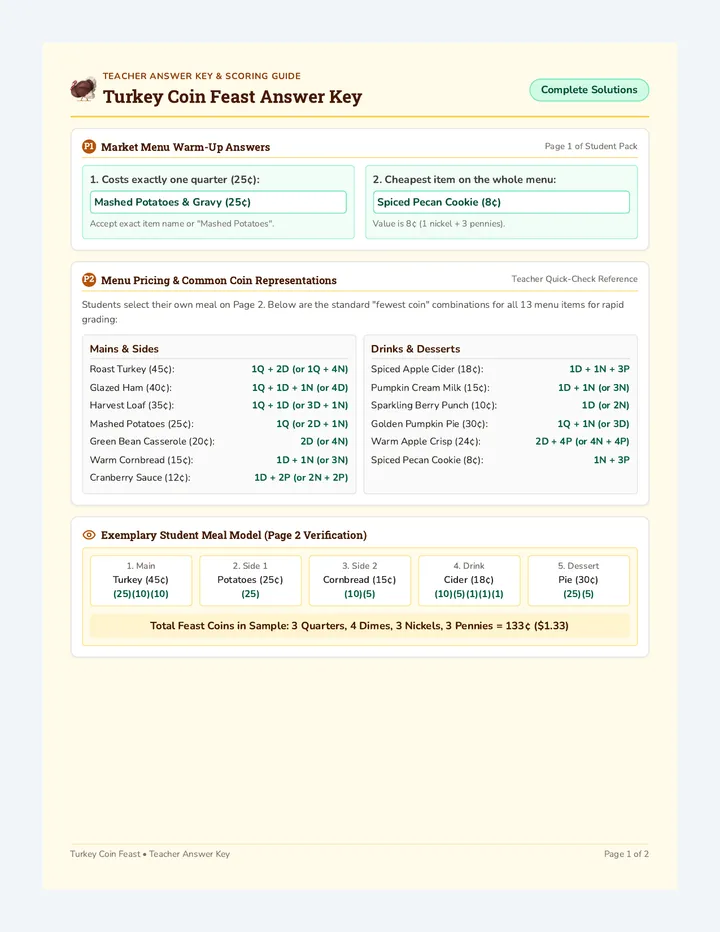
Turkey Coin Feast Answer Key
Complete Solutions
P1 Market Menu Warm-Up Answers
Page 1 of Student Pack
1. Costs exactly one quarter (25¢):
Mashed Potatoes & Gravy (25¢)
Accept exact item name or "Mashed Potatoes".
2. Cheapest item on the whole menu:
Spiced Pecan Cookie (8¢)
Value is 8¢ (1 nickel + 3 pennies).
P2 Menu Pricing & Common Coin Representations
Teacher Quick-Check Reference
Students select their own meal on Page 2. Below are the standard "fewest coin" combinations for all 13 menu items for rapid grading:
Mains & Sides
Roast Turkey (45¢): 1Q + 2D (or 1Q + 4N)
Glazed Ham (40¢): 1Q + 1D + 1N (or 4D)
Harvest Loaf (35¢): 1Q + 1D (or 3D + 1N)
Mashed Potatoes (25¢): 1Q (or 2D + 1N)
Green Bean Casserole (20¢): 2D (or 4N)
Warm Cornbread (15¢): 1D + 1N (or 3N)
Cranberry Sauce (12¢): 1D + 2P (or 2N + 2P)
Drinks & Desserts
Spiced Apple Cider (18¢): 1D + 1N + 3P
Pumpkin Cream Milk (15¢): 1D + 1N (or 3N)
Sparkling Berry Punch (10¢): 1D (or 2N)
Golden Pumpkin Pie (30¢): 1Q + 1N (or 3D)
Warm Apple Crisp (24¢): 2D + 4P (or 4N + 4P)
Spiced Pecan Cookie (8¢): 1N + 3P
Exemplary Student Meal Model (Page 2 Verification)
1. Main Turkey (45¢) (25)(10)(10)
2. Side 1 Potatoes (25¢) (25)
3. Side 2 Cornbread (15¢) (10)(5)
4. Drink Cider (18¢) (10)(5)(1)(1)(1)
5. Dessert Pie (30¢) (25)(5)
Total Feast Coins in Sample: 3 Quarters, 4 Dimes, 3 Nickels, 3 Pennies = 133¢ ($1.33)
Turkey Coin Feast • Teacher Answer Key Page 1 of 2
Cash Register & Budget Solutions
Market Challenges & $1.00 Budget
Pages 3 & 4 Solutions
P3 Page 3: Cash Register Challenges Solutions
Exact Solutions
Challenge 1: Two Ways to Pay for Pumpkin Pie (30¢)
Way A (Using Quarter): 1 Quarter (25¢) + 1 Nickel (5¢) = 30¢ (Also accept: 1Q + 5 Pennies)
Way B (Using Dimes/Nickels): 3 Dimes (10¢ + 10¢ + 10¢ = 30¢) (Also accept: 6 Nickels OR 2 Dimes + 2 Nickels)
Challenge 2: Customer Register Check
Shopper Maya (25¢ + 10¢ + 10¢ + 5¢):
Total: 50¢ Can buy: Any menu item! (All ≤ 45¢)
Shopper Leo (10¢ + 5¢ + 5¢ + 1¢ + 1¢):
Total: 22¢ Can buy: Green Beans, Cornbread, Cranberry, Cider, Milk, Punch, or Cookie
Challenge 3: Coin Comparison Showdown
Sam: 15¢ (1D + 1N) • Emma: 12¢ (1D + 2P) Difference: 3 cents more (15¢ − 12¢ = 3¢)
P4 Page 4: $1.00 Budget Sample Combinations
Valid Budget Models (≤ 100¢)
Sample Budget Option A:
1. Harvest Veggie Loaf: 35¢
2. Mashed Potatoes: 25¢
3. Warm Cornbread: 15¢
4. Warm Apple Cider: 18¢
Total Spent: 93¢ Change: 7¢
Sample Budget Option B:
1. Roast Turkey Slice: 45¢
2. Green Bean Casserole: 20¢
3. Sparkling Berry Punch: 10¢
4. Warm Apple Crisp: 24¢
Total Spent: 99¢ Change: 1¢
Chef Reflection Guidance (Page 4):
• Favorite Coin: Students often choose Dimes (easy to skip-count by 10s) or Quarters (counts up fast: 25, 50, 75, 100). Credit any reasoned answer.
Turkey Coin Feast • Teacher Answer Key Page 2 of 2