Congruence Mastery Slides High School Geometry Unit 4: Geometric Proofs
Triangle Congruence &
Coordinate Distance Proofs
Mastering SSS, SAS, ASA, AAS, HL and applying \(d = \sqrt{(\Delta x)^2 + (\Delta y)^2}\) to solve geometric problems.
Rigorous Problem Solving • Coordinate Plane Analysis
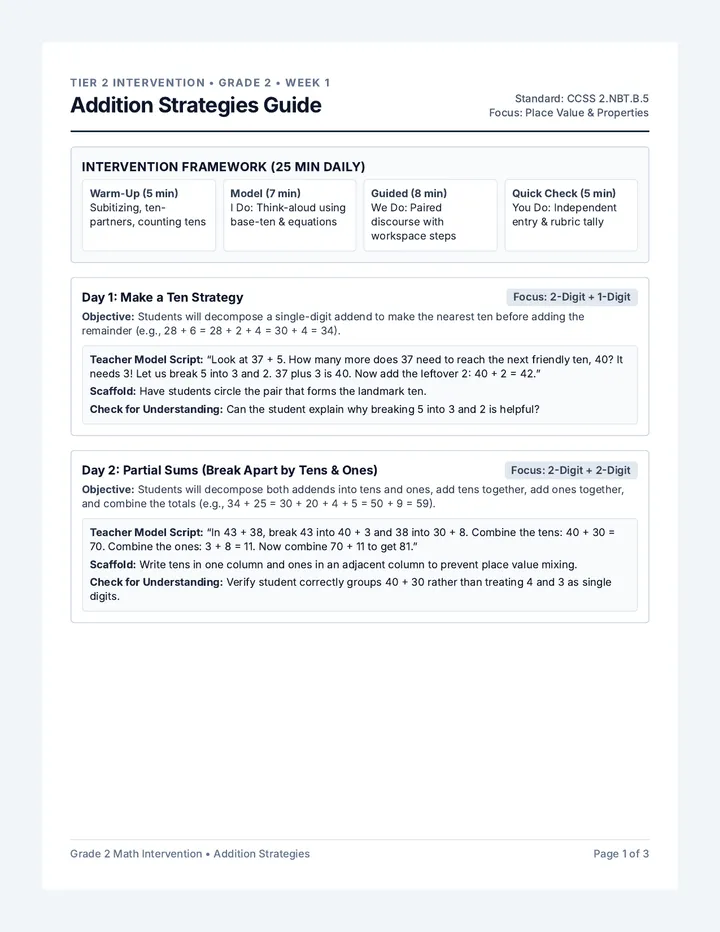
Geometry Core Deck
Core Foundation
5 Valid Congruence Criteria
Postulates & Theorems
SSS
Side-Side-Side
All 3 pairs of corresponding sides are congruent.
Uses Distance Formula
SAS
Side-Angle-Side
Two sides and their included angle match.
Angle between sides
ASA
Angle-Side-Angle
Two angles and their included side match.
Side between angles
AAS
Angle-Angle-Side
Two angles and a non-included side match.
Non-included side
HL
Hypotenuse-Leg
Right triangles only: hypotenuse and 1 leg match.
Requires \(90^\circ\) Angle
Caution Traps: AAA shows similarity only (not congruence!). SSA does not guarantee congruence due to the ambiguous case.
Coordinate Toolkit
The Distance Formula: \(d = \sqrt{(\Delta x)^2 + (\Delta y)^2}\)
Pythagorean Link
Fundamental Formula
\[d = \sqrt{(x_2 - x_1)^2 + (y_2 - y_1)^2}\]
1
Find Run: \(\Delta x = (x_2 - x_1)\), then square it.
2
Find Rise: \(\Delta y = (y_2 - y_1)\), then square it.
3
Sum & Root: Add squares and find square root.
Segment Length Example
Points \(P(1, 2)\) and \(Q(5, 5)\)
P(1,2) Q(5,5) Δx = 4 Δy = 3 d = 5
\(d = \sqrt{(5-1)^2 + (5-2)^2}\)
\(d = \sqrt{4^2 + 3^2} = \sqrt{16 + 9}\)
\(d = \sqrt{25}\)
\(d = 5\text{ units}\)
Key Strategy: In coordinate proofs, calculate all 3 side lengths to prove congruence by SSS !
Guided Demonstration
Coordinate Proof via SSS
3-Step Comparison
\(\triangle ABC\)
\(A(1,1), B(4,5), C(1,5)\)
Side \(AB\): \(\sqrt{(4-1)^2 + (5-1)^2} = \sqrt{9+16} = \mathbf{5}\)
Side \(BC\): \(\sqrt{(1-4)^2 + (5-5)^2} = \sqrt{9+0} = \mathbf{3}\)
Side \(AC\): \(\sqrt{(1-1)^2 + (5-1)^2} = \sqrt{0+16} = \mathbf{4}\)
\(\triangle DEF\)
\(D(-2,1), E(-5,5), F(-2,5)\)
Side \(DE\): \(\sqrt{(-5+2)^2 + (5-1)^2} = \sqrt{9+16} = \mathbf{5}\)
Side \(EF\): \(\sqrt{(-2+5)^2 + (5-5)^2} = \sqrt{9+0} = \mathbf{3}\)
Side \(DF\): \(\sqrt{(-2+2)^2 + (5-1)^2} = \sqrt{0+16} = \mathbf{4}\)
✓
Conclusion: \(\triangle ABC \cong \triangle DFE\)
All corresponding sides have identical lengths \(\{3, 4, 5\}\). By SSS Congruence , the triangles are congruent!
CPCTC Enabled
Question Showdown 1
Identify the Congruence Postulate
Classroom Polling
Given: \(\overline{AB} \parallel \overline{CD}\) and \(M\) is the midpoint of \(\overline{AD}\).
M A B C D Which shortcut proves \(\triangle ABM \cong \triangle DCM\)?
A SSA — because two sides and one non-included angle match
B ASA — Alternate interior angles and vertical angles with included side \(\overline{AM} \cong \overline{DM}\)
C HL — since segments form perpendicular diagonals
D AAA — all three pairs of angles are congruent
Key insight: Vertical angles are congruent; parallel lines provide alternate interior angles. Answer: B (ASA)
Question Showdown 2
Coordinate Plane Side Length
Distance Formula
Triangle \(RST\) has vertices \(R(-3, 2)\), \(S(1, 5)\), and \(T(1, 2)\). What is the exact length of hypotenuse \(\overline{RS}\)?
\(\Delta x = 1 - (-3) = 4\)
\(\Delta y = 5 - 2 = 3\)
Which option represents the exact distance?
A \(d = \sqrt{7} \approx 2.65\text{ units}\)
B \(d = \sqrt{14} \approx 3.74\text{ units}\)
C \(d = \mathbf{5}\text{ units}\) \(\left(\sqrt{4^2 + 3^2} = \sqrt{25}\right)\)
D \(d = 25\text{ units}\)
Avoid the common trap of forgetting to take the square root of 25! Answer: C (\(d = 5\))
Question Showdown 3
Algebraic Problem Solving with CPCTC
Variable Solution
Given \(\triangle JKL \cong \triangle MNP\), with corresponding sides:
\(JK = 3x + 7\)
\(MN = 5x - 9\)
\(NP = 2x + 1\)
Find the length of segment \(\overline{KL}\).
A \(x = 8\), so \(KL = 17\)
B \(x = 4\), so \(KL = 9\)
C \(x = 8\), so \(KL = 31\)
D \(x = 16\), so \(KL = 33\)
Step 1: Set \(3x+7 = 5x-9 \implies 2x=16 \implies x=8\). Step 2: \(KL = NP = 2(8)+1 = 17\). Answer: A (\(KL = 17\))
Mastery Checklist
Triangle Congruence Problem Protocol
4-Step Strategy
1
Diagram Audit
Label all given marks. Look for shared sides (Reflexive ) and vertical angles (Bowtie ).
2
Select Shortcut
Verify SSS, SAS, ASA, AAS, or HL. Never use AAA or SSA. Watch the order of letters!
3
Coordinate Distances
On coordinate grids, calculate \(\sqrt{\Delta x^2 + \Delta y^2}\) for each side to verify equal lengths.
4
Apply CPCTC
Set corresponding parts equal algebraically to solve for unknown variables, angles, or perimeters.
Ready for independent practice: grab your 15-Question Challenge Worksheet !
Let's Practice! →
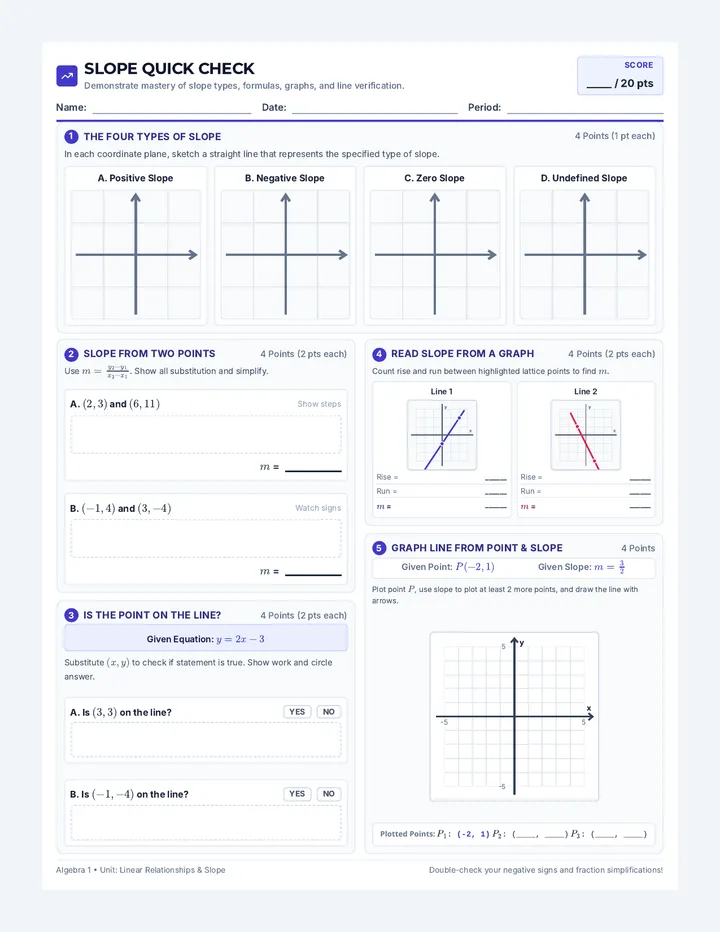
Triangle Congruence Challenge Worksheet Geometry Practice Series
Triangle Congruence Challenge
Postulates, Distance Formula, and Coordinate Proofs
Name:
Date:
Period:
Score: / 15
Part 1: Congruence Criteria & Direct Proofs Questions 1–4
In the figure below, \(\overline{AB} \cong \overline{DE}\), \(\angle B \cong \angle E\), and \(\overline{BC} \cong \overline{EF}\). Which theorem or postulate directly establishes that \(\triangle ABC \cong \triangle DEF\)?
A SSS (Side-Side-Side)
B SAS (Side-Angle-Side)
C ASA (Angle-Side-Angle)
D AAS (Angle-Angle-Side)
B C A E F D
In the bowtie figure, lines intersect at point \(P\). Given that \(\overline{AB} \parallel \overline{CD}\) and \(P\) is the midpoint of \(\overline{AD}\), what criteria proves \(\triangle APB \cong \triangle DPC\)?
A ASA (or AAS)
B SSA
C HL
D AAA
P A B C D
Triangles \(\triangle PQR\) and \(\triangle STU\) are right triangles with right angles at \(Q\) and \(T\). Given hypotenuses \(PR = SU = 13\) and legs \(PQ = ST = 5\), which condition justifies congruence?
A AAS Theorem
B HL (Hypotenuse-Leg)
C SAS Postulate
D ASA Postulate
Q P R 13 5 T S U 13 5
If \(\triangle GHI \cong \triangle JKL\) with \(GH = 4x - 5\), \(JK = 19\), and \(\angle H = (3y + 12)^\circ\) with \(\angle K = 72^\circ\), what are the values of \(x\) and \(y\)?
A \(x = 6\) and \(y = 20\)
B \(x = 5\) and \(y = 24\)
C \(x = 6\) and \(y = 28\)
D \(x = 4\) and \(y = 20\)
Work Area:
Unit 4: Triangle Congruence Page 1 of 4
Part 2: Distance Formula & Coordinate Proofs Formula: \(d = \sqrt{(x_2-x_1)^2 + (y_2-y_1)^2}\)
On the coordinate plane, segment \(\overline{AB}\) has endpoints \(A(2, 3)\) and \(B(6, 6)\). What is the exact length of \(\overline{AB}\)?
A \(d = 5\text{ units}\)
B \(d = 7\text{ units}\)
C \(d = \sqrt{7}\text{ units}\)
D \(d = 25\text{ units}\)
A(2,3) B(6,6)
Triangle \(\triangle KLM\) has coordinates \(K(-1, 1)\), \(L(3, 4)\), and \(M(-1, 4)\). What are the side lengths of \(\triangle KLM\), and is it a right triangle?
A Sides: \(3, 4, 5\); Yes, right triangle
B Sides: \(4, 4, \sqrt{32}\); Yes, isosceles
C Sides: \(3, 3, 6\); No, obtuse
D Sides: \(2, 4, \sqrt{20}\); Yes, scalene
K(-1,1) M(-1,4) L(3,4) 3 4 5
To prove \(\triangle ABC \cong \triangle DEF\) using SSS, student Maya computes all 6 side lengths. If \(A(0,0), B(3,0), C(0,4)\) and \(D(4,1), E(7,1), F(4,5)\), which statement accurately confirms congruence?
A \(AB=DE=3,\; BC=EF=5,\; AC=DF=4\)
B \(AB=DE=4,\; BC=EF=3,\; AC=DF=5\)
C \(AB=DE=3,\; BC=EF=\sqrt{7},\; AC=DF=4\)
D \(AB=DE=5,\; BC=EF=5,\; AC=DF=3\)
A B C D E F
Segment \(\overline{MN}\) connects \(M(-2, 1)\) and \(N(2, 4)\). Segment \(\overline{PQ}\) connects \(P(1, -1)\) and \(Q(4, 3)\). Using the distance formula, determine whether \(\overline{MN} \cong \overline{PQ}\).
A Yes, both segments have length \(5\text{ units}\)
B No, \(MN = 5\) while \(PQ = \sqrt{7}\)
C No, \(MN = \sqrt{13}\) while \(PQ = 5\)
D Yes, both segments have length \(\sqrt{20}\text{ units}\)
Work Area:
Unit 4: Triangle Congruence Page 2 of 4
Part 3: Overlapping Figures & Algebraic CPCTC Questions 9–12
In the overlapping triangles below, \(\overline{AB} \cong \overline{DC}\) and \(\angle BAD \cong \angle CDA\). What additional congruence statement is immediately available by the Reflexive Property to prove \(\triangle BAD \cong \triangle CDA\)?
A \(\overline{AD} \cong \overline{DA}\)
B \(\overline{BD} \cong \overline{AC}\)
C \(\angle B \cong \angle C\)
D \(\overline{AB} \parallel \overline{CD}\)
A D B C
Right triangle \(\triangle ABC\) has hypotenuse \(AB = 5\) where \(A(1,2)\) and \(B(4,6)\). Triangle \(\triangle DEF \cong \triangle ABC\), and its hypotenuse has endpoints \(D(0,0)\) and \(E(3, k)\) where \(k > 0\). What is the value of \(k\)?
A \(k = 4\)
B \(k = 3\)
C \(k = 5\)
D \(k = \sqrt{16} = 2\)
Work Area:
Triangles \(\triangle WXY\) and \(\triangle ZXY\) share side \(\overline{XY}\) and are known to be congruent (\(\triangle WXY \cong \triangle ZXY\)). If \(WX = 2a + 3\), \(ZX = 3a - 4\), \(WY = 4a - 1\), and \(XY = 12\), what is the perimeter of \(\triangle ZXY\)?
A \(56\text{ units}\)
B \(42\text{ units}\)
C \(46\text{ units}\)
D \(38\text{ units}\)
X Y W Z 12
A student argues that two triangles with two congruent pairs of side lengths (\(8\text{ cm}\) and \(12\text{ cm}\)) and a non-included angle of \(42^\circ\) must be congruent by "SSA". Why is this argument flawed?
A SSA can form two distinct triangles (ambiguous case)
B SSA is only valid if both triangles are obtuse
C SSA only works when angles exceed \(90^\circ\)
D SSA is actually valid; the student's conclusion was correct
12 8 8 42°
Unit 4: Triangle Congruence Page 3 of 4
Part 4: Coordinate Synthesis & Multi-Step Proofs Questions 13–15
Triangle \(\triangle PQR\) has vertices \(P(2, 1)\), \(Q(5, 2)\), and \(R(3, 4)\). Triangle \(\triangle STU\) has vertices \(S(-1, 0)\), \(T(2, 1)\), and \(U(0, 3)\). Using the distance formula, what is the length of side \(\overline{PR}\) and side \(\overline{SU}\)?
A \(PR = \sqrt{10}\) and \(SU = \sqrt{10}\)
B \(PR = \sqrt{8}\) and \(SU = \sqrt{10}\)
C \(PR = 3\) and \(SU = 3\)
D \(PR = \sqrt{13}\) and \(SU = \sqrt{13}\)
P Q R S T U
In isosceles triangle \(\triangle ABC\) where \(AB = AC\), an altitude \(\overline{AD}\) is drawn perpendicular to base \(\overline{BC}\). Which theorem directly proves \(\triangle ABD \cong \triangle ACD\), establishing that \(D\) bisects \(\overline{BC}\)?
A HL (Hypotenuse-Leg)
B AAA
C SSA
D Geometric Mean Theorem
A B C D
Right triangle \(\triangle ABC\) has vertices \(A(1, 1)\), \(B(4, 1)\), and \(C(1, 5)\). To construct \(\triangle DEF \cong \triangle ABC\) with vertices \(D(2, -2)\), \(E(5, -2)\), and right angle at \(D\), what must be the coordinates of vertex \(F\) if \(F\) lies below segment \(\overline{DE}\)?
A \(F(2, -6)\)
B \(F(2, 2)\)
C \(F(5, -6)\)
D \(F(-2, -6)\)
A(1,1) B C D(2,-2) E F(?)
Review & Verify Congruence
Remember: When calculating coordinate distance, double-check signs with negative coordinates: \((x_2 - (-x_1))^2 = (x_2 + x_1)^2\).
15 Total Points
Unit 4: Triangle Congruence Page 4 of 4
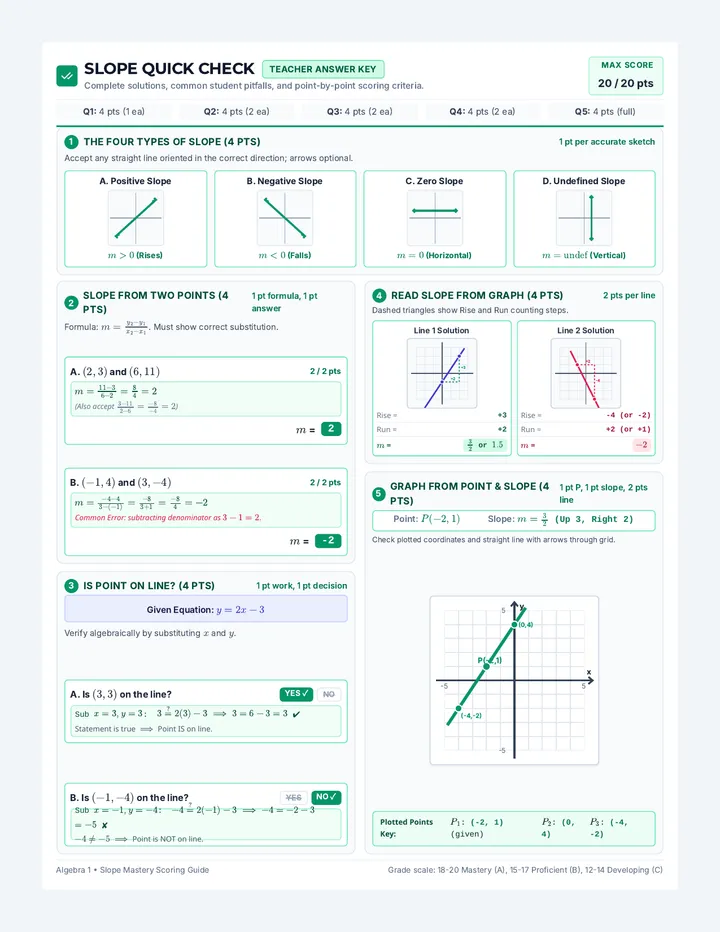
Congruence Solutions Guide Teacher Resource • Geometry
Triangle Congruence Solutions Guide
Comprehensive Answer Key, Proof Rationale, and Distance Formula Work
Master Answer Key
Quick-Reference Answer Key 15 Questions Total
B (SAS)
A (ASA)
B (HL)
A (6, 20)
A (d = 5)
A (3,4,5)
A (3, 5, 4)
A (Both 5)
A (AD ≅ DA)
A (k = 4)
A (P = 56)
A (SSA Amb)
A (√10)
A (HL)
A (2, -6)
Detailed Solutions: Questions 1–7
1. Correct Answer: B (SAS)
\(\overline{AB} \cong \overline{DE}\) (Side), \(\angle B \cong \angle E\) (Included Angle), and \(\overline{BC} \cong \overline{EF}\) (Side). The marked angle is strictly between the two congruent sides, satisfying SAS directly.
2. Correct Answer: A (ASA / AAS)
Because \(\overline{AB} \parallel \overline{CD}\), alternate interior angles \(\angle A \cong \angle D\) and \(\angle B \cong \angle C\). Midpoint \(P\) gives \(\overline{AP} \cong \overline{DP}\). Vertical angles at \(P\) ensure \(\angle APB \cong \angle DPC\). By ASA, \(\triangle APB \cong \triangle DPC\).
3. Correct Answer: B (HL)
Both are right triangles. The hypotenuses are congruent (\(PR = SU = 13\)) and one pair of legs is congruent (\(PQ = ST = 5\)). The Hypotenuse-Leg (HL) Theorem guarantees congruence.
4. Correct Answer: A (\(x = 6\) and \(y = 20\))
By CPCTC, corresponding sides and angles are equal: \(GH = JK \implies 4x - 5 = 19 \implies 4x = 24 \implies x = 6\). Likewise, \(\angle H = \angle K \implies 3y + 12 = 72 \implies 3y = 60 \implies y = 20\).
5. Correct Answer: A (\(d = 5\text{ units}\))
Apply distance formula: \(d = \sqrt{(6 - 2)^2 + (6 - 3)^2} = \sqrt{4^2 + 3^2} = \sqrt{16 + 9} = \sqrt{25} = 5\).
6. Correct Answer: A (Sides: \(3, 4, 5\); Yes, right triangle)
Vertical leg \(KM = |4 - 1| = 3\). Horizontal leg \(LM = |3 - (-1)| = 4\). Hypotenuse \(KL = \sqrt{(3 - (-1))^2 + (4 - 1)^2} = \sqrt{4^2 + 3^2} = 5\). Since \(3^2 + 4^2 = 5^2\), it forms a right triangle.
7. Correct Answer: A (\(AB=DE=3,\; BC=EF=5,\; AC=DF=4\))
\(\triangle ABC\): \(AB = 3 - 0 = 3\); \(AC = 4 - 0 = 4\); \(BC = \sqrt{3^2 + 4^2} = 5\). \(\triangle DEF\): \(DE = 7 - 4 = 3\); \(DF = 5 - 1 = 4\); \(EF = \sqrt{(7-4)^2 + (1-5)^2} = \sqrt{9 + 16} = 5\). Matching lengths prove SSS.
Teacher Guide • Triangle Congruence Page 1 of 2
Detailed Solutions: Questions 8–15 Algebra & Coordinate Proofs
8. Correct Answer: A (Yes, both segments have length \(5\text{ units}\))
\(MN = \sqrt{(2 - (-2))^2 + (4 - 1)^2} = \sqrt{4^2 + 3^2} = \sqrt{25} = 5\).
9. Correct Answer: A (\(\overline{AD} \cong \overline{DA}\))
Both \(\triangle BAD\) and \(\triangle CDA\) share base segment \(\overline{AD}\). By the Reflexive Property of Congruence, any segment is congruent to itself (\(\overline{AD} \cong \overline{DA}\)), completing the SAS proof.
10. Correct Answer: A (\(k = 4\))
Since \(\triangle ABC \cong \triangle DEF\), hypotenuse \(DE = AB = 5\). Using \(D(0,0)\) and \(E(3, k)\): \(\sqrt{(3 - 0)^2 + (k - 0)^2} = 5 \implies 3^2 + k^2 = 5^2 \implies 9 + k^2 = 25 \implies k^2 = 16\). Given \(k > 0\), \(k = 4\).
11. Correct Answer: A (\(56\text{ units}\))
\(\triangle WXY \cong \triangle ZXY \implies WX = ZX \implies 2a + 3 = 3a - 4 \implies a = 7\).
12. Correct Answer: A (SSA can form two distinct triangles, ambiguous case)
When the given angle is acute and opposite a side shorter than the adjacent side, that swinging side can intersect the base in two different locations, forming an acute or obtuse triangle. Hence, SSA is invalid.
13. Correct Answer: A (\(PR = \sqrt{10}\) and \(SU = \sqrt{10}\))
\(PR = \sqrt{(3 - 2)^2 + (4 - 1)^2} = \sqrt{1^2 + 3^2} = \sqrt{1 + 9} = \sqrt{10}\).
14. Correct Answer: A (HL)
Right triangles \(\triangle ABD\) and \(\triangle ACD\) share leg \(\overline{AD}\) (\(AD = AD\) by Reflexive Property) and have congruent hypotenuses \(AB = AC\). By HL, \(\triangle ABD \cong \triangle ACD\), which implies \(BD = CD\) by CPCTC.
15. Correct Answer: A (\(F(2, -6)\))
In \(\triangle ABC\), leg \(AB = |4 - 1| = 3\) is horizontal, and leg \(AC = |5 - 1| = 4\) is vertical with right angle at \(A\). In \(\triangle DEF\), leg \(DE = |5 - 2| = 3\) is horizontal along \(y = -2\). Leg \(DF\) must be vertical with length 4 from \(D(2, -2)\). Since \(F\) is below \(\overline{DE}\), \(y = -2 - 4 = -6\), yielding \(F(2, -6)\).
Common Student Misconceptions & Remediation
• Subtracting Negatives: Students frequently calculate \(-2 - 2\) as \(0\) or \(-1 - (-4)\) incorrectly. Encourage writing parentheses: \((x_2 - x_1)^2 = (3 - (-1))^2 = 4^2 = 16\).
• SSS vs. SSA Trap: Students often assume any combination of two sides and an angle guarantees congruence. Emphasize checking whether the angle is physically between the sides (SAS) or opposite (SSA).
Teacher Guide • Triangle Congruence Page 2 of 2