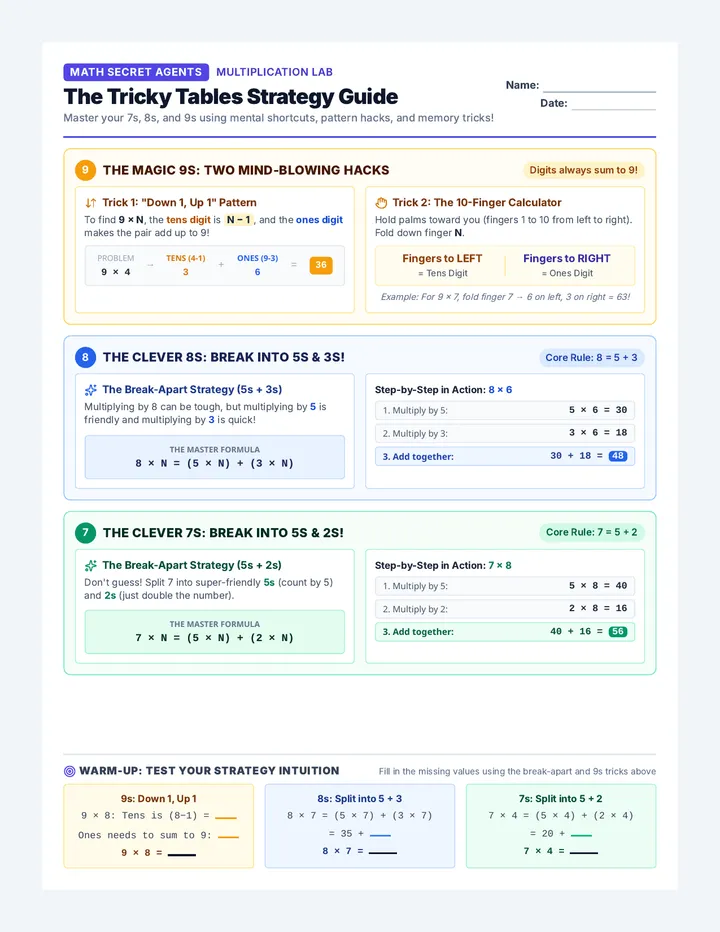
Break Apart Slides Grade 3 Math • Multiplication Superpower
Math Workshop
The Distributive Property
The Break-Apart Strategy!
Make tough multiplication facts easy by splitting big numbers into friendly numbers!
1
Break One Factor
2
Multiply Both Parts
3
Add Them Together
THE BIG MATH SECRET
Concept
You Can Break Numbers Apart!
When a multiplication fact looks scary, break one number into two smaller, friendlier numbers that you already know!
Tough Number
7
Hard to multiply?
Break Apart!
Friendly Fact
5
Fives are easy!
Friendly Fact
2
Twos are easy!
Because \(5 + 2 = 7\), multiplying by 7 is the exact same as multiplying by 5 and 2, then adding the totals!
THE BREAK-APART FORMULA
3 Simple Steps
How To Distribute in 3 Steps
Follow these three steps every single time!
STEP 1
SPLIT
Choose the bigger number and break it into two friendly numbers (like 5 + something).
8 = 5 + 3
STEP 2
MULTIPLY
Multiply the other factor by both of your new smaller parts.
(4 × 5) and (4 × 3)
STEP 3
ADD UP
Add the two answers (products) together to get your final grand total!
20 + 12 = 32
Think: Break it → Times both → Add 'em up!
PROBLEM 1 Guided Example
Let's Think First
How would you solve this fact?
4 × 7 = ?
Don't know your 7s yet? No problem! Use the break-apart strategy.
Question 1: Which number to split?
Look at 7. What two friendly numbers make 7?
Hint: Use Fives and Twos!
\( 7 = 5 + 2 \). Can you multiply 4 by both?
Try it in your head or on paper! Ready to see the step-by-step work? →
PROBLEM 1 Work & Answer
Solution Check
Fact: 4 × 7
Break 7 into 5 + 2
PART A Fives Fact
Multiply 4 by 5:
4 × 5 = 20
5, 10, 15, 20
PART B Twos Fact
Multiply 4 by 2:
4 × 2 = 8
Double 4: 4 + 4 = 8
PART C Add Parts
Combine totals:
20 + 8 = 28
Add 20 and 8 together
Full Equation: \( (4 \times 5) + (4 \times 2) = 28 \)
4 × 7 = 28
PROBLEM 2 Your Turn to Try!
Whiteboard Challenge
How would you break apart this fact?
3 × 8 = ?
Which number should we split? Break the 8 into friendly parts!
A
Break 8 into 5 + 3
Multiply \( 3 \times 5 \) and \( 3 \times 3 \). Then add!
B
Break 8 into 4 + 4
Multiply \( 3 \times 4 \) twice. Then add the double!
Work it out with a partner! Let's check the steps on the next slide →
PROBLEM 2 Work & Answer
Solution Check
Fact: 3 × 8
Split 8 into 5 + 3
STEP 1
Split 8
Choose friendly numbers:
8 = 5 + 3
STEP 2
Multiply Both
Share 3 to each part:
3 × 5 = 15
3 × 3 = 9
STEP 3
Add Parts
Combine the totals:
15 + 9
= 24
Final Answer: \( (3 \times 5) + (3 \times 3) \)
3 × 8 = 24
PROBLEM 3 Boss Challenge Fact!
Super Challenge
The trickiest fact on the times table:
6 × 7 = ?
Many third graders get stuck here. But YOU have the break-apart superpower!
Split the 7 into 5 + 2
Multiply 6 by 5, then multiply 6 by 2.
Why does this help?
Fives are easy to count, and Twos are just doubles!
Solve it on your paper now! Next slide reveals the full breakdown →
PROBLEM 3 Work & Answer
Solution Check
Fact: 6 × 7
Split 7 into 5 + 2
A
Part 1: Multiply 6 by 5
Skip count: 5, 10, 15, 20, 25, 30
6 × 5 = 30
B
Part 2: Multiply 6 by 2
Double 6: 6 + 6 = 12
6 × 2 = 12
30 + 12
Add both parts:
Final Product: 6 × 7 = 42
Success! You just conquered 6 × 7 with ease!
YOU ARE A DISTRIBUTIVE MASTER!
Wrap-Up
Your Distributive Cheat Sheet
Keep this rhyme in your head whenever you multiply:
1
BREAK IT!
Split a tough factor into friendly numbers.
2
SHARE IT!
Multiply the other number by both parts.
3
ADD IT!
Add the two products to get your final answer.
Turn and Talk to a Partner
How would you break apart 9 to solve \( 5 \times 9 \) ?
\( 5 + 4 \) or \( 5 + ? \)
Break Apart Worksheet Grade 3 Math • Distributive Property
Break-Apart Multiplication Worksheet
Split big numbers into friendly numbers to make multiplying easy!
Name:
Date:
TIP
The 3-Step Break-Apart Rule
1. Split one number → 2. Multiply both parts → 3. Add them up!
Example: \( 4 \times 7 \)
\( (4 \times 5) + (4 \times 2) = 28 \)
PART 1
Guided Break-Apart Practice
Fill in the boxes step by step
Problem 1: 3 × 8 = ?
1 Split 8 into: 5 +
2 Part A: \( 3 \times 5 = \)
Part B: \( 3 \times \) \( = \)
3 Add: + =
Final Answer: 3 × 8 = ______
Problem 2: 6 × 7 = ?
1 Split 7 into: 5 +
2 Part A: \( 6 \times 5 = \)
Part B: \( 6 \times \) \( = \)
3 Add: + =
Final Answer: 6 × 7 = ______
PART 2
Distributive Number Puzzles
Fill in the blank to make each equation true
A) \( 5 \times 9 = (5 \times 5) + (5 \times \) \( ) \)
B) \( 4 \times 8 = (4 \times \) \( ) + (4 \times 3) \)
C) \( 7 \times 6 = (7 \times 5) + (7 \times \) \( ) \)
D) \( 8 \times 7 = (8 \times 5) + (8 \times \) \( ) \)
Great job! Flip over to Page 2 to solve on your own and tackle the word problem challenge! →
Page 2 • Independent Practice
Show Your Break-Apart Superpower!
Name:
PART 3
Solve & Show Your Work
Break apart one factor, multiply both, and add
Problem 3: 4 × 9 = ?
Hint: Break 9 into \( 5 + 4 \)
Final Product: 4 × 9 = ________
Problem 4: 8 × 6 = ?
Hint: Break 6 into \( 5 + 1 \)
Final Product: 8 × 6 = ________
PART 4
Word Problem Detectives
Use the distributive strategy to solve
5
Leo bought 7 packs of juice boxes for soccer practice. Each pack has 6 juice boxes. How many juice boxes did Leo buy in all?
Break apart: \( 7 \times (5 + 1) \) or \( 6 \times (5 + 2) \) Answer: ________ juice boxes
6
Ms. Rivera arranged 8 rows of chairs for the third grade play. Each row has 7 chairs. How many chairs are in the auditorium?
Break apart: \( 8 \times (5 + 2) \) Answer: ________ chairs
Self-Check Reflection
How confident do you feel breaking apart multiplication facts?
Break Apart Answer Key Teacher Resource • Distributive Property
Break-Apart Worksheet • Answer Key
Complete step-by-step solutions, scoring guide, and common misconceptions
Reference
ANSWER KEY
Common Student Misconception: Students occasionally add the split factors instead of multiplying (e.g., writing \( 3 + 5 = 8 \) instead of \( 3 \times 5 = 15 \)), or forget to add both partial products at the end. Look for clean multi-step notation.
PART 1 SOLUTIONS
Guided Break-Apart Practice
Full Model Answers
Problem 1: 3 × 8 = 24
1 Split 8 into: 5 + 3
2 Part A: \( 3 \times 5 = \) 15
Part B: \( 3 \times \) 3 \( = \) 9
3 Add: 15 + 9 = 24
Final Answer: 3 × 8 = 24
Problem 2: 6 × 7 = 42
1 Split 7 into: 5 + 2
2 Part A: \( 6 \times 5 = \) 30
Part B: \( 6 \times \) 2 \( = \) 12
3 Add: 30 + 12 = 42
Final Answer: 6 × 7 = 42
PART 2 SOLUTIONS
Distributive Number Puzzles
Correct answers in green boxes
A) \( 5 \times 9 = (5 \times 5) + (5 \times \) 4 \( ) \)
B) \( 4 \times 8 = (4 \times \) 5 \( ) + (4 \times 3) \)
C) \( 7 \times 6 = (7 \times 5) + (7 \times \) 1 \( ) \)
D) \( 8 \times 7 = (8 \times 5) + (8 \times \) 2 \( ) \)
Page 1 Complete • See Page 2 for Independent Practice & Word Problem Solutions →
Page 2 Answer Key • Independent & Word Problems
Detailed Scoring & Exemplar Solutions
Grade 3 Standards: 3.OA.B.5
PART 3 SOLUTIONS
Exemplar Student Work
2 Points Each
Problem 3: 4 × 9 = 36
• Split 9 into \( 5 + 4 \)
• \( 4 \times 5 = 20 \)
• \( 4 \times 4 = 16 \)
• \( 20 + 16 = 36 \)
Product: 4 × 9 = 36
Problem 4: 8 × 6 = 48
• Split 6 into \( 5 + 1 \)
• \( 8 \times 5 = 40 \)
• \( 8 \times 1 = 8 \)
• \( 40 + 8 = 48 \)
Product: 8 × 6 = 48
PART 4 SOLUTIONS
Word Problem Solutions & Scoring
3 Points Each
5
Leo bought 7 packs with 6 juice boxes each. Fact: 7 × 6
Method 1: \( 7 \times (5 + 1) = (7 \times 5) + (7 \times 1) = 35 + 7 = 42 \)
Method 2: \( 6 \times (5 + 2) = (6 \times 5) + (6 \times 2) = 30 + 12 = 42 \)
Full credit for either decomposition method Answer: 42 juice boxes
6
Ms. Rivera arranged 8 rows of 7 chairs. Fact: 8 × 7
Decomposition: Split 7 into \( 5 + 2 \)
\( (8 \times 5) + (8 \times 2) = 40 + 16 = 56 \)
Check for \( 8 \times 5 = 40 \) and \( 8 \times 2 = 16 \) Answer: 56 chairs
Mastery (9-10 pts)
Splits factors accurately and computes partial products independently.
Developing (7-8 pts)
Understands break-apart concept but makes minor basic-fact arithmetic slips.
Needs Support (<7 pts)
Requires guided scaffolding with 5s facts; review with concrete counters.