Rational Operations Study Guide
CCSS 7.NS.A.2 Grade 7 Mathematics • Mastery Study Guide
Rational Numbers Study Guide
Part 1: Integer Fluency • Part 2: Real-World Modeling • Part 3: Signed Fractions • Part 4: Long Division • Part 5: Sign Sorting
Name:
Date:
Period:
Integer Operation Rules & Sign Conventions
Multiplication Sign Rules \((-) \times (-) = (+)\) | \((-) \times (+) = (-)\)
Division Sign Rules \(\frac{-a}{-b} = \frac{a}{b}\) | \(\frac{-a}{b} = -\frac{a}{b}\)
Multiple Factors Even number of \((-)\) \(\rightarrow\) Positive | Odd number of \((-)\) \(\rightarrow\) Negative
PART 1: INTEGER MULTIPLICATION & DIVISION FLUENCY (Questions 1–5) Evaluate each expression completely
1 Evaluate: \(-6 \times -8 \times 5\)
Answer:
2 Evaluate: \(-72 \times -5\)
Answer:
3 Evaluate: \(-2 \times -7 \times 8 \times -3\)
Answer:
4 Evaluate: \(-12 \div -3\)
Answer:
5 Evaluate: \(-60 \div -5 \div 4\)
Answer:
PART 2: REAL-WORLD MODELING WITH INTEGER EXPRESSIONS (Questions 6–7) Generate signed expressions & solve
6 Real-World Problem: Generating a Multiplication Expression
A deep-sea scientific research probe descends from sea level at a constant rate of \(24\text{ meters per minute}\) for \(8\text{ consecutive minutes}\).
MULTIPLICATION EXPRESSION:
FINAL ELEVATION / DEPTH:
7 Real-World Problem: Generating a Division Expression
During a severe polar cold front, the water level in an outdoor reservoir dropped by a total of \(-48\text{ inches}\) at an even rate over a period of \(6\text{ days}\).
DIVISION EXPRESSION:
DAILY RATE OF CHANGE:
Page 1 of 4 • Rational Numbers Study Guide (7.NS.A.2)
CCSS 7.NS.A.2b, 7.NS.A.2c Grade 7 Mathematics • Signed Rational Division
Part 3: Dividing Signed Fractions & Rational Numbers
Student Name:
Signed Fraction Division Strategy Anchor
1. Multiplicative Inverse \(\frac{a}{b} \div \frac{c}{d} = \frac{a}{b} \times \frac{d}{c}\) (multiply by the reciprocal)
2. Mixed Numbers First Convert all mixed numbers to improper fractions before inverting: \(-a\frac{b}{c} = -\frac{a \cdot c + b}{c}\)
3. Sign Conventions \((-) \div (-) = (+)\) | \((-) \div (+) = (-)\) | \(-\frac{p}{q} = \frac{-p}{q} = \frac{p}{-q}\)
SECTION 3: DIVIDING SIGNED FRACTIONS (Questions 8–12) Show full reciprocal setup & cross-simplification
8 Divide two signed fractions: \(-\frac{5}{6} \div \left(-\frac{10}{21}\right)\)
Simplest Form:
9 Divide fraction by an integer: \(\frac{7}{12} \div (-14)\)
Simplest Form:
10 Divide mixed number by fraction: \(-2\frac{2}{5} \div \left(-\frac{8}{15}\right)\)
Simplest Form:
11 Divide two mixed numbers: \(-3\frac{3}{8} \div 1\frac{7}{16}\)
Simplest Form:
12 Simplify complex fraction: \(\frac{-\frac{9}{20}}{\frac{27}{35}}\)
Simplest Form:
Page 2 of 4 • Rational Numbers Study Guide (7.NS.A.2)
CCSS 7.NS.A.2d Grade 7 Mathematics • Rational Decimal Conversions
Part 4: Long Division Conversions & Gridline Templates
Student Name:
Long Division Protocol & Place Value Grid Alignment
1. Division Setup Numerator goes inside division bracket; Denominator divides on outside. Place decimal and trailing zeros.
2. Gridline Alignment Keep each place value digit centered inside its vertical grid column to prevent subtraction errors!
3. Remainder Analysis Remainder reaches \(0 \rightarrow\) Terminating. Remainder repeats in cycle \(\rightarrow\) Repeating with bar (\(\overline{\phantom{x}}\)).
SECTION 4: LONG DIVISION TO DECIMALS (Questions 13–14) Use the gridline templates below to show all division steps
13 Convert the signed fraction \(-\frac{11}{16}\) into its decimal equivalent.
Divide \(11 \div 16\)
Long Division Workspace (Keep columns aligned):
16
11.0000
STEP 1: SIGN CHECK
\(\text{Negative} \div \text{Positive} = \mathbf{\text{Negative}}\)
STEP 2: REMAINDER CHECK
Terminating Repeating
FINAL SIGNED DECIMAL
14 Convert the signed fraction \(-\frac{7}{12}\) into its decimal equivalent.
Divide \(7 \div 12\)
Long Division Workspace (Identify repeating remainder):
12
7.0000
REPEATING REMAINDER
Cycle repeats at remainder:
REPEATING DIGIT(S)
Digit(s) under bar:
FINAL ANSWER (BAR NOTATION)
Page 3 of 4 • Rational Numbers Study Guide (7.NS.A.2)
CCSS 7.NS.A.2a, 7.NS.A.2b Grade 7 Mathematics • Conceptual Classification
Part 5: Sign Sorting & T-Chart Classification
Student Name:
Multi-Sign Reasoning Rule for Products and Quotients
- Positive Outcome: Occurs when there is an EVEN number of negative factors/signs in the expression (e.g., \(2, 4, 6\) negatives).
- Negative Outcome: Occurs when there is an ODD number of negative factors/signs in the expression (e.g., \(1, 3, 5\) negatives).
QUESTION 15: SORTING MULTIPLICATION & DIVISION EXPRESSIONS Analyze the sign of each expression and sort into the T-Chart
Expression Bank (Examine signs without needing to fully compute):
12 Expressions (A through L)
A \((-4)(-9)(-2)\)
B \(\frac{-96}{-12}\)
C \((-3) \times 7 \times (-5)\)
D \(\frac{144}{-8}\)
E \((-1)(-2)(-3)(-5)\)
F \((-2)(-3)(-4)(-5)\)
G \(\frac{(-18)(-6)}{-4}\)
H \((-8) \div (-2) \div (-2)\)
I \(-\left(\frac{-25}{5}\right)\)
J \((-2) \times (-3) \times (-4)\)
K \(\frac{-54}{(-3)(-2)}\)
L \((-7) \times (-1) \times (-3) \times (-2)\)
- POSITIVE PRODUCT OR QUOTIENT (> 0)
- NEGATIVE PRODUCT OR QUOTIENT (< 0)
Write the letter and expression:
Total Positive Expressions:
Write the letter and expression:
Total Negative Expressions:
Rule Generalization & Extension:
a) Explain the counting rule:
How can you tell whether a product of 11 negative factors is positive or negative?
b) Sign reasoning challenge:
What is the sign of \((-8) \times 3 \times (-5) \times (-2) \times 7 \times (-1)\)? Justify:
Page 4 of 4 • Rational Numbers Study Guide (7.NS.A.2)
Rational Operations Answer Key
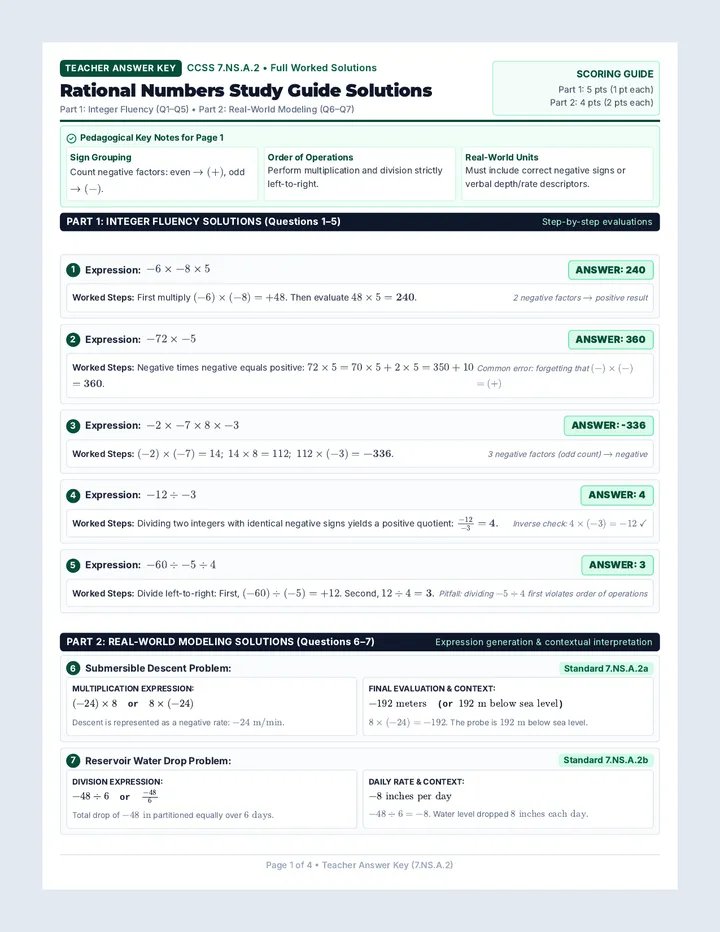
TEACHER ANSWER KEY CCSS 7.NS.A.2 • Full Worked Solutions
Rational Numbers Study Guide Solutions
Part 1: Integer Fluency (Q1–Q5) • Part 2: Real-World Modeling (Q6–Q7)
SCORING GUIDE
Part 1: 5 pts (1 pt each)
Part 2: 4 pts (2 pts each)
Pedagogical Key Notes for Page 1
Sign Grouping Count negative factors: even \(\rightarrow (+)\), odd \(\rightarrow (-)\).
Order of Operations Perform multiplication and division strictly left-to-right.
Real-World Units Must include correct negative signs or verbal depth/rate descriptors.
PART 1: INTEGER FLUENCY SOLUTIONS (Questions 1–5) Step-by-step evaluations
1 Expression: \(-6 \times -8 \times 5\)
ANSWER: 240
Worked Steps: First multiply \((-6) \times (-8) = +48\). Then evaluate \(48 \times 5 = \mathbf{240}\).
2 negative factors \(\rightarrow\) positive result
2 Expression: \(-72 \times -5\)
ANSWER: 360
Worked Steps: Negative times negative equals positive: \(72 \times 5 = 70 \times 5 + 2 \times 5 = 350 + 10 = \mathbf{360}\).
Common error: forgetting that \((-) \times (-) = (+)\)
3 Expression: \(-2 \times -7 \times 8 \times -3\)
ANSWER: -336
Worked Steps: \((-2) \times (-7) = 14\); \(14 \times 8 = 112\); \(112 \times (-3) = \mathbf{-336}\).
3 negative factors (odd count) \(\rightarrow\) negative
4 Expression: \(-12 \div -3\)
ANSWER: 4
Worked Steps: Dividing two integers with identical negative signs yields a positive quotient: \(\frac{-12}{-3} = \mathbf{4}\).
Inverse check: \(4 \times (-3) = -12\) \(\checkmark\)
5 Expression: \(-60 \div -5 \div 4\)
ANSWER: 3
Worked Steps: Divide left-to-right: First, \((-60) \div (-5) = +12\). Second, \(12 \div 4 = \mathbf{3}\).
Pitfall: dividing \(-5 \div 4\) first violates order of operations
PART 2: REAL-WORLD MODELING SOLUTIONS (Questions 6–7) Expression generation & contextual interpretation
6 Submersible Descent Problem:
Standard 7.NS.A.2a
MULTIPLICATION EXPRESSION:
\((-24) \times 8\) or \(8 \times (-24)\)
Descent is represented as a negative rate: \(-24\text{ m/min}\).
FINAL EVALUATION & CONTEXT:
\(-192\text{ meters}\) (or \(192\text{ m below sea level}\))
\(8 \times (-24) = -192\). The probe is \(192\text{ m}\) below sea level.
7 Reservoir Water Drop Problem:
Standard 7.NS.A.2b
DIVISION EXPRESSION:
\(-48 \div 6\) or \(\frac{-48}{6}\)
Total drop of \(-48\text{ in}\) partitioned equally over \(6\text{ days}\).
DAILY RATE & CONTEXT:
\(-8\text{ inches per day}\)
\(-48 \div 6 = -8\). Water level dropped \(8\text{ inches each day}\).
Page 1 of 4 • Teacher Answer Key (7.NS.A.2)
TEACHER ANSWER KEY CCSS 7.NS.A.2c • Signed Fraction Division
Part 3: Dividing Signed Fractions Solutions
SCORING GUIDE
Part 3: 10 pts (2 pts each)
1 pt reciprocal setup, 1 pt simplified answer
Grading Criteria & Key Mathematical Practices
Reciprocal Execution Verify students invert ONLY the divisor (second fraction).
Negative Sign Placement Check that \(-\frac{a}{b} \times \left(-\frac{c}{d}\right) = +\frac{ac}{bd}\).
Simplest Form Accept either fully simplified improper fractions or mixed numbers.
PART 3: SIGNED FRACTION SOLUTIONS (Questions 8–12) Complete cross-simplification steps shown
8 Problem: \(-\frac{5}{6} \div \left(-\frac{10}{21}\right)\)
ANSWER: \(\frac{7}{4}\) or \(1\frac{3}{4}\)
Worked Solution: \(\text{Negative} \div \text{Negative} = \text{Positive}\)
\(-\frac{5}{6} \times \left(-\frac{21}{10}\right) = \frac{5 \times 21}{6 \times 10} = \frac{1 \times 7}{2 \times 2} = \mathbf{\frac{7}{4}} = \mathbf{1\frac{3}{4}}\)
Cross-cancel \(5\) and \(10\) by dividing by \(5\) (\(1\) and \(2\)); cross-cancel \(6\) and \(21\) by dividing by \(3\) (\(2\) and \(7\)).
9 Problem: \(\frac{7}{12} \div (-14)\)
ANSWER: \(-\frac{1}{24}\)
Worked Solution: Rewrite \(-14\) as \(-\frac{14}{1}\); reciprocal is \(-\frac{1}{14}\)
\(\frac{7}{12} \times \left(-\frac{1}{14}\right) = -\frac{7 \times 1}{12 \times 14} = -\frac{1 \times 1}{12 \times 2} = \mathbf{-\frac{1}{24}}\)
Cross-cancel \(7\) and \(14\) by dividing by \(7\) (\(1\) and \(2\)). Result has \(1\) negative factor \(\rightarrow\) negative.
10 Problem: \(-2\frac{2}{5} \div \left(-\frac{8}{15}\right)\)
ANSWER: \(\frac{9}{2}\) or \(4\frac{1}{2}\)
Worked Solution: Convert mixed number: \(-2\frac{2}{5} = -\frac{12}{5}\)
\(-\frac{12}{5} \div \left(-\frac{8}{15}\right) = -\frac{12}{5} \times \left(-\frac{15}{8}\right) = \frac{12 \times 15}{5 \times 8} = \frac{3 \times 3}{1 \times 2} = \mathbf{\frac{9}{2}} = \mathbf{4\frac{1}{2}}\)
Divide \(12\) and \(8\) by \(4\) (\(3\) and \(2\)); divide \(15\) and \(5\) by \(5\) (\(3\) and \(1\)).
11 Problem: \(-3\frac{3}{8} \div 1\frac{7}{16}\)
ANSWER: \(-\frac{54}{23}\) or \(-2\frac{8}{23}\)
Worked Solution: Improper conversions: \(-3\frac{3}{8} = -\frac{27}{8}\), \(1\frac{7}{16} = \frac{23}{16}\)
\(-\frac{27}{8} \times \frac{16}{23} = -\frac{27 \times 16}{8 \times 23} = -\frac{27 \times 2}{1 \times 23} = \mathbf{-\frac{54}{23}} = \mathbf{-2\frac{8}{23}}\)
Cross-cancel \(16\) and \(8\) by dividing by \(8\) (\(2\) and \(1\)). \(23\) is prime, so \(\frac{54}{23}\) is fully simplified.
12 Problem: \(\frac{-\frac{9}{20}}{\frac{27}{35}}\)
ANSWER: \(-\frac{7}{12}\)
Worked Solution: Rewrite fraction bar as division: \(-\frac{9}{20} \div \frac{27}{35}\)
\(-\frac{9}{20} \times \frac{35}{27} = -\frac{9 \times 35}{20 \times 27} = -\frac{1 \times 7}{4 \times 3} = \mathbf{-\frac{7}{12}}\)
Cross-cancel \(9\) and \(27\) by dividing by \(9\) (\(1\) and \(3\)); cross-cancel \(35\) and \(20\) by dividing by \(5\) (\(7\) and \(4\)).
Page 2 of 4 • Teacher Answer Key (7.NS.A.2)
TEACHER ANSWER KEY CCSS 7.NS.A.2d • Long Division Gridline Solutions
Part 4: Long Division Conversions Solutions
SCORING GUIDE
Part 4: 6 pts (3 pts each)
2 pts division work, 1 pt correct notation/sign
Long Division Mastery Expectations & Common Errors
Decimal Placement Decimal point must be written directly above the dividend decimal.
Bar Placement In Q14, verify bar is ONLY over digit \(3\) (\(-0.58\overline{3}\)), NOT over \(5\) or \(8\).
Carry Negative Sign Remind students that original fractions were negative; quotients must be negative!
PART 4: LONG DIVISION STEP-BY-STEP KEYS (Questions 13–14) Complete division algorithms and remainder cycles
13 Convert \(-\frac{11}{16}\) using long division
CORRECT VALUE: -0.6875 (Terminating)
Completed Division Steps:
0.6875
16 11.0000
- 9.6 \((16 \times 6 = 96)\)
1.40 (remainder 14, bring down 0)
- 1.28 \((16 \times 8 = 128)\)
0.120 (remainder 12, bring down 0)
- 0.112 \((16 \times 7 = 112)\)
0.0080 (remainder 8, bring down 0)
- 0.0080 \((16 \times 5 = 80)\)
0 (Terminates!)
TEACHER CHECKPOINT 1
Sign: Negative numerator divided by positive denominator results in \(-0.6875\). Award 1 pt for sign accuracy.
TEACHER CHECKPOINT 2
Classification: Student must mark [ \(\checkmark\) ] Terminating because division ends with remainder \(0\).
FINAL ANSWER -0.6875
14 Convert \(-\frac{7}{12}\) using long division
CORRECT VALUE: -0.583̅ (Repeating)
Completed Division Steps:
0.5833...
12 7.0000
- 6.0 \((12 \times 5 = 60)\)
1.00 (remainder 10, bring down 0)
- 0.96 \((12 \times 8 = 96)\)
0.040 \(\leftarrow\) Remainder 4 occurs!
- 0.036 \((12 \times 3 = 36)\)
0.0040 \(\leftarrow\) Remainder 4 repeats!
- 0.0036 \((12 \times 3 = 36)\)
4 (Remainder repeats infinitely)
REPEATING REMAINDER
Cycle repeats at remainder 4. Each subtraction \(40 - 36 = 4\) reproduces quotient digit 3.
BAR NOTATION WARNING
Bar is placed only over the 3: \(-0.58\overline{3}\). Deduct 0.5 pt if student places bar over \(583\) or \(83\).
FINAL ANSWER \(-0.58\overline{3}\)
Page 3 of 4 • Teacher Answer Key (7.NS.A.2)
TEACHER ANSWER KEY CCSS 7.NS.A.2a, 7.NS.A.2b • Concept Classification
Part 5: Sign Sorting & T-Chart Classification Solutions
SCORING GUIDE
Part 5: 8 pts
6 pts T-chart (0.5 pt/item), 2 pts synthesis
Pedagogical Key: Negative Factor Counting Strategy
EVEN Number of Negative Signs \(\rightarrow\) POSITIVE (+) Pairs of negatives multiply to positives: \((-)\times(-) = (+)\).
ODD Number of Negative Signs \(\rightarrow\) NEGATIVE (-) All pairs become positive, leaving exactly one negative sign: \((+)\times(-) = (-)\).
QUESTION 15 MASTER SOLUTION & CLASSIFICATION TABLE Complete item-by-item breakdown
- POSITIVE EXPRESSIONS (> 0) [6 TOTAL]
- NEGATIVE EXPRESSIONS (< 0) [6 TOTAL]
B) \(\frac{-96}{-12}\) 2 negs \(\rightarrow +8\)
C) \((-3) \times 7 \times (-5)\) 2 negs \(\rightarrow +105\)
E) \((-1)(-2)(-3)(-5)\) 4 negs \(\rightarrow +30\)
F) \((-2)(-3)(-4)(-5)\) 4 negs \(\rightarrow +120\)
I) \(-\left(\frac{-25}{5}\right)\) 2 negs \(\rightarrow -(-5) = +5\)
L) \((-7) \times (-1) \times (-3) \times (-2)\) 4 negs \(\rightarrow +42\)
Total Positive Count: 6
A) \((-4)(-9)(-2)\) 3 negs \(\rightarrow -72\)
D) \(\frac{144}{-8}\) 1 neg \(\rightarrow -18\)
G) \(\frac{(-18)(-6)}{-4}\) 3 negs \(\rightarrow \frac{108}{-4} = -27\)
H) \((-8) \div (-2) \div (-2)\) 3 negs \(\rightarrow 4 \div (-2) = -2\)
J) \((-2) \times (-3) \times (-4)\) 3 negs \(\rightarrow -24\)
K) \(\frac{-54}{(-3)(-2)}\) 3 negs \(\rightarrow \frac{-54}{6} = -9\)
Total Negative Count: 6
Synthesis Questions Sample Exemplar Answers (2 points total):
a) Explain the counting rule (1 pt):
Prompt: How can you tell whether a product of 11 negative factors is positive or negative?
Exemplar Answer: "The product is NEGATIVE because 11 is an odd number. Every pair of negative factors multiplies to a positive (\(5\) pairs \(= 10\) negatives make positive), leaving one negative factor remaining that makes the entire product negative."
b) Sign reasoning challenge (1 pt):
Prompt: What is the sign of \((-8) \times 3 \times (-5) \times (-2) \times 7 \times (-1)\)? Justify:
Exemplar Answer: "The product is POSITIVE (+). Counting the negative factors (\(-8, -5, -2, -1\)), there are exactly 4 negative factors. Since 4 is an even number, all negative signs pair up to produce a positive result."
Teacher Remediation Guide for Common Student Misconceptions:
Misconception 1: Over-generalizing Signs
Students often say "two negatives make a positive" during addition (e.g. \(-3 + (-5) = 8\)). Reiterate that this rule applies strictly to multiplication and division.
Misconception 2: Inverting Both Fractions
Students mistakenly invert both the dividend and divisor. Reinforce: "Keep the first fraction, Change division to multiplication, Flip ONLY the second fraction."
Misconception 3: Bar Over Entire Decimal
In \(-\frac{7}{12} = -0.58\overline{3}\), students write \(-0.\overline{583}\). Point to the subtraction steps: remainders \(10\) and \(4\) occur once; only remainder \(4\) repeats!
Page 4 of 4 • Teacher Answer Key (7.NS.A.2)