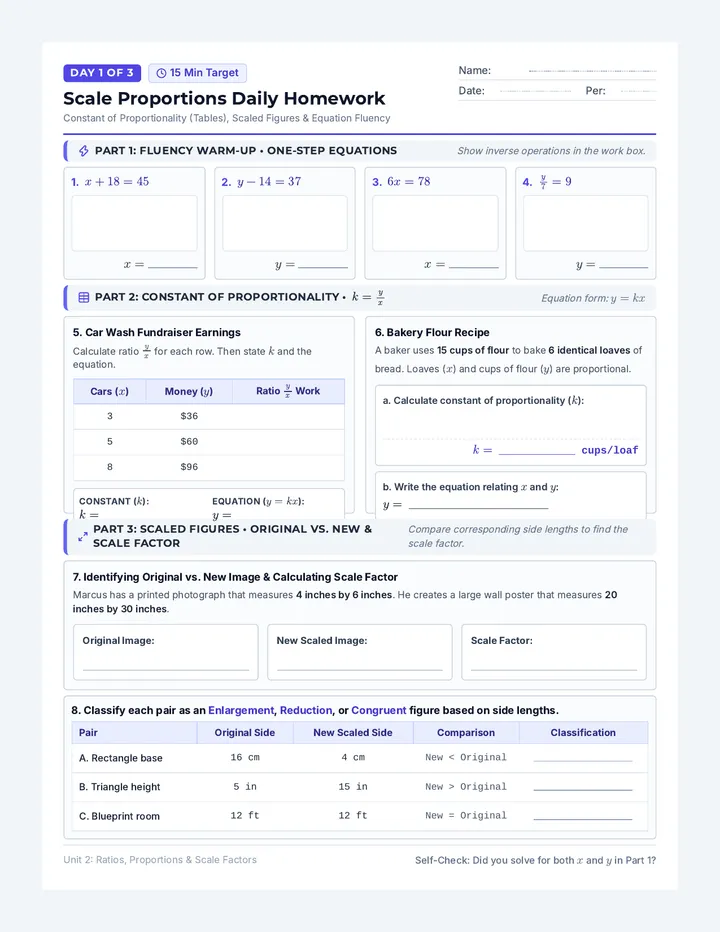
A comprehensive 7th-grade math lesson based on Texas Bluebonnet Learning Module 1 Topic 3 (Proportionality). Students explore the constant of proportionality ($k = y/x$), represent proportional relationships using tables, graphs through the origin, and equations ($y = kx$), and apply these concepts to real-world rate scenarios.
2. Locate the coordinate point \((1, k)\):
The point is (1, ). In this context, this point means:
Constant \(k\):
Equation:
4 Application: The Community Garden Watering System
A solar-powered irrigation system delivers 45 gallons of water in 6 minutes at a steady, continuous rate.
A. Find the constant rate \(k\) (gallons per minute):
B. Write the equation relating gallons (\(g\)) to minutes (\(m\)):
g =
C. Use your equation to calculate how many gallons will be pumped in 22 minutes:
5 Mathematical Reasoning: Error Analysis
Critique & Explain: Marcus is given a proportional data set where an input of \(x = 4\) yields an output of \(y = 20\). Marcus claims that the constant of proportionality is \(k = \frac{1}{5}\) and writes the equation as \(y = \frac{1}{5}x\).
Identify Marcus's error:
Correct \(k\) and correct equation:
Correct \(k\): Correct Equation:
Bluebonnet Learning Grade 7 Math • Module 1 Topic 3: Proportionality Page 2 of 2
Misconception 1: Calculating \(\frac{x}{y}\) instead of \(\frac{y}{x}\)
Why students do it: Students often divide the smaller number into the larger number or divide whichever column appears first.
Teacher Prompt: "Remember unit rate phrasing: 'miles per hour' means miles divided by hours (\(y \div x\)). The dependent variable always sits on top!"
Misconception 2: Believing any linear graph is proportional
Why students do it: They see a straight line and assume constant rate means proportional, forgetting the origin constraint.
Teacher Prompt: "If you work 0 hours, do you get paid $20? In a direct proportion, zero input MUST equal zero output: \((0, 0)\)."
Misconception 3: Checking only the first row in a table
Why students do it: Students calculate \(\frac{y_1}{x_1}\) and assume the rest follow the pattern without testing remaining pairs.
Teacher Prompt: "A rule isn't constant until it survives at least three trials. Always calculate every single row!"
Tiered Differentiation Strategies
Support / Scaffolding
Provide index cards with the formula \(k = \frac{y}{x}\) prominently displayed.
Have students highlight \(x\) in yellow and \(y\) in blue across all tables and word problems.
Provide pre-drawn arrows from \(y\) to \(x\) with division symbols.
On-Level Reinforcement
Require students to explain in full sentences what \((1, k)\) means in the context of the story.
Have students generate a fourth coordinate pair that fits each proportional table.
Extension / Challenge
Introduce fractional or decimal constants of proportionality (e.g., \(k = \frac{2}{3}\) or \(k = 0.75\)).
Have students compare two competing rates on a single graph and determine which represents a better deal.
Marcus's Mistake: Marcus inverted the ratio! He divided \(x\) by \(y\) (\(\frac{4}{20} = \frac{1}{5}\)) instead of dividing the output \(y\) by the input \(x\) (\(k = \frac{y}{x}\)).