Complex Vectors Slides COMPLEX VECTORS
Visualizing Complex Operations
The Complex Plane
How do we graph z = -3 - 5i?
HOOK: 5 MIN
Embedded media
Watch & Wonder
Which axis represents the real part?
Where does the imaginary part go?
Look for the "i" inclusion error!
Anatomy of a Complex Number
z = a + bi
Standard Form
Real Part
Re(z) = a
Imaginary Part
Im(z) = b
⚠️ Do not include the 'i'!
Algebraic Addition
10 MIN
To add complex numbers, combine the Like Parts.
(a + bi) + (c + di) = (a + c) + (b + d)i
Example 1
\( (2 + 3i) + (4 + 1i) \)
\( = 6 + 4i \)
Example 2
\( (-1 + 2i) + (4 + 3i) \)
\( = 3 + 5i \)
The Visual Challenge
If we represent complex numbers as vectors (arrows starting from the origin), how does the addition look on a graph?
Plot \( z_1 \)
Plot \( z_2 \)
Plot \( z_1 + z_2 \)
The Parallelogram Rule
The Discovery
When you add \( z_1 + z_2 \), the resulting point forms the opposite corner of a parallelogram defined by the original vectors.
Key Takeaway
Geometric addition = Head-to-Tail addition.
Algebra = Geometry
(a + bi) + (c + di)
Summing the parts
Completing the Parallelogram
They are two ways of saying the exact same thing!
Vector Addition Worksheet Vector Addition
12th Grade Pre-Calculus | Complex Operations
Name:
Date:
Part 1: The Complex Plane
Based on the video segment, identify the parts of the following complex numbers.
\( z_1 = 4 - 2i \)
Re(z):
Im(z):
\( z_2 = -3 + 5i \)
Re(z):
Im(z):
Part 2: Algebraic Sums
Solve each sum. Show the grouped real and imaginary parts.
\( (3 + 4i) + (2 + 1i) = \)
\( (-5 + 2i) + (4 - 6i) = \)
Part 3: The Parallelogram Discovery
Use your Complex Plane Grid to complete these steps. Use three different colored pencils if possible (one for \( z_1 \), one for \( z_2 \), and one for the sum).
CASE A: Quadrant I Sum
Given \( z_1 = 4 + 2i \) and \( z_2 = 1 + 5i \)
Plot \( z_1 \) and \( z_2 \) as vectors (arrows from the origin).
Calculate the algebraic sum: \( z_{sum} = \)
Plot \( z_{sum} \) as a vector on the same grid.
Draw dashed lines from the head of \( z_1 \) to the head of \( z_{sum} \), and from the head of \( z_2 \) to the head of \( z_{sum} \).
What shape is formed by the four points? (Origin, head of \( z_1 \), head of \( z_2 \), and head of \( z_{sum} \))
CASE B: Crossing Axes
Given \( z_1 = -3 + 4i \) and \( z_2 = 5 - 1i \)
Calculate the algebraic sum: \( z_{sum} = \)
Graph all three vectors on a new grid.
Complete the parallelogram. Does the rule still hold true?
Final Reflection
In your own words, explain how you can find the sum of two complex numbers graphically WITHOUT doing the math first.
Complex Plane Grid Complex Plane Grids
Horizontal Axis: Real (Re) | Vertical Axis: Imaginary (Im)
Im
Re
Grid A
Im
Re
Grid B
Im
Re
Grid C
Im
Re
Grid D
Pre-Calculus | Unit: Complex Numbers
Page 1 of 1
Complex Vectors Teacher Guide Teacher Facilitation Guide
Complex Vectors & Addition
12th Grade Pre-Calculus
Duration: 45 Minutes
Learning Objective
Students will transition from algebraic complex addition to geometric vector addition. By the end of the lesson, they should be able to predict the sum of two complex numbers using the parallelogram rule on the complex plane.
Materials
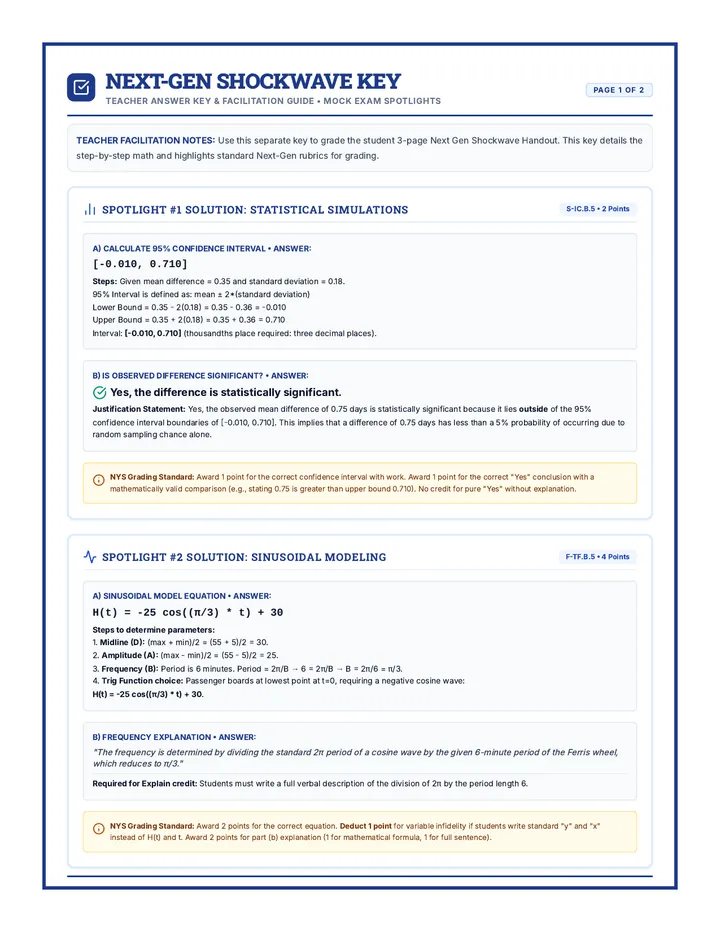
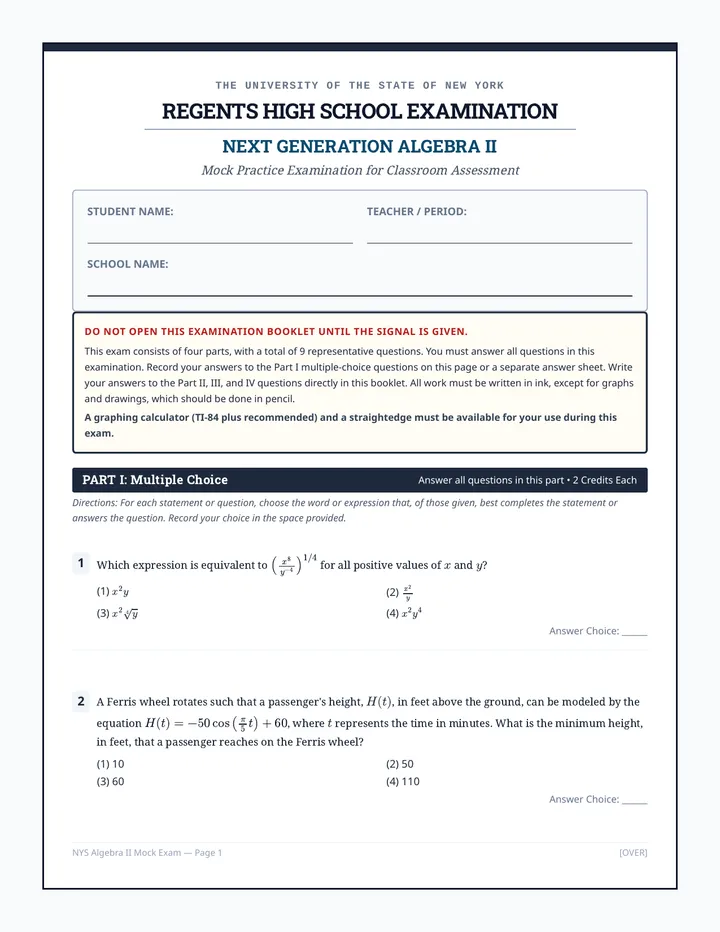
• Complex Vectors Slides
• Vector Addition Worksheet
• Complex Plane Grids
• Colored Pencils (Red, Blue, Black)
Instructional Pacing
00-05m
Hook: Video Analysis
Play segment 2:48–5:50 of the "Parts of Complex Numbers" video.
Key Pause Point (3:15): Ask students to write down the imaginary part of \( -3-5i \). Most will write \( -5i \). Let the video correct them to highlight that \( Im(z) \) is just the coefficient.
05-15m
Instruction: Algebraic Sums
Model 2 examples on the board. Emphasize that adding complex numbers is identical to "combining like terms" in algebra.
Reals go with Reals.
Imaginaries go with Imaginaries.
15-40m
Main Activity: Parallelogram Discovery
Students work through the "Vector Addition Worksheet" using the "Complex Plane Grids."
Facilitator Tips
Scaffolding: Ensure students draw arrows from the origin (0,0) to the point. Without the arrows, the "shape" of the parallelogram is harder to see.
Circulation: Watch for students who flip the axes (putting imaginary on the x-axis).
Worksheet Answer Key
Part 1: Video Review
\( z_1 \): Re=4, Im=-2
\( z_2 \): Re=-3, Im=5
Part 2: Algebraic Sums
1. \( 5 + 5i \)
2. \( -1 - 4i \)
Part 3: Discovery Cases
Case A Sum: \( 5 + 7i \)
Visual check: Does the point (5,7) form a parallelogram with (4,2) and (1,5)? Yes.
Case B Sum: \( 2 + 3i \)
Visual check: Does the point (2,3) form a parallelogram with (-3,4) and (5,-1)? Yes.
Reflection Exemplar
"To find the sum graphically, you can treat each number as a vector from the origin. If you draw the two vectors, then copy each vector and place it at the tip of the other, they will meet at the sum. This creates a parallelogram."