Business Mathematics Semester Final Exam Page 1 of 4 • Questions 1–8
2 Points Each
9. Which of the following is classified as an optional voluntary paycheck deduction?
A) Federal Income Tax (FIT)
B) 401(k) Retirement Fund Contribution
C) FICA Medicare Tax
D) State Income Tax (SIT)
10. If an employee has $2,400.00 in gross earnings and $620.00 in total deductions, Net Pay is:
A) $3,020.00
B) $1,780.00 ($2,400.00 - $620.00)
C) $1,880.00
D) $1,500.00
11. Which of the following expenditures is correctly classified as a fixed essential need?
A) Monthly apartment lease ($1,150.00)
B) Electric heating utility bill ($90–$180)
C) Grocery food purchases
D) Restaurant dining out
12. Why must personal household budgets ALWAYS be constructed using Net Income?
A) Net income is larger than gross income
B) Gross income includes taxes already withheld and unspendable
C) Banks require gross income for personal checking accounts
D) Net pay represents pre-tax contract figures
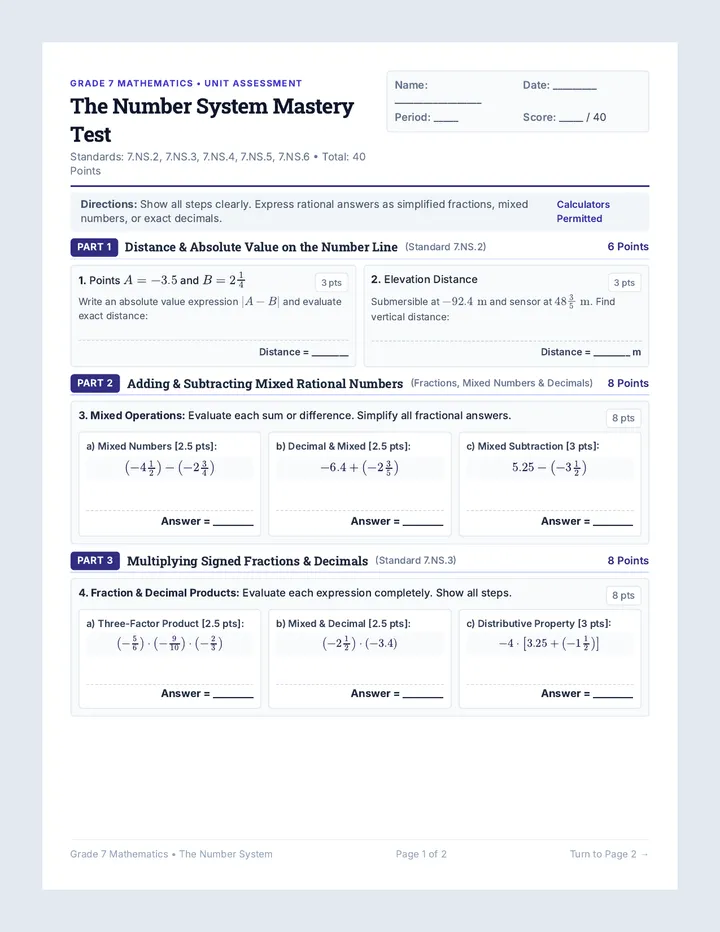
13. Under UCC law, if the numeric box ($85.00) conflicts with the written words line on a check:
A) The numeric box amount is honored
B) The check is voided immediately
C) The written words legally control and govern
D) The bank processes the average of both
14. What is the standard bank reconciliation formula to establish the true adjusted balance?
A) Stmt Balance - Deposits in Transit + Outstanding Checks
B) Stmt Balance + Deposits in Transit - Outstanding Checks
C) Check Register Balance + Statement Balance ÷ 2
D) Check Register Balance - Bank Fees
15. In the compound interest formula \( A = P(1 + r/n)^{nt} \), what does the variable \( n \) represent?
A) Total number of years invested
B) Number of compounding cycles per year
C) Net annual percentage rate
D) Initial principal deposit
The bar graph below illustrates the Davis family's recorded heating utility expenditures across four consecutive months:
$200 $100 $0 $180 Jan $210 Feb $150 Mar $120 Apr
Q16. Total & Average Monthly Expense (5 Pts):
Total Spent (Sum): $180 + $210 + $150 + $120 = $____________
Average Monthly Expense (Total ÷ 4): $____________ / mo
Q17. Seasonal Variance Analysis (5 Pts):
What is the dollar variance between peak winter (Feb) and spring (Apr)?
$210.00 - $120.00 = $____________
Business Mathematics Semester Final Exam Page 2 of 4 • Questions 9–17
Complete the comparative matrix below analyzing the fundamental compensation architectures:
| Compensation Model | Core Mathematical Formula | FLSA Overtime / Legal Protection | Typical Industry |
|---|---|---|---|
| Straight-Time Hourly | Gross Pay = Hours × Rate | 1.5× regular wage after 40 hours in work week | Retail, Warehousing |
| Piecework Production | Gross Pay = ____________________ | Under FLSA, if effective rate < minimum wage: ____________________ | Manufacturing, Garment |
| Salaried Contract | Paycheck = Annual Salary ÷ ______ | Exempt roles receive fixed contract pay regardless of hours worked | Management, Teaching |
Show complete mathematical setup
Hourly Rate: $20.00 / hr
Marcus worked 46 total hours this week. Total statutory and voluntary deductions equal 24% of his gross pay.
OT Rate (1.5x): $___________ / hr
Regular Pay (40 hrs): $___________
Overtime Pay (6 hrs): $___________
Total Gross Pay: $___________
Total Deductions (Gross × 0.24): $____________________
Final Net Take-Home Pay (Gross - Deductions): $____________________
Statement Bal: $1,550.00
Reconcile the bank statement against the personal register. Statement ending balance is $1,550.00. Outstanding deposits in transit total $320.00. Outstanding uncleared checks total $190.00. The register balance is $1,685.00, with an unrecorded $5.00 bank maintenance fee.
Step 1: Statement Ending Balance: $1,550.00
Step 2: Add Outstanding Deposit (+): +$320.00 → Subtotal: $____________________
Step 3: Deduct Outstanding Checks (-): -$190.00
Reconciled Adjusted Bank Balance = $____________________
Register Adjustment ($1,685.00 - $5.00 fee) = $1,680.00. Do they balance? [ YES / NO ]
Business Mathematics Semester Final Exam Page 3 of 4 • Sections 3 & 4
College & Career Readiness
4 Points Each
20. (Algebraic Modeling) An employee earns a base rate of \( x \) dollars/hr for up to 40 hours in a week and \( 1.5x \) for overtime hours. If the employee logs 46 hours and earns $1,029.00 in gross wages, which equation models this scenario to solve for \( x \)?
A) \( 46(1.5x) = 1,029 \)
B) \( 40x + 6(1.5x) = 1,029 \)
C) \( 40x + 1.5x = 1,029 \)
D) \( 46x + 6(1.5) = 1,029 \)
21. (Pay Frequency Analysis) Employee A earns an annual salary of $52,000 paid bi-weekly across 26 pay periods. Employee B earns $52,000 paid semi-monthly across 24 pay periods. How does Employee A's paycheck compare to Employee B's paycheck?
A) Employee A receives $166.67 less per paycheck
B) Employee A receives $166.67 more per paycheck
C) Employee A receives $200.00 less per paycheck
D) Both employees receive identical check amounts
22. (Tiered Commission) A sales agent earns a $500 base weekly salary plus 4% commission on sales up to $40,000, and 7% on sales exceeding $40,000. If the agent generates $55,000 in total sales, what is their total gross compensation?
A) $2,600.00
B) $3,150.00 [ $500 + $1,600 + $1,050 ]
C) $3,850.00
D) $4,350.00
23. (Budget Inequality Constraints) A financial guideline recommends spending 25% to 28% of monthly net income on housing. If an individual's net monthly income is $3,200.00, which inequality represents all permissible monthly housing payments, \( h \)?
A) \( 750 \le h \le 840 \)
B) \( 800 \le h \le 896 \)
C) \( 850 \le h \le 920 \)
D) \( 960 \le h \le 1,120 \)
24. (Comparative Interest Yield) Maya invests $2,000 at 5% simple annual interest for 2 years (\( I = Prt \)). Leo invests $2,000 at 5% compounded annually for 2 years (\( A = P(1+r)^t \)). How much more interest does Leo earn than Maya after 2 years?
A) $2.50
B) $5.00 [ $205.00 - $200.00 ]
C) $10.00
D) $20.00
Comprehensive Synthesis
Prompt: Compare an hourly job paying $22.00/hr (with overtime potential) versus a salaried contract position paying $48,000/year (exempt status). In your essay: (1) Contrast the legal overtime rules under the FLSA; (2) Explain how mandatory deductions (FICA: 6.2% SS + 1.45% Medicare, FIT, SIT) impact net take-home pay differently; and (3) Discuss why personal budgeting must strictly rely on Net Pay rather than Gross Income.
Business Mathematics Semester Final Exam Page 4 of 4 • Sections 5 & 6
Item 13 (UCC Rules): Under UCC Article 3, written words control figures because handwritten words are deliberate and harder to alter fraudulently than numeric digits.
Business Math Cumulative Final Exam Teacher Guide Page 1 of 3 • Sections 1 & 2 Keys
Teacher Solution Guide & Rubric
25 Points Total (Sec 3: 10 pts | Sec 4: 15 pts)
Award up to 5 points per blank row based on accuracy of formula and FLSA regulatory knowledge:
| Compensation Model | Core Mathematical Formula | FLSA Overtime / Legal Protections | Typical Industry |
|---|---|---|---|
| Straight-Time Hourly | Gross Pay = Hours × Rate | 1.5× regular hourly wage for cumulative weekly hours over 40. | Retail, Warehousing |
| Piecework Production | Gross Pay = Units × Rate/Unit | ||
| Eff Rate = Gross ÷ Hours | Employer must make up shortfall if effective hourly rate falls below minimum wage. | Manufacturing, Garment, Agriculture | |
| Salaried Contract | Paycheck = Annual Salary ÷ Pay Periods (52, 26, 24, 12) | Exempt professional/executive staff do not earn overtime; pay is fixed regardless of hours. | Management, Teaching, Software |
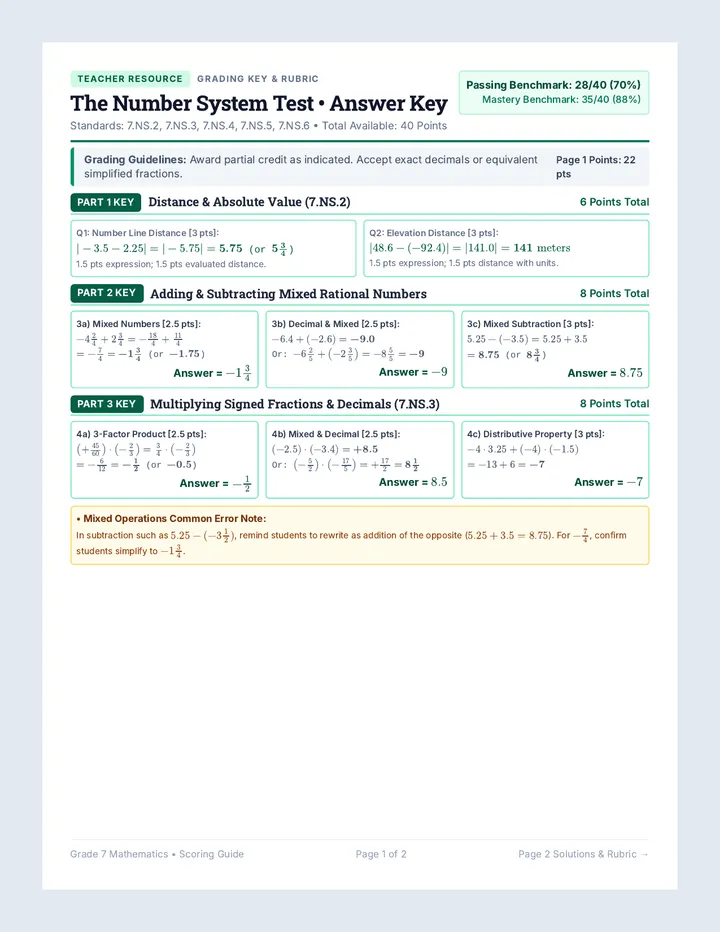
Problem 18: Overtime & Paycheck Deductions Lab Solution (7.5 Pts) Rate: $20.00 / hr
OT Rate (1 Pt):$20 × 1.5 = $30.00/hr
Regular Pay (1 Pt):40 × $20 = $800.00
OT Pay (1 Pt):6 × $30 = $180.00
Total Gross (1.5 Pts):$800 + $180 = $980.00
Total Deductions (1.5 Pts):$980.00 × 0.24 = $235.20
Final Net Pay (1.5 Pts):$980.00 - $235.20 = $744.80
Problem 19: Bank Statement Reconciliation Solution (7.5 Pts) Stmt Bal: $1,550.00
• Step 1 (1.5 pts): Statement Ending Balance = $1,550.00
• Step 2 (2 pts): Add Outstanding Deposit: $1,550.00 + $320.00 = $1,870.00 Subtotal
• Step 3 (2 pts): Deduct Outstanding Checks: $1,870.00 - $190.00 = $1,680.00 Adjusted Bank Balance
• Register Verification (2 pts): $1,685.00 Register - $5.00 Bank Maintenance Fee = $1,680.00 Adjusted Register Balance. Balances match exactly: [ YES ]
Business Math Cumulative Final Exam Teacher Guide Page 2 of 3 • Sections 3 & 4 Keys
Teacher Solution Guide & Rubric
35 Points Total (Sec 5: 20 pts | Sec 6: 15 pts)
Q20. Key: B — Overtime linear equation: 40 hours at baseline \( x \) plus 6 overtime hours at \( 1.5x \) equals total gross earnings of $1,029.00: \( 40x + 6(1.5x) = 1,029 \). (Solving: \( 49x = 1029 \rightarrow x = \$21.00 \)/hr).
Q21. Key: A — Pay frequency division: Employee A receives $52,000 ÷ 26 = $2,000.00. Employee B receives $52,000 ÷ 24 = $2,166.67. Employee A's paycheck is $166.67 less than Employee B's paycheck ($2,166.67 - $2,000.00).
Q22. Key: B — Tiered commission calculation: Base $500 + ($40,000 × 0.04 = $1,600) + ($15,000 excess × 0.07 = $1,050) = $500 + $1,600 + $1,050 = $3,150.00.
Q23. Key: B — Budget inequality test: Lower rent limit = $3,200 × 0.25 = $800.00; Upper rent limit = $3,200 × 0.28 = $896.00. Permissible housing range is \( 800 \le h \le 896 \).
Q24. Key: B — Compound vs simple yield: Account X (simple) earns \( I = 2000 \times 0.05 \times 2 = \$200.00 \). Account Y (compound) yields \( A = 2000(1.05)^2 = 2000(1.1025) = \$2,205.00 \), earning $205.00 in interest. Difference = $205 - $200 = $5.00 more.
1. FLSA Overtime Rules (5 Pts)
• 5 pts: Thoroughly explains that Job A (hourly non-exempt) is entitled to 1.5x regular pay ($33.00/hr) for all hours over 40 in a work week under the FLSA, whereas Job B (salaried exempt) receives a fixed $48,000 contract regardless of hours logged.
• 3 pts: Identifies 1.5x rate but omits FLSA weekly 40-hr threshold.
2. Net Pay & Deductions (5 Pts)
• 5 pts: Identifies mandatory statutory withholdings (FICA: 6.2% Social Security + 1.45% Medicare, FIT, SIT) and optional voluntary deductions (401k, health); clearly explains why personal budgets must use Net Pay rather than Gross to avoid debt.
• 3 pts: Mentions taxes but fails to cite exact FICA percentages.
3. Synthesis & Clarity (5 Pts)
• 5 pts: Demonstrates logical organization, accurate financial terminology, sound mathematical reasoning, and professional sentence structure throughout the response.
• 3 pts: Basic response with minor structural gaps.
Benchmark Model Takeaway: High-scoring student responses clearly state: "Budgeting on Gross Pay creates immediate cash deficits because taxes are subtracted before the paycheck clears. An employee taking home $3,000 net who budgets based on $4,000 gross will quickly accumulate high-interest debt."
Business Math Cumulative Final Exam Teacher Guide Page 3 of 3 • Sections 5 & 6 Keys