Surface Area Lab Workbook
NSW Mathematics Stage 5 • Area & Surface Area A
Surface Area Lab Workbook
Scaffolded Practice, Labelled Diagrams & Real-World Engineering Challenges
Skill Tiers
Entry • Core • Challenge
Name: _______________________
Class: ______________
Date: ______________
Curriculum Mastery Checklist (9 Sections • 135 Questions)
1. Composite Shapes: Practical area problems
2. Prism Anatomy: Edges & faces of prisms
3. Justifying Nets: Valid vs invalid prism nets
4. Building Nets: Create & rearrange nets
5. SA from Nets: Calculate SA using nets
6. Prism SA: Solve prism SA problems
7. Curved Surface: Cylinder label as rectangle
8. Cylinder Formula: \(A = 2\pi r^2 + 2\pi r h\)
9. Composite Solids: Cylinders & prisms
Essential Formula Toolkit
Rectangle & Triangle
Rectangle: \(A = l \times w\)
Triangle: \(A = \frac{1}{2} b h\)
Trapezium: \(A = \frac{h}{2}(a + b)\)
Circles & Sectors
Area: \(A = \pi r^2\)
Circumference: \(C = 2\pi r = \pi d\)
Semicircle: \(A = \frac{1}{2}\pi r^2\)
Prisms & Cylinders
Rect. Prism: \(SA = 2(lb+lh+bh)\)
Any Prism: \(SA = 2A_{\text{base}} + P_{\text{base}}h\)
Closed Cylinder: \(SA = 2\pi r^2 + 2\pi r h\)
How to Use This Workbook
Q1–Q4: Entry
Follow the guided prompts and fill-in-the-blank steps to build confidence.
Q5–Q10: Core & Challenge
Apply formulas independently. Look for the CHALLENGE badge for extension thinking.
Q11–Q15: Real Life
Solve practical design, trade, and packaging problems. Always include units (e.g. \(\text{cm}^2, \text{m}^2\)).
Section 1 • Area of 2D Figures
Composite Shapes
Dot Point 1
Worked Example Strategy: Split into simpler shapes & add (or enclose & subtract)
8 cm 9 cm 14 cm 4 cm A B
Find the total area of the L-shaped plate.
Step 1 (Find missing height of A): \(9 - 4 = 5\text{ cm}\).
Step 2 (Area of Top Rectangle A): \(A_A = 8 \times 5 = 40\text{ cm}^2\).
Step 3 (Area of Bottom Rectangle B): \(A_B = 14 \times 4 = 56\text{ cm}^2\).
Step 4 (Total Area): \(40 + 56 = \mathbf{96\text{ cm}^2}\).
Q1. Guided Split ENTRY
5 cm 7 cm 10 cm 3 cm
Top height = \(7 - 3 =\) ____
\(A_{\text{top}} = 5 \times\) ____ \(=\) ____
\(A_{\text{bot}} = 10 \times 3 =\) ____
Total = ________ \(\text{cm}^2\)
Q2. House Shape ENTRY
8 m 5 m 3 m
\(A_{\text{tri}} = \frac{1}{2} \times 8 \times\) ____
\(A_{\text{rect}} = 8 \times\) ____
Total = ________ \(\text{m}^2\)
Q3. Cut-Out Corner ENTRY
12 cm 8 cm 4 cm 3 cm
Subtract method:
Full = \(12 \times 8 =\) ____
Cut = \(4 \times 3 =\) ____
Area = ________ \(\text{cm}^2\)
Q4. Stadium Track End ENTRY
10 m 6 m
Radius \(r = 6 \div 2 =\) ____
\(A_{\text{rect}} = 10 \times 6 =\) ____
\(A_{\text{semi}} = \frac{1}{2}\pi r^2 \approx\) ____
Total (1 d.p.) = ______ \(\text{m}^2\)
Section 1 • Composite Shapes (Core & Challenge) Round to 2 d.p. where needed
Q5. T-Beam Cross Section CORE
16 cm 4 cm 9 cm 5 cm
Calculate the total area of the T-shaped beam cross-section.
Q6. Arrow Signpost CORE
12 cm 6 h=8 Tip base = 12 cm
Rectangle \(12 \times 6\text{ cm}\) joined to triangle of base \(12\text{ cm}\) and height \(8\text{ cm}\).
Q7. Shaded Picture Frame CORE
20 cm 14 12 × 8 cm
Find the shaded frame area. Outer: \(20 \times 14\text{ cm}\). Inner hole: \(12 \times 8\text{ cm}\).
Q8. Double-Ended Capsule CHALLENGE
15 m w = 8 m
Two semicircles at the ends of a \(15\text{ m} \times 8\text{ m}\) rectangle. Find total area (2 d.p.).
Q9. Missing Side Length CHALLENGE
6 cm x 14 cm 4 cm
Total area is \(92\text{ cm}^2\). Find the unknown height \(x\).
Q10. Quarter-Circle Corner CHALLENGE
12 cm 9 cm r=5
A quarter-circle (\(r=5\text{ cm}\)) is cut from a \(12 \times 9\text{ cm}\) rectangle. Find shaded area (2 d.p.).
Section 1 • Real-Life Contexts (Composite Shapes) PRACTICAL APPLICATIONS
Q11. Backyard Timber Deck
6 m 4 3 m 2.5
Sam oils an L-shaped deck: \(6\text{ m} \times 4\text{ m}\) plus \(3\text{ m} \times 2.5\text{ m}\). Total area?
Q12. School Basketball Key
4.9 m 5.8 d=3.6 m
\(5.8\text{ m} \times 4.9\text{ m}\) rectangle + semicircle (\(d=3.6\text{ m}\)). Painted area (1 d.p.)?
Q13. Turfing Around a Pond SKETCH & SOLVE
A rectangular lawn is \(14\text{ m} \times 9\text{ m}\). A circular fishpond of radius \(2\text{ m}\) sits in the middle. Sketch and find how many \(\text{m}^2\) of turf are needed (1 d.p.).
Q14. Kitchen Stone Benchtop SKETCH & SOLVE
A \(3.2\text{ m} \times 0.9\text{ m}\) benchtop has a sink cutout of \(0.8\text{ m} \times 0.5\text{ m}\). Sketch it and find the cost at \(\$450/\text{m}^2\).
10 m 4 m h=3 m
Q15. Gable Wall Painting Quote (CHALLENGE)
A house gable wall is \(10\text{ m}\) wide, \(4\text{ m}\) tall to the eaves, with a triangular roof peak \(3\text{ m}\) high. Do not paint the door (\(2.1\text{ m} \times 1\text{ m}\)) or window (\(1.5\text{ m} \times 1.2\text{ m}\)). If 1 L of paint covers \(12\text{ m}^2\), how many whole litres are needed for 2 coats?
Section 2 • 3D Geometry Anatomy
Edge Lengths & Faces of Prisms
Dot Point 2
Worked Example A right prism has 2 identical bases + rectangular lateral faces
6 cm 5 cm 5 cm 10 cm
List all faces and their edge dimensions for this triangular prism.
Total Faces: 5 faces (2 triangles + 3 rectangles).
2 Triangular Bases: Each has sides \(6\text{ cm}, 5\text{ cm}, 5\text{ cm}\).
3 Rectangular Faces: Bottom is \(10\text{ cm} \times 6\text{ cm}\); two slanted sides are each \(10\text{ cm} \times 5\text{ cm}\).
Total Edges: 9 edges (6 base edges + 3 lateral edges of \(10\text{ cm}\)).
Q1. Rectangular Prism ENTRY
8 cm 5 4
Faces = ____ rectangles
Front/Back: ___ \(\times\) ___
Top/Bot: ___ \(\times\) ___
Left/Right: ___ \(\times\) ___
Q2. Cube Properties ENTRY
7 cm
Face shape: ________
No. of faces: ____
No. of edges: ____
Total edge length: ____
Q3. Right-Triangular Prism ENTRY
4 m 3 5 9 m
2 triangles: \(3 \times 4 \times 5\)
3 rectangles:
9 \(\times\) ___, 9 \(\times\) ___, 9 \(\times\) ___
Q4. Trapezoidal Prism ENTRY
10 6 12
Base shape: ________
Total faces: ____
Total edges: ____
Section 2 • Edge Lengths & Faces (Core & Challenge) Identify all faces & dimensions
Q5. Regular Pentagonal Prism CORE
4 cm 11 cm
List the number and dimensions of all faces.
Q6. Regular Hexagonal Prism CORE
5 m 8 m
How many faces, edges, and vertices? Find total edge length.
Q7. L-Shaped Prism CORE
5 cm 10
Cross-section edges \(6,5,2,3,4,2\text{ cm}\), depth \(10\text{ cm}\). List all 8 faces.
Q8. Reverse Edge Sum CHALLENGE
9 cm 4 h=?
Sum of all 12 edges is \(76\text{ cm}\). Find \(h\) and list all 6 faces.
Q9. Hidden Face Dimensions CHALLENGE
A rectangular prism has faces of area \(24\text{ cm}^2\), \(30\text{ cm}^2\), and \(20\text{ cm}^2\). Deduce the three edge lengths (\(l, w, h\)).
Q10. General \(n\)-gonal Prism CHALLENGE
Write algebraic expressions in terms of \(n\) (number of base sides) for the number of faces, edges, and vertices of any prism.
Section 2 • Real-Life Contexts (Prism Faces & Edges) PRACTICAL APPLICATIONS
Q11. Toblerone Chocolate Box
5 cm 28 cm
Equilateral tri-prism (\(5\text{ cm}\) side, \(28\text{ cm}\) long). List all printed faces & sizes.
Q12. Parcel Taping Edges
50 25 30
\(50 \times 30 \times 25\text{ cm}\) carton. Tape goes along every edge. Total metres?
Q13. Camping Tent Wedge SKETCH & SOLVE
A tent is a triangular prism \(2.2\text{ m}\) long, \(1.8\text{ m}\) wide floor, and \(1.4\text{ m}\) slant sides. Which faces are waterproof walls vs the groundsheet?
Q14. Timber Doorstop
10 cm 4 cm
Right-triangle (\(3, 10, 10.4\text{ cm}\)), width \(4\text{ cm}\). List 5 faces & largest face.
0.6 m 1.5 m
Q15. Museum Display Case Frame (CHALLENGE)
An open-bottom hexagonal prism glass case has hexagon side \(0.6\text{ m}\) and height \(1.5\text{ m}\). Aluminium trim is needed for all edges except the bottom hexagon resting on the plinth. Calculate total metres of trim and number of glass panels.
Section 3 • Spatial Reasoning
Recognise & Justify Prism Nets
Dot Point 3
Worked Example 3 Checks: (1) Right face count (2) Matching edge lengths (3) No overlapping faces
Does this diagram form a valid net of a cube? Justify your answer.
Decision: No, it is NOT a valid cube net.
Justification: Although it has 6 square faces, both top flaps are on the same side of the central strip. When folded up, they will overlap on the top face, leaving the bottom open.
Q1. Cube Net Check ENTRY
Valid cube net? Yes / No
Check: 6 squares? ____
Flaps on opposite sides? ____
Q2. Triangular Prism Net ENTRY
Valid net? Yes / No
3 rect + 2 tri? ____
Explain why:
Q3. Edge Mismatch Check ENTRY
18 10
Top flap = 18, bottom = 10.
Valid rect. prism? Yes / No
Why?
Q4. Z-Shaped Cube Net ENTRY
Valid cube net? Yes / No
Justify by imagining folding:
Section 3 • Justifying Prism Nets (Core & Challenge) State Yes/No and give a geometric reason
Q5. 2×3 Grid of Squares CORE
Can this \(2 \times 3\) grid fold into a cube? Explain what happens at the corners.
Q6. Unequal Triangle Edges CORE
4 5 6
Widths \(4, 5, 6\text{ cm}\); equilateral triangles of side \(5\text{ cm}\). Valid or invalid?
Q7. Pentagonal Prism Check CORE
5 equal rectangles + 2 opposite regular pentagons. Valid net? Explain.
Q8. 5-in-a-Row Cube Attempt CHALLENGE
Why can NO valid cube net ever have 5 squares in a single straight line? (Sketch a diagram to support your explanation.)
Q9. Impossible Triangle Sides CHALLENGE
3 4 9 cm
Widths \(3, 4, 9\text{ cm}\). Can this ever form a closed triangular prism net?
Q10. Rotated Rectangular Flap CHALLENGE
8 × 5 5×3 3cm
\(5 \times 3\) flap attached by its \(3\text{ cm}\) edge to an \(8 \times 5\) face. Will it fold cleanly?
Section 3 • Real-Life Contexts (Justifying Nets) PRACTICAL APPLICATIONS
Q11. Cereal Box Die-Cut
Both lid flaps are on the top side. What happens on the assembly line?
Q12. Flat-Pack Storage Cube
5 squares in a "+" shape. Is this a valid net for an open-top cube? Explain.
Q13. Gift Box Ribbon Alignment
T-net with red line across 4 vertical squares. Will it form a closed loop when folded?
Q14. Triangular Chocolate Sleeve SKETCH & SOLVE
A designer draws 3 rectangles (\(20 \times 4\text{ cm}\)) and attaches a \(4 \times 4 \times 4\text{ cm}\) triangle to the \(20\text{ cm}\) edge instead of the \(4\text{ cm}\) edge. Sketch why this fails.
16×9 16×4
Q15. Packaging Engineer Quality Audit (CHALLENGE)
A \(16 \times 9 \times 4\text{ cm}\) phone box net has one \(9 \times 4\) cap on the \(16 \times 9\) panel (\(9\text{ cm}\) edge) and the other \(9 \times 4\) cap on the \(16 \times 4\) panel (\(4\text{ cm}\) edge, opposite side). Will this fold into a closed box? Justify carefully.
Section 4 • Net Construction
Create & Rearrange Nets of Prisms
Dot Point 4
Worked Example Unfold the lateral band first, then attach the two bases
3×5 4×5 4×3 4×3
Draw a net for a \(4 \times 3 \times 5\text{ cm}\) prism & rearrange one base.
1. Lateral Strip: 4 rectangles of height \(5\text{ cm}\) and alternating widths \(3, 4, 3, 4\text{ cm}\).
2. Bases: Attach \(4 \times 3\) bases on opposite sides. Notice the bottom base was slid from panel 2 to panel 4—both are \(4\text{ cm}\) wide, so it still folds cleanly!
Q1. Complete the Cube Net ENTRY
Add 2 more squares in valid positions to complete this \(2\text{ cm}\) cube net.
2 cm
Q2. Label Missing Edges ENTRY
Label all side lengths on this \(6 \times 4 \times 2\text{ cm}\) rectangular prism net.
6 × 2 4 × 2
Q3. Triangular Prism Net ENTRY
Complete the net for this equilateral triangular prism (\(4\text{ cm}\) triangle, \(10\text{ cm}\) long) by adding the 2 triangles.
4 × 10 cm
Q4. Rearrange One Face ENTRY
Redraw this net with the shaded top triangle moved to a different rectangle.
Section 4 • Creating & Rearranging Nets (Core & Challenge) Sketch neatly & label all dimensions
Q5. Right-Triangular Prism Net CORE
4 3 5 8 cm
Create a labelled net for this right-triangular prism.
Q6. Three Distinct Cube Nets CORE
Sketch 3 non-congruent valid nets of a cube (rotations/reflections count as the same net).
Q7. Trapezoidal Prism Net CORE
8 4 10
Parallel sides \(8, 4\text{ cm}\), slant sides \(5\text{ cm}\), length \(10\text{ cm}\). Draw the net.
Q8. Open-Top Box Rearrangement CHALLENGE
Draw 2 different nets for an open-top rectangular box (\(5 \times 4 \times 3\text{ cm}\)): one cross-shaped, one strip-shaped.
Q9. Hexagonal Prism Net CHALLENGE
3 cm 7
Sketch a net with bases on non-adjacent panels.
Q10. Perimeter of Cube Nets CHALLENGE
Every valid net of a \(1\text{ cm}\) cube has an outer perimeter of \(14\text{ cm}\). Explain why this is always true, no matter how you rearrange the 6 squares.
Section 4 • Real-Life Contexts (Creating & Rearranging Nets) PRACTICAL APPLICATIONS
Q11. Pizza Box Fold-Out
30 cm 4
\(30 \times 30 \times 4\text{ cm}\). Sketch net with hinged lid on back wall.
Q12. Jewellery Gift Box
10 cm 3
\(10 \times 8 \times 3\text{ cm}\) box net fitting inside a \(22 \times 16\text{ cm}\) sheet.
Q13. Architectural Roof Model
12 20
Gable roof (base \(12\text{ cm}\), slant \(8\text{ cm}\), length \(20\text{ cm}\)). Draw net.
Q14. Locker Divider Sleeve
30×25 40
Open-ended sleeve (4 walls only). Draw net & find sheet length.
T-net
Q15. Minimising Cardboard Sheet Waste (CHALLENGE)
Nets for a \(6 \times 4 \times 2\text{ cm}\) box are cut from \(20 \times 12\text{ cm}\) sheets. Rearrange this T-net into a staircase/offset net that fits within \(20 \times 12\text{ cm}\) and calculate its bounding rectangle area.
Section 5 • Net Calculations
Surface Area of Prisms from Nets
Dot Point 5
Worked Example Label every face, find each area, then add them up
6×10 5×10 5×10 h=4
Find the surface area of the triangular prism from its net.
2 Triangles: \(2 \times (\frac{1}{2} \times 6 \times 4) = 24\text{ cm}^2\).
2 Side Rectangles: \(2 \times (5 \times 10) = 100\text{ cm}^2\).
1 Base Rectangle: \(6 \times 10 = 60\text{ cm}^2\).
Total SA: \(24 + 100 + 60 = \mathbf{184\text{ cm}^2}\).
Q1. Cube Net SA ENTRY
4cm
1 square = ____ \(\text{cm}^2\)
Total = \(6 \times\) ____ = ____
Q2. Rectangular Prism Net ENTRY
5×2 3×2 5×3
Two \(5\times 3\), two \(5\times 2\), two \(3\times 2\text{ cm}\). Find SA.
Q3. Right-Triangle Net ENTRY
3×7 4×7 5×7
2 triangles (\(3,4,5\text{ m}\)) + 3 rect of length \(7\text{ m}\). Find SA.
Q4. Square-Base Prism Net ENTRY
6×6 6×12
Two \(6\times 6\text{ cm}\) squares + four \(6\times 12\text{ cm}\) sides. Find SA.
Section 5 • Surface Area from Nets (Core & Challenge) Show area of each face clearly
Q5. Isosceles Triangle Net CORE
13×15 10×15 h=12
2 triangles (\(b=10, h=12\), slant \(13\)) + 3 rect (length \(15\text{ cm}\)). Find SA.
Q6. Trapezoidal Prism Net CORE
8×10 h=3
Trapezium (\(8, 4\text{ m}, h=3\text{ m}\), slant \(3.6\text{ m}\)), length \(10\text{ m}\). Find SA.
Q7. Hexagonal Prism Net CORE
3×9
Each hexagon \(= 23.4\text{ cm}^2\), side \(3\text{ cm}\), height \(9\text{ cm}\). Find SA.
Q8. Missing Length from Net SA CHALLENGE
A cube net has total surface area \(294\text{ cm}^2\). Find the side length of one square and the perimeter of the net.
Q9. L-Prism Net SA CHALLENGE
P = 22 cm, h = 8
Two L-bases (each \(22\text{ cm}^2\), \(P=22\text{ cm}\)) + strip height \(8\text{ cm}\). Find SA.
Q10. Unknown Depth \(d\) CHALLENGE
4×3 14 × d
\(4 \times 3\text{ cm}\) bases, strip \(14\text{ cm} \times d\). If \(SA = 136\text{ cm}^2\), find \(d\).
Section 5 • Real-Life Contexts (SA from Nets) PRACTICAL APPLICATIONS
Q11. Cardboard Moving Box
45×60
Four \(60 \times 45\text{ cm}\) walls + two \(45 \times 45\text{ cm}\) bases. How many \(\text{m}^2\)?
Q12. Wrapping Paper Sheet SKETCH & SOLVE
You unfold a gift box net: \(25 \times 18 \times 8\text{ cm}\). Will a \(60 \times 50\text{ cm}\) wrapping sheet cover the entire net area? Compare areas.
Q13. Unfolded Tent Canvas
2.4×1.8
Two roof panels (\(2.4 \times 1.8\text{ m}\)) + two ends (\(b=2, h=1.5\text{ m}\)). Canvas area?
Q14. Flat-Pack Locker Panels SKETCH & SOLVE
A school locker net is \(180\text{ cm}\) tall, \(35\text{ cm}\) wide, and \(45\text{ cm}\) deep. Find the total steel sheet area in \(\text{cm}^2\) and \(\text{m}^2\).
14×20
Q15. Custom Packaging Die-Cut Costing (CHALLENGE)
500 trapezoidal pastry boxes: two trapezium ends (\(14, 8\text{ cm}, h=6\text{ cm}\), slant \(6.7\text{ cm}\)) + 4 sides of length \(20\text{ cm}\). Add \(10\%\) extra per box for glue tabs. At \(\$4.20/\text{m}^2\), find total cost.
Section 6 • 3D Prism Formulas
Surface Area of Prisms
Dot Point 6
Worked Example \(SA_{\text{rect}} = 2(lb + lh + bh)\) | \(SA_{\text{prism}} = 2A_{\text{base}} + P_{\text{base}}h\)
9 cm 4 cm 5 cm
Find the total surface area of this \(9 \times 4 \times 5\text{ cm}\) rectangular prism.
Formula: \(SA = 2(lb + lh + bh)\)
Substitute: \(SA = 2(9\times 4 + 9\times 5 + 4\times 5)\)
Calculate: \(SA = 2(36 + 45 + 20) = 2(101) = \mathbf{202\text{ cm}^2}\).
Q1. Guided Rectangular Prism ENTRY
10 cm 5 3
\(SA = 2(10\times 5 + 10\times 3 + 5\times 3) =\) ____ \(\text{cm}^2\)
Q2. Cube Surface Area ENTRY
8.5 m
\(SA = 6s^2 = 6 \times (\) ____ \()^2 =\) ______ \(\text{m}^2\)
Q3. Right-Triangular Prism ENTRY
6 8 10 12 cm
\(A_{\text{base}}=\) ____, \(P_{\text{base}}=\) ____, \(SA=\) ______ \(\text{cm}^2\)
Q4. Open-Top Box ENTRY
12 cm 7 5
Open-top box. Only 1 bottom base + 4 walls! Find SA.
Section 6 • Surface Area of Prisms (Core & Challenge) Include units in all answers
Q5. Triangular Prism (Pythagoras) CORE
12 cm 5 20
Find the hypotenuse first, then calculate total SA.
Q6. Trapezoidal Prism CORE
10 m 6 15
Height \(4\text{ m}\), slant sides \(4.5\text{ m}\), length \(15\text{ m}\). Find SA.
Q7. L-Shaped Prism CORE
7 cm 12
Outer edges \(8,7,3,4,5,3\text{ cm}\), depth \(12\text{ cm}\). Find total SA.
Q8. Find Missing Height CHALLENGE
10 cm 6 h
Total surface area is \(312\text{ cm}^2\). Find its height \(h\).
Q9. Cube Side from SA CHALLENGE
A cube has a surface area of \(486\text{ cm}^2\). Find its side length, then find the new SA if the side length is doubled.
Q10. Hollow Square Tube CHALLENGE
8×8 20
\(8\times 8\text{ cm}\) prism (\(20\text{ cm}\) long) with \(4\times 4\text{ cm}\) hole through centre. Find total SA.
Section 6 • Real-Life Contexts (Surface Area of Prisms) PRACTICAL APPLICATIONS
Q11. Tiling a Swimming Pool
12 m 5 1.8
\(12 \times 5 \times 1.8\text{ m}\) deep pool. Area of floor + 4 walls to tile?
Q12. Glass Aquarium Tank SKETCH & SOLVE
An open-top fish tank is \(90\text{ cm} \times 40\text{ cm} \times 50\text{ cm}\). Sketch it and find how many \(\text{cm}^2\) of glass are needed.
Q13. Shipping Container Paint
6 m 2.4 2.6
\(6 \times 2.4 \times 2.6\text{ m}\). Paint costs \(\$18/\text{m}^2\). Cost for all 6 faces?
Q14. Timber Skate Ramp
2.4 m 1.5
Base \(2.4\text{ m}, h=0.7\text{ m}\), slope \(2.5\text{ m}\), width \(1.5\text{ m}\). Total wood SA?
4 m 5 m 2.2
Q15. Garden Shed Exterior Cladding (CHALLENGE)
Pentagonal prism shed: lower walls \(4\text{ m}\) wide, \(5\text{ m}\) long, \(2.2\text{ m}\) high; symmetric gable roof (\(0.8\text{ m}\) peak above eaves, slope \(2.15\text{ m}\)). Find total wall + roof area (exclude floor). How many \(2.5\text{ m}^2\) cladding sheets are needed?
Section 7 • Unrolling Cylinders
Curved Surface Area of a Cylinder
Dot Point 7
Worked Example Unrolling the curved wall forms a rectangle: width \(= 2\pi r\), height \(= h\)
r=4 h=10 → C = 2πr 10
Find the curved surface area of a cylinder with \(r = 4\text{ cm}, h = 10\text{ cm}\).
Rectangle Length: \(C = 2\pi r = 2 \times \pi \times 4 = 8\pi\text{ cm}\).
Curved Area: \(A_{\text{curved}} = 2\pi r h = 8\pi \times 10 = 80\pi\text{ cm}^2\).
Decimal (2 d.p.): \(80 \times \pi \approx \mathbf{251.33\text{ cm}^2}\).
Q1. Guided Unrolled Label ENTRY
r=5 12
\(C = 2\pi(\) ___ \() =\) ____ \(\pi\)
\(A = C \times 12 =\) ____ \(\text{cm}^2\)
Q2. Diameter Given ENTRY
d = 14 m 9 m
\(r = 14 \div 2 =\) ____
\(A_{\text{curved}} \approx\) ______ \(\text{m}^2\)
Q3. Exact \(\pi\) Form ENTRY
r=6 15
Find the curved surface area in exact \(\pi\) form (\(r=6\text{ cm}, h=15\text{ cm}\)).
Q4. Unrolled Rectangle ENTRY
31.4 cm 8
Unrolled curved surface rectangle. Find its area.
Section 7 • Cylinder Curved Surface (Core & Challenge) Round to 2 d.p. unless exact \(\pi\) asked
Q5. Half-Cylinder Curved Wall CORE
r=7 m 12 m
Find the curved surface area only of this half-cylinder.
Q6. Open-Ended Pipe CORE
1.2 m d=18cm
Find outer curved surface area in \(\text{cm}^2\) (watch units!).
Q7. Find Height \(h\) CORE
r=5 h=?
Curved surface area is \(314.16\text{ cm}^2\). Find height \(h\).
Q8. Find Radius \(r\) CHALLENGE
r=? 12 m
Curved surface area is \(192\pi\text{ m}^2\). Find exact radius \(r\).
Q9. Rolling A4 Paper Two Ways CHALLENGE
A \(30 \times 20\text{ cm}\) sheet is rolled into an open tube either along the \(30\text{ cm}\) edge or the \(20\text{ cm}\) edge. Sketch both tubes and compare their curved surface areas.
Q10. Square Unrolled Label CHALLENGE
A cylinder's curved surface unrolls into a square of side \(10\pi\text{ cm}\). Find the cylinder's radius \(r\) and curved surface area.
Section 7 • Real-Life Contexts (Curved Surface) PRACTICAL APPLICATIONS
Q11. Soup Can Paper Label
d=7.4 11
Find the area of the paper label (no overlap, 1 d.p.).
Q12. Garden Lawn Roller
0.9 m r=0.25
Area flattened in 1 full turn (2 d.p.) and in 15 turns?
Q13. Paint Roller Sleeve
23 cm d=4
How many \(\text{cm}^2\) does it roll in 10 revolutions (nearest \(\text{cm}^2\))?
Q14. Wrapping 8 Pillars SKETCH & SOLVE
Eight cylindrical shopping-centre pillars (\(r = 0.4\text{ m}, h = 3.5\text{ m}\)) are wrapped in promotional vinyl. Find total vinyl area (1 d.p.).
d = 12 m 450 m
Q15. Highway Tunnel Arch Lining (CHALLENGE)
A semicircular highway tunnel is \(450\text{ m}\) long with an inner arch diameter of \(12\text{ m}\). Its curved ceiling is sprayed with coating at \(\$24/\text{m}^2\). Calculate total area and cost (nearest dollar).
Section 8 • Complete Cylinder Formula
Surface Area of a Closed Cylinder
Dot Point 8
Worked Example \(A = 2\pi r^2 + 2\pi r h\) (2 circular ends + 1 curved wall)
r = 3 m h = 8 m
Find the total surface area of a closed cylinder with \(r = 3\text{ m}, h = 8\text{ m}\).
Formula: \(A = 2\pi r^2 + 2\pi r h\)
Substitute: \(A = 2\pi(3)^2 + 2\pi(3)(8) = 18\pi + 48\pi = 66\pi\text{ m}^2\).
Decimal (2 d.p.): \(66\pi \approx \mathbf{207.35\text{ m}^2}\).
Q1. Guided Closed Cylinder ENTRY
r=5 10
\(2\pi r^2 =\) ____ \(\pi\)
\(2\pi r h =\) ____ \(\pi\)
Total = ______ \(\text{cm}^2\)
Q2. Diameter Given ENTRY
d=12 7
\(r =\) ____ \(\text{cm}\). Find total SA (2 d.p.).
Q3. Exact \(\pi\) Answer ENTRY
r=4 11 m
Find total SA in exact \(\pi\) form.
Q4. Open-Top vs Closed ENTRY
r=6 9
Find SA if: (a) closed both ends, (b) open at top only.
Section 8 • Closed Cylinder Formula (Core & Challenge) Round to 2 d.p. unless exact \(\pi\) asked
Q5. Decimal Dimensions CORE
Calculate the total surface area of a closed cylinder with \(r = 3.5\text{ cm}\) and \(h = 12.4\text{ cm}\).
Q6. Closed Half-Cylinder CORE
A solid half-cylinder has \(r = 5\text{ cm}\) and length \(14\text{ cm}\). Find its total SA (2 semicircles + half curved wall + flat rectangular base).
Q7. Factored Formula \(2\pi r(r+h)\) CORE
Show that \(2\pi r^2 + 2\pi r h = 2\pi r(r + h)\), then use it to find the SA when \(r = 8\text{ m}, h = 12\text{ m}\).
Q8. Find Height \(h\) from Total SA CHALLENGE
A closed cylinder has radius \(6\text{ cm}\) and total surface area \(192\pi\text{ cm}^2\). Find its height \(h\).
Q9. Equal Height & Diameter CHALLENGE
A closed cylinder has \(h = 2r\). Write its SA purely in terms of \(r\), and find \(r\) if \(SA = 150\pi\text{ cm}^2\).
Q10. Doubling Dimensions CHALLENGE
If both \(r\) and \(h\) of a closed cylinder are tripled, by what factor does its total surface area increase? Prove algebraically.
Section 8 • Real-Life Contexts (Closed Cylinder) PRACTICAL APPLICATIONS
Q11. Sealed Steel Oil Drum
A sealed oil drum has diameter \(0.58\text{ m}\) and height \(0.88\text{ m}\). Find the total area of steel sheet used (2 d.p.).
Q12. Backyard Rainwater Tank
A closed cylindrical water tank has \(r = 1.2\text{ m}\) and \(h = 2.1\text{ m}\). Find its total exterior surface area (1 d.p.).
Q13. AA Battery Casing
An AA battery is \(14\text{ mm}\) wide and \(50\text{ mm}\) long. Find the metal casing surface area in \(\text{mm}^2\) (1 d.p.).
Q14. Tin-Plating 1000 Cans
A closed food tin has \(r = 4\text{ cm}, h = 11\text{ cm}\). How many \(\text{m}^2\) of tinplate are needed to make 1,000 cans (1 d.p.)?
Q15. Material Efficiency Comparison (CHALLENGE)
Two closed drink cans hold the exact same volume (\(375\text{ mL}\)):
• Can A (Classic): \(r = 3.3\text{ cm}, h = 11.0\text{ cm}\)
• Can B (Sleek): \(r = 2.9\text{ cm}, h = 14.2\text{ cm}\)
Calculate the total surface area of both cans (1 d.p.). Which can uses less aluminium, and by what percentage?
Section 9 • Advanced 3D Solids
Cylinders & Composite Solids
Dot Point 9
Worked Example "Paint Test" Rule: Only count exposed outer surfaces!
10×8×4 cm r=2, h=5
A cylinder (\(r=2, h=5\text{ cm}\)) sits on a \(10 \times 8 \times 4\text{ cm}\) prism. Find total SA.
Key Insight: The cylinder's bottom circle covers part of the prism's top, but the cylinder's top circle replaces that exact area! So: \(SA = SA_{\text{prism}} + A_{\text{curved cyl}}\).
Calc: \(2(80+40+32) + 2\pi(2)(5) = 304 + 20\pi \approx \mathbf{366.83\text{ cm}^2}\).
Q1. Cylinder on a Cube ENTRY
A cylinder (\(r=3\text{ cm}, h=6\text{ cm}\)) sits on top of a \(10\text{ cm}\) cube.
\(SA = 6(10)^2 + 2\pi(3)(6) =\) ______ \(\text{cm}^2\) (2 d.p.)
Q2. Two Stacked Cylinders ENTRY
Small cylinder (\(r=3\text{ cm}, h=4\text{ cm}\)) centred on a large cylinder (\(r=6\text{ cm}, h=5\text{ cm}\)).
\(SA = SA_{\text{large}} + A_{\text{curved small}}\)
Q3. Half-Cylinder on Prism ENTRY
A half-cylinder (\(r=4\text{ m}, l=10\text{ m}\)) rests flush on a \(10 \times 8 \times 3\text{ m}\) prism (no top on prism, add 2 semicircles + curved arch).
Q4. Quarter-Cylinder Corner ENTRY
Find the total SA of a solid quarter-cylinder with radius \(r = 8\text{ cm}\) and height \(h = 10\text{ cm}\) (2 quarter-circles + 2 rectangles + \(\frac{1}{4}\) curved wall).
Section 9 • Cylinders & Composite Solids (Core & Challenge) Round to 2 d.p.
Q5. Hollow Cylindrical Pipe CORE
A pipe has outer radius \(R = 5\text{ cm}\), inner radius \(r = 3\text{ cm}\), and length \(20\text{ cm}\). Find total SA (outer + inner + 2 ring ends).
Q6. Three-Quarter Cylinder CORE
A \(90^\circ\) wedge is cut out of a cylinder (\(r = 6\text{ m}, h = 10\text{ m}\)), leaving a \(\frac{3}{4}\) cylinder. Find its total SA.
Q7. Cube with Cylindrical Hole CORE
A \(10\text{ cm}\) cube has a circular hole of radius \(2\text{ cm}\) drilled straight through from top to bottom. Find total SA.
Q8. 3-Tiered Cylinder CHALLENGE
Three cylinders stacked concentrically: radii \(12\text{ cm}, 8\text{ cm}, 4\text{ cm}\), each \(5\text{ cm}\) tall. Find total SA (including bottom).
Q9. Dumbbell Solid CHALLENGE
Two identical end cylinders (\(r=5\text{ cm}, h=3\text{ cm}\)) are joined by a central handle cylinder (\(r=1.5\text{ cm}, h=12\text{ cm}\)). Find total SA.
Q10. Half-Pipe Trough CHALLENGE
A hollow open-top half-cylinder trough has outer \(R=10\text{ cm}\), inner \(r=8\text{ cm}\), and length \(50\text{ cm}\). Find total SA (all exposed surfaces).
Section 9 • Real-Life Contexts (Composite Solids) PRACTICAL APPLICATIONS
Q11. Arch-Topped Mailbox
A mailbox is a \(40 \times 24 \times 20\text{ cm}\) rectangular box topped with a half-cylinder (\(r = 12\text{ cm}, l = 40\text{ cm}\)). Find total exterior SA (1 d.p.).
Q12. Two-Tier Wedding Cake
Bottom tier: \(r=15\text{ cm}, h=10\text{ cm}\). Top tier: \(r=10\text{ cm}, h=10\text{ cm}\). Find the total area to be covered in fondant icing (excluding bottom!). (1 d.p.)
Q13. Concrete Drainage Pipe
A concrete pipe is \(2.4\text{ m}\) long with outer diameter \(1.0\text{ m}\) and inner diameter \(0.8\text{ m}\). Find total surface area to waterproof (2 d.p.).
Q14. Quonset Barn Exterior
A half-cylinder barn (\(r=5\text{ m}, l=18\text{ m}\)) sits on the ground. Find the exterior curved roof + 2 semicircular end walls (exclude floor). (1 d.p.)
Q15. Industrial Grain Silo Coating (CHALLENGE)
A farm grain silo consists of a cylindrical body (\(r = 3\text{ m}, h = 8\text{ m}\)) mounted centrally on a rectangular concrete pump-house (\(7\text{ m} \times 7\text{ m} \times 2.5\text{ m}\)). The silo is sealed with a flat circular lid on top. Calculate the total exposed exterior surface area (excluding the pump-house floor on the ground). At \(\$16/\text{m}^2\), find the total coating cost (nearest dollar).
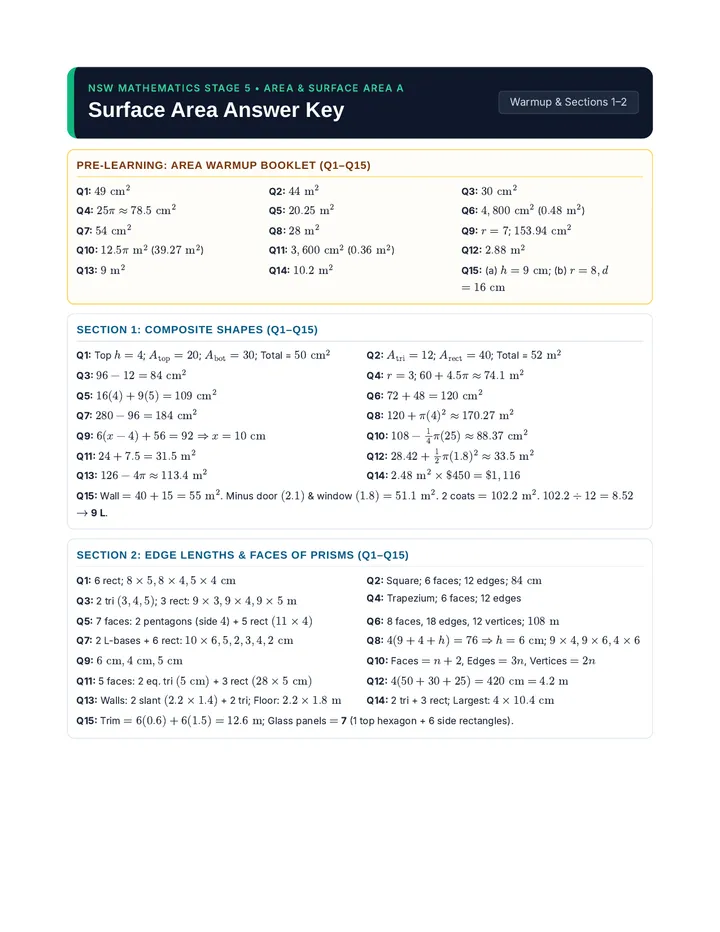
Surface Area Answer Key
NSW Mathematics Stage 5 • Area & Surface Area A
Surface Area Answer Key
Warmup & Sections 1–2
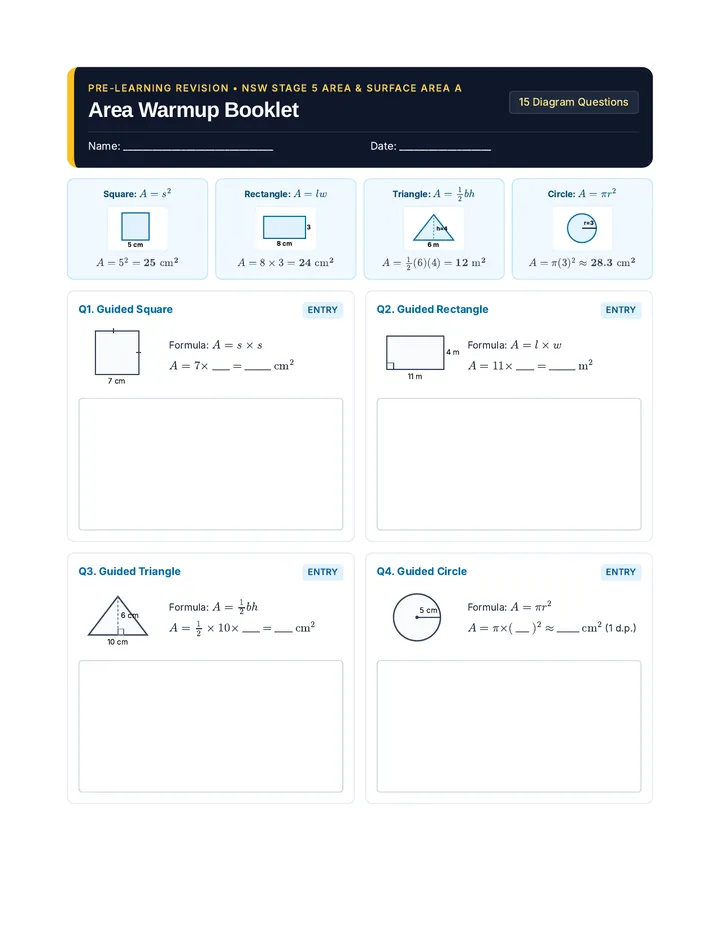
Pre-Learning: Area Warmup Booklet (Q1–Q15)
Q1: \(49\text{ cm}^2\)
Q2: \(44\text{ m}^2\)
Q3: \(30\text{ cm}^2\)
Q4: \(25\pi \approx\) \(78.5\text{ cm}^2\)
Q5: \(20.25\text{ m}^2\)
Q6: \(4,800\text{ cm}^2\) (\(0.48\text{ m}^2\))
Q7: \(54\text{ cm}^2\)
Q8: \(28\text{ m}^2\)
Q9: \(r=7\); \(153.94\text{ cm}^2\)
Q10: \(12.5\pi\text{ m}^2\) (\(39.27\text{ m}^2\))
Q11: \(3,600\text{ cm}^2\) (\(0.36\text{ m}^2\))
Q12: \(2.88\text{ m}^2\)
Q13: \(9\text{ m}^2\)
Q14: \(10.2\text{ m}^2\)
Q15: (a) \(h=9\text{ cm}\); (b) \(r=8, d=16\text{ cm}\)
Section 1: Composite Shapes (Q1–Q15)
Q1: Top \(h = 4\); \(A_{\text{top}}=20\); \(A_{\text{bot}}=30\); Total = \(50\text{ cm}^2\)
Q2: \(A_{\text{tri}}=12\); \(A_{\text{rect}}=40\); Total = \(52\text{ m}^2\)
Q3: \(96 - 12 =\) \(84\text{ cm}^2\)
Q4: \(r=3\); \(60 + 4.5\pi \approx\) \(74.1\text{ m}^2\)
Q5: \(16(4) + 9(5) =\) \(109\text{ cm}^2\)
Q6: \(72 + 48 =\) \(120\text{ cm}^2\)
Q7: \(280 - 96 =\) \(184\text{ cm}^2\)
Q8: \(120 + \pi(4)^2 \approx\) \(170.27\text{ m}^2\)
Q9: \(6(x-4) + 56 = 92 \Rightarrow\) \(x = 10\text{ cm}\)
Q10: \(108 - \frac{1}{4}\pi(25) \approx\) \(88.37\text{ cm}^2\)
Q11: \(24 + 7.5 =\) \(31.5\text{ m}^2\)
Q12: \(28.42 + \frac{1}{2}\pi(1.8)^2 \approx\) \(33.5\text{ m}^2\)
Q13: \(126 - 4\pi \approx\) \(113.4\text{ m}^2\)
Q14: \(2.48\text{ m}^2 \times \$450 =\) \(\$1,116\)
Q15: Wall \(= 40 + 15 = 55\text{ m}^2\). Minus door \((2.1)\) & window \((1.8) = 51.1\text{ m}^2\). 2 coats \(= 102.2\text{ m}^2\). \(102.2 \div 12 = 8.52 \rightarrow\) 9 L.
Section 2: Edge Lengths & Faces of Prisms (Q1–Q15)
Q1: 6 rect; \(8\times 5, 8\times 4, 5\times 4\text{ cm}\)
Q2: Square; 6 faces; 12 edges; \(84\text{ cm}\)
Q3: 2 tri \((3,4,5)\); 3 rect: \(9\times 3, 9\times 4, 9\times 5\text{ m}\)
Q4: Trapezium; 6 faces; 12 edges
Q5: 7 faces: 2 pentagons (side \(4\)) + 5 rect \((11\times 4)\)
Q6: 8 faces, 18 edges, 12 vertices; \(108\text{ m}\)
Q7: 2 L-bases + 6 rect: \(10\times 6, 5, 2, 3, 4, 2\text{ cm}\)
Q8: \(4(9+4+h)=76 \Rightarrow\) \(h = 6\text{ cm}\); \(9\times 4, 9\times 6, 4\times 6\)
Q9: \(6\text{ cm}, 4\text{ cm}, 5\text{ cm}\)
Q10: Faces \(= n+2\), Edges \(= 3n\), Vertices \(= 2n\)
Q11: 5 faces: 2 eq. tri \((5\text{ cm})\) + 3 rect \((28\times 5\text{ cm})\)
Q12: \(4(50+30+25) = 420\text{ cm} =\) \(4.2\text{ m}\)
Q13: Walls: 2 slant \((2.2\times 1.4)\) + 2 tri; Floor: \(2.2\times 1.8\text{ m}\)
Q14: 2 tri + 3 rect; Largest: \(4\times 10.4\text{ cm}\)
Q15: Trim \(= 6(0.6) + 6(1.5) =\) \(12.6\text{ m}\); Glass panels \(= \) 7 (1 top hexagon + 6 side rectangles).
NSW Mathematics Stage 5 • Area & Surface Area A
Surface Area Answer Key
Sections 3–5
Section 3: Recognise & Justify Prism Nets (Q1–Q15)
Q1: Yes — 6 squares, flaps on opposite sides, no overlap.
Q2: Yes — 3 rect + 2 opposite tri, matching edges.
Q3: No — opposite bases must be congruent \((18\neq 10)\).
Q4: Yes — Z-net folds cleanly into a cube.
Q5: No — squares overlap around corners, ends stay open.
Q6: No — equilateral tri \((5\text{ cm})\) won't match \(4, 6\text{ cm}\).
Q7: Yes — 5 lateral rect + 2 opposite pentagons.
Q8: Only 4 faces wrap in a loop; 5th overlaps 1st.
Q9: No — \(3+4 < 9\) (violates triangle inequality).
Q10: No — \(3\text{ cm}\) edge cannot attach to \(8\times 5\) face.
Q11: Lid flaps overlap on top; bottom stays open.
Q12: Yes — 1 base + 4 walls fold into open-top cube.
Q13: Yes — 4 vertical squares form a closed loop.
Q14: \(4\text{ cm}\) triangle edge mismatches \(20\text{ cm}\) length.
Q15: Yes — \(9\text{ cm}\) edge attaches to \(16\times 9\) panel and \(4\text{ cm}\) edge attaches to \(16\times 4\) panel on opposite sides; folds cleanly.
Section 4: Create & Rearrange Prism Nets (Q1–Q15)
Q1: Add 1 square above and 1 square below the 4-strip.
Q2: 4 rect \((6\times 4, 6\times 2, 6\times 4, 6\times 2)\) + two \(4\times 2\) bases.
Q3: Three \(10\times 4\text{ cm}\) rect + 2 eq. tri (side \(4\text{ cm}\)).
Q4: Slide 1 triangle to an adjacent \(4\text{ cm}\) rect edge.
Q5: Rect \(8\times 3, 8\times 4, 8\times 5\text{ cm}\) + two \(3\)-\(4\)-\(5\text{ cm}\) tri.
Q6: Any 3 of the 11 distinct cube nets (e.g. T, Z, cross).
Q7: Rect \(10\times 8, 10\times 5, 10\times 4, 10\times 5\) + 2 trapeziums.
Q8: Cross: \(5\times 4\) centre + 4 walls; Strip: 4 walls + 1 base.
Q9: 6 rect \((7\times 3\text{ cm})\) + 2 hexagons on non-adjacent panels.
Q10: 24 total edges minus \(5\times 2 = 10\) glued edges \(= \) \(14\text{ cm}\).
Q11: Base \(30\times 30\), 4 walls \(30\times 4\), lid \(30\times 30\) on back wall.
Q12: Strip of 4 walls \((10\times 3, 8\times 3)\) + two \(10\times 8\) ends \(= 16\times 16\text{ cm}\) span.
Q13: Rect \(20\times 12, 20\times 8, 20\times 8\) + 2 tri \((12, 8, 8\text{ cm})\).
Q14: 4 walls: \(40\times 30, 40\times 25, 40\times 30, 40\times 25\); length \(= \) \(110\text{ cm}\).
Q15: Rearranging end-caps into a staircase/offset layout fits inside \(20\times 12\text{ cm}\) (e.g., \(16\times 12 = 192\text{ cm}^2\) bounding box).
Section 5: Surface Area from Nets (Q1–Q15)
Q1: \(16 \times 6 =\) \(96\text{ cm}^2\)
Q2: \(2(15+10+6) =\) \(62\text{ cm}^2\)
Q3: \(12 + 84 =\) \(96\text{ m}^2\)
Q4: \(72 + 288 =\) \(360\text{ cm}^2\)
Q5: \(120 + 540 =\) \(660\text{ cm}^2\)
Q6: \(36 + 192 =\) \(228\text{ m}^2\)
Q7: \(46.8 + 162 =\) \(208.8\text{ cm}^2\)
Q8: \(s = 7\text{ cm}\); Net perimeter \(= 14\times 7 =\) \(98\text{ cm}\)
Q9: \(44 + 176 =\) \(220\text{ cm}^2\)
Q10: \(24 + 14d = 136 \Rightarrow\) \(d = 8\text{ cm}\)
Q11: \(14,850\text{ cm}^2 =\) \(1.485\text{ m}^2\)
Q12: Box \(= 1588\text{ cm}^2 < 3000\text{ cm}^2\); Yes
Q13: \(8.64 + 3 =\) \(11.64\text{ m}^2\)
Q14: \(31,950\text{ cm}^2\) or \(3.195\text{ m}^2\)
Q15: 1 box \(= 132 + 708 = 840\text{ cm}^2\). \(+10\% = 924\text{ cm}^2 = 0.0924\text{ m}^2\). 500 boxes \(= 46.2\text{ m}^2 \times \$4.20 =\) \(\$194.04\).
NSW Mathematics Stage 5 • Area & Surface Area A
Surface Area Answer Key
Sections 6–9
Section 6: Surface Area of Prisms (Q1–Q15)
Q1: \(2(95) =\) \(190\text{ cm}^2\)
Q2: \(6(8.5)^2 =\) \(433.5\text{ m}^2\)
Q3: \(A=24, P=24 \Rightarrow SA =\) \(336\text{ cm}^2\)
Q4: \(84 + 120 + 70 =\) \(274\text{ cm}^2\)
Q5: Hyp \(= 13\); \(60 + 600 =\) \(660\text{ cm}^2\)
Q6: \(64 + 375 =\) \(439\text{ m}^2\)
Q7: \(2(36) + 30(12) =\) \(432\text{ cm}^2\)
Q8: \(60 + 16h = 156 \Rightarrow\) \(h = 6\text{ cm}\)
Q9: \(s = 9\text{ cm}\); Doubled \(s=18 \Rightarrow SA =\) \(1,944\text{ cm}^2\)
Q10: \(640 + 320 + 96 =\) \(1,056\text{ cm}^2\)
Q11: \(60 + 43.2 + 18 =\) \(121.2\text{ m}^2\)
Q12: \(3600 + 9000 + 4000 =\) \(16,600\text{ cm}^2\)
Q13: \(72.48\text{ m}^2 \times \$18 =\) \(\$1,304.64\)
Q14: \(1.68 + 8.4 =\) \(10.08\text{ m}^2\)
Q15: Walls \(= 39.6\text{ m}^2\); Gables \(= 3.2\text{ m}^2\); Roof \(= 21.5\text{ m}^2\). Total \(= 64.3\text{ m}^2 \div 2.5 = 25.72 \rightarrow\) 26 sheets.
Section 7: Curved Surface of a Cylinder (Q1–Q15)
Q1: \(10\pi\); \(120\pi \approx\) \(376.99\text{ cm}^2\)
Q2: \(r=7\); \(126\pi \approx\) \(395.84\text{ m}^2\)
Q3: \(180\pi\text{ cm}^2\)
Q4: \(31.4 \times 8 =\) \(251.2\text{ cm}^2\)
Q5: \(84\pi \approx\) \(263.89\text{ m}^2\)
Q6: \(r=9, h=120\text{ cm}\); \(2160\pi \approx\) \(6,785.84\text{ cm}^2\)
Q7: \(h = 314.16 \div (10\pi) \approx\) \(10.00\text{ cm}\)
Q8: \(24\pi r = 192\pi \Rightarrow\) \(r = 8\text{ m}\)
Q9: Equal! Both have area \(30 \times 20 =\) \(600\text{ cm}^2\)
Q10: \(r = 5\text{ cm}\); Area \(= 100\pi^2 \approx\) \(986.96\text{ cm}^2\)
Q11: \(\pi(7.4)(11) \approx\) \(255.7\text{ cm}^2\)
Q12: 1 turn \(\approx\) \(1.41\text{ m}^2\); 15 turns \(\approx\) \(21.21\text{ m}^2\)
Q13: \(920\pi \approx\) \(2,890\text{ cm}^2\)
Q14: \(8 \times 2\pi(0.4)(3.5) \approx\) \(70.4\text{ m}^2\)
Q15: \(r=6\text{ m}\); Area \(= \pi(6)(450) = 2700\pi \approx 8,482.30\text{ m}^2\). Cost \(= 8,482.30 \times 24 \approx\) \(\$203,575\).
Section 8: Closed Cylinder Formula (Q1–Q15)
Q1: \(50\pi + 100\pi = 150\pi \approx\) \(471.24\text{ cm}^2\)
Q2: \(r=6\); \(156\pi \approx\) \(490.09\text{ cm}^2\)
Q3: \(32\pi + 88\pi =\) \(120\pi\text{ m}^2\)
Q4: (a) \(565.49\text{ cm}^2\); (b) \(452.39\text{ cm}^2\)
Q5: \(111.3\pi \approx\) \(349.66\text{ cm}^2\)
Q6: \(95\pi + 140 \approx\) \(438.45\text{ cm}^2\)
Q7: \(2\pi(8)(20) = 320\pi \approx\) \(1,005.31\text{ m}^2\)
Q8: \(72\pi + 12\pi h = 192\pi \Rightarrow\) \(h = 10\text{ cm}\)
Q9: \(SA = 6\pi r^2\); \(6\pi r^2 = 150\pi \Rightarrow\) \(r = 5\text{ cm}\)
Q10: Factor of 9 (\(3^2\))
Q11: \(r=0.29\); \(SA \approx\) \(2.13\text{ m}^2\)
Q12: \(7.92\pi \approx\) \(24.9\text{ m}^2\)
Q13: \(r=7\text{ mm}\); \(798\pi \approx\) \(2,507.0\text{ mm}^2\)
Q14: \(1000 \times 120\pi\text{ cm}^2 \approx\) \(37.7\text{ m}^2\)
Q15: Can A \(\approx 296.5\text{ cm}^2\); Can B \(\approx 311.6\text{ cm}^2\). Can A uses less aluminium by \(4.8\%\).
Section 9: Cylinders & Composite Solids (Q1–Q15)
Q1: \(600 + 36\pi \approx\) \(713.10\text{ cm}^2\)
Q2: \(132\pi + 24\pi = 156\pi \approx\) \(490.09\text{ cm}^2\)
Q3: \(188 + 56\pi \approx\) \(363.93\text{ m}^2\)
Q4: \(72\pi + 160 \approx\) \(386.19\text{ cm}^2\)
Q5: \(200\pi + 120\pi + 32\pi = 352\pi \approx\) \(1,105.84\text{ cm}^2\)
Q6: \(144\pi + 120 \approx\) \(572.39\text{ m}^2\)
Q7: \(600 - 8\pi + 40\pi = 600 + 32\pi \approx\) \(700.53\text{ cm}^2\)
Q8: \(288\pi + 120\pi + 80\pi + 40\pi = 528\pi \approx\) \(1,658.76\text{ cm}^2\)
Q9: \(160\pi - 4.5\pi + 36\pi = 191.5\pi \approx\) \(601.62\text{ cm}^2\)
Q10: \(936\pi + 200 \approx\) \(3,140.53\text{ cm}^2\)
Q11: \(3520 + 624\pi \approx\) \(5,480.4\text{ cm}^2\)
Q12: \(225\pi + 300\pi + 200\pi = 725\pi \approx\) \(2,277.7\text{ cm}^2\)
Q13: \(4.5\pi \approx\) \(14.14\text{ m}^2\)
Q14: \(90\pi + 25\pi = 115\pi \approx\) \(361.3\text{ m}^2\)
Q15: Pump-house \(= 70 + 49 = 119\text{ m}^2\); Silo \(= 48\pi \approx 150.80\text{ m}^2\). Total \(= 269.80\text{ m}^2 \times \$16 \approx\) \(\$4,317\).