DOK Tiered Questions WorksheetNC.8.NS.2 • Rational Approximations & Irrational Numbers DOK Tiered Questions: Word Problems 1–10 Name: _______________________ Date: _______________ DOK 1 • Recall: Facts, formulas, and routine calculations. DOK 2 • Skills & Concepts: Estimating, comparing, multi-step solving. DOK 3 • Strategic Thinking: Justifying, critiquing errors, non-routine tasks. Problem 01: The Square Garden Area = 50 sq ft (side = \(\sqrt{50}\) ft) • 2nd garden side = 7.2 ft DOK 1 What are the two consecutive perfect squares that 50 lies between, and what are their square roots? DOK 2 Estimate \(\sqrt{50}\) to the nearest tenth of a foot, and compare it to 7.2 feet to determine which garden has the longer side. DOK 3 A landscaper claims a square garden with an area of 50 sq ft has a side length of 25 ft because \(50 \div 2 = 25\). Explain the error using squaring, and justify a reasonable range for the true side length without a calculator. Problem 02: The Cube-Shaped Storage Box Box 1 = 125 cu in • Box 2 = 150 cu in DOK 1 Calculate the exact side length of the first cube-shaped box by finding \(\sqrt[3]{125}\). DOK 2 Estimate \(\sqrt[3]{150}\) to the nearest tenth of an inch, and find the approximate difference in side length between the two boxes. DOK 3 You need to fit a rigid 5.2-inch-long tool flat along the bottom edge of the 150-cubic-inch box. Using cube benchmarks, justify whether the tool will definitely fit, might fit, or will not fit. NC.8.NS.2 • DOK Tiered Questions Problems 03–04 Problem 03: The Basketball Court Diagonal Width = 8 m • Length = 11 m • Diagonal = \(\sqrt{8^2 + 11^2}\) DOK 1 Evaluate the expression \(8^2 + 11^2\). DOK 2 Estimate the diagonal length \(\sqrt{185}\) to the nearest tenth of a meter. DOK 3 A coach wants to lengthen the court so the diagonal is between 14 and 15 meters while keeping the width at 8 meters. Propose a new whole-number length for the court and justify why your choice satisfies the diagonal requirement. Problem 04: Comparing Two Hiking Trails Trail A = \(\sqrt{70}\) mi • Trail B = \(\sqrt{65}\) mi DOK 1 Which two consecutive whole numbers does \(\sqrt{70}\) fall between? DOK 2 Estimate both \(\sqrt{70}\) and \(\sqrt{65}\) to the nearest tenth, and determine approximately how many miles longer Trail A is than Trail B. DOK 3 A hiker says Trail A is 5 miles longer than Trail B because \(70 - 65 = 5\). Explain why you cannot subtract radicands directly, and use square benchmarks to prove why the actual difference is less than 1 mile. NC.8.NS.2 • DOK Tiered Questions Problems 05–06 Problem 05: The Circular Fountain Diameter = 9.5 ft • \(\pi \approx 3.14\) • \(C = \pi d\) DOK 1 State the formula for the circumference of a circle given its diameter, and identify the diameter of the fountain. DOK 2 Use \(\pi \approx 3.14\) to calculate the approximate circumference of the fountain to the nearest hundredth of a foot. DOK 3 A contractor buys 30 feet of decorative edging to wrap around the fountain, assuming \(\pi \approx 3\) is "close enough." Explain whether 30 feet of edging will be enough when using \(\pi \approx 3.14\), and justify how much extra or short they will be. Problem 06: The Science Fair Sphere Radius = 4 in • \(\pi \approx 3.14\) • \(C = 2\pi r\) DOK 1 If the radius of the spherical model is 4 inches, what is its diameter? DOK 2 Use \(C = 2\pi r\) and \(\pi \approx 3.14\) to estimate the circumference of the sphere's great circle to the nearest hundredth of an inch. DOK 3 Another student doubles the radius of their spherical model from 4 inches to 8 inches and claims the circumference will increase by 4 times. Critique this claim and justify how the circumference actually changes. NC.8.NS.2 • DOK Tiered Questions Problems 07–08 Problem 07: The Number Line Challenge Values: \(\sqrt{10}, \sqrt{15}, \sqrt{20}, \sqrt{30}\) DOK 1 Identify which of the four numbers (\(\sqrt{10}, \sqrt{15}, \sqrt{20}, \sqrt{30}\)) is closest to 4, and state the perfect square equal to \(4^2\). DOK 2 Estimate each of the four square roots to the nearest tenth, order them from least to greatest, and identify which ones lie between 3 and 5. DOK 3 Without calculating decimals, explain how you can tell whether \(\sqrt{15}\) is closer to 3 or closer to 4, and justify where a fifth value, \(\sqrt{25.5}\), would be placed relative to your ordered list. Problem 08: The Aquarium Display Tank 1 = 216 cu ft • Tank 2 = 250 cu ft DOK 1 Find the exact side length of the first aquarium tank by calculating \(\sqrt[3]{216}\). DOK 2 Estimate \(\sqrt[3]{250}\) to the nearest tenth of a foot, and determine how much greater the side length of the second tank is than the first. DOK 3 The aquarium's doorway is 6.25 feet wide. Using rational approximations and cubing, justify whether the 250-cubic-foot tank can fit through the doorway without tilting. NC.8.NS.2 • DOK Tiered Questions Problems 09–10 Problem 09: The Circular Running Track Radius = 18 m • \(\pi \approx 3.14\) • 3 laps DOK 1 Write the formula for the circumference of a circle using its radius, and substitute \(r = 18\) and \(\pi \approx 3.14\) into the formula. DOK 2 Estimate the circumference of the track to the nearest hundredth of a meter, and calculate the total distance run in 3 laps. DOK 3 A runner wants to run at least 500 meters on this track. Determine the minimum number of full laps they must complete, and justify whether 4.5 laps would reach their goal. Problem 10: The Mystery Number Target \(\approx 4.6\) • Candidates: \(\sqrt{21}, \sqrt{22}, \sqrt{24}\) DOK 1 Calculate \(4.6^2\) to find the exact number whose square root is 4.6. DOK 2 Estimate \(\sqrt{21}\), \(\sqrt{22}\), and \(\sqrt{24}\) to the nearest tenth, and determine which expression is closest to 4.6. DOK 3 Explain how squaring 4.6 provides stronger evidence than rounding alone when deciding between \(\sqrt{21}\) and \(\sqrt{22}\), and create another square root \(\sqrt{n}\) (where \(n\) is a whole number) that is even closer to 4.65.
DOK Questions Answer KeyNC.8.NS.2 • Teacher Reference DOK Tiered Questions: Answer Key (Problems 1–4) KEY • PAGE 1 Problem 01: The Square Garden DOK 1 49 and 64; their square roots are \(\sqrt{49} = 7\) and \(\sqrt{64} = 8\). DOK 2 \(\sqrt{50} \approx 7.1\text{ ft}\). Since \(7.1 < 7.2\), the second garden (7.2 ft) has the longer side. DOK 3 Error: Area of a square is \(s^2\), not \(2s\). A side of 25 ft would give \(25^2 = 625\text{ sq ft}\). Since \(7^2 = 49 < 50 < 64 = 8^2\), the true side length must be between 7 and 8 ft, very close to 7 ft. Problem 02: The Cube-Shaped Storage Box DOK 1 \(\sqrt[3]{125} = 5\text{ in}\) (because \(5^3 = 125\)). DOK 2 \(\sqrt[3]{150} \approx 5.3\text{ in}\). The second box is about \(5.3 - 5.0 = 0.3\text{ in}\) longer per side. DOK 3 The tool will definitely fit. Since \(5.2^3 = 140.608 < 150\), the true side length \(\sqrt[3]{150}\) must be greater than 5.2 in. Problem 03: The Basketball Court Diagonal DOK 1 \(8^2 + 11^2 = 64 + 121 = 185\). DOK 2 \(\sqrt{185} \approx 13.6\text{ m}\) (since \(13.6^2 = 184.96\)). DOK 3 A whole-number length of 12 m works. With width 8 m, \(8^2 + 12^2 = 64 + 144 = 208\). Because \(14^2 = 196 < 208 < 225 = 15^2\), the diagonal \(\sqrt{208} \approx 14.4\text{ m}\) is between 14 and 15 m. (13 m gives \(\sqrt{233} > 15\text{ m}\)). Problem 04: Comparing Two Hiking Trails DOK 1 Between 8 and 9 (since \(8^2 = 64\) and \(9^2 = 81\)). DOK 2 \(\sqrt{70} \approx 8.4\text{ mi}\); \(\sqrt{65} \approx 8.1\text{ mi}\). Trail A is about \(8.4 - 8.1 = 0.3\text{ mi}\) longer. DOK 3 You cannot subtract radicands directly because \(\sqrt{70} - \sqrt{65} \neq \sqrt{70 - 65}\). Both 65 and 70 lie between \(8^2 = 64\) and \(9^2 = 81\), so both trail lengths are between 8 and 9 miles and must differ by less than 1 mile. DOK Tiered Questions: Answer Key (Problems 5–7) KEY • PAGE 2 Problem 05: The Circular Fountain DOK 1 Formula: \(C = \pi d\); diameter \(d = 9.5\text{ ft}\). DOK 2 \(C \approx 3.14 \times 9.5 = 29.83\text{ ft}\). DOK 3 Yes, 30 ft of edging is enough because \(29.83\text{ ft} < 30\text{ ft}\). Using \(\pi \approx 3.14\), the contractor will have \(30 - 29.83 = 0.17\text{ ft}\) extra. (Estimating with \(\pi \approx 3\) gives \(28.5\text{ ft}\), which underestimates the true length by \(1.33\text{ ft}\)). Problem 06: The Science Fair Sphere DOK 1 Diameter \(d = 2r = 2 \times 4 = 8\text{ in}\). DOK 2 \(C \approx 2 \times 3.14 \times 4 = 25.12\text{ in}\). DOK 3 The claim is incorrect. Circumference \(C = 2\pi r\) is linear with respect to \(r\), not squared. Doubling \(r\) from 4 in to 8 in doubles the circumference to \(2 \times 3.14 \times 8 = 50.24\text{ in}\) (2 times larger, not 4 times). Problem 07: The Number Line Challenge DOK 1 \(\sqrt{15}\) is closest to 4; \(4^2 = 16\). DOK 2 \(\sqrt{10} \approx 3.2,\ \sqrt{15} \approx 3.9,\ \sqrt{20} \approx 4.5,\ \sqrt{30} \approx 5.5\). Order: \(\sqrt{10}, \sqrt{15}, \sqrt{20}, \sqrt{30}\). Between 3 and 5: \(\sqrt{10}, \sqrt{15}, \sqrt{20}\). DOK 3 Since \(3^2 = 9\) and \(4^2 = 16\), 15 is only 1 unit from 16 but 6 units from 9, so \(\sqrt{15}\) is much closer to 4. Because \(20 < 25.5 < 30\), \(\sqrt{25.5}\) belongs between \(\sqrt{20}\) and \(\sqrt{30}\). DOK Tiered Questions: Answer Key (Problems 8–10) KEY • PAGE 3 Problem 08: The Aquarium Display DOK 1 \(\sqrt[3]{216} = 6\text{ ft}\) (since \(6^3 = 216\)). DOK 2 \(\sqrt[3]{250} \approx 6.3\text{ ft}\). The second tank's side is about \(6.3 - 6.0 = 0.3\text{ ft}\) greater. DOK 3 The tank will not fit without tilting. Cubing the doorway width gives \(6.25^3 \approx 244.14 < 250\), which proves \(\sqrt[3]{250} > 6.25\text{ ft}\). Problem 09: The Circular Running Track DOK 1 \(C = 2\pi r\); \(C \approx 2 \times 3.14 \times 18\). DOK 2 One lap: \(C \approx 113.04\text{ m}\). Three laps: \(113.04 \times 3 = 339.12\text{ m}\). DOK 3 Minimum full laps: 5 full laps (since 4 laps is \(452.16\text{ m} < 500\text{ m}\) and 5 laps is \(565.20\text{ m}\)). Yes, 4.5 laps would reach the goal because \(4.5 \times 113.04 = 508.68\text{ m} \ge 500\text{ m}\). Problem 10: The Mystery Number DOK 1 \(4.6^2 = 21.16\). DOK 2 \(\sqrt{21} \approx 4.6\), \(\sqrt{22} \approx 4.7\), \(\sqrt{24} \approx 4.9\). \(\sqrt{21}\) is closest to 4.6. DOK 3 Squaring 4.6 gives \(21.16\), showing 21 is only 0.16 away while 22 is 0.84 away—more precise than rounding decimals. For 4.65: \(4.65^2 = 21.6225\), which is closer to 22 than 21, so \(\sqrt{22}\) is the closest whole-number square root to 4.65.
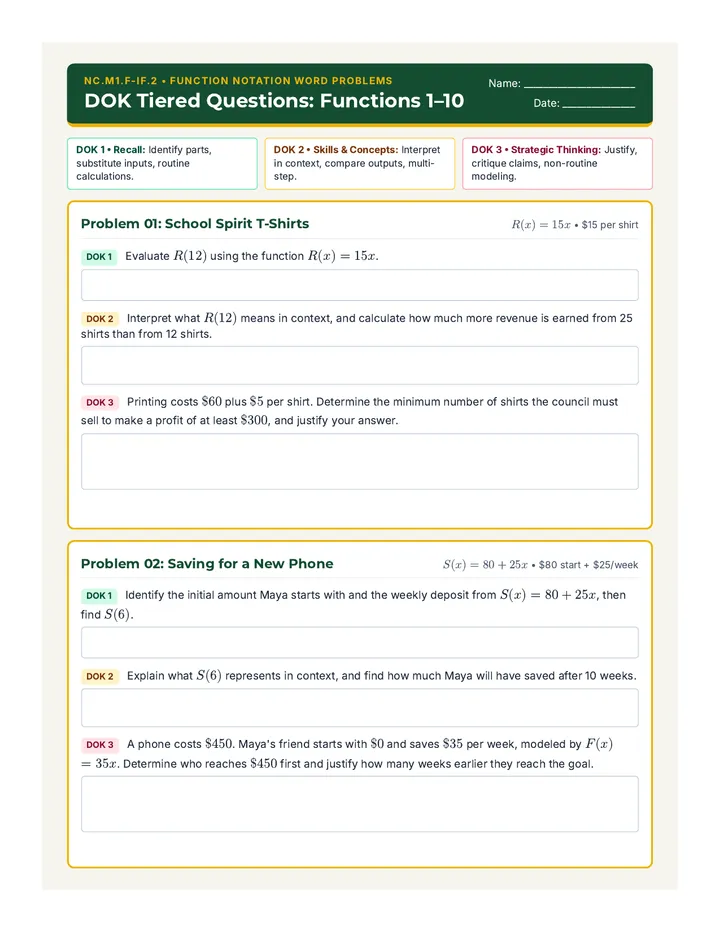
IF2 DOK Questions WorksheetNC.M1.F-IF.2 • Function Notation Word Problems DOK Tiered Questions: Functions 1–10 Name: _______________________ Date: _______________ DOK 1 • Recall: Identify parts, substitute inputs, routine calculations. DOK 2 • Skills & Concepts: Interpret in context, compare outputs, multi-step. DOK 3 • Strategic Thinking: Justify, critique claims, non-routine modeling. Problem 01: School Spirit T-Shirts \(R(x) = 15x\) • $15 per shirt DOK 1 Evaluate \(R(12)\) using the function \(R(x) = 15x\). DOK 2 Interpret what \(R(12)\) means in context, and calculate how much more revenue is earned from 25 shirts than from 12 shirts. DOK 3 Printing costs \(\$60\) plus \(\$5\) per shirt. Determine the minimum number of shirts the council must sell to make a profit of at least \(\$300\), and justify your answer. Problem 02: Saving for a New Phone \(S(x) = 80 + 25x\) • $80 start + $25/week DOK 1 Identify the initial amount Maya starts with and the weekly deposit from \(S(x) = 80 + 25x\), then find \(S(6)\). DOK 2 Explain what \(S(6)\) represents in context, and find how much Maya will have saved after 10 weeks. DOK 3 A phone costs \(\$450\). Maya's friend starts with \(\$0\) and saves \(\$35\) per week, modeled by \(F(x) = 35x\). Determine who reaches \(\$450\) first and justify how many weeks earlier they reach the goal. NC.M1.F-IF.2 • DOK Tiered Questions Problems 03–04 Problem 03: A Basketball's Height \(h(t) = -16t^2 + 32t + 6\) • Height (ft) after \(t\) sec DOK 1 Calculate \(h(1)\) using \(h(t) = -16t^2 + 32t + 6\). DOK 2 Find \(h(1.5)\) and compare it to \(h(1)\) to describe whether the ball is rising or falling between \(t = 1\) and \(t = 1.5\) seconds. DOK 3 A player claims the ball reaches its maximum height at \(t = 1.5\) seconds. Use values of \(h(t)\) (such as \(h(0)\), \(h(1)\), and \(h(2)\)) to critique this claim and justify when the ball actually reaches its peak. Problem 04: School Dance Tickets \(T(x) = 8x\) • $8 per ticket DOK 1 Evaluate \(T(35)\) for the function \(T(x) = 8x\). DOK 2 Interpret \(T(35)\) and \(T(50)\) in context, and find how many additional tickets must be sold to increase total money from \(T(35)\) to \(T(50)\). DOK 3 The DJ costs \(\$350\) and decorations cost \(\$90\). If the school wants to pay all costs and donate \(\$120\) to charity, explain why \(T(50)\) is not enough and determine the minimum number of tickets needed. NC.M1.F-IF.2 • DOK Tiered Questions Problems 05–06 Problem 05: Bacteria Growth \(B(t) = 100(2)^t\) • Starts at 100, doubles hourly DOK 1 Find \(B(3)\) using \(B(t) = 100(2)^t\). DOK 2 Calculate \(B(5)\) and explain why \(B(t)\) represents exponential growth rather than linear growth. DOK 3 A lab technician predicts that after 6 hours there will be \(2 \times B(3) = 1,600\) bacteria because 6 hours is double 3 hours. Explain the flaw in this reasoning and calculate the actual population at \(t = 6\). Problem 06: A Taxi Ride \(C(m) = 4 + 2.50m\) • $4 fee + $2.50/mile DOK 1 Evaluate \(C(8)\) using \(C(m) = 4 + 2.50m\). DOK 2 Interpret \(C(8)\) in context, find \(C(12)\), and determine how much more a 12-mile ride costs than an 8-mile ride. DOK 3 A rival rideshare company charges no starting fee and \(\$3.00\) per mile, modeled by \(R(m) = 3.00m\). Determine for which trip distances the taxi is cheaper than the rideshare, and justify your answer. NC.M1.F-IF.2 • DOK Tiered Questions Problems 07–08 Problem 07: The Area of a Garden \(A(x) = x^2\) • Side length \(x\) feet DOK 1 Find \(A(6)\) using \(A(x) = x^2\), and include the correct units. DOK 2 Calculate \(A(10)\) and compare the area of a 10-foot square garden to a 6-foot square garden. DOK 3 A gardener doubles the side length from 6 feet to 12 feet and expects to need twice as much mulch. Critique this expectation using \(A(6)\) and \(A(12)\) to justify how much mulch is actually needed. Problem 08: Laptop Depreciation \(V(t) = 1200(0.8)^t\) • $1,200, loses 20%/yr DOK 1 Calculate \(V(1)\) using \(V(t) = 1200(0.8)^t\). DOK 2 Find \(V(3)\), interpret what it means in context, and explain why the base \(0.8\) represents exponential decay. DOK 3 A student thinks that losing 20% per year means the laptop loses \(20\% \times 3 = 60\%\) of its original value after 3 years, leaving \(\$480\). Explain why \(V(3)\) is actually higher than \(\$480\). NC.M1.F-IF.2 • DOK Tiered Questions Problems 09–10 Problem 09: Filling a Swimming Pool \(W(t) = 500 + 120t\) • 500 gal + 120 gal/min DOK 1 Evaluate \(W(5)\) using \(W(t) = 500 + 120t\). DOK 2 Find \(W(12)\) and explain what the expression \(W(12) - W(5)\) represents in context. DOK 3 The pool holds \(2,900\) gallons. After 10 minutes, a second hose adding \(80\) gallons per minute is turned on. Determine the total time from the start until the pool is full, and justify your steps. Problem 10: A Firework's Height \(H(t) = -16t^2 + 96t\) • Height (ft) after \(t\) sec DOK 1 Evaluate \(H(0)\) and \(H(2)\) using \(H(t) = -16t^2 + 96t\). DOK 2 Find \(H(3)\) and \(H(4)\), and explain what \(H(0)\) means in the context of the firework's flight. DOK 3 Using the symmetry of \(H(t)\) and values you calculated, justify when the firework returns to the ground, and determine the total time the firework stays above 128 feet.
IF2 DOK Answer KeyNC.M1.F-IF.2 • Teacher Reference DOK Tiered Questions: Answer Key (Problems 1–4) KEY • PAGE 1 Problem 01: School Spirit T-Shirts DOK 1 \(R(12) = 15(12) = \$180\). DOK 2 \(R(12) = \$180\) is the revenue from selling 12 shirts. \(R(25) = \$375\), which is \(\$375 - \$180 = \$195\) more. DOK 3 Profit \(P(x) = 15x - (60 + 5x) = 10x - 60\). Solving \(10x - 60 \ge 300\) gives \(10x \ge 360\), so 36 shirts minimum (\(R(36) = \$540\), cost = \(\$240\), profit = \(\$300\)). Problem 02: Saving for a New Phone DOK 1 Initial amount = \(\$80\); weekly deposit = \(\$25\); \(S(6) = 80 + 25(6) = \$230\). DOK 2 \(S(6) = \$230\) means Maya has \(\$230\) saved after 6 weeks. After 10 weeks: \(S(10) = 80 + 25(10) = \$330\). DOK 3 Maya: \(80 + 25x \ge 450 \Rightarrow x \ge 14.8\) (15 weeks). Friend: \(35x \ge 450 \Rightarrow x \ge 12.86\) (13 weeks). The friend reaches \(\$450\) first, 2 weeks earlier. Problem 03: A Basketball's Height DOK 1 \(h(1) = -16(1)^2 + 32(1) + 6 = 22\text{ ft}\). DOK 2 \(h(1.5) = -16(2.25) + 32(1.5) + 6 = 18\text{ ft}\). Since \(18 < 22\), the ball is falling between \(t = 1\) and \(t = 1.5\text{ s}\). DOK 3 The claim is incorrect. Since \(h(0) = 6\text{ ft}\), \(h(1) = 22\text{ ft}\), and \(h(2) = 6\text{ ft}\), symmetry shows the peak (vertex) occurs halfway between \(t = 0\) and \(t = 2\), at \(t = 1\text{ second}\) (22 ft). Problem 04: School Dance Tickets DOK 1 \(T(35) = 8(35) = \$280\). DOK 2 \(T(35) = \$280\) is money from 35 tickets; \(T(50) = \$400\) is money from 50 tickets. \(50 - 35 = 15\) additional tickets are needed. DOK 3 Total needed = \(350 + 90 + 120 = \$560\). \(T(50) = \$400\) is \(\$160\) short. Solving \(8x \ge 560\) gives a minimum of 70 tickets. DOK Tiered Questions: Answer Key (Problems 5–7) KEY • PAGE 2 Problem 05: Bacteria Growth DOK 1 \(B(3) = 100(2)^3 = 800\text{ bacteria}\). DOK 2 \(B(5) = 100(2)^5 = 3,200\text{ bacteria}\). It is exponential growth because the population multiplies by a constant factor of 2 each hour rather than adding a constant amount. DOK 3 Exponential functions do not scale proportionally with time; doubling \(t\) from 3 to 6 multiplies by another \(2^3 = 8\), not by 2. Actual population: \(B(6) = 100(2)^6 = \mathbf{6,400\text{ bacteria}}\). Problem 06: A Taxi Ride DOK 1 \(C(8) = 4 + 2.50(8) = \$24\). DOK 2 \(C(8) = \$24\) is the fare for an 8-mile ride. \(C(12) = 4 + 2.50(12) = \$34\), which is \(\$10\) more than an 8-mile ride. DOK 3 Setting \(4 + 2.50m < 3.00m\) gives \(4 < 0.50m \Rightarrow m > 8\). At \(m = 8\) miles both cost \(\$24\); for trips longer than 8 miles, the taxi is cheaper. Problem 07: The Area of a Garden DOK 1 \(A(6) = 6^2 = 36\text{ ft}^2\). DOK 2 \(A(10) = 100\text{ ft}^2\), which is \(100 - 36 = 64\text{ ft}^2\) larger than the 6-foot garden. DOK 3 The expectation is incorrect. \(A(6) = 36\text{ ft}^2\) and \(A(12) = 12^2 = 144\text{ ft}^2\). Because area grows with \(x^2\), doubling the side length requires 4 times as much mulch (\(144 \div 36 = 4\)). DOK Tiered Questions: Answer Key (Problems 8–10) KEY • PAGE 3 Problem 08: Laptop Depreciation DOK 1 \(V(1) = 1200(0.8)^1 = \$960\). DOK 2 \(V(3) = 1200(0.8)^3 = \$614.40\), meaning the laptop is worth \(\$614.40\) after 3 years. Because \(0 < 0.8 < 1\), multiplying by \(0.8\) retains 80% each year (exponential decay). DOK 3 Each 20% decrease is taken from the current (smaller) value, not the original \(\$1,200\). The dollar loss shrinks each year (\(\$240\), then \(\$192\), then \(\$153.60\)), leaving \(\$614.40 > \$480\). Problem 09: Filling a Swimming Pool DOK 1 \(W(5) = 500 + 120(5) = 1,100\text{ gallons}\). DOK 2 \(W(12) = 1,940\text{ gallons}\). \(W(12) - W(5) = 840\text{ gallons}\) represents the water added between minute 5 and minute 12. DOK 3 At \(t = 10\), \(W(10) = 1,700\text{ gal}\), leaving \(2,900 - 1,700 = 1,200\text{ gal}\). Combined rate = \(120 + 80 = 200\text{ gal/min}\). Additional time = \(1,200 \div 200 = 6\text{ min}\), for a total of 16 minutes. Problem 10: A Firework's Height DOK 1 \(H(0) = 0\text{ ft}\); \(H(2) = -16(4) + 96(2) = 128\text{ ft}\). DOK 2 \(H(3) = 144\text{ ft}\); \(H(4) = 128\text{ ft}\). \(H(0) = 0\text{ ft}\) means the firework launches from ground level (0 ft) at \(t = 0\text{ seconds}\). DOK 3 With vertex at \(t = 3\) and launch at \(t = 0\), symmetry gives \(H(6) = 0\text{ ft}\), so it returns to the ground at \(t = 6\text{ seconds}\). Since \(H(2) = H(4) = 128\text{ ft}\), it stays above 128 ft for \(4 - 2 = \mathbf{2\text{ seconds}}\).