Lenny.com
Explore
Create
ActivitiesNewMathEnglish Language ArtsScience & EngineeringSocial StudiesGlobal LanguagesHealth & Physical EducationSpecial EducationCounseling & Life SkillsArts & CreativityESL
Lenny.com
Lenny.com
Explore
Create
ActivitiesNewMathEnglish Language ArtsScience & EngineeringSocial StudiesGlobal LanguagesHealth & Physical EducationSpecial EducationCounseling & Life SkillsArts & CreativityESL
Lenny.com
Lenny.com

Solutions

Lenny for EducatorsLenny for SchoolsLenny for Districts

Product

ExploreSign inCreateSupportAbout

Resources

Getting startedMTSS Acceleration Program

© 2026 Lenny Learning Inc.

TermsPrivacyAccessibility
LinkedInInstagramX
Lenny
MathNumbers & CountingCounting ObjectsNumber NamesComparing NumbersNumber OperationsCounting SequenceNumbers 0-10Place Value Understanding and SystemAdd and Subtract Within 20Addition and Subtraction ConceptsAddition and Subtraction EquationsAddition and Subtraction ProblemsFoundations for MultiplicationMultiplication and Division PropertiesMultiply and Divide Within 100Multiplication and Division ProblemsFactors and MultiplesProperties of OperationsPatterns and RelationshipsGenerate and Analyze PatternsMulti-Digit ArithmeticPlace Value OperationsMulti-Digit and Decimal OperationsNumerical ExpressionsFour Operations and PatternsFour Operations Problem SolvingMeasurement & DataMeasurable AttributesMeasuring LengthsMeasure and Estimate Lengths in Standard UnitsRelate Addition and Subtraction to LengthClassifying and Counting ObjectsTime and MoneyArea Concepts and MeasurementPerimeter and Area MeasuresAngle Concepts and MeasurementTime, Volume, and MassMeasurement Unit ConversionsGeometryIdentifying ShapesShapes and AttributesShape Attributes and ReasoningShapes and CompositionClassifying 2D FiguresGeometric Figures and RelationshipsLines, Angles, and ShapesAngle, Area, and VolumeGeometric MeasurementVolume of 3D ShapesCoordinate Plane ApplicationsTransformations in the PlaneCongruence and SimilarityUnderstand congruence in terms of rigid motionsSimilarity and TransformationsProve Theorems Involving SimilarityPythagorean TheoremTrigonometry for General TrianglesMake Geometric ConstructionsProve Geometric TheoremsTheorems About CirclesFind Arc Lengths And Areas of Sectors of CirclesVolume FormulasRelationships Between Two-Dimensional and Three-Dimensional ObjectsProve Simple Geometric Theorems AlgebraicallyTranslate Between Geometric Description and Equation for Conic SectionApply Geometric Concepts in Modeling SituationsFractions & DecimalsFractions as NumbersBuilding FractionsFraction Equivalence and OrderingAdding and Subtracting FractionsMultiplying and Dividing FractionsDividing FractionsDecimal FractionsMulti-Digit Computation and FactorsAdd, Subtract, Multiply, and Divide Rational NumbersRational Number SystemIrrational Numbers and ApproximationsRatiosRatios and ProportionsProportional RelationshipsUnit RateAlgebraAlgebraic ExpressionsGenerate Equivalent ExpressionsQuantitative RelationshipsProportional Relationships and Linear EquationsEquations and InequalitiesEquation Solving and ReasoningLinear Equations and SystemsGraph Equations and InequalitiesSystems of EquationsReal-World Algebraic ProblemsQuantitative Reasoning with UnitsExpression StructureEquivalent Expression FormsRadicals and Integer ExponentsRational ExponentsRational and Irrational NumbersPolynomial OperationsPolynomial IdentitiesPolynomial Zeros and FactorsRational ExpressionsComplex Number OperationsComplex Numbers in PolynomialsComplex Numbers on PlaneStatistics & ProbabilityRepresent and Interpret DataData DistributionsStatistical VariabilityProbability ModelsCompound Event ProbabilitiesStatistical SamplingInterpret Categorical and Quantitative DataBivariate Data PatternsInterpret Linear ModelsComparing Two PopulationsRandom Processes in StatisticsIndependence and Conditional ProbabilityExpected ValuesProbability-Based Decision MakingStatistical Inference and ConclusionsFunctionsFunction Concepts and NotationDefine and Compare FunctionsInterpret Functions in ContextAnalyze Function RepresentationsModel Relationships with FunctionsIdentify Linear vs Exponential GrowthDistinguish Between Function TypesCompare Growth RatesInterpret Function ExpressionsBuild Functions from RelationshipsConstruct and Model FunctionsTransform and Combine FunctionsModel Comparison and SelectionSolve Exponential EquationsTrigonometryTrigonometric Ratios Involving Right TrianglesTrigonometric Functions and Unit CircleModel with Trigonometric FunctionsTrigonometric IdentitiesVectors & MatricesIntroduction to Vectors and MatricesVector QuantitiesVector OperationsMatrix OperationsCalculusLimits and ContinuityDerivative Concepts and NotationDerivative Rules and TechniquesApplications of DerivativesOptimization ProblemsRelated RatesCurve Sketching and AnalysisIntegration Concepts and NotationAntiderivatives and Indefinite IntegralsDefinite Integrals and AreaFundamental Theorem of CalculusIntegration TechniquesApplications of IntegrationDifferential EquationsSequences and SeriesParametric and Polar FunctionsVector-Valued Functions

Area and Multiplication Benchmark

A third-grade math assessment suite focusing on unit square area, rectilinear shapes, multiplication concepts, and the distributive property.

CJCarolyn Jordan

Area and Multiplication Benchmark

A third-grade math assessment suite focusing on unit square area, rectilinear shapes, multiplication concepts, and the distributive property.

CJCarolyn Jordan
  • C: U-shape = 7 + 2 + 2 = 11 units
  • D: 5 × 2 = 10 units (Equal area)
  • Shapes can look different while having identical areas.

    Question 6 3.MD.C.7a

    Correct: C

    The figure has 5 rows of 8 unit squares.

    • A: Finds perimeter (5 + 8 + 5 + 8 = 26).
    • B: Incomplete perimeter (side + side).
    • C: 5 × 8 = 40 (Area formula).
    • D: Multiplies all four side lengths.

    Common misconception: confusing perimeter with area.

    Question 7 3.OA.B.5

    Correct: B

    Distributive Property over addition:

    (7 × 6) + (7 × 4) = 7 × (6 + 4) = 7 × 10 = 70.

    • A: Adds 7+7 and 6+4 incorrectly.
    • C & D: Wrong operations or incorrect terms.

    Standard: Apply properties of operations to multiply.

    Question 8 3.MD.C.7c

    Correct: A

    Blue: 5 rows × 3 cols = 5 × 3.
    Green: 5 rows × 6 cols = 5 × 6.

    Total area = (5 × 3) + (5 × 6).

    Decomposes a 5 × 9 rectangle into two smaller parts.

    Standard: Tiling area using the distributive property.

    Page 1 of 2 • Unit 3 Assessment Answer Key

    Teacher Resource • Scoring Guide

    Unit 3 Practice Test — Answer Key

    Questions 9–16

    Grade 3 Math Assessment

    Quick Scan (9–16): 9: B (12) | 10: 46 sq m | 11: 8 | 12: 64 | 13: A, C | 14: D | 15: A, B, D | 16: C (27)

    Question 9 3.MD.C.5b

    Correct: B (12 square units)

    Top block: 3 × 2 = 6 sq units.
    Bottom block: 6 × 1 = 6 sq units.
    Total area: 6 + 6 = 12 square units.

    Distractor D (2) counts shapes rather than area.

    Question 10 3.MD.C.7d

    Correct: 46 (or 46 square meters)

    Decompose into 2 rectangles:
    • Left: 6 m × 3 m = 18 sq m
    • Right: 4 m × 7 m = 28 sq m
    Total area: 18 + 28 = 46 square meters.

    Award 1 pt for exact numeric answer 46.

    Question 11 3.NBT.A.3

    Correct: 8

    Step 1: Simplify: (6 × 5) = 30.
    Step 2: Solve 30 × □ = 240.
    Since 3 × 8 = 24, 30 × 8 = 240.

    Assesses multiplying 1-digit by multiples of 10.

    Question 12 3.OA.C.7

    Correct: 64

    Fact fluency: 8 × 8 = 64.
    Strategy: (8 × 5) + (8 × 3) = 40 + 24 = 64.

    Core benchmark multiplication fact.

    Question 13 3.OA.B.5

    Correct: A, C

    Target: 4 × 3 × 7 = 84.
    • A: 4 × 7 × 3 = 84 (Commutative)
    • C: (3 × 4) × 7 = 84 (Associative)

    Award 1 pt for both A and C; no partial credit.

    Question 14 3.OA.B.6

    Correct: D (9 × 6)

    To solve 54 ÷ 9 = ?, think 9 × ? = 54.
    The matching multiplication fact is 9 × 6.

    Division related to multiplication fact families.

    Question 15 3.NBT.A.3

    Correct: A, B, D

    Target: 180 books.
    • A: 2 × 90 = 180 • B: 3 × 60 = 180
    • D: 20 × 9 = 180. (C = 240, E = 2500)

    Award 1 pt for all 3 correct selections (A, B, D).

    Question 16 3.OA.C.7

    Correct: C (27)

    9 × 3 = 27.
    A = 6 (9 − 3), B = 12 (9 + 3), D = 93 (digits joined).

    Diagnostic distractors isolate operation slips.

    Domain & Standard Breakdown Total: 16 points

    Operations & Alg. Thinking 3.OA.B.5, 3.OA.B.6, 3.OA.C.7 Questions: 2, 7, 12, 13, 14, 16 (6 pts)

    Number & Operations (Base 10) 3.NBT.A.3 (Multiples of 10) Questions: 11, 15 (2 pts)

    Measurement & Data 3.MD.C.5a/b, 3.MD.C.6, 3.MD.C.7a-d Questions: 1, 3, 4, 5, 6, 8, 9, 10 (8 pts)

    Page 2 of 2 • Unit 3 Assessment Answer Key
    You might also like

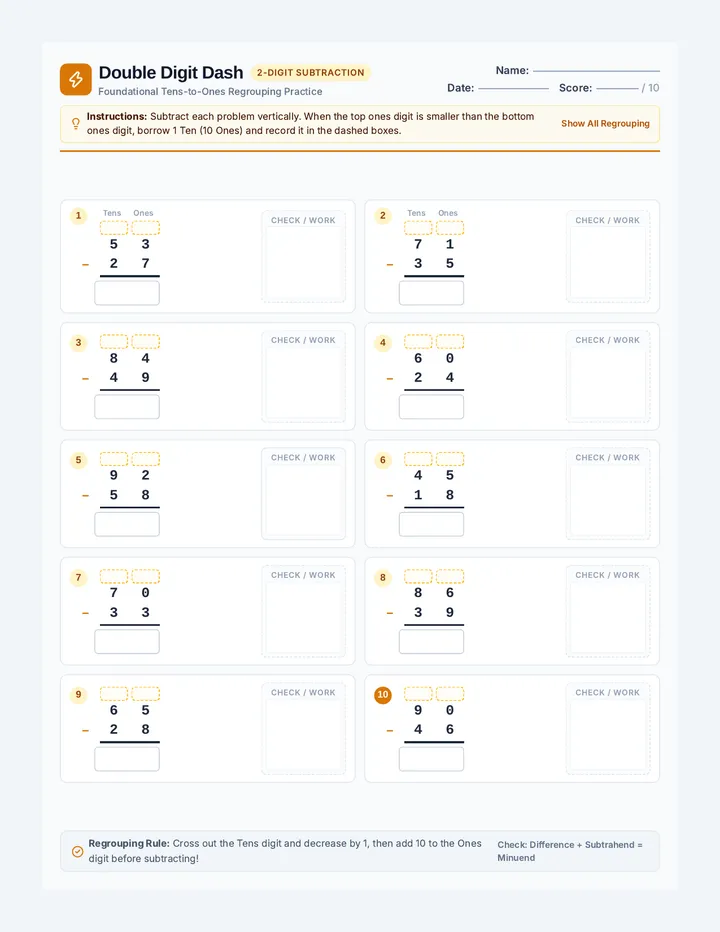
    Double Digit Dash Worksheet

    Elementary Skills Lab

    A foundational elementary curriculum covering progressive multi-digit mathematics operations and early literacy grammar and phonics analysis.

    JM

    Jennifer Murphy

    5
    Cross-Cross Combine Divide Worksheet

    Cross-Cross Equations

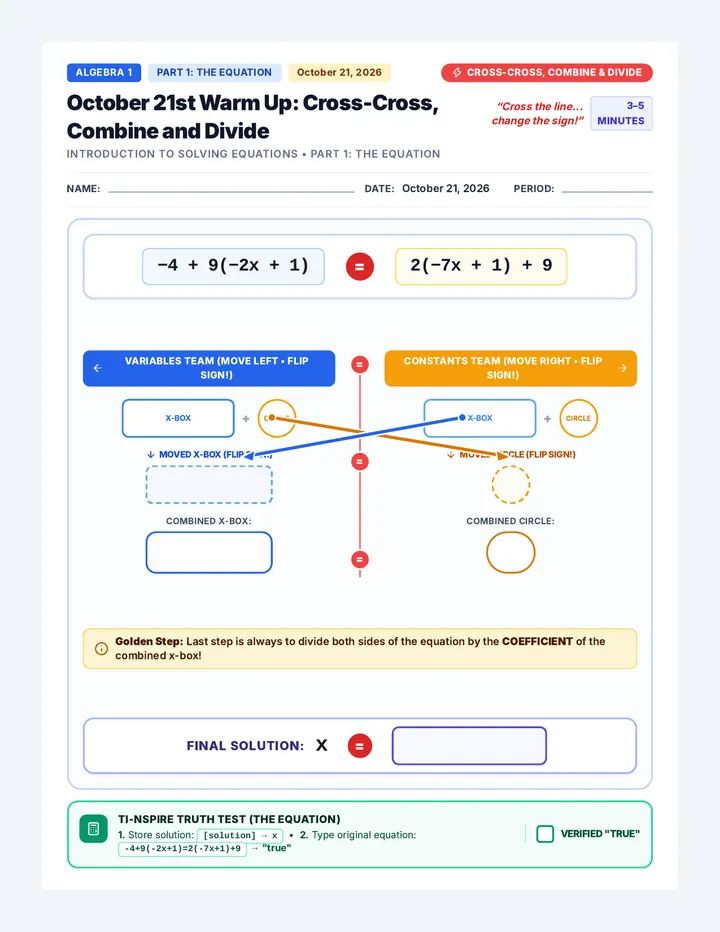
    Algebra 1 lesson covering solving multi-step linear equations using the Cross-Cross, Combine and Divide method with visual boxes and circles.

    H

    Harlston

    3
    Spanish Cross Cross Worksheet

    Spanish Cross Cross Worksheet

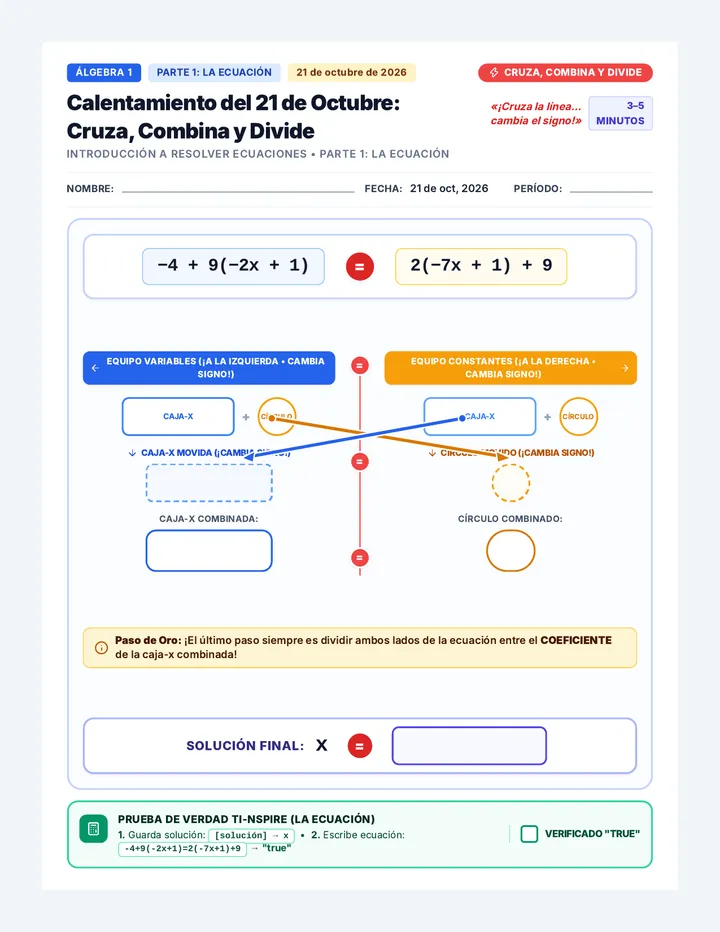
    Spanish version of the two-page Algebra 1 warm-up worksheet 'Cruza, Combina y Divide' for October 21st. The front page guides students through solving the equation with the straight crossing arrows method and student header, while the back page provides practice simplifying both expressions using the boxes and circles strategy with TI-Nspire verification.

    H

    Harlston

    Roll and Multiply Slides

    Fact Master Quest

    A comprehensive 3-day instructional sequence designed to build fluency in single-digit multiplication facts from 1 to 10. Students progress from experiential dice rolling and array modeling to systematic 10x10 chart mapping, culminating in flashcard fabrication and timed partner drills.

    AA

    alicia accapezzato

    9
    Triangle Similarity & Angle Review

    Angle Explorers

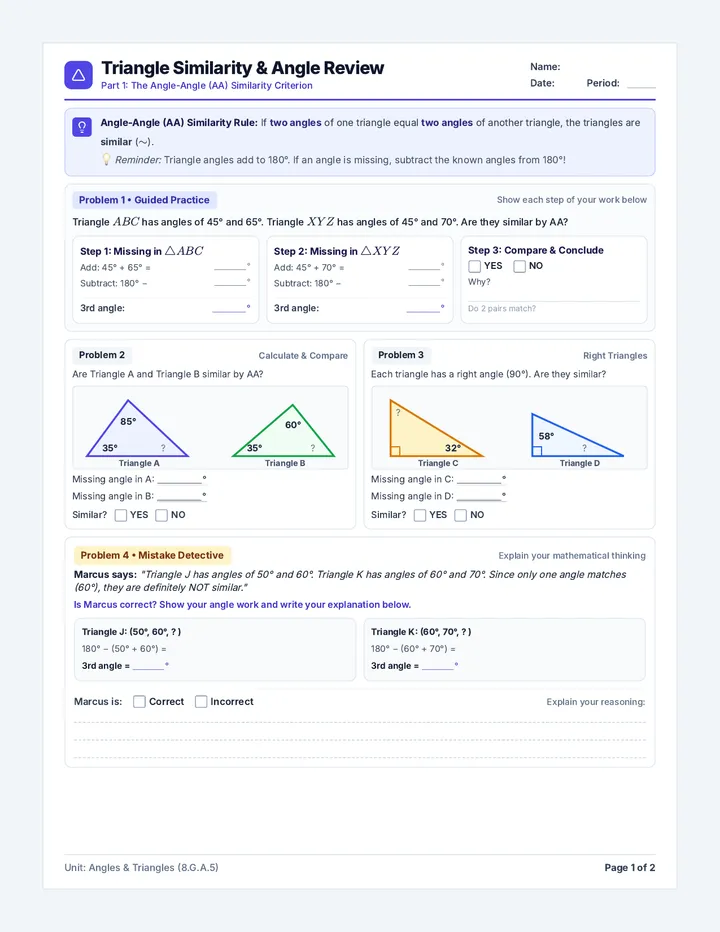
    An 8th grade geometry lesson exploring angle-angle triangle similarity, the exterior angle theorem, and angle relationships formed by parallel lines cut by transversals.

    L

    Logan-Greene

    2
    Cross-Cross Equations Answer Key

    Cross-Cross Equations Answer Key

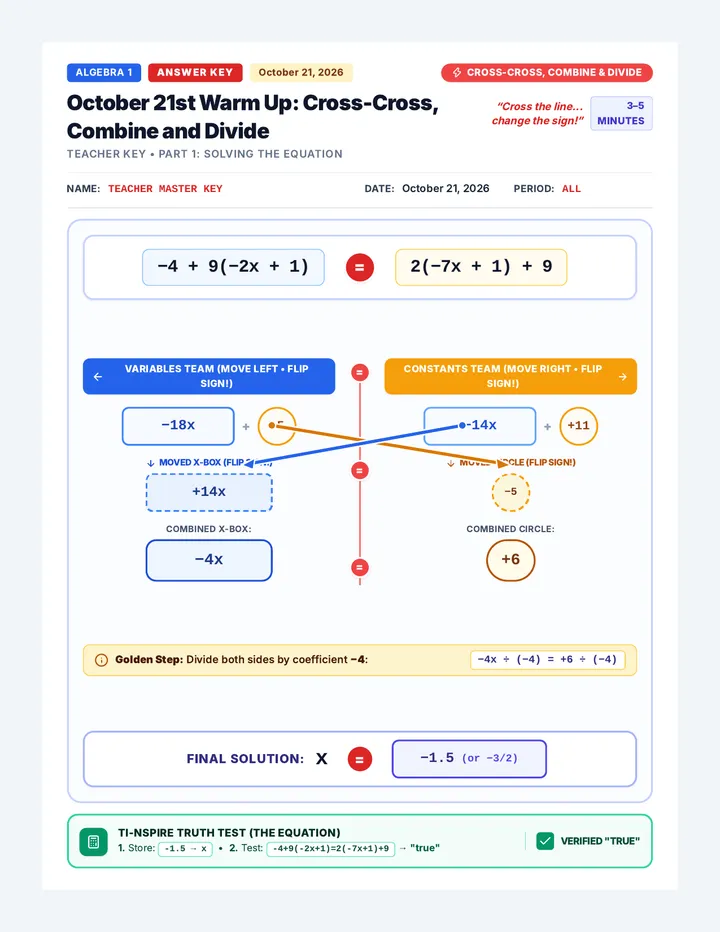
    Comprehensive two-page teacher answer key for the Cross-Cross, Combine and Divide warm-up worksheet. Shows full step-by-step solutions, intermediate distribution steps, box and circle values, sign flips, combined terms, golden step division, and TI-Nspire verification results.

    H

    Harlston

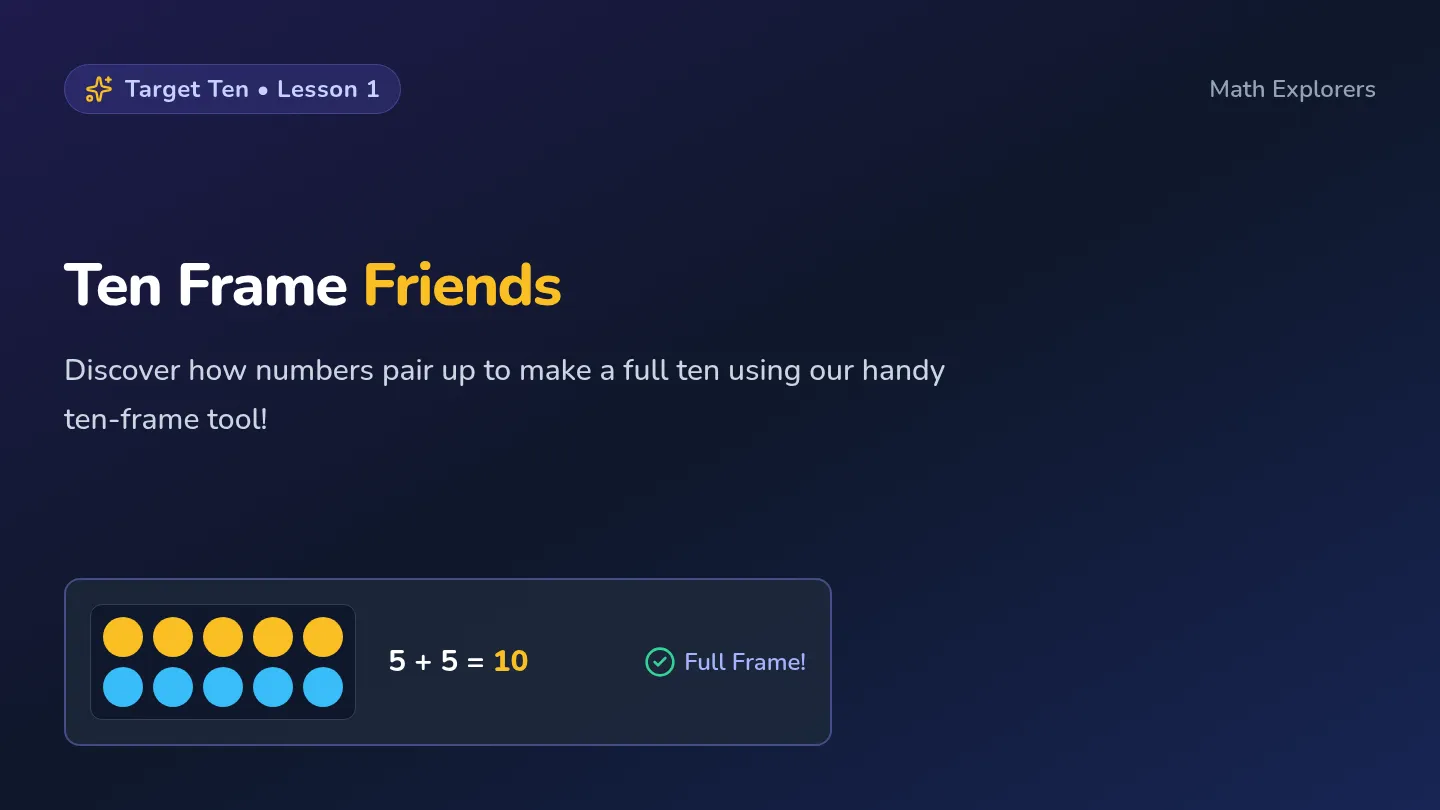
    Ten Frame Slides

    Target Ten

    A foundational math sequence engineered to build addition fluency to 10 through concrete ten-frame modeling, number path navigation, and missing addend investigations. Designed with visual scaffolds and structured repetition for students needing extra support.

    Lenny Avatar
    Lenny
    9
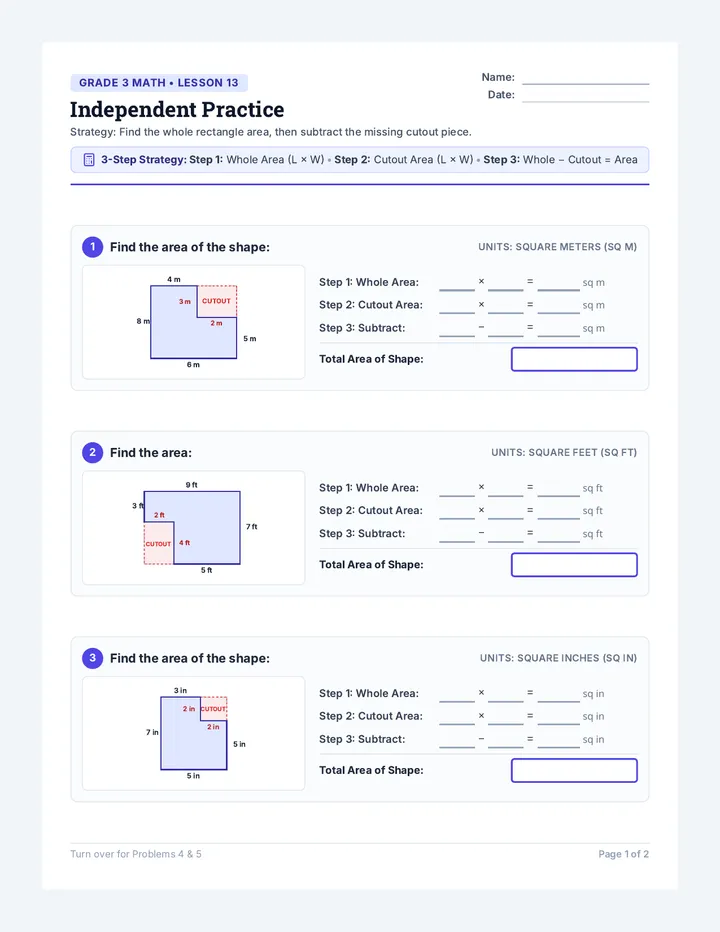
    Cutout Area Practice Worksheet

    Cutout Area Detectives

    A 3rd-grade math lesson on calculating the area of composite figures using the subtraction strategy (finding total area of the large rectangle and subtracting the cut-out missing piece).

    SM

    Samantha McBath

    2
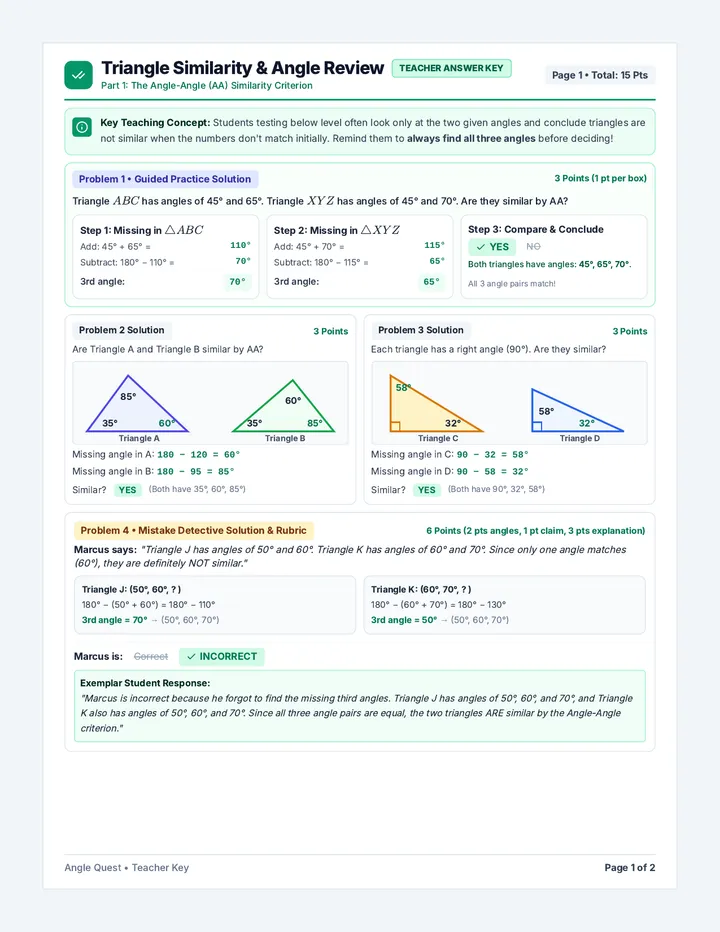
    Triangle Similarity & Angle Review Answer Key

    Triangle Similarity & Angle Review Answer Key

    A comprehensive 2-page print-ready teacher answer key and scoring guide for the Angle Quest Worksheet. Features fully worked-out step-by-step solutions, completed diagrams with highlighted answers, common student misconceptions, and scoring tips.

    L

    Logan-Greene

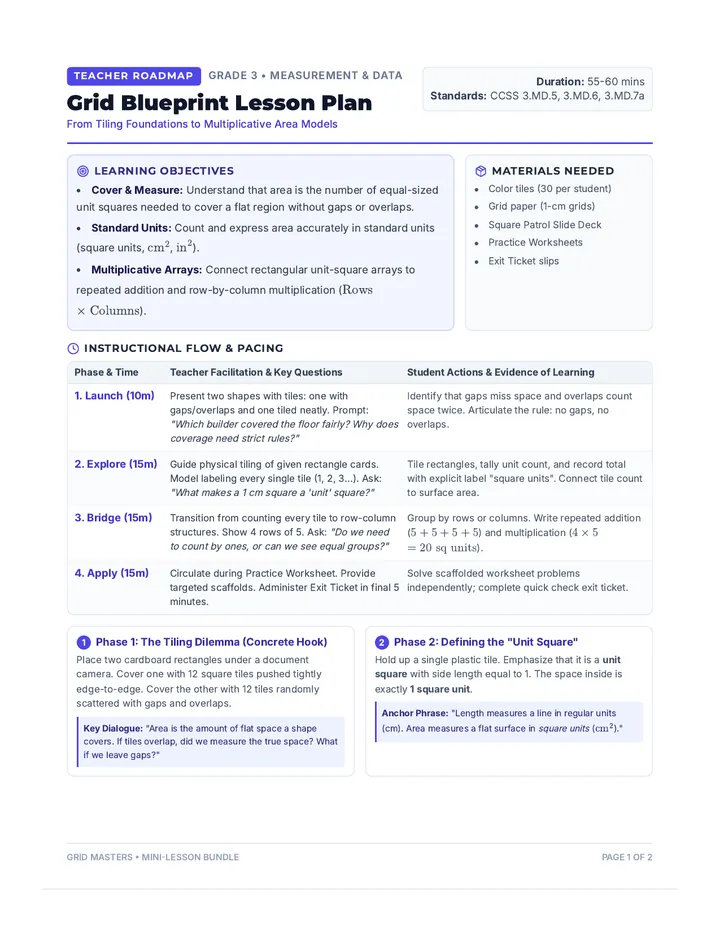
    Grid Blueprint Lesson Plan

    Dimension Architects

    A coherent spatial measurement sequence bridging two-dimensional surface coverage to three-dimensional volume measurement. Students transition from tiling flat regions with unit squares to packing solid rectangular prisms with unit cubes, connecting spatial arrays to multiplicative formulas.

    MJ

    Meg Jones

    8
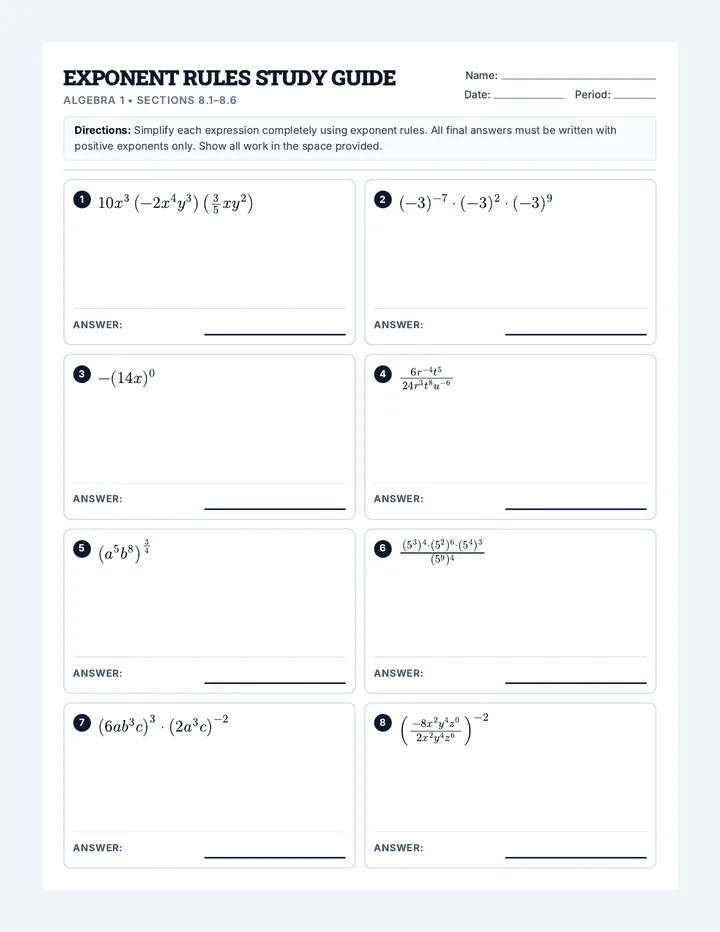
    Exponent Rules Study Guide

    Exponent Rules

    A comprehensive unit covering laws of exponents including product, quotient, power, zero, negative, and rational exponent rules.

    CD

    Craig Davis

    2
    Cross-Cross Combine Divide Worksheet

    Cross-Cross Combine Divide Worksheet

    Two-page Algebra 1 warm-up worksheet for October 21st titled 'Cross-Cross, Combine and Divide' for solving linear equations. The front page guides students through the three-step method (cross-cross with straight directional arrows, combine like terms, and divide by the coefficient) on the full equation, while the back page provides practice simplifying both expressions.

    H

    Harlston