Animal Unit Rates Slides Grade 6 Math • Small Group
Animal Unit Rates
Finding the price for 1 item and spotting the best deal!
🦁🐘🦒🦓🦏
5 Plastic Animals
Today’s Tools: 5 Plastic Animals • Class Store Items • Pencil
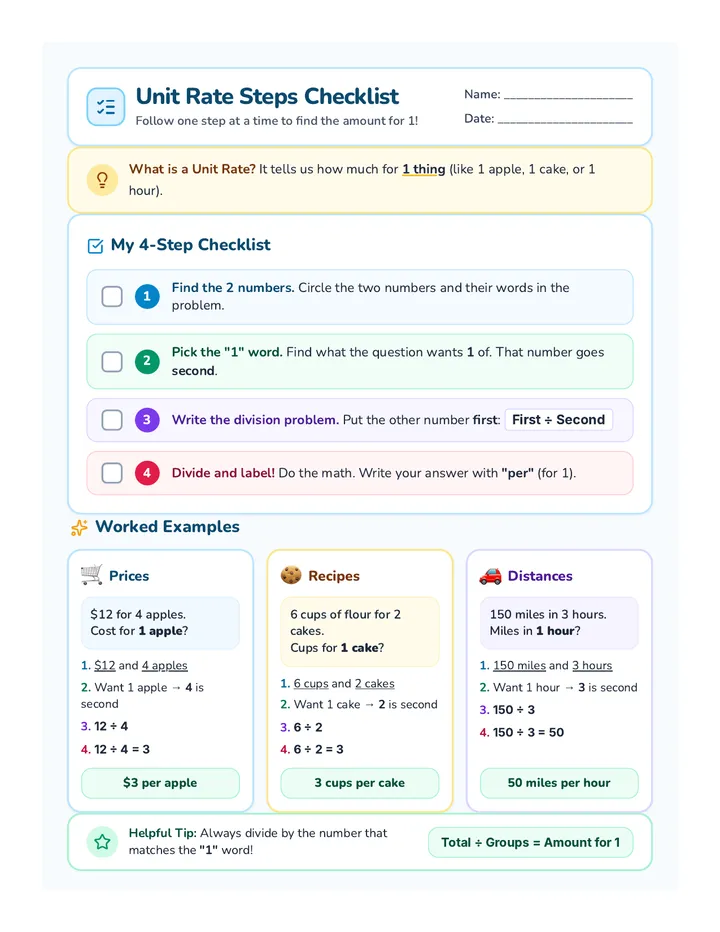
What Is a Unit Rate?
Key Idea
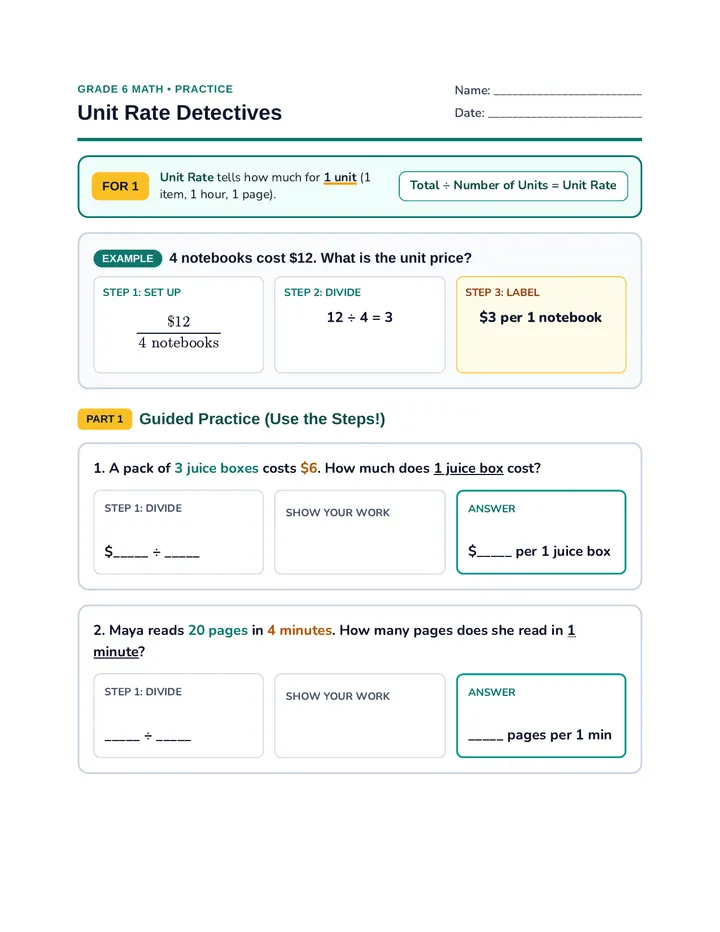
Unit Rate (Unit Price)
The cost for 1 single item.
“Unit” means ONE!
Real-Life Example: 1 Juice Box
🧃
$2 per juice box
To find the unit price, we share the total cost equally!
Teacher Model: 4 Juice Boxes for $8
Teacher Model (I Do)
🧃 🧃 🧃 🧃 A 4-pack of juice boxes
Store Price = $8
🧃 $2
🧃 $2
🧃 $2
🧃 $2
\( \$8 \div 4\text{ juice boxes} = \$2\text{ per juice box} \)
Unit Price = $2!
Student Try: 3 Slices of Pizza for $9
Student Try
🍕 🍕 🍕 3 slices of pizza altogether
Total = $9
Your Turn to Solve
Share $9 equally among 3 slices.
\( \$9 \div 3 = \; ? \)
Share Out
“1 slice of pizza costs $____.”
Write your work in the Student Try box on your paper!
Now let’s use this same strategy with our 5 Plastic Animals!
Question 1: 5 Animals for $5
We Do
🦁 🐘 🦒 🦓 🦏 5 animals altogether
Total = $5
🦁 $1
🐘 $1
🦒 $1
🦓 $1
🦏 $1
\( \$5 \div 5\text{ animals} = \$1\text{ per animal} \)
Divide total cost by 5!
Question 2: 5 Animals for $10
We Do
If 5 animals cost $10 altogether...
How much is 1 animal?
Step 1: Set Up Division
Total Cost ÷ Number of Animals
\( \$10 \div 5 = \; ? \)
Step 2: Explain Your Answer
“I divided $10 by 5 animals.”
“Each animal costs $2.”
Check: $2 + $2 + $2 + $2 + $2 = $10!
Question 3: $100 Pack
We Do
5 animals cost $100 altogether.
Step 1: Find 1 Animal
🦁 Unit Price
\( \$100 \div 5 = \$20 \)
1 animal costs $20.
Step 2: Find 3 Animals
🦁 🐘 🦒 3 Animals
\( \$20 \times 3 = \$60 \)
3 animals cost $60.
First find 1 (divide), then find any number (multiply)!
What Process Did We Just Do?
1
Divide to Find 1
Take the total price and divide by the number of items.
Total ÷ Quantity = Unit Price
2
Multiply for More
Take the unit price and multiply by how many items you want.
Unit Price × Needed = New Total
Let’s use this process in our Class Store!
Class Store: Which Is the Better Buy?
Your Turn
Pack A: 4 Pencils
✏️
Total Price: $8
\( \$8 \div 4 = \$2\text{ per pencil} \)
Pack B: 6 Pencils
✏️
Total Price: $6
\( \$6 \div 6 = \$1\text{ per pencil} \)
Better Buy = Lower Unit Price!
Pack B ($1) is cheaper per pencil than Pack A ($2).
Animal Unit Rates Worksheet Name: ______________________________
Date: ___________________
Animal Unit Rates
Unit Rate = Price for 1 Item
Teacher Model (Watch) 🧃🧃🧃🧃
4 juice boxes cost $8.
\( \$8 \div 4 = \$2 \) for 1 juice box
Student Try (Your Turn) 🍕🍕🍕
3 slices of pizza cost $9. Find 1 slice:
1 slice = $________
1. If 5 animals cost $5 altogether, how much is 1 animal?
🦁 🐘 🦒 🦓 🦏 = $5
Show Your Work
1 animal costs: $____________
Explain how you know:
2. If 5 animals cost $10 altogether, how much does 1 animal cost?
Total: $10
Show Your Work
1 animal costs: $____________
Explain how you know:
3. If 5 animals cost $100 altogether:
Total: $100
a) How much does 1 animal cost? 🦁
Show Your Work
1 animal = $____________
b) How much do 3 animals cost? 🦁 🐘 🦒
Show Your Work
3 animals = $____________
Class Store Unit Rates
Page 2
Stop & Think: What math process did we just do?
Write or draw the steps we used to find 1 animal, and then 3 animals.
4. Pick 1 object from our Class Store. Find its unit price!
Object Name: ______________________
Total Price: $_________
How many in pack? _________
Unit Price (1 item): $____________
Show Your Work (Total ÷ How Many)
5. Pick 2 similar objects from our Class Store. Compare their unit prices!
Object A
Name: ________________________
Total: $_______ Count: _______
Work Space
Unit Price: $____________
Object B
Name: ________________________
Total: $_______ Count: _______
Work Space
Unit Price: $____________
Which is the better buy? ________________________ How do you know?
Animal Unit Rates Teacher Guide Grade 6 • Tier 3 Small-Group Intervention
Animal Unit Rates Teacher Guide
Pacing
25–30 Minutes
Learning Target (6.RP.A.2 / 6.RP.A.3b)
Students will find the unit rate (unit price) by dividing total cost by quantity, scale up to find the cost of multiple items, and compare unit prices to identify the better buy.
Prep & Materials
5 plastic animals per student or pairClass Store items with price & countPlay money ($1, $5, $10, $20) optional
Animal Unit Rates Slides & Worksheet
Part 1: Real-Life Model, Student Try & Plastic Animals (15 min)
1. Hook & Key Vocabulary (Slides 1–2 • 2 min)
Introduce
Say: “Before we use our plastic animals, let’s talk about real shopping! A unit rate or unit price means the price for just ONE item. Unit means one.”
2. Teacher Model: 4 Juice Boxes for $8 (Slide 3 • 3 min)
I Do
Think aloud: “Imagine I buy a 4-pack of juice boxes for $8. To find the price of 1 juice box , I share $8 equally among 4 boxes: \( \$8 \div 4 = \$2 \). The unit price is $2 per juice box.”
3. Student Try: 3 Slices of Pizza for $9 (Slide 4 • 3 min)
You Try
Have students complete the Student Try box at the top of their worksheet (\( \$9 \div 3 = \$3 \) per slice). Check answers together before handing out the plastic animals!
4. Plastic Animals — Q1: 5 Animals = $5 (Slide 5 • 2 min)
We Do
Give each student/pair 5 plastic animals . Connect to the warm-up: “Just like the juice and pizza, divide total cost by how many: \( \$5 \div 5 = \$1 \) per animal.”
5. Guided Practice — Q2: 5 Animals = $10 (Slide 6 • 2 min)
We Do
Students write \( \$10 \div 5 = \$2 \) and explain orally: “I divided $10 by 5 animals, so 1 animal costs $2.” Skip-count by 2s across the 5 animals to verify.
6. Two-Step Bridge — Q3: 5 Animals = $100 (Slide 7 • 3 min)
We Do
Guide Part A (\( \$100 \div 5 = \$20 \) per animal). Have students pull 3 animals forward for Part B : “If 1 animal is $20, how much are 3 animals?” (\( \$20 \times 3 = \$60 \)).
Animal Unit Rates Teacher Guide
Page 2
Part 2: Process Reflection & Class Store (12–15 min)
7. Stop & Think: “What process did we just do?” (Slide 8 • 3 min)
Before writing, have students turn and talk. Summarize on the board: Step 1: Divide to find 1 (Total ÷ Count). Step 2: Multiply to find more (Unit Price × Needed). Have students record this in their own words on Page 2.
8. Class Store Investigation — Q4 & Q5 (Slide 9 • 10 min)
You Do Together
Tip for Tier 3: Pre-stock the Class Store with friendly numbers that divide evenly (e.g., 4 pencils for $8, 6 pencils for $6, 3 erasers for $6, 5 stickers for $10).
Q4: Students pick 1 multi-pack item, record total price and count, and divide to find the unit price.Q5: Students pick 2 similar items (e.g., two different packs of pencils or markers), find both unit prices, and circle/explain which has the lower unit price (better buy).
Common Tier 3 Misconceptions & Quick Fixes
Dividing Backwards (5 ÷ $10)
Remind students: “Money goes in the house (first)! Total dollars ÷ number of items.”
Picking the Lower Total Price
For “better buy,” ask: “If you only bought ONE from each pack, which one costs less?”
Tier 3 Differentiation & Scaffolds
Calculation Support
Provide a multiplication chart or 4-function calculator for Q3–Q5 so students focus on the unit rate concept.
Sentence Frames
Post: “I divided ___ by ___.” and “___ is the better buy because $___ is less than $___.”
Extension
Ask early finishers: “How much would 10 of your Class Store item cost?”
Animal Unit Rates Answer Key Teacher Resource • Grade 6 Tier 3
Animal Unit Rates Answer Key
Answer Key
Warm-Up Student Try: 3 slices of pizza = $9
Work: \( \$9 \div 3 = \$3 \)
Answer: $3 per slice 🍕
1. 5 animals = $5 altogether
Work: \( \$5 \div 5 = \$1 \)
Answer: $1 per animal
Sample Explanation: I divided $5 equally among 5 animals, so each animal costs $1. (Check: $1 × 5 = $5.)
2. 5 animals = $10 altogether
Work: \( \$10 \div 5 = \$2 \)
Answer: $2 per animal
Sample Explanation: I divided $10 by 5 animals to get $2 for each animal. (Check: 2 + 2 + 2 + 2 + 2 = 10.)
3. 5 animals = $100 altogether
a) Cost of 1 animal:
Work: \( \$100 \div 5 = \$20 \)
Answer: $20
b) Cost of 3 animals:
Work: \( \$20 \times 3 = \$60 \) (or \( \$20 + \$20 + \$20 \))
Answer: $60
Stop & Think: What math process did we just do?
Sample Student Response: First, we divided the total price by 5 to find the unit price (cost of 1 animal). Then, we multiplied the unit price by 3 (or added it 3 times) to find the cost of 3 animals.
4 & 5. Class Store Answers (Student Choice — Look-Fors)
Answers vary by item
Q4: Single Object Look-Fors
Student correctly records Total Price and Pack Count.
Student divides Total Price ÷ Count (not Count ÷ Price).
Example: Pack of 4 stickers for $8 → \( \$8 \div 4 = \$2 \) per sticker.
Q5: Better Buy Look-Fors
Student finds the unit price for both Object A and Object B.
Student identifies the item with the lower unit price as the better buy.
Example: Pack A ($2/pencil) vs. Pack B ($1/pencil) → “Pack B is the better buy because $1 per pencil is cheaper than $2 per pencil.”