Polynomial Graphing Objectives Guide
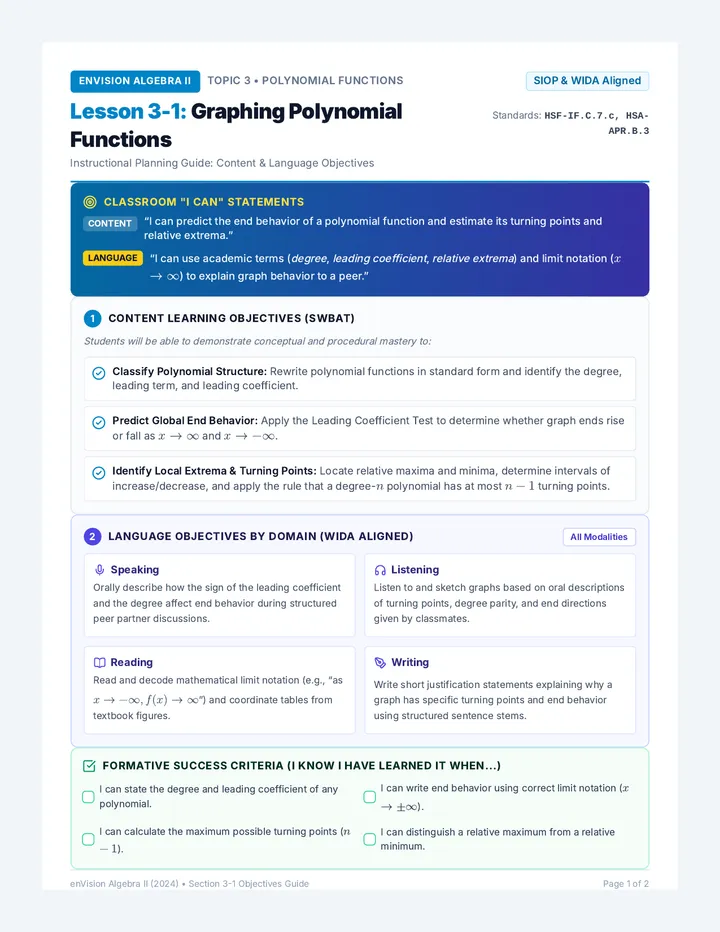
enVision Algebra II Topic 3 • Polynomial Functions
SIOP & WIDA Aligned
Lesson 3-1: Graphing Polynomial Functions
Instructional Planning Guide: Content & Language Objectives
Standards: HSF-IF.C.7.c, HSA-APR.B.3
Classroom "I Can" Statements
Content
“I can predict the end behavior of a polynomial function and estimate its turning points and relative extrema.”
Language
“I can use academic terms (degree, leading coefficient, relative extrema) and limit notation (\(x \to \infty\)) to explain graph behavior to a peer.”
1
Content Learning Objectives (SWBAT)
Students will be able to demonstrate conceptual and procedural mastery to:
-
Classify Polynomial Structure: Rewrite polynomial functions in standard form and identify the degree, leading term, and leading coefficient.
-
Predict Global End Behavior: Apply the Leading Coefficient Test to determine whether graph ends rise or fall as \(x \to \infty\) and \(x \to -\infty\).
-
Identify Local Extrema & Turning Points: Locate relative maxima and minima, determine intervals of increase/decrease, and apply the rule that a degree-\(n\) polynomial has at most \(n-1\) turning points.
2
Language Objectives by Domain (WIDA Aligned)
All Modalities
Speaking
Orally describe how the sign of the leading coefficient and the degree affect end behavior during structured peer partner discussions.
Listening
Listen to and sketch graphs based on oral descriptions of turning points, degree parity, and end directions given by classmates.
Reading
Read and decode mathematical limit notation (e.g., “as \(x \to -\infty, f(x) \to \infty\)”) and coordinate tables from textbook figures.
Writing
Write short justification statements explaining why a graph has specific turning points and end behavior using structured sentence stems.
Formative Success Criteria (I Know I Have Learned It When...)
I can state the degree and leading coefficient of any polynomial.
I can write end behavior using correct limit notation (\(x \to \pm\infty\)).
I can calculate the maximum possible turning points (\(n - 1\)).
I can distinguish a relative maximum from a relative minimum.
enVision Algebra II (2024) • Section 3-1 Objectives Guide Page 1 of 2
Lesson 3-1 • Linguistic Support & Vocabulary Guide Teacher Resource
Academic Vocabulary & Language Scaffolds
Target Vocabulary (Section 3-1 Word Bank)
Textbook Specified Terms
Degree of a polynomial: The greatest exponent of all terms in the polynomial.
Leading coefficient: The coefficient of the term with the highest degree when written in standard form.
Standard form of a polynomial: Arranged with terms in descending order of their degrees.
Polynomial function: A function whose rule is given by a polynomial in one variable.
Turning point: A point on the graph where the function changes from increasing to decreasing or vice versa.
Relative maximum: The value of \(f(x)\) at a turning point where the function values are greater than nearby points.
Relative minimum: The value of \(f(x)\) at a turning point where the function values are less than nearby points.
Visual Anchor: The Leading Coefficient Test
Even Degree (Ends go same direction)
- • \(a_n > 0\) (Positive): Both ends up (\(x \to \pm\infty, f(x) \to \infty\))
- • \(a_n < 0\) (Negative): Both ends down (\(x \to \pm\infty, f(x) \to -\infty\))
Odd Degree (Ends go opposite directions)
- • \(a_n > 0\) (Positive): Down on left, up on right
- • \(a_n < 0\) (Negative): Up on left, down on right
Tiered Sentence Frames (Speaking & Writing)
Scaffolding
Emerging / Developing (Levels 1-2):
“The degree is [even / odd], so the ends point in the [same / opposite] direction.”
“The point is a [relative max / min] because it is a [peak / valley] on the curve.”
Expanding / Bridging (Levels 3-4):
“Because the degree is [even/odd] and the leading coefficient is [positive/negative], as \(x \to \infty\), \(f(x) \to\) ___, and as \(x \to -\infty\), \(f(x) \to\) ___.”
“Since the degree is \(n =\) ___, the graph can have at most \(n - 1 =\) ___ turning points.”
Teacher Question Stems to Prompt Academic Discourse
Prompting Prediction: “How does changing the sign of the leading coefficient flip the end behavior?”
Prompting Justification: “What evidence from the equation proves this graph cannot have 4 turning points?”
enVision Algebra II (2024) • Section 3-1 Objectives Guide Page 2 of 2
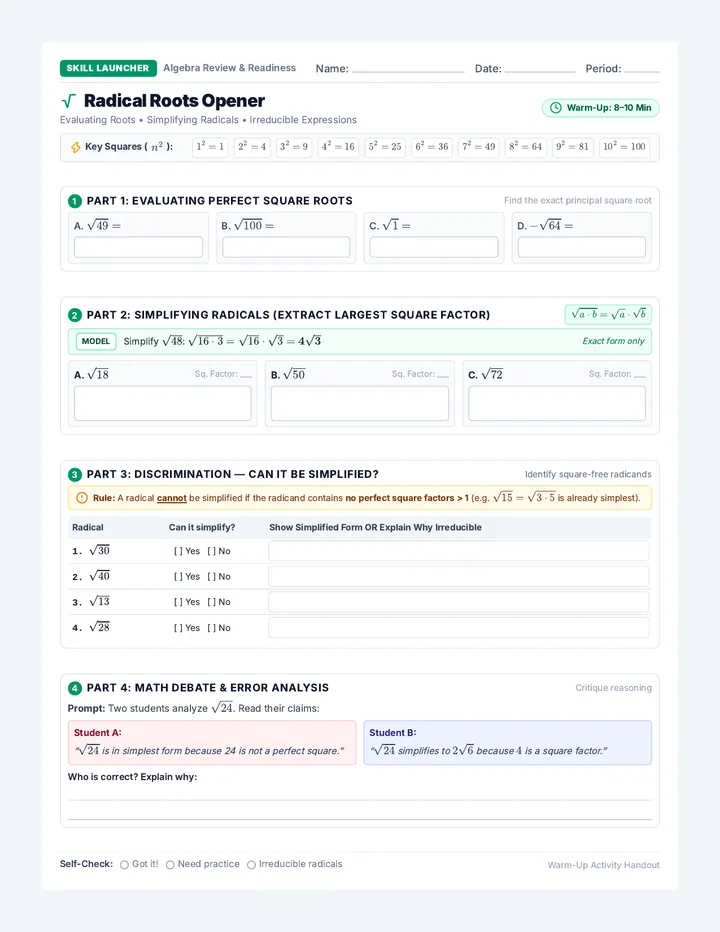
Radical Roots Opener
Skill Launcher Algebra Review & Readiness
Name:
Date:
Period:
Radical Roots Opener
Evaluating Roots • Simplifying Radicals • Irreducible Expressions
Warm-Up: 8–10 Min
Key Squares (\(n^2\)):
\(1^2=1\) \(2^2=4\) \(3^2=9\) \(4^2=16\) \(5^2=25\) \(6^2=36\) \(7^2=49\) \(8^2=64\) \(9^2=81\) \(10^2=100\)
1 Part 1: Evaluating Perfect Square Roots
Find the exact principal square root
A. \(\sqrt{49} =\)
B. \(\sqrt{100} =\)
C. \(\sqrt{1} =\)
D. \(-\sqrt{64} =\)
2 Part 2: Simplifying Radicals (Extract Largest Square Factor)
\(\sqrt{a \cdot b} = \sqrt{a} \cdot \sqrt{b}\)
Model Simplify \(\sqrt{48}\): \(\sqrt{16 \cdot 3} = \sqrt{16} \cdot \sqrt{3} = \mathbf{4\sqrt{3}}\)
Exact form only
A. \(\sqrt{18}\) Sq. Factor: ___
B. \(\sqrt{50}\) Sq. Factor: ___
C. \(\sqrt{72}\) Sq. Factor: ___
3 Part 3: Discrimination — Can It Be Simplified?
Identify square-free radicands
Rule: A radical cannot be simplified if the radicand contains no perfect square factors > 1 (e.g. \(\sqrt{15} = \sqrt{3 \cdot 5}\) is already simplest).
| Radical |
Can it simplify? |
Show Simplified Form OR Explain Why Irreducible |
| 1. \(\sqrt{30}\) |
[ ] Yes [ ] No |
|
|
|
|
| 2. \(\sqrt{40}\) |
[ ] Yes [ ] No |
|
|
| 3. \(\sqrt{13}\) | [ ] Yes [ ] No |
|
| 4. \(\sqrt{28}\) | [ ] Yes [ ] No |
|
4 Part 4: Math Debate & Error Analysis
Critique reasoning
Prompt: Two students analyze \(\sqrt{24}\). Read their claims:
Student A:
“\(\sqrt{24}\) is in simplest form because 24 is not a perfect square.”
Student B:
“\(\sqrt{24}\) simplifies to \(2\sqrt{6}\) because \(4\) is a square factor.”
Who is correct? Explain why:
Self-Check: Got it! Need practice Irreducible radicals
Warm-Up Activity Handout