Lenny.com
Explore
Create
ActivitiesNewMathEnglish Language ArtsScience & EngineeringSocial StudiesGlobal LanguagesHealth & Physical EducationSpecial EducationCounseling & Life SkillsArts & CreativityESL
Lenny.com
Lenny.com
Explore
Create
ActivitiesNewMathEnglish Language ArtsScience & EngineeringSocial StudiesGlobal LanguagesHealth & Physical EducationSpecial EducationCounseling & Life SkillsArts & CreativityESL
Lenny.com
Lenny.com

Solutions

Lenny for EducatorsLenny for SchoolsLenny for Districts

Product

ExploreSign inCreateSupportAbout

Resources

Getting startedMTSS Acceleration Program

© 2026 Lenny Learning Inc.

TermsPrivacyAccessibility
LinkedInInstagramX
Lenny
MathNumbers & CountingCounting ObjectsNumber NamesComparing NumbersNumber OperationsCounting SequenceNumbers 0-10Place Value Understanding and SystemAdd and Subtract Within 20Addition and Subtraction ConceptsAddition and Subtraction EquationsAddition and Subtraction ProblemsFoundations for MultiplicationMultiplication and Division PropertiesMultiply and Divide Within 100Multiplication and Division ProblemsFactors and MultiplesProperties of OperationsPatterns and RelationshipsGenerate and Analyze PatternsMulti-Digit ArithmeticPlace Value OperationsMulti-Digit and Decimal OperationsNumerical ExpressionsFour Operations and PatternsFour Operations Problem SolvingMeasurement & DataMeasurable AttributesMeasuring LengthsMeasure and Estimate Lengths in Standard UnitsRelate Addition and Subtraction to LengthClassifying and Counting ObjectsTime and MoneyArea Concepts and MeasurementPerimeter and Area MeasuresAngle Concepts and MeasurementTime, Volume, and MassMeasurement Unit ConversionsGeometryIdentifying ShapesShapes and AttributesShape Attributes and ReasoningShapes and CompositionClassifying 2D FiguresGeometric Figures and RelationshipsLines, Angles, and ShapesAngle, Area, and VolumeGeometric MeasurementVolume of 3D ShapesCoordinate Plane ApplicationsTransformations in the PlaneCongruence and SimilarityUnderstand congruence in terms of rigid motionsSimilarity and TransformationsProve Theorems Involving SimilarityPythagorean TheoremTrigonometry for General TrianglesMake Geometric ConstructionsProve Geometric TheoremsTheorems About CirclesFind Arc Lengths And Areas of Sectors of CirclesVolume FormulasRelationships Between Two-Dimensional and Three-Dimensional ObjectsProve Simple Geometric Theorems AlgebraicallyTranslate Between Geometric Description and Equation for Conic SectionApply Geometric Concepts in Modeling SituationsFractions & DecimalsFractions as NumbersBuilding FractionsFraction Equivalence and OrderingAdding and Subtracting FractionsMultiplying and Dividing FractionsDividing FractionsDecimal FractionsMulti-Digit Computation and FactorsAdd, Subtract, Multiply, and Divide Rational NumbersRational Number SystemIrrational Numbers and ApproximationsRatiosRatios and ProportionsProportional RelationshipsUnit RateAlgebraAlgebraic ExpressionsGenerate Equivalent ExpressionsQuantitative RelationshipsProportional Relationships and Linear EquationsEquations and InequalitiesEquation Solving and ReasoningLinear Equations and SystemsGraph Equations and InequalitiesSystems of EquationsReal-World Algebraic ProblemsQuantitative Reasoning with UnitsExpression StructureEquivalent Expression FormsRadicals and Integer ExponentsRational ExponentsRational and Irrational NumbersPolynomial OperationsPolynomial IdentitiesPolynomial Zeros and FactorsRational ExpressionsComplex Number OperationsComplex Numbers in PolynomialsComplex Numbers on PlaneStatistics & ProbabilityRepresent and Interpret DataData DistributionsStatistical VariabilityProbability ModelsCompound Event ProbabilitiesStatistical SamplingInterpret Categorical and Quantitative DataBivariate Data PatternsInterpret Linear ModelsComparing Two PopulationsRandom Processes in StatisticsIndependence and Conditional ProbabilityExpected ValuesProbability-Based Decision MakingStatistical Inference and ConclusionsFunctionsFunction Concepts and NotationDefine and Compare FunctionsInterpret Functions in ContextAnalyze Function RepresentationsModel Relationships with FunctionsIdentify Linear vs Exponential GrowthDistinguish Between Function TypesCompare Growth RatesInterpret Function ExpressionsBuild Functions from RelationshipsConstruct and Model FunctionsTransform and Combine FunctionsModel Comparison and SelectionSolve Exponential EquationsTrigonometryTrigonometric Ratios Involving Right TrianglesTrigonometric Functions and Unit CircleModel with Trigonometric FunctionsTrigonometric IdentitiesVectors & MatricesIntroduction to Vectors and MatricesVector QuantitiesVector OperationsMatrix OperationsCalculusLimits and ContinuityDerivative Concepts and NotationDerivative Rules and TechniquesApplications of DerivativesOptimization ProblemsRelated RatesCurve Sketching and AnalysisIntegration Concepts and NotationAntiderivatives and Indefinite IntegralsDefinite Integrals and AreaFundamental Theorem of CalculusIntegration TechniquesApplications of IntegrationDifferential EquationsSequences and SeriesParametric and Polar FunctionsVector-Valued Functions

Equation Arena Review

A comprehensive, gamified review lesson covering systems of linear equations and inequalities, laws of exponents and radicals, and exponential functions from Modules 7, 8, and 9. Students review core algebra competencies through cooperative game play, modular challenge stages, and structured problem solving.

Jjfrisk

Solutions follow on Pages 2, 3, & 4

Master Solution Key • Realm I

SYSTEMS OF EQUATIONS & INEQUALITIES (MODULE 7)

Quests 01 to 06

Quest 01: Classification Consistent & Indep.

System: \(3x + 5y = -5\) and \(6y + 15 = -15x\).
Step 1: Find slopes in slope-intercept form:
• Eq 1: \(5y = -3x - 5 \Rightarrow y = -\frac{3}{5}x - 1\) (\(m_1 = -0.6\)).
• Eq 2: \(6y = -15x - 15 \Rightarrow y = -\frac{5}{2}x - 2.5\) (\(m_2 = -2.5\)).
Conclusion: Unequal slopes (\(m_1 \ne m_2\)) mean the lines intersect at exactly one point.

10-Ft Glance Check: Look for \(m_1 = -3/5\) and \(m_2 = -5/2\) on the board.

Quest 02: Solution Count No Solution (0)

System: \(2y - 8 = -6x\) and \(3y + 9x = -12\).
Step 1: Solve each for \(y\):
• Line 1: \(2y = -6x + 8 \Rightarrow y = -3x + 4\).
• Line 2: \(3y = -9x - 12 \Rightarrow y = -3x - 4\).
Conclusion: Both lines share identical slope (\(m = -3\)) but have different y-intercepts (\(4 \ne -4\)). The lines are parallel.

10-Ft Glance Check: Look for \(y = -3x + 4\) and \(y = -3x - 4\) (parallel lines).

Quest 03: Shoes & Jacket Shoes: $22 • Jacket: $16

Equations: Let \(x\) = shoes, \(y\) = jacket.
\(x + y = 38\) and \(x = y + 6\).
Step 1: Substitute \((y + 6)\) for \(x\):
\((y + 6) + y = 38 \Rightarrow 2y + 6 = 38 \Rightarrow 2y = 32 \Rightarrow y = 16\).
Step 2: Solve for \(x\): \(x = 16 + 6 = 22\).
Check: \(\$22 + \$16 = \$38\) and \(\$22 - \$16 = \$6\).

10-Ft Glance Check: Look for boxed $22 (shoes) and $16 (jacket).

Quest 04: Substitution \((x, y) = (-5, -2)\)

System: \(3x - 2y = -11\) and \(-4x + y = 18\).
Step 1: Isolate \(y\) in Eq 2: \(y = 4x + 18\).
Step 2: Substitute into Eq 1:
\(3x - 2(4x + 18) = -11 \Rightarrow 3x - 8x - 36 = -11\)
\(-5x = 25 \Rightarrow x = -5\).
Step 3: \(y = 4(-5) + 18 = -20 + 18 = -2\).

10-Ft Glance Check: Look for boxed ordered pair (-5, -2).

Quest 05: Elimination \((x, y) = (10, -12)\)

System: \(9x + 11y = -42\) and \(3x + 4y = -18\).
Step 1: Multiply Eq 2 by \(-3\):
\(-9x - 12y = 54\).
Step 2: Add to Eq 1:
\((9x - 9x) + (11y - 12y) = -42 + 54 \Rightarrow -y = 12 \Rightarrow y = -12\).
Step 3: \(3x + 4(-12) = -18 \Rightarrow 3x = 30 \Rightarrow x = 10\).

10-Ft Glance Check: Look for boxed ordered pair (10, -12).

Quest 06: Inequalities Test (0,0) & (-5,6) are sol.

Conditions: \(y \ge -x\) AND \(2x + y \le 2\).
• \((0,0)\): \(0 \ge 0\) (True) & \(0 \le 2\) (True) \(\Rightarrow\) YES.
• \((-5,6)\): \(6 \ge 5\) (True) & \(2(-5)+6 = -4 \le 2\) (True) \(\Rightarrow\) YES.
• \((4,-5)\): \(-5 \ge -4\) is FALSE (\(-5 < -4\)) \(\Rightarrow\) NO.
Both inequalities must be satisfied.

10-Ft Glance Check: Look for (0,0)=YES, (-5,6)=YES, (4,-5)=NO on board.

Speed Check Tip: Give a quick dry-erase star on their board when verified so they can immediately erase and advance. Page 2 of 4

Master Solution Key • Realm II

EXPONENTS AND ROOTS (MODULE 8)

Quests 07 to 12

Quest 07: Power of a Monomial \(27x^6y^{15}\)

Expression: \((3x^2y^5)^3\).
Step 1: Apply power of a product rule: \((ab)^n = a^n b^n\).
\((3)^3 \cdot (x^2)^3 \cdot (y^5)^3\).
Step 2: Evaluate coefficient: \(3^3 = 27\).
Step 3: Multiply exponents: \(x^{2 \times 3} = x^6\), \(y^{5 \times 3} = y^{15}\).
Caution: Don't multiply base: \(3 \times 3 \ne 9\).

10-Ft Glance Check: Check that base is 27, not 9! Boxed: \(27x^6y^{15}\).

Quest 08: Negative Exponents \(\frac{1}{3a^7b^2}\)

Expression: \(\frac{5a^{-5}b^4}{15a^2b^6}\).
Step 1: Coefficients: \(\frac{5}{15} = \frac{1}{3}\).
Step 2: Subtract exponents:
\(a^{-5 - 2} = a^{-7} = \frac{1}{a^7}\).
\(b^{4 - 6} = b^{-2} = \frac{1}{b^2}\).
Result: Put terms with negative powers into denominator: \(\frac{1}{3a^7b^2}\).

10-Ft Glance Check: Ensure all variables are in denominator: \(\frac{1}{3a^7b^2}\).

Quest 09: Scientific Notation \(5.972 \times 10^{24}\text{ kg}\)

Value: 5,972 followed by 21 zeros (24 digits after 5).
Rule: Scientific notation format is \(a \times 10^n\) where \(1 \le a < 10\).
Step 1: Moving the decimal point 24 places left gives \(a = 5.972\).
Step 2: Power is positive: \(n = 24\).
Result: \(5.972 \times 10^{24}\) kg.

10-Ft Glance Check: Look for positive power of 24: \(5.972 \times 10^{24}\).

Quest 10: Rational Exponents \(8\)

Evaluate: \(\left(\frac{100}{25}\right)^{3/2}\).
Step 1: Divide inside parentheses:
\(\frac{100}{25} = 4\).
Step 2: Apply exponent \(4^{3/2}\):
The denominator 2 is the index (square root): \(\sqrt{4} = 2\).
The numerator 3 is the power: \(2^3 = 8\).

10-Ft Glance Check: Look for clean integer 8 boxed on board.

Quest 11: Radical Distributive \(60\sqrt{2} - 30\)

Expression: \(5\sqrt{3}(4\sqrt{6} - 2\sqrt{3})\).
Step 1: Distribute to first term:
\(5\sqrt{3} \cdot 4\sqrt{6} = 20\sqrt{18} = 20\sqrt{9 \cdot 2} = 20(3)\sqrt{2} = 60\sqrt{2}\).
Step 2: Distribute to second term:
\(5\sqrt{3} \cdot (-2\sqrt{3}) = -10\sqrt{9} = -10(3) = -30\).
Result: \(60\sqrt{2} - 30\).

10-Ft Glance Check: Look for \(60\sqrt{2} - 30\) (terms cannot be combined).

Quest 12: Common Base Equation \(x = 3\)

Equation: \(4^2 = 16^{x - 2}\).
Step 1: Rewrite 16 with base 4: \(16 = 4^2\).
\(4^2 = (4^2)^{x - 2} \Rightarrow 4^2 = 4^{2(x - 2)}\).
Step 2: Equate exponents:
\(2 = 2(x - 2) \Rightarrow 2 = 2x - 4 \Rightarrow 2x = 6 \Rightarrow x = 3\).
Check: \(16^{3-2} = 16^1 = 16 = 4^2\) ✓.

10-Ft Glance Check: Look for boxed x = 3 on board.

Zero exponent reminder: Make sure students know \((-5/6)^0 = 1\) if asked. Page 3 of 4

Master Solution Key • Realm III & Finale

EXPONENTIAL FUNCTIONS & BOSS BATTLE SOLUTIONS

Quests 13 to 18 + Bosses

Quest 13: Geometric Sequences A: No • B: Yes • C: Yes

A) \(2, 6, 10, 14 \dots\) difference \(d=+4\) \(\Rightarrow\) Arithmetic (No).
B) \(4, 16, 64, 256 \dots\) ratio \(r=4\) \(\Rightarrow\) Geometric (Yes).
C) \(50, 25, 12.5, 6.25 \dots\) ratio \(r=0.5\) \(\Rightarrow\) Geometric (Yes).

Quest 14: Explicit Nth Term \(a_n = \frac{1}{2}(16)^{n-1}\)

Sequence: \(\frac{1}{2}, 8, 128, 2048, \dots\)
First term \(a_1 = \frac{1}{2}\). Common ratio \(r = 8 \div (1/2) = 16\).
Formula: \(a_n = a_1(r)^{n-1} = \frac{1}{2}(16)^{n-1}\).

Quest 15: Decay Model \(y = 358,000(0.998)^t\)

Rate \(r = 0.2\% = 0.002\). Decay factor \(b = 1 - r = 0.998\).
Model: \(y = 358,000(0.998)^t\). Represents decay because base is between 0 and 1.

Quest 16: Compound Interest \$4,437.86

\(P = \$2500, r = 0.039, t = 15\).
\(A = 2500(1 + 0.039)^{15} = 2500(1.039)^{15} \approx \$4437.86\).

Quest 17: Transformations Left 3 • Reflect y-axis

  1. \(j(x) = 2^{x+3}\): Shifted 3 units left.
  2. \(h(x) = 2^{-x}\): Reflected across the y-axis.

Quest 18: Points Equation \(y = 4^x\)

Passes \((1, 4)\) and \((2, 16)\). Base \(b = \frac{16}{4} = 4\).
At \(x = 1\), \(a(4)^1 = 4 \Rightarrow a = 1\). Function: \(y = 4^x\).

Dual Whiteboard Boss Battle Solutions 250 pts each

Boss 1: Sandal & Shoe System: Equations: \(2.50x + 4y = 2450\) and \(5.00x + 4y = 3700\).
Subtracting equations yields \(2.50x = 1250 \Rightarrow x = 500\) sandals.
Substitute: \(2.50(500) + 4y = 2450 \Rightarrow 1250 + 4y = 2450 \Rightarrow 4y = 1200 \Rightarrow y = 300\) shoes.

Sandals = 500, Shoes = 300

Boss 2: Recursive to Explicit & 5th Term: Given \(a_1 = 45\) and \(a_n = 3a_{n-1}\) for \(n \ge 2\).
Part A: \(a_n = a_1(r)^{n-1} = 45(3)^{n-1}\).
Part B: \(a_5 = 45(3)^{5-1} = 45(3^4) = 45(81) = 3645\).

\(a_n = 45(3)^{n-1}\)  |  \(a_5 = 3,645\)

Whiteboard Remediation: Catch These Across the Room

Decay Rate vs Factor: If you see \(y = 358,000(0.2)^t\) on a board, tell the group: "Did the city drop to 20% or lose 0.2%?"

Marker Dominance: If one student is doing all the writing and thinking, gently enforce the rule: "Pass the marker to your teammate right now."

Distributing Exponents: If you see \(9x^6y^{15}\) instead of \(27x^6y^{15}\), point to the 3 and ask: "What is 3 to the 3rd power?"

Question 10 • Module 8 Rational Exponents

Evaluate without using a calculator:

\[\left(\frac{100}{25}\right)^{3/2}\]

Teacher Answer: 8  [\(\frac{100}{25} = 4\); \(4^{3/2} = (\sqrt{4})^3 = 2^3 = 8\)]


Question 11 • Module 8 Radical Operations

Multiply and simplify completely:

\(5\sqrt{3}(4\sqrt{6} - 2\sqrt{3})\)

Teacher Answer: \(60\sqrt{2} - 30\)  [\(20\sqrt{18} - 10(3) = 60\sqrt{2} - 30\)]


Question 12 • Module 8 Common Base Equations

Solve for \(x\) by finding a common base:

\(4^2 = 16^{x - 2}\)

Teacher Answer: \(x = 3\)  [\(4^2 = 4^{2(x - 2)} \Rightarrow 2 = 2x - 4 \Rightarrow 2x = 6\)]


Question 13 • Module 9 Geometric Sequences

Identify which sequences are Geometric (Yes / No):

A) \(2, 6, 10, 14, \dots\)

B) \(4, 16, 64, 256, \dots\)

C) \(50, 25, 12.5, 6.25, \dots\)

Teacher Answer: A: NO (diff \(+4\)) • B: YES (\(r = 4\)) • C: YES (\(r = 0.5\))


Question 14 • Module 9 Explicit Nth Term Formula

Write the explicit formula \(a_n = a_1(r)^{n-1}\) for:

\(\frac{1}{2}, 8, 128, 2048, \dots\)

Teacher Answer: \(a_n = \frac{1}{2}(16)^{n-1}\)  [\(a_1 = 1/2\), common ratio \(r = 16\)]


Question 15 • Module 9 Exponential Decay

A city's population is 358,000 and is decreasing at an annual rate of 0.2%.

Write the function \(y = a(b)^t\) and state the decay factor \(b\).

Teacher Answer: \(y = 358,000(0.998)^t\)  [\(b = 1 - 0.002 = 0.998\)]


Question 16 • Module 9 Compound Interest

Ellie's parents invest $2,500 at 3.9% interest compounded annually for 15 years.

Use \(A = P(1 + r)^t\). How much is in the account? Round to the nearest cent.

Teacher Answer: \$4,437.86  [\(2500(1.039)^{15} \approx 4437.86\)]


Question 17 • Module 9 Transformations

Parent function: \(f(x) = 2^x\). Describe each transformation:

  1. \(j(x) = 2^{x + 3}\)

  2. \(h(x) = 2^{-x}\)

Teacher Answer: 1) Shift 3 units LEFT • 2) Reflection across y-axis


Question 18 • Module 9 Function from Points

Write an exponential function in the form \(y = b^x\) passing through:

\((1, 4)\)   and   \((2, 16)\)

Teacher Answer: \(y = 4^x\)  [Base \(b = 16 \div 4 = 4\)]


Boss Battle 01 • Synthesis 250 Points

A company spends $2.50 to make sandals (\(x\)) and $4.00 to make running shoes (\(y\)). Normal month total: $2,450. In April, they double sandals and spend $3,700.

\(2.50x + 4y = 2450\)

\(5.00x + 4y = 3700\)

How many pairs of sandals and running shoes are made in a normal month?

Teacher Answer: Sandals = 500 pairs • Running Shoes = 300 pairs


Boss Battle 02 • Synthesis 250 Points

A sequence is defined recursively: \(a_1 = 45\) and \(a_n = 3a_{n-1}\) for \(n \ge 2\).

Part A: Write the explicit formula for \(a_n\).

Part B: Calculate the exact value of the 5th term (\(a_5\)).

Teacher Answer: Part A: \(a_n = 45(3)^{n-1}\) • Part B: \(a_5 = 3,645\)
You might also like

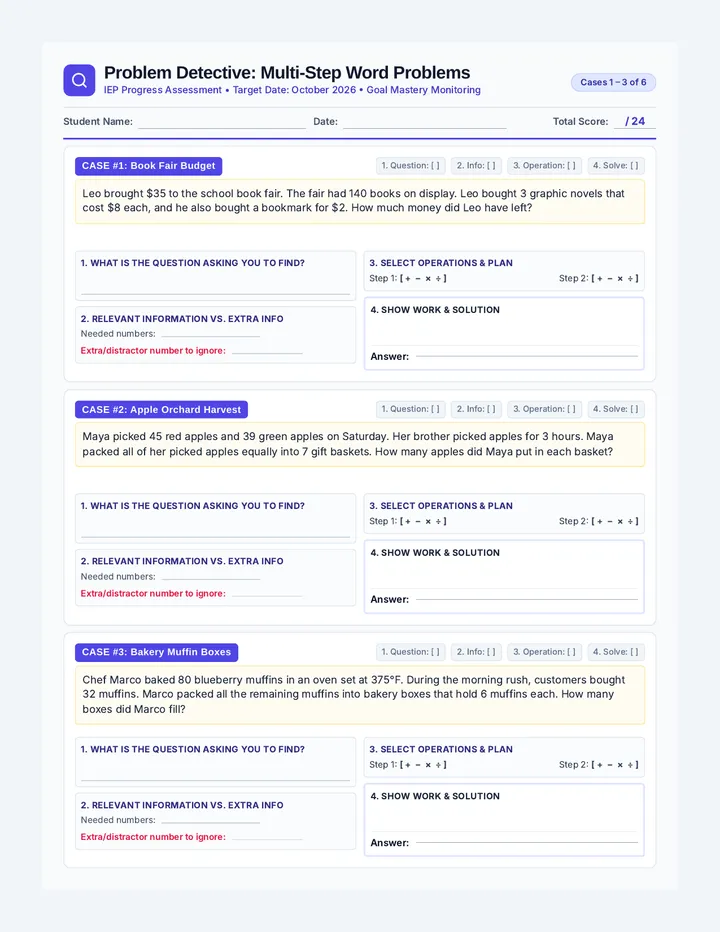
Problem Detective Assessment

Math Goal Mastery

A targeted sequence of progress monitoring assessments and evaluation guides designed to measure and document key IEP mathematics benchmarks, including multi-step word problems and multi-digit operations.

JD

Jenny Daniels

4
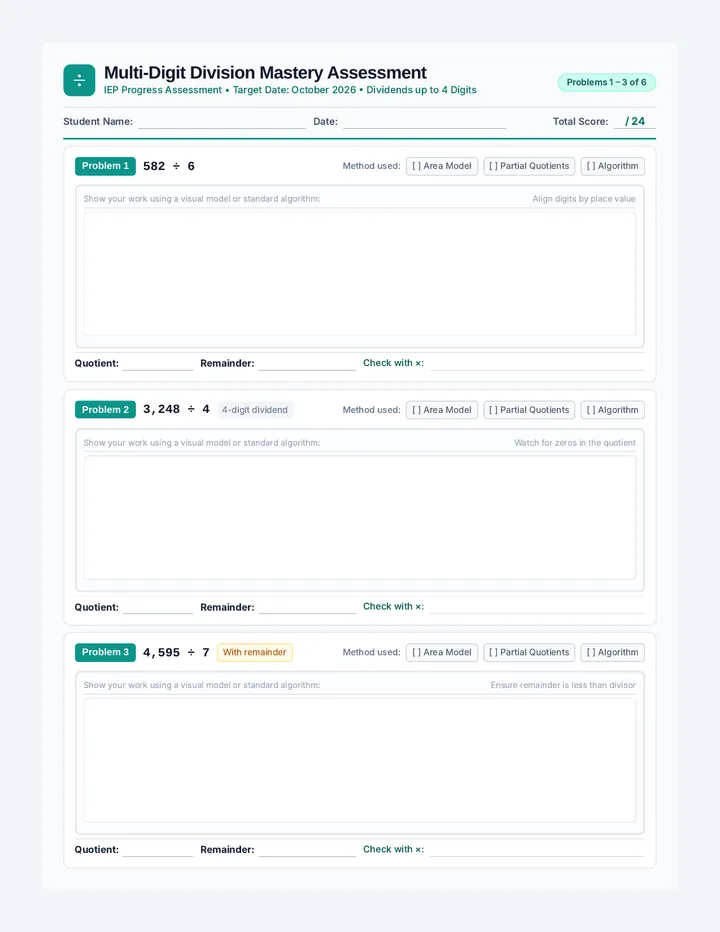
Division Mastery Assessment

Division Masters

A progress monitoring lesson focusing on multi-digit whole number division with dividends up to four digits. Students demonstrate conceptual understanding and computational fluency using visual models, partial quotients, or the standard algorithm.

JD

Jenny Daniels

2
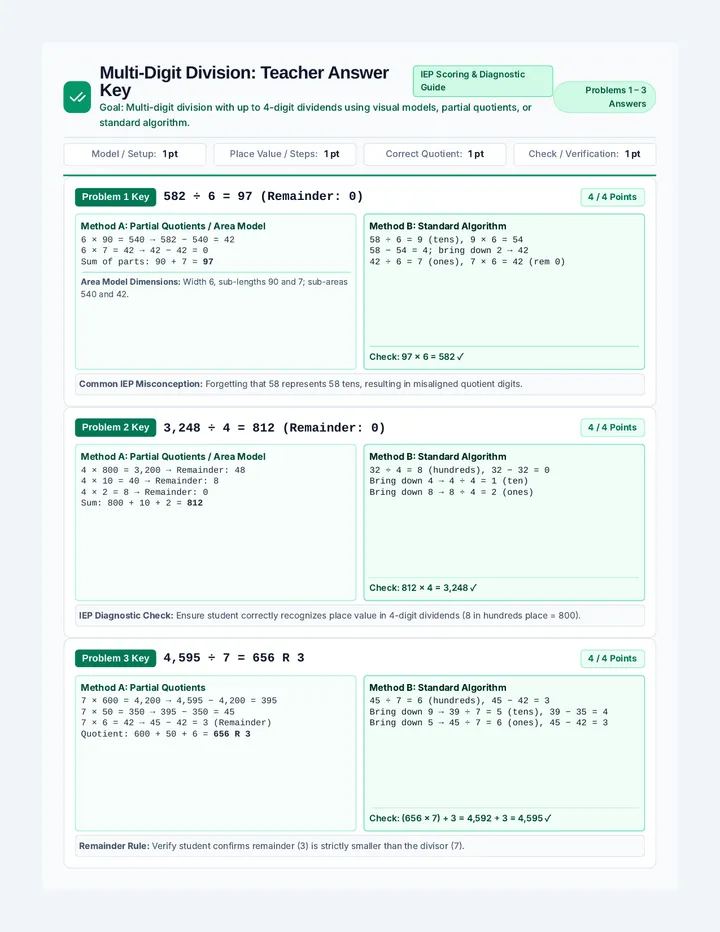
Division Mastery Answer Key

Division Mastery Answer Key

A 2-page teacher answer key and diagnostic error guide for the multi-digit division assessment, providing worked solutions across visual models, partial quotients, standard algorithms, and an IEP scoring rubric.

JD

Jenny Daniels

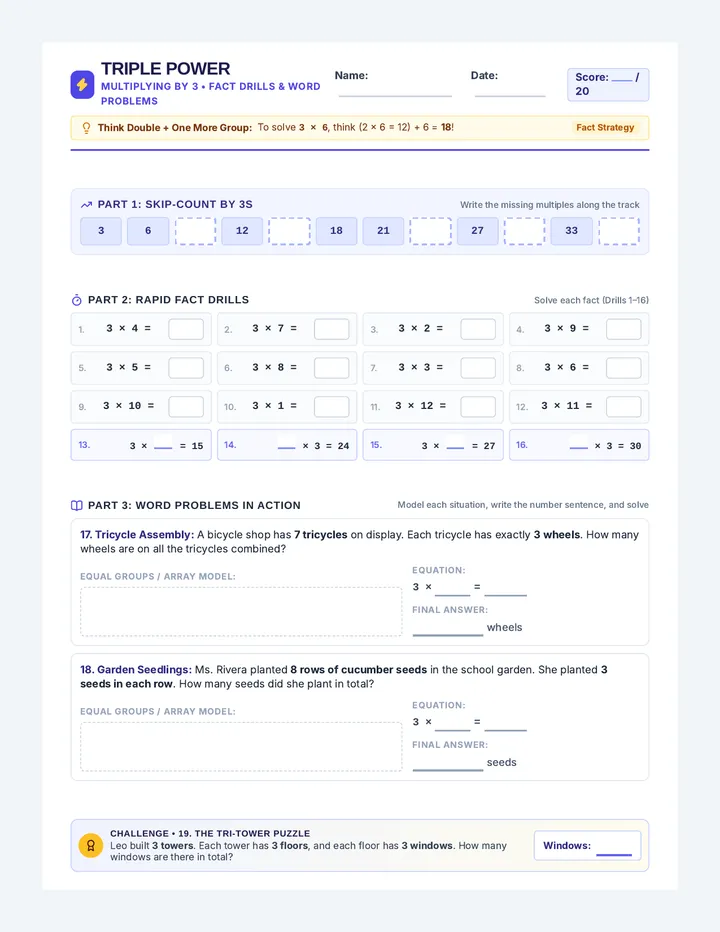
Triple Power Worksheet

Fact Power Academy

A comprehensive multiplication unit guiding elementary students through foundational fact strategies, visual models, rapid drills, and contextual word problems.

TM

Tiffany Muniz

4
Problem Detective Assessment

Problem Detectives

A targeted assessment and progress monitoring unit focused on multi-step word problem analysis. Students develop skills in determining what is being asked, filtering relevant details from distractors, and selecting sequential operations to solve real-world problems.

JD

Jenny Daniels

2
Division Mastery Assessment

Division Mastery Assessment

A 2-page print-ready IEP progress monitoring assessment featuring 6 multi-digit division problems with dividends up to four digits, visual model selection checkboxes, place-value alignment grid workspaces, and check-by-multiplication sections.

JD

Jenny Daniels

Ratio Launch Slides

Ratio Quest

A 4-lesson Indiana Academic Standards ratio sequence preparing 6th graders for ILEARN. Covers ratio representations, equivalent ratio tables and graphs, unit rates, and mixed test-prep items with authentic item formats.

RG

Richard Gist

9
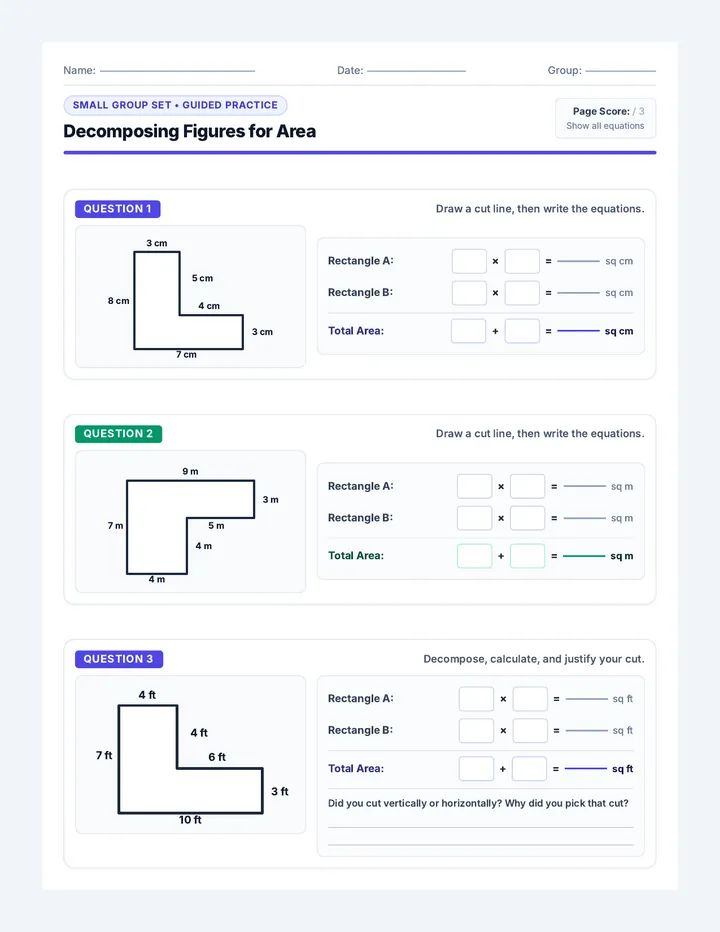
Decomposing Area Practice Worksheet

Area Decomposers

A focused small-group mathematics intervention and practice lesson on decomposing L-shaped rectilinear polygons into non-overlapping rectangles to calculate total area using multiplication and addition.

DG

Danielle Garland

2
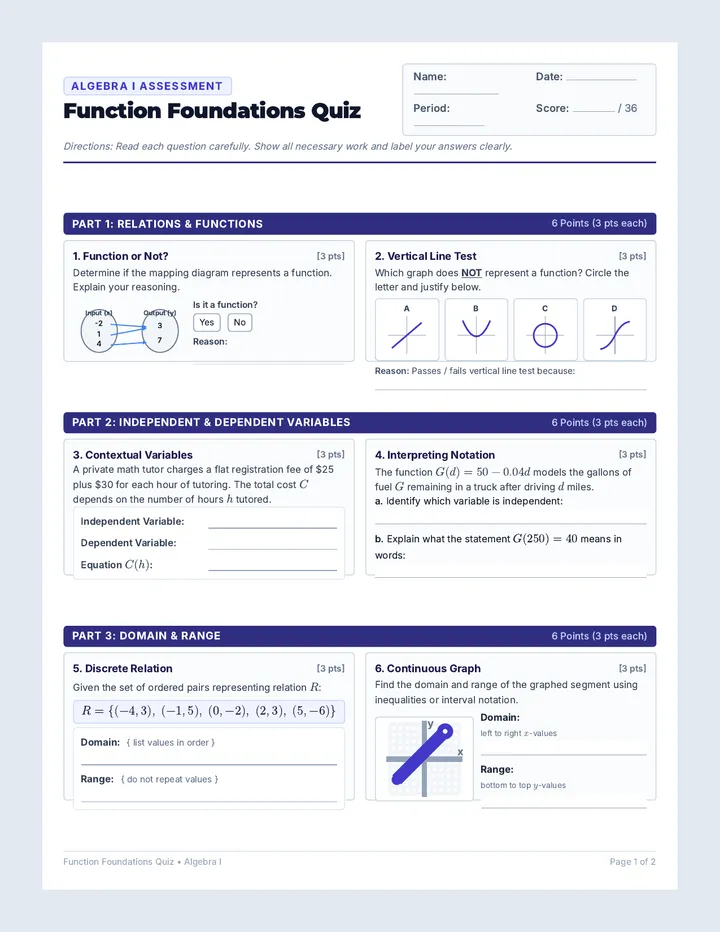
Function Foundations Quiz

Function Foundations Quiz

A comprehensive 12-question Algebra 1 quiz covering relations and functions, independent and dependent variables, domain and range, linear versus nonlinear relationships, and evaluating and graphing in function notation.

MM

Monica Michalak

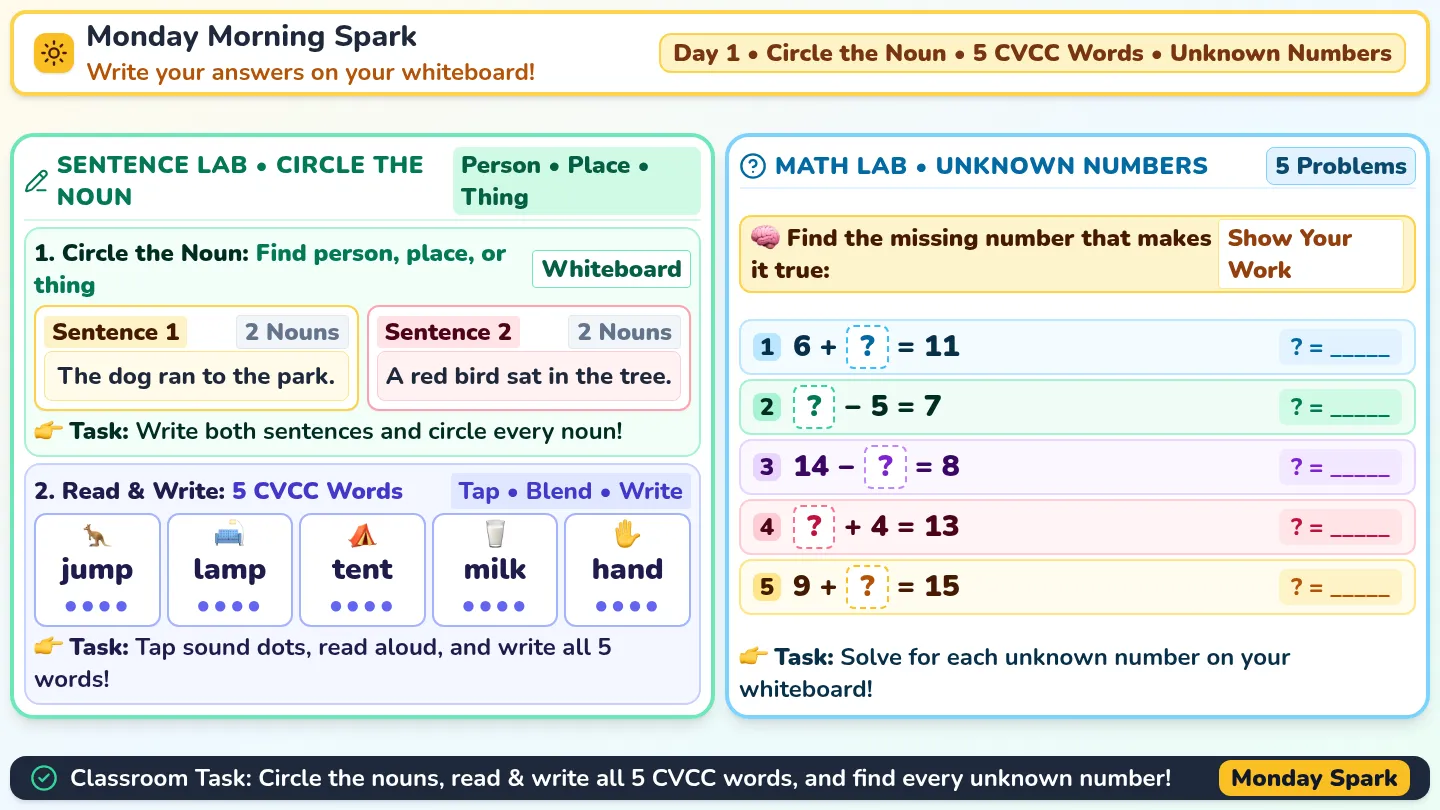
Monday Morning Spark Slides

Morning Spark Routine

A 3-week Grade 1 morning routine sequence featuring daily Circle the Noun sentence challenges, Read and Write with 5 decodable CVCC words, and Math Lab with solving for unknown numbers up to 15.

CJ

Creesha Jones-Stone

15
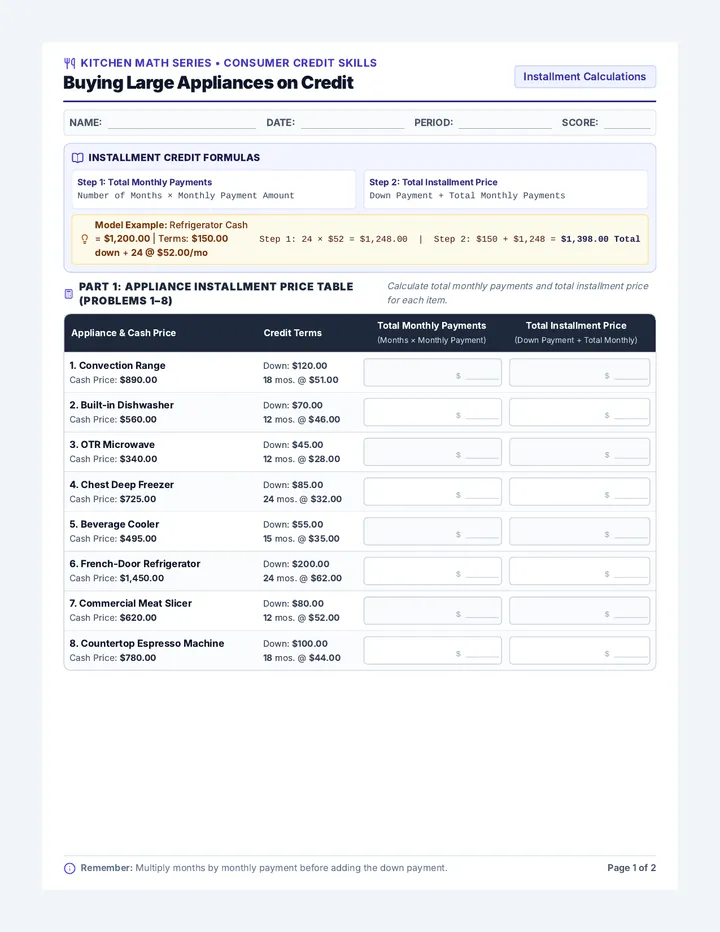
Kitchen Credit Crunch Worksheet

Kitchen Credit Math

A practical consumer math lesson on understanding installment purchase agreements, calculating total monthly payments, and finding total installment prices for major kitchen appliances.

CD

Cheri Donahoe

2
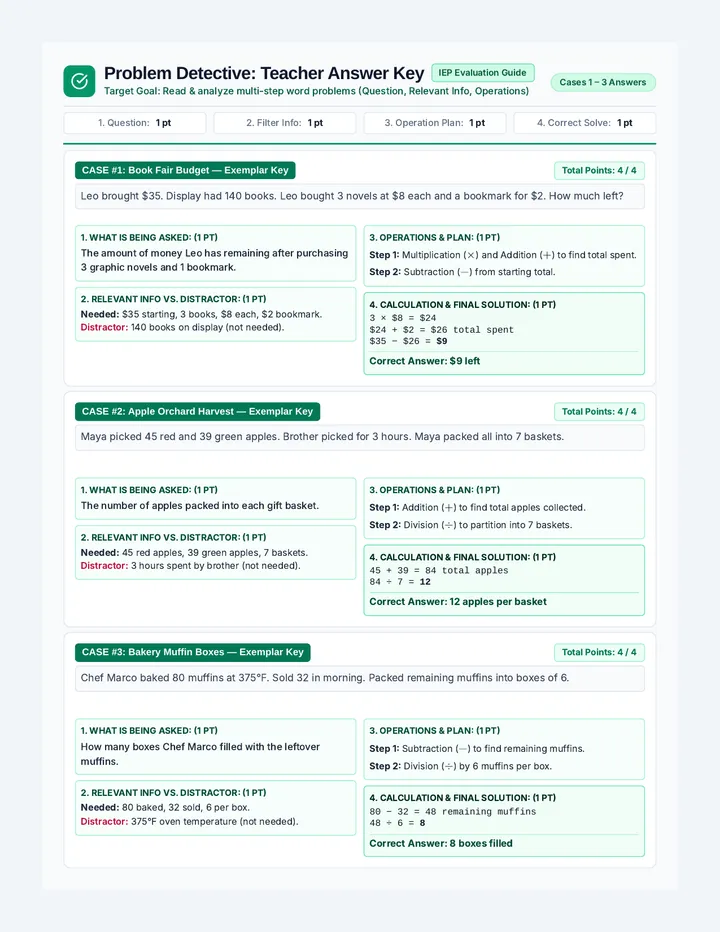
Problem Detective Answer Key

Problem Detective Answer Key

A 2-page teacher answer key and IEP scoring guide providing worked solutions, distractor analysis, operation pathways, and progress monitoring rubrics for all 6 word problem cases.

JD

Jenny Daniels