Lenny.com
Explore
Create
ActivitiesNewMathEnglish Language ArtsScience & EngineeringSocial StudiesGlobal LanguagesHealth & Physical EducationSpecial EducationCounseling & Life SkillsArts & CreativityESL
Lenny.com
Lenny.com
Explore
Create
ActivitiesNewMathEnglish Language ArtsScience & EngineeringSocial StudiesGlobal LanguagesHealth & Physical EducationSpecial EducationCounseling & Life SkillsArts & CreativityESL
Lenny.com
Lenny.com

Solutions

Lenny for EducatorsLenny for SchoolsLenny for Districts

Product

ExploreSign inCreateSupportAbout

Resources

Getting startedMTSS Acceleration Program

© 2026 Lenny Learning Inc.

TermsPrivacyAccessibility
LinkedInInstagramX
Lenny

Model with Trigonometric Functions

Application of sine and cosine functions to periodic real-world phenomena like sound waves, tides, and orbital mechanics. Builds skills in identifying amplitude, period, and midline from data sets to construct mathematical models.

MathNumbers & CountingCounting ObjectsNumber NamesComparing NumbersNumber OperationsCounting SequenceNumbers 0-10Place Value Understanding and SystemAdd and Subtract Within 20Addition and Subtraction ConceptsAddition and Subtraction EquationsAddition and Subtraction ProblemsFoundations for MultiplicationMultiplication and Division PropertiesMultiply and Divide Within 100Multiplication and Division ProblemsFactors and MultiplesProperties of OperationsPatterns and RelationshipsGenerate and Analyze PatternsMulti-Digit ArithmeticPlace Value OperationsMulti-Digit and Decimal OperationsNumerical ExpressionsFour Operations and PatternsFour Operations Problem SolvingMeasurement & DataMeasurable AttributesMeasuring LengthsMeasure and Estimate Lengths in Standard UnitsRelate Addition and Subtraction to LengthClassifying and Counting ObjectsTime and MoneyArea Concepts and MeasurementPerimeter and Area MeasuresAngle Concepts and MeasurementTime, Volume, and MassMeasurement Unit ConversionsGeometryIdentifying ShapesShapes and AttributesShape Attributes and ReasoningShapes and CompositionClassifying 2D FiguresGeometric Figures and RelationshipsLines, Angles, and ShapesAngle, Area, and VolumeGeometric MeasurementVolume of 3D ShapesCoordinate Plane ApplicationsTransformations in the PlaneCongruence and SimilarityUnderstand congruence in terms of rigid motionsSimilarity and TransformationsProve Theorems Involving SimilarityPythagorean TheoremTrigonometry for General TrianglesMake Geometric ConstructionsProve Geometric TheoremsTheorems About CirclesFind Arc Lengths And Areas of Sectors of CirclesVolume FormulasRelationships Between Two-Dimensional and Three-Dimensional ObjectsProve Simple Geometric Theorems AlgebraicallyTranslate Between Geometric Description and Equation for Conic SectionApply Geometric Concepts in Modeling SituationsFractions & DecimalsFractions as NumbersBuilding FractionsFraction Equivalence and OrderingAdding and Subtracting FractionsMultiplying and Dividing FractionsDividing FractionsDecimal FractionsMulti-Digit Computation and FactorsAdd, Subtract, Multiply, and Divide Rational NumbersRational Number SystemIrrational Numbers and ApproximationsRatiosRatios and ProportionsProportional RelationshipsUnit RateAlgebraAlgebraic ExpressionsGenerate Equivalent ExpressionsQuantitative RelationshipsProportional Relationships and Linear EquationsEquations and InequalitiesEquation Solving and ReasoningLinear Equations and SystemsGraph Equations and InequalitiesSystems of EquationsReal-World Algebraic ProblemsQuantitative Reasoning with UnitsExpression StructureEquivalent Expression FormsRadicals and Integer ExponentsRational ExponentsRational and Irrational NumbersPolynomial OperationsPolynomial IdentitiesPolynomial Zeros and FactorsRational ExpressionsComplex Number OperationsComplex Numbers in PolynomialsComplex Numbers on PlaneStatistics & ProbabilityRepresent and Interpret DataData DistributionsStatistical VariabilityProbability ModelsCompound Event ProbabilitiesStatistical SamplingInterpret Categorical and Quantitative DataBivariate Data PatternsInterpret Linear ModelsComparing Two PopulationsRandom Processes in StatisticsIndependence and Conditional ProbabilityExpected ValuesProbability-Based Decision MakingStatistical Inference and ConclusionsFunctionsFunction Concepts and NotationDefine and Compare FunctionsInterpret Functions in ContextAnalyze Function RepresentationsModel Relationships with FunctionsIdentify Linear vs Exponential GrowthDistinguish Between Function TypesCompare Growth RatesInterpret Function ExpressionsBuild Functions from RelationshipsConstruct and Model FunctionsTransform and Combine FunctionsModel Comparison and SelectionSolve Exponential EquationsTrigonometryTrigonometric Ratios Involving Right TrianglesTrigonometric Functions and Unit CircleModel with Trigonometric FunctionsTrigonometric IdentitiesVectors & MatricesIntroduction to Vectors and MatricesVector QuantitiesVector OperationsMatrix OperationsCalculusLimits and ContinuityDerivative Concepts and NotationDerivative Rules and TechniquesApplications of DerivativesOptimization ProblemsRelated RatesCurve Sketching and AnalysisIntegration Concepts and NotationAntiderivatives and Indefinite IntegralsDefinite Integrals and AreaFundamental Theorem of CalculusIntegration TechniquesApplications of IntegrationDifferential EquationsSequences and SeriesParametric and Polar FunctionsVector-Valued Functions

Videos

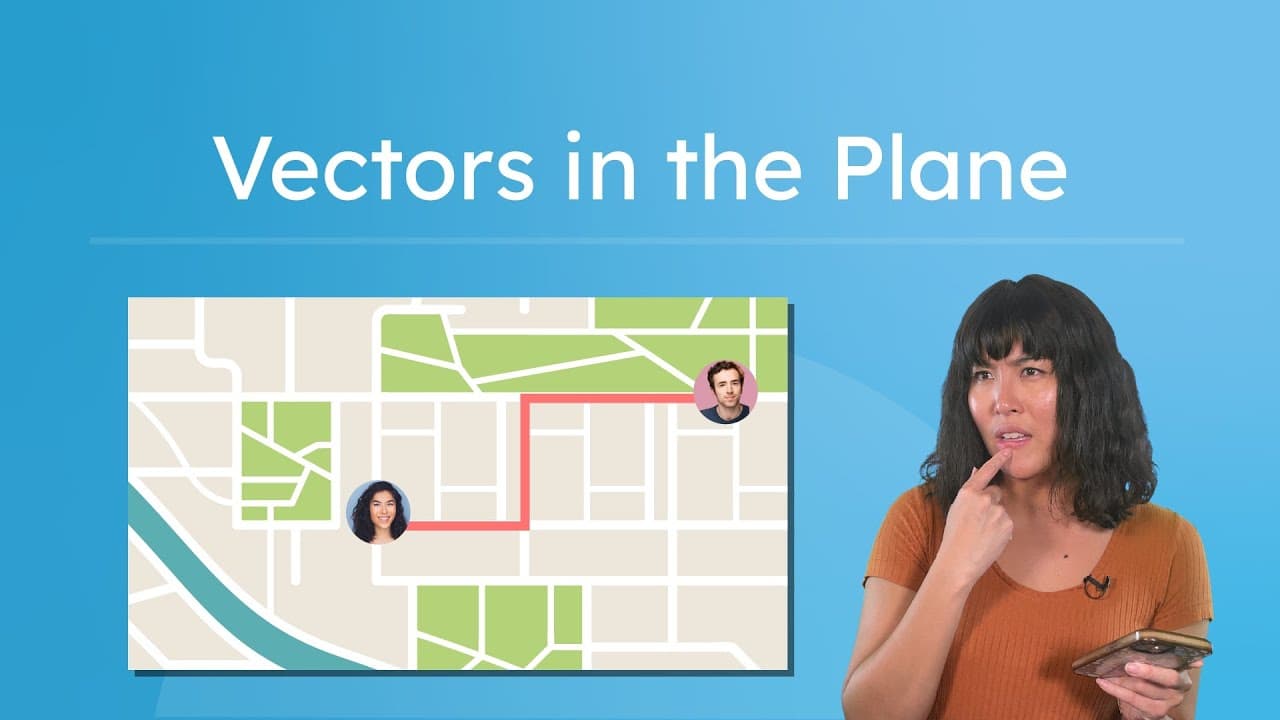
Understanding Vectors in the Coordinate Plane

Understanding Vectors in the Coordinate Plane

This video serves as a comprehensive introduction to vectors in the coordinate plane, specifically tailored for a precalculus curriculum. The lesson begins with a relatable skit about giving directions, illustrating why both distance and direction are necessary to reach a destination, which naturally leads into the definition of a vector. The video then transitions into formal mathematical definitions, explaining vectors as directed line segments with an initial and terminal point. It covers essential concepts such as component form, position vectors, magnitude, and direction, using visual graphs and clear animations to demonstrate how these properties are calculated and represented.
Miacademy & MiaPrep Learning ChannelMiacademy & MiaPrep Learning Channel

16mins 22s

Sequences

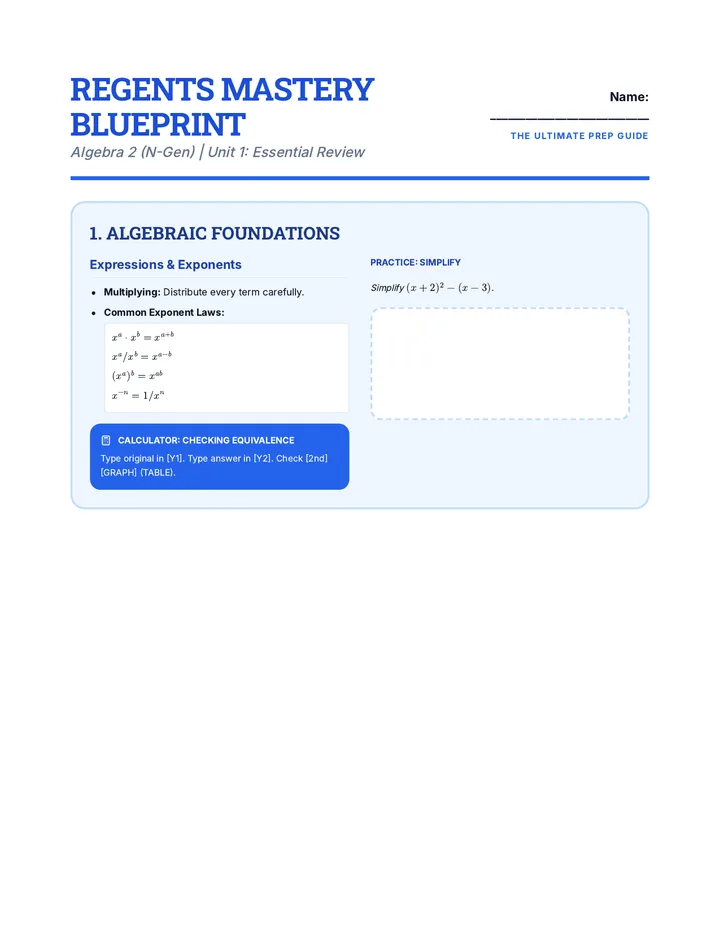
Regents Mastery Blueprint Study Guide

Regents Mastery Suite

A comprehensive review suite for the New York State Mathematics Regents exams, including Algebra 1, Geometry, and Algebra 2, featuring mastery blueprints, calculator strategies, and exam-taking tips.

KB

Kayla Borozny

15
Vital Vitals Project Booklet

Vital Vitals Healthcare Project

A 3-day healthcare-themed project for remedial precalculus students. It covers algebra 2 fundamentals, systems of equations, and introductory trigonometric transformations within clinical contexts.

KC

Kris Coyne

3
Strategy Blueprint Slides

ACT Math Mastery

A comprehensive ACT Math preparation program focusing on essential strategies, high-yield Algebra and Geometry concepts, and realistic practice to boost scores.

AL

ava larumbe

26
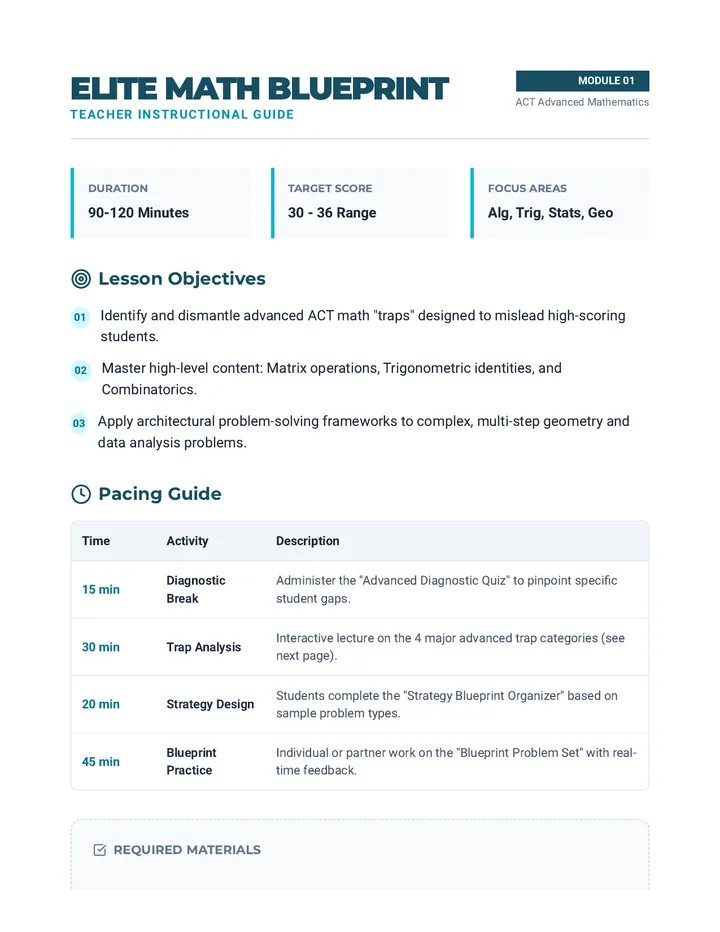
Elite Math Teacher Guide

Advanced ACT Mastery

A comprehensive prep sequence for the most challenging questions on the ACT Math and Science sections. It focuses on high-level conceptual blueprints for math topics like complex numbers and matrices, alongside speed-reading and data-interpretation strategies for the Science section.

AL

ava larumbe

29
Inverse Equation Slides

Trig Mastery Lab

A targeted intervention sequence focused on mastering trigonometric equations through inverse functions, visual symmetry, and contextual application. This sequence provides Tier 2 support for students needing scaffolded paths to find both principal and secondary solutions.

4
Curvilinear Blueprint Slides

Curvilinear Coordinates and Vector Analysis

This mathematical physics sequence explores the coordinate systems necessary for solving problems involving complex shapes, moving beyond Cartesian coordinates to General Curvilinear systems. Students derive scale factors, volume elements, and differential operators, culminating in solving Laplace's equation and understanding metric tensors.

15

Lessons

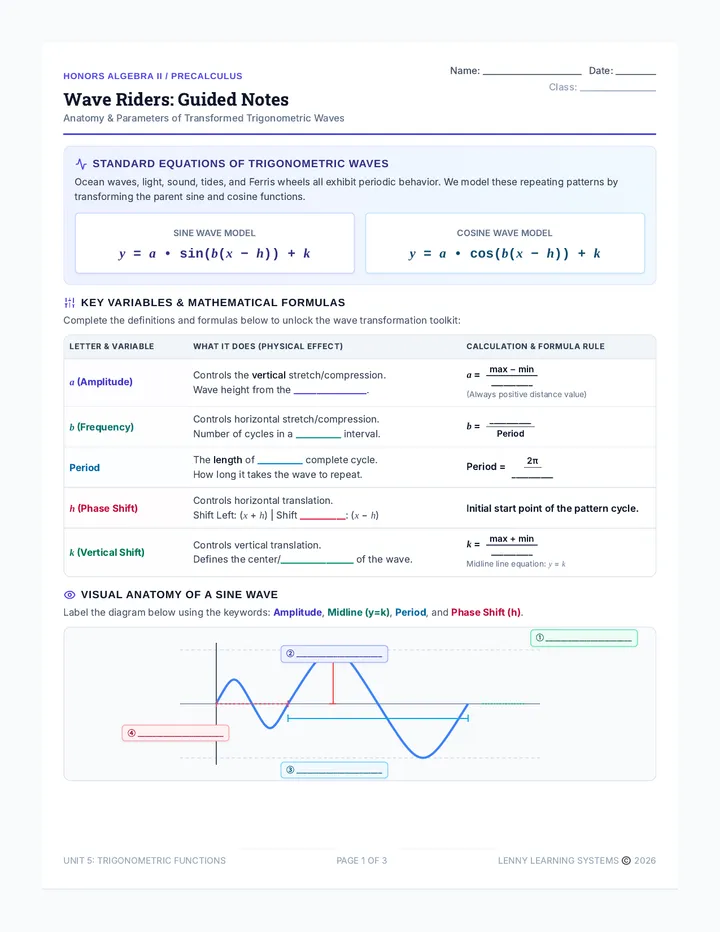
Wave Riders Guided Notes

Wave Riders

A mini-lesson on graphing, analyzing, and modeling transformed sine and cosine trigonometric waves. Students learn to identify key parameters (amplitude, period, phase shift, midline) from equations and graphs, and apply them to periodic real-world scenarios.

AE

Aysenur Ersoy

5
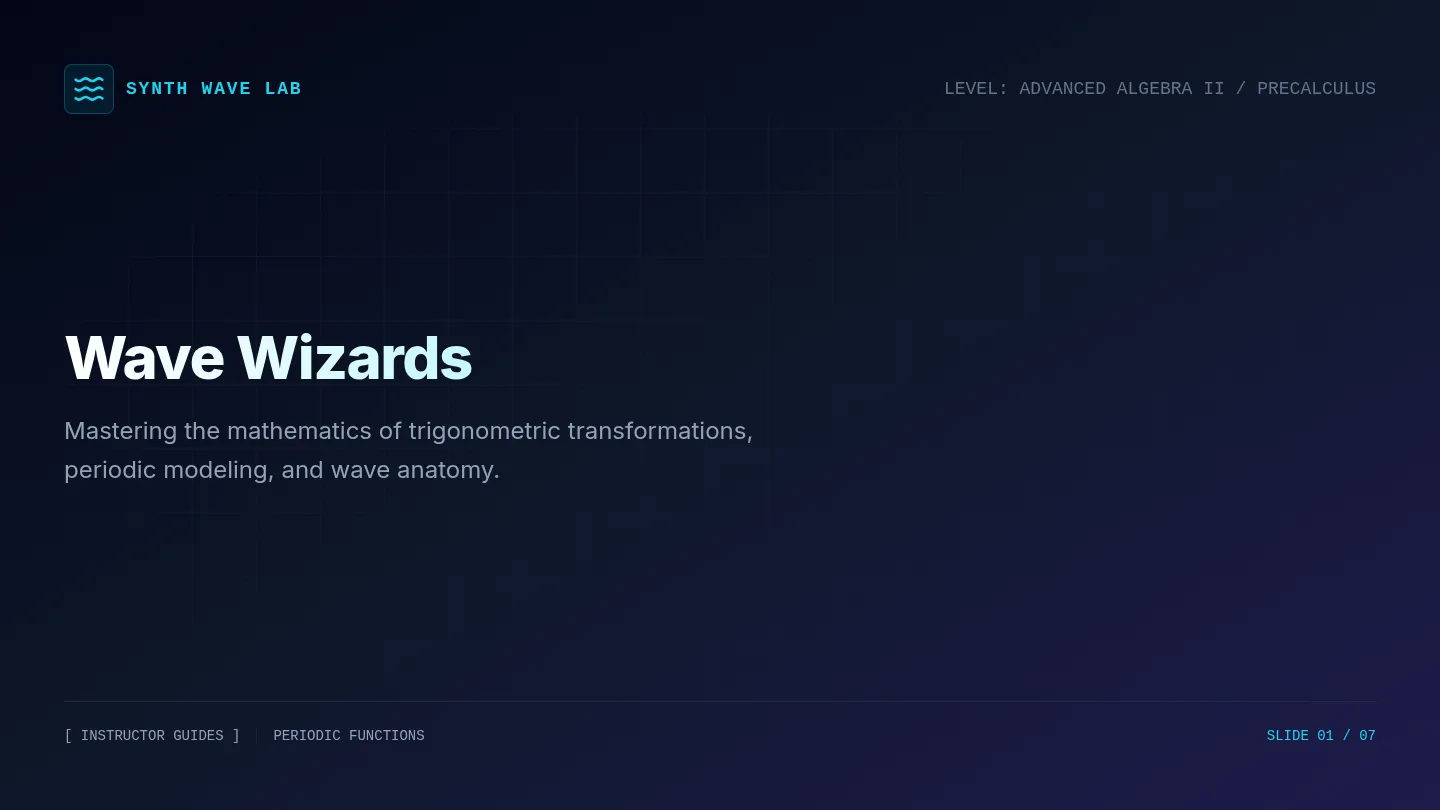
Wave Wizards Slides

Wave Wizards

A mini-lesson on transforming trigonometric sine and cosine functions. Students will learn to identify key wave parameters, sketch transformations on a grid, write equations from sinusoidal graphs, and model real-world periodic phenomena.

AE

Aysenur Ersoy

5
Trigonometry Radar Review Worksheet

Trigonometry Radar Review

A high-intensity review session for AP Precalculus Unit 3, covering trigonometric functions, inverse functions, and polar coordinates through a "Radar Tech" thematic lens.

W

wcragoe

3
Trig Tactics Reference Sheet

Unit 3 Mastery Review

A comprehensive review for Unit 3 of AP Precalculus, focusing on trigonometric and polar functions through reference materials and practice assessments.

W

wcragoe

3
Wave Navigator Notes Handout

Wave Navigator

A comprehensive lesson on graphing Sine and Cosine functions, featuring guided notes, instructional slides, and a detailed answer key. Students will learn to identify amplitude, period, midline, and phase shifts to accurately sketch periodic graphs.

AP

Abha Poddar

4
Tidal Trends Teacher Guide

Tidal Trends

A Tier 2 intervention lesson focused on modeling periodic phenomena using trigonometric functions. Students learn to extract amplitude, midline, and frequency from real-world data to construct sine and cosine equations.

4